

50G Passive Optical Networks (PON) Equipment Market Report 2026
Global Outlook – By Component ( Optical Line Terminal, Optical Network Unit, Optical Distribution Network, Other Components), By Technology ( Time Division Multiplexing, Wavelength Division Multiplexing, Other technologies), By Deployment Mode ( Centralized, Distributed), By Application ( Fiber To The Home(FTTH), Fiber To The Building(FTTB), Fiber To The X(FTTx), Other Applications), By End-User ( Residential, Commercial, Industrial, Other End-Users) – Market Size, Trends, Strategies, and Forecast to 2035
50G Passive Optical Networks (PON) Equipment Market Overview
• 50G Passive Optical Networks (PON) Equipment market size has reached to $1.7 billion in 2025 • Expected to grow to $5.07 billion in 2030 at a compound annual growth rate (CAGR) of 24.4% • Growth Driver: Surge In Connectivity Solutions Driving Growth Of The Market Due To Rising Demand For High-speed, Reliable Networks • Market Trend: Advancements In Optical Line Terminal (OLT) Technology • Asia-Pacific was the largest region in 2025.Market Gains By 2030 – Top Opportunities By Segment
Market Gain identifies the most promising market opportunities by highlighting the segments or products expected to generate the highest incremental revenue growth over the next five years.
What Is Covered Under 50G Passive Optical Networks (PON) Equipment Market?
50G passive optical network (PON) equipment is a high-speed telecommunication device used to deliver broadband services over optical fiber networks, supporting data transmission at 50 gigabits per second. It utilizes passive splitters to distribute optical signals from a central office to multiple endpoints without requiring active electronic components in the distribution network. The equipment is designed to enable efficient, scalable, and reliable fiber-to-the-home (FTTH) connectivity, reduce network latency, and support high-bandwidth applications such as ultra-HD streaming, cloud computing, and IoT services. The main components of 50G passive optical networks (PON) equipment are optical line terminals, optical network units, optical distribution networks, and others. Optical line terminals (OLTs) refer to the central network devices located at the service provider’s end that manage data transmission between the core network and multiple optical network units, enabling high-speed, low-latency communication. These systems operate using advanced technologies such as time division multiplexing (TDM) and wavelength division multiplexing (WDM), and can be deployed in centralized and distributed configurations. The key applications include fiber to the home (FTTH), fiber to the building (FTTB), fiber to the X (FTTx), and others. The major end users include residential, commercial, and industrial sectors, along with others.
What Is The 50G Passive Optical Networks (PON) Equipment Market Size 2026 And Growth Rate?
The 50G passive optical networks (pon) equipment market size has grown exponentially in recent years. It will grow from $1.7 billion in 2025 to $2.12 billion in 2026 at a compound annual growth rate (CAGR) of 24.7%. The growth in the historic period can be attributed to growing broadband adoption, deployment of ftth and fttb networks, advancements in optical splitters and transceivers, government initiatives for digital connectivity, expansion of commercial fiber networks.What Is The 50G Passive Optical Networks (PON) Equipment Market Growth Forecast?
The 50G passive optical networks (pon) equipment market size is expected to see exponential growth in the next few years. It will grow to $5.07 billion in 2030 at a compound annual growth rate (CAGR) of 24.4%. The growth in the forecast period can be attributed to adoption of 50g-pon technology, integration with cloud and iot platforms, deployment of centralized and distributed architectures, increasing demand for ultra-hd streaming and cloud services, rising industrial and enterprise connectivity requirements. Major trends in the forecast period include expansion of fiber-to-the-home deployments, growing demand for ultra-hd streaming and cloud services, adoption of energy-efficient optical components, deployment of scalable pon architectures, need for low-latency and high-reliability connectivity.
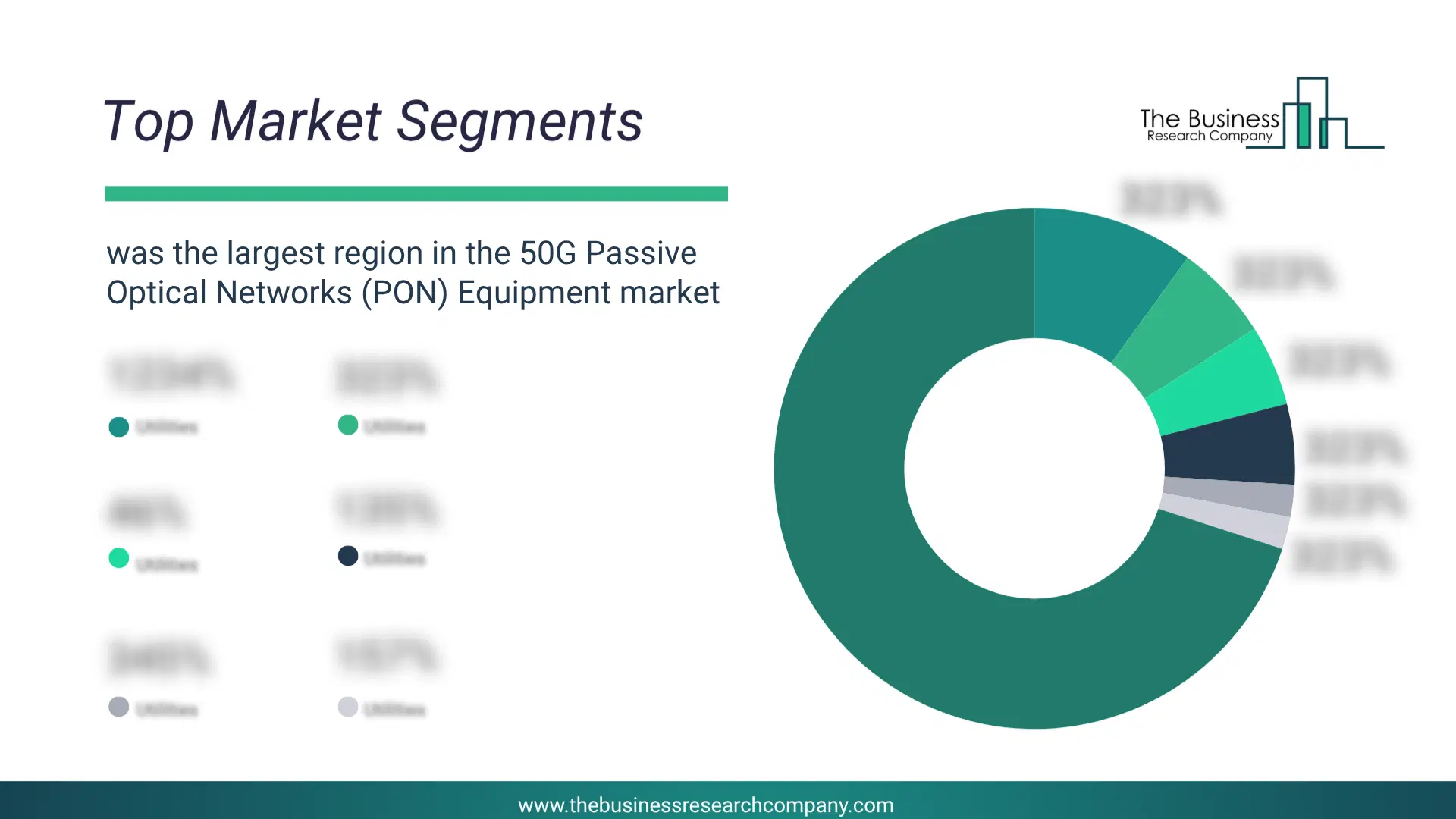
Global 50G Passive Optical Networks (PON) Equipment Market Segmentation
1) By Component: Optical Line Terminal, Optical Network Unit, Optical Distribution Network, Other Components 2) By Technology: Time Division Multiplexing, Wavelength Division Multiplexing, Other technologies 3) By Deployment Mode: Centralized, Distributed 4) By Application: Fiber To The Home(FTTH), Fiber To The Building(FTTB), Fiber To The X(FTTx), Other Applications 5) By End-User: Residential, Commercial, Industrial, Other End-Users Subsegments: 1) By Optical Line Terminal: Central Office Terminal, Enterprise Terminal, Residential Terminal 2) By Optical Network Unit: Indoor Unit, Outdoor Unit, Customer Premises Unit 3) By Optical Distribution Network: Fiber Cable, Splitter, Patch Panel, Connector 4) By Other Components: Transceiver Module, Network Interface Device, Power Supply The top segments in the 50g passive optical networks (pon) equipment market will be: • Time Division Multiplexing will reach $1676.2 Million by 2025. • Centralized will reach $1185.7 Million by 2025. • Optical Line Terminal will reach $709.6 Million by 2025. • Distributed will reach $513.3 Million by 2025. • Optical Network Unit will reach $489 Million by 2025.What Is The Driver Of The 50G Passive Optical Networks (PON) Equipment Market?
The increasing demand for high-performance connectivity solutions is expected to propel the growth of the 50G passive optical networks (PON) equipment market going forward. The demand for high-performance connectivity solutions is rising due to the rapid growth of data-intensive applications, which require faster and more reliable network connections to operate efficiently. 50G PON equipment enhances connectivity solutions by providing ultra-high-speed, reliable, and scalable fiber-optic networks that support seamless data transmission for residential, enterprise, and industrial applications. For instance, in July 2024, the Global Mobile Suppliers Association, a UK-based trade association, reported that by the first quarter of 2024, global 5G subscriptions had reached 1.7 billion, marking an increase of 160 million from the previous period. Additionally, at the close of 2023, North America led in 5G subscription penetration at 59%, followed by Northeast Asia at 41%, the Gulf Cooperation Council (GCC) countries at 34%, and Western Europe at 26%. Therefore, the growing demand for high-performance connectivity solutions is driving the growth of the 50G Passive Optical Networks (PON) Equipment industry.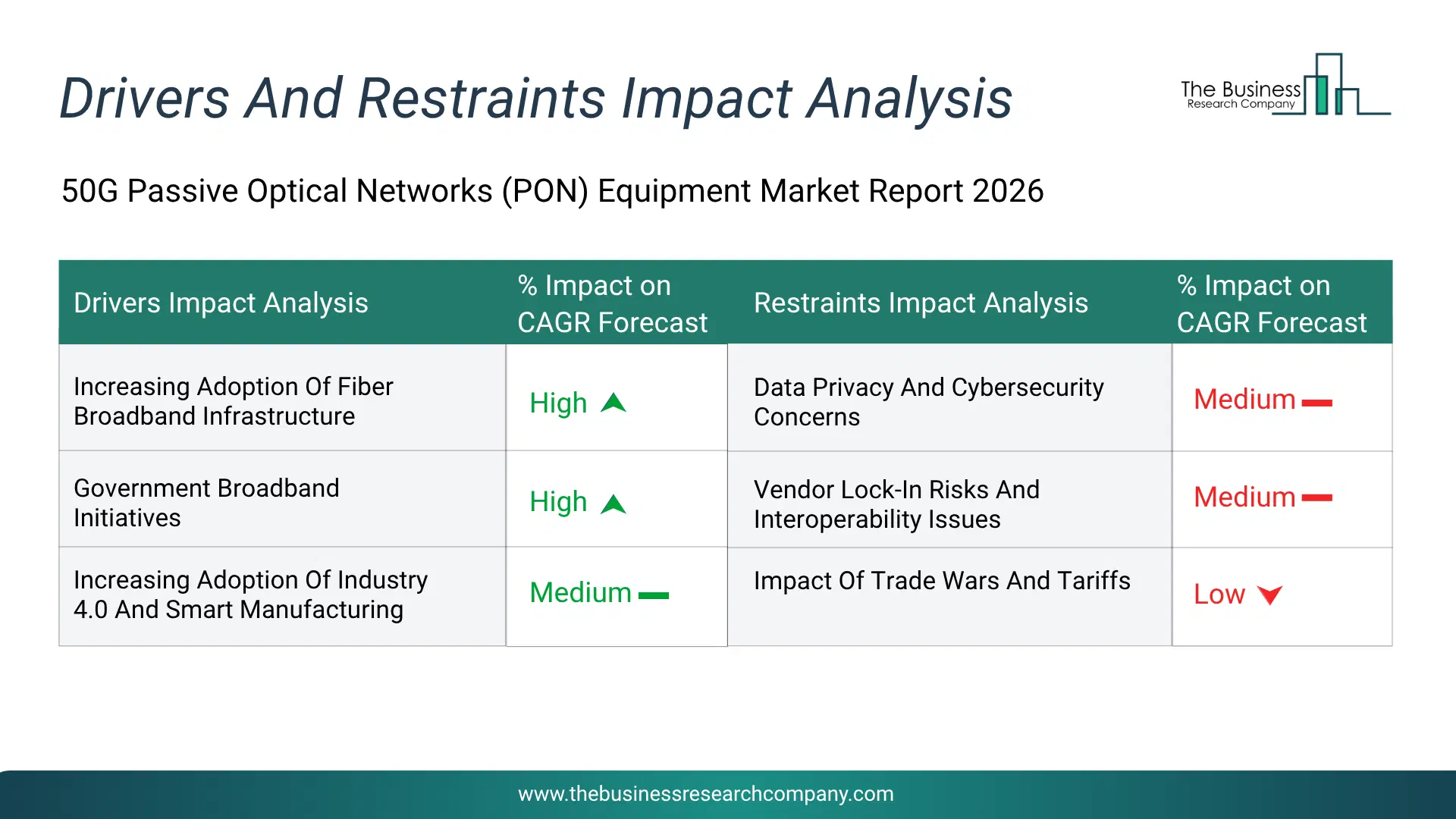
Infographic Chart Showing Key Market Drivers Analysis And Restraints For 50G Passive Optical Networks (Pon) Equipment Market
The chart presents an impact analysis of key drivers and restraints, quantifying their relative influence on the market's growth rate and helping assess the balance between growth enablers and limiting factors. This chart offers a high-level perspective; the full report contains more detailed insights.
How Will The Drivers Impact Growth In The Global 50G Passive Optical Networks (PON) Equipment Market?
• Increasing Adoption Of Fiber Broadband Infrastructure (High) – The increasing adoption of fiber broadband infrastructure will become a key driver of growth in the 50G passive optical networks (PON) equipment market by 2030. As governments and telecommunications providers continue to expand high-capacity fiber networks to support rising internet traffic and digital connectivity needs, the deployment of advanced optical access technologies is accelerating. The growing rollout of fiber-to-the-home (FTTH), fiber-to-the-building (FTTB) and fiber-to-the-premises (FTTP) networks is increasing the demand for high-speed optical equipment capable of supporting multi-gigabit bandwidth and low-latency data transmission. The expanding adoption of fiber broadband infrastructure is driving greater demand for next-generation optical line terminals (OLTs), optical network units (ONUs) and related components in the 50G passive optical networks (PON) equipment market. As a result, the increasing adoption of fiber broadband infrastructure is anticipated to contributing to a 1.8% annual growth in the market. • Government Broadband Initiatives (High) – The government broadband initiatives will emerge as a major factor driving the expansion of the 50G passive optical networks (PON) equipment market by 2030. As governments across various countries prioritize nationwide high-speed connectivity and digital infrastructure development, large-scale fiber network expansion programs are being implemented to improve broadband accessibility in urban and rural areas. Public investments and policy initiatives aimed at accelerating fiber-to-the-home (FTTH) and next-generation broadband deployment are encouraging telecommunications operators to upgrade their access networks with higher-capacity optical technologies. The growing emphasis on government-supported broadband expansion projects is driving greater demand for advanced high-speed optical access solutions and next-generation fiber infrastructure in the 50G passive optical networks (PON) equipment market. Consequently, the government broadband initiatives is projected to contributing to a 1.5% annual growth in the market. • Increasing Adoption Of Industry 4.0 And Smart Manufacturing (Medium) – The increasing adoption of industry 4.0 and smart manufacturing will serve as a key growth catalyst for the 50G passive optical networks (PON) equipment market by 2030. As manufacturing facilities integrate advanced technologies such as automation, robotics, artificial intelligence and industrial internet of things (IIoT) systems, there is a rising need for high-speed, low-latency and reliable network infrastructure to support large-scale data transmission and real-time communication. The growing deployment of connected machines, sensors and smart production systems in industrial environments is increasing the demand for high-capacity fiber-based connectivity solutions capable of handling massive data traffic. The expansion of Industry 4.0-enabled smart manufacturing ecosystems is driving greater demand for advanced fiber access technologies, thereby supporting the growth of the 50G passive optical networks (PON) equipment market. Therefore, this increasing adoption of industry 4.0 and smart manufacturing is projected to supporting to a 1.0% annual growth in the market. • Rising Ultra-HD Video Streaming Consumption (Medium) – The rising ultra-HD video streaming consumption will become a significant driver contributing to the growth of the 50G passive optical networks (PON) equipment market by 2030. As demand for high-resolution digital entertainment such as 4K and 8K video content increases, telecommunications networks are experiencing significant pressure to deliver higher bandwidth and faster data transmission speeds. The growing adoption of streaming platforms and connected devices in households is increasing overall internet traffic and placing greater demands on fiber access infrastructure. The increasing consumption of ultra-HD video streaming is driving greater demand for high-capacity broadband networks, accelerating the deployment of advanced fiber access technologies such as 50G passive optical networks (PON) equipment. Consequently, the rising ultra-HD video streaming consumption is projected to contributing to a 0.6% annual growth in the market.How Will The Restraints Impact Growth In The Global 50G Passive Optical Networks (PON) Equipment Market?
• Data Privacy And Cybersecurity Concerns (High) – Data privacy and cybersecurity concerns is expected to restrain market growth during the forecast period. It creates operational, financial, regulatory, or commercial challenges that can increase costs, delay projects, reduce investments, or discourage purchasing decisions depending on the market. These challenges can reduce product adoption, affect business confidence, and limit the ability of companies to expand efficiently across key regions. This can reduce operational efficiency, delay expansion plans, and affect the ability of companies to achieve sustainable business growth. • Vendor Lock-In Risks And Interoperability Issues (High) – During the forecast period, vendor lock-in risks and interoperability issues is likely to limit market expansion. It creates operational, financial, regulatory, or commercial challenges that can increase costs, delay projects, reduce investments, or discourage purchasing decisions depending on the market. These challenges can reduce product adoption, affect business confidence, and limit the ability of companies to expand efficiently across key regions. As a result, businesses may face increased cost pressures, slower commercial adoption, and reduced revenue opportunities. • Impact Of Trade Wars And Tariffs (Medium) – The market is expected to face challenges due to impact of trade wars and tariffs over the forecast period. It creates operational, financial, regulatory, or commercial challenges that can increase costs, delay projects, reduce investments, or discourage purchasing decisions depending on the market. These challenges can reduce product adoption, affect business confidence, and limit the ability of companies to expand efficiently across key regions. This may discourage new investments, delay strategic expansion initiatives, and weaken the overall competitive position of market participants.Key Players In The Global 50G Passive Optical Networks (PON) Equipment Market
Major companies operating in the 50G passive optical networks (pon) equipment market are Huawei Technologies Co. Ltd., Cisco Systems Inc., Broadcom Inc., Mitsubishi Electric Corporation, NEC Corporation, Nokia Corporation, ZTE Corporation, CommScope Holding Company Inc., Ciena Corporation, Sercomm Corporation, Lumentum Holdings Inc., Kontron d.o.o., ADTRAN Holdings Inc., Calix Inc., Semtech Corporation, Radisys Corporation, Source Photonics Inc., Tejas Networks Limited, Dasan Zhone Solutions Inc., Shenzhen Gigalight Technology Co. Ltd.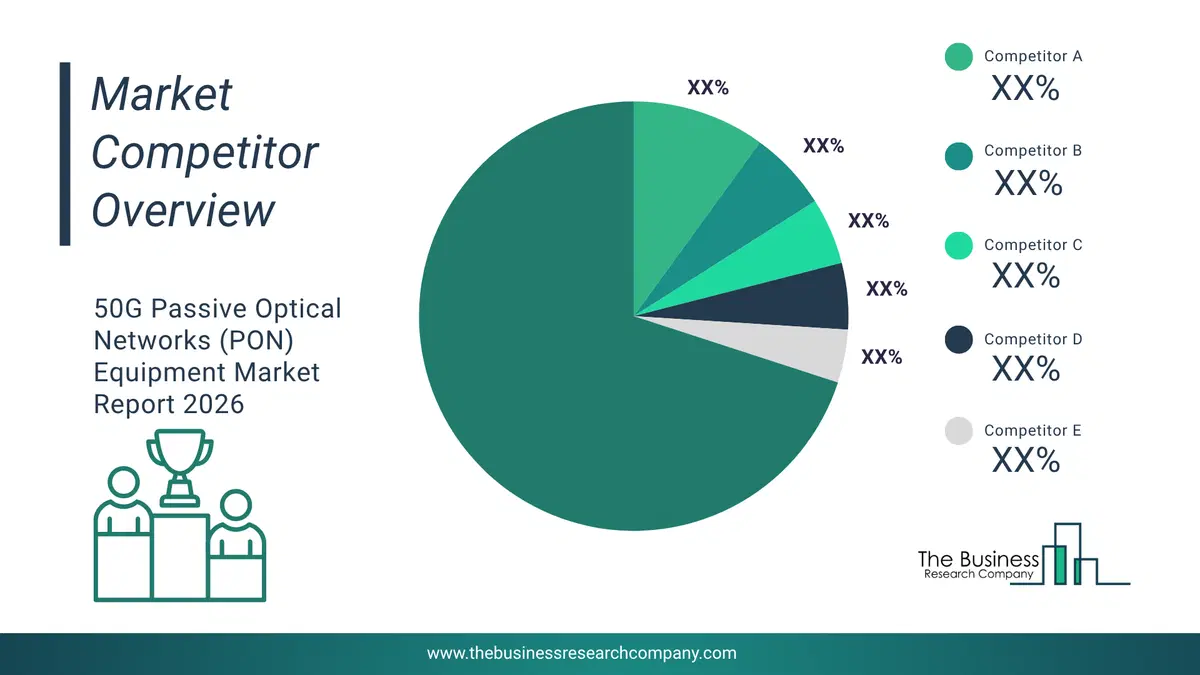
This chart is for illustrative purposes; the full report includes a detailed competitor analysis and comprehensive overview of the top 10 companies in the market.
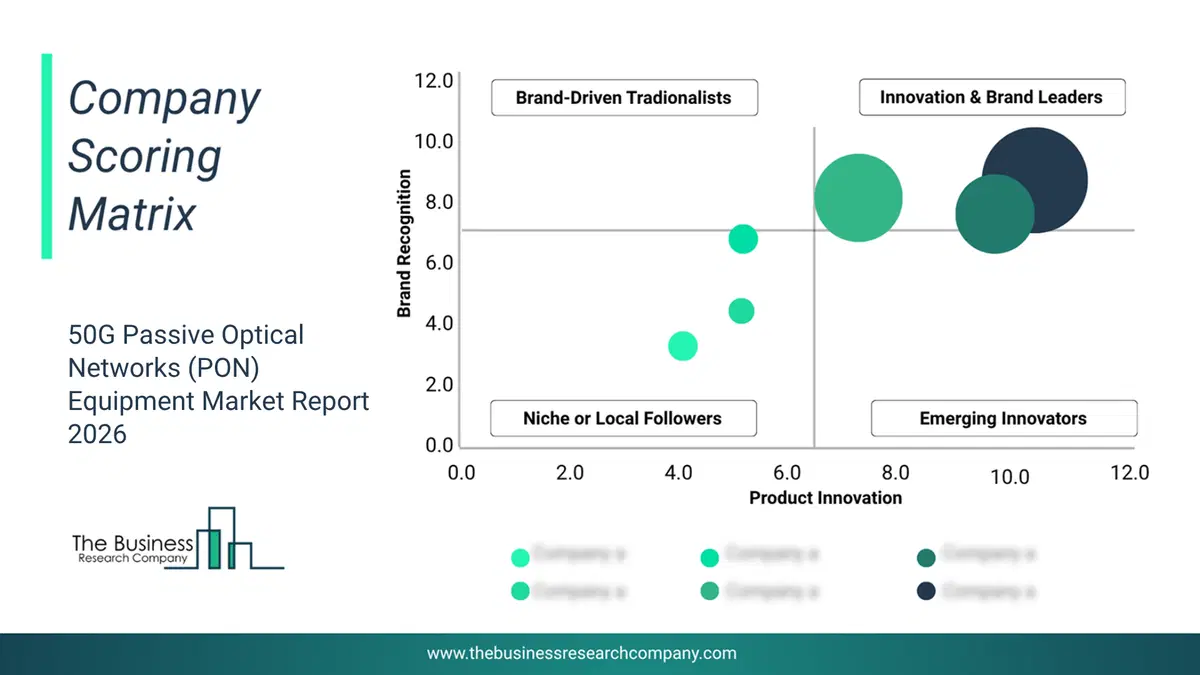
This chart maps companies by product innovation and brand strength, with bubble size indicating relative revenue, helping identify market leaders, challengers, and niche players. This is an illustrative chart; the full report provides a complete and accurate competitive analysis.
Global 50G Passive Optical Networks (PON) Equipment Market Trends and Insights
Major companies operating in the 50G passive optical networks (PON) equipment market are focusing on technological advancements, such as ITU-compliant asymmetric 50G PON OLT chipsets to enable scalable, energy-efficient, and high-capacity deployment of 50G passive optical networks through advanced optical signal processing and network management technologies. The ITU-compliant asymmetric 50G PON OLT chipset refers to a semiconductor chipset designed for optical line terminals (OLTs) that supports asymmetric 50G data transmission, optimizes power and size constraints, and ensures compliance with international telecommunications standards to deliver ultra-high-speed broadband connectivity. For instance, in March 2025, Semtech Corporation, a US-based semiconductor company, introduced the industry's first ITU-compliant asymmetric 50G PON OLT chipset featuring the GN7161, GN7153BW, and GN25L80B models, which address power and size limitations, enabling compact, energy-efficient SFP-DD modules and ensuring seamless integration into existing GPON, XGSPON, and HS-PON networks, facilitating scalable global deployment. This launch aims to accelerate the adoption of next-generation 50G PON networks by providing operators with a high-performance, energy-efficient, and standards-compliant solution that supports large-scale, reliable, and cost-effective broadband connectivity worldwide.What Are Latest Mergers And Acquisitions In The 50G Passive Optical Networks (PON) Equipment Market?
In June 2025, Nokia Corporation, a Finland-based telecommunications and technology company, acquired Infinera Corporation for $2.3 billion. Through this acquisition, Nokia Corporation aims to strengthen its optical networking portfolio and enhance its global 50G passive optical networks capabilities by integrating the advanced technologies and expertise of Infinera Corporation. Infinera Corporation is a US-based optical networking solutions company specializing in high-capacity transport systems that enable advanced connectivity across service providers, enterprises, and data centers.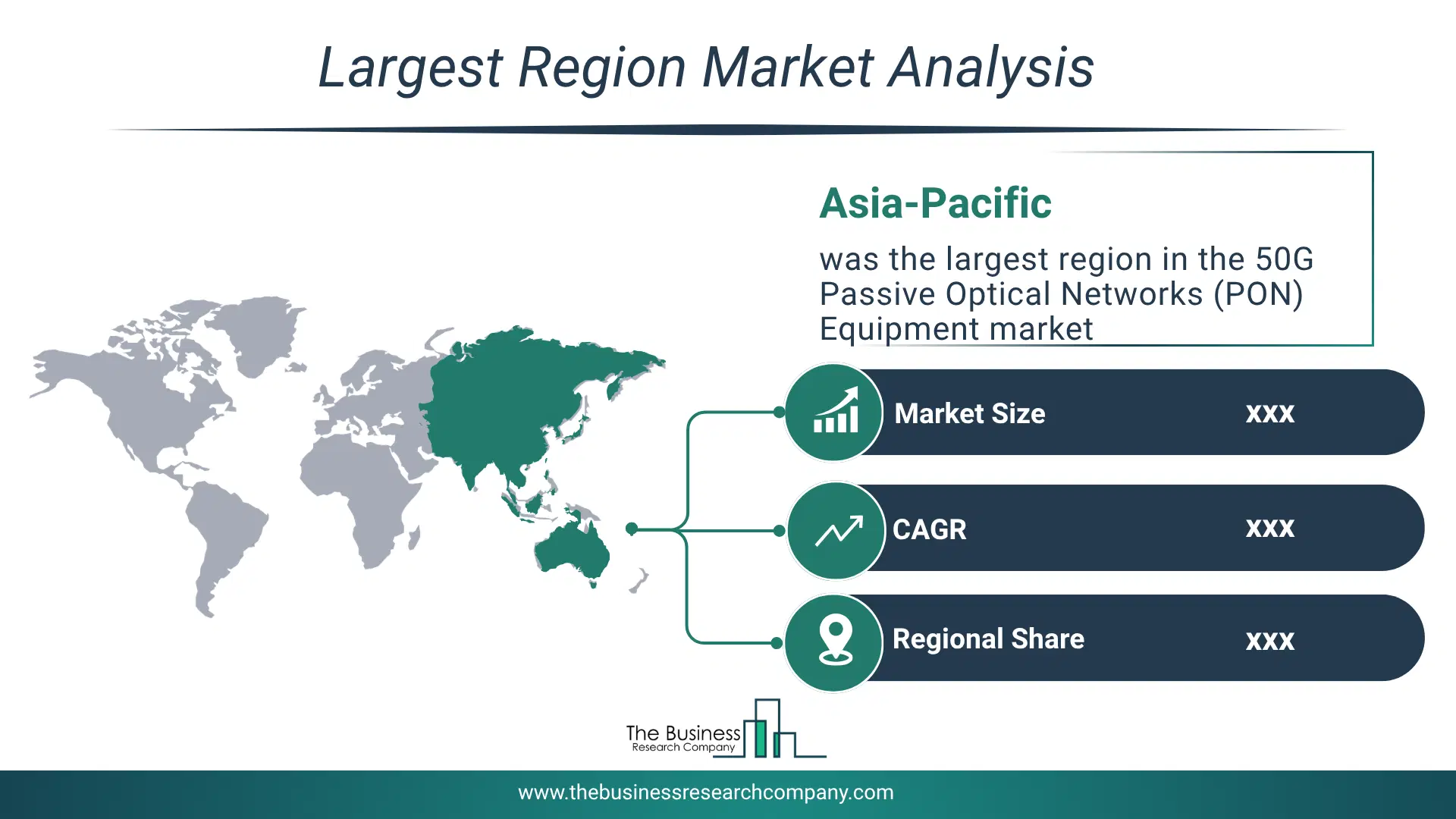
Regional Outlook
Asia-Pacific was the largest region in the 50G passive optical networks (PON) equipment market in 2025. The regions covered in this market report are Asia-Pacific, South East Asia, Western Europe, Eastern Europe, North America, South America, Middle East, Africa. The countries covered in this market report are Australia, Brazil, China, France, Germany, India, Indonesia, Japan, Taiwan, Russia, South Korea, UK, USA, Canada, Italy, Spain.What Defines the 50G Passive Optical Networks (PON) Equipment Market?
The 50G passive optical network (PON) equipment market consists of sales of optical line terminals (OLT), optical network units (ONU), optical transceivers, OLT chipsets, passive optical splitters, fiber optic cables, power modules, and cooling systems. Values in this market are ‘factory gate’ values, that is the value of goods sold by the manufacturers or creators of the goods, whether to other entities (including downstream manufacturers, wholesalers, distributors and retailers) or directly to end customers. The value of goods in this market includes related services sold by the creators of the goods.How is Market Value Defined and Measured?
The market value is defined as the revenues that enterprises gain from the sale of goods and/or services within the specified market and geography through sales, grants, or donations in terms of the currency (in USD unless otherwise specified). The revenues for a specified geography are consumption values that are revenues generated by organizations in the specified geography within the market, irrespective of where they are produced. It does not include revenues from resales along the supply chain, either further along the supply chain or as part of other products.
This chart presents market attractiveness based on a quantitative evaluation of growth, competition, strategic alignment, and risk, offering a clear view of opportunity areas for decision-making. This chart is for illustrative purposes; the full report contains the complete analysis.

This chart highlights the Total Addressable Market (TAM) by estimating the maximum revenue opportunity using an assumption-driven approach, supporting strategic planning and opportunity sizing across markets. The chart is illustrative; the full report provides a more comprehensive analysis.
What Key Data and Analysis Are Included in the 50G Passive Optical Networks (PON) Equipment Market Report 2026?
The 50g passive optical networks (pon) equipment market research report is one of a series of new reports from The Business Research Company that provides market statistics, including industry global market size, regional shares, competitors with the market share, detailed market segments, market trends and opportunities, and any further data you may need to thrive in the 50g passive optical networks (pon) equipment industry. The market research report delivers a complete perspective of everything you need, with an in-depth analysis of the current and future state of the industry.50G Passive Optical Networks (PON) Equipment Market Report 2026 Market Report Forecast Analysis
| Report Attribute | Details |
|---|---|
| Market Size Value In 2026 | $2.12 billion |
| Revenue Forecast In 2035 | $5.07 billion |
| Growth Rate | CAGR of 24.7% from 2026 to 2035 |
| Base Year For Estimation | 2025 |
| Actual Estimates/Historical Data | 2020-2025 |
| Forecast Period | 2026 - 2030 - 2035 |
| Market Representation | Revenue in USD Billion and CAGR from 2026 to 2035 |
| Segments Covered | Component, Technology, Deployment Mode, Application, End-User |
| Regional Scope | Asia-Pacific, Western Europe, Eastern Europe, North America, South America, Middle East, Africa |
| Country Scope | The countries covered in the report are Australia, Brazil, China, France, Germany, India, ... |
| Key Companies Profiled | Huawei Technologies Co. Ltd., Cisco Systems Inc., Broadcom Inc., Mitsubishi Electric Corporation, NEC Corporation, Nokia Corporation, ZTE Corporation, CommScope Holding Company Inc., Ciena Corporation, Sercomm Corporation, Lumentum Holdings Inc., Kontron d.o.o., ADTRAN Holdings Inc., Calix Inc., Semtech Corporation, Radisys Corporation, Source Photonics Inc., Tejas Networks Limited, Dasan Zhone Solutions Inc., Shenzhen Gigalight Technology Co. Ltd. |
| Customization Scope | Request for Customization |
| Pricing And Purchase Options | Explore Purchase Options |