
Aftermarket Automotive Parts Market Report 2026
Global Outlook – By Product Type (Engine Components, Electrical Parts, Suspension And Steering Parts, Brake Parts, Exhaust Parts, Other Product Types), By Vehicle Type (Passenger Cars, Commercial Vehicles, Two-Wheelers), By Application (Replacement And Wear-And-Tear, Performance, Customization And Aesthetic Enhancements, Collision Repair And Structural Replacement), By Distribution Channel (Online Retailers, Offline Retailers, Original Equipment Suppliers (OES)) – Market Size, Trends, Strategies, and Forecast to 2030
Aftermarket Automotive Parts Market Overview
• Aftermarket Automotive Parts market size has reached to $482.35 billion in 2025 • Expected to grow to $659.88 billion in 2030 at a compound annual growth rate (CAGR) of 6.5% • Growth Driver: Surge in Integration of Smart and Connected Vehicle Components Driving Market Growth due to Real-Time Data and Compatibility • Market Trend: Advanced Driver Assistance Sensors Improve Vehicle Safety And Automation • North America was the largest region in 2025 and Asia-Pacific is the fastest growing region.Market Gains By 2030 – Top Opportunities By Segment
Market Gain identifies the most promising market opportunities by highlighting the segments or products expected to generate the highest incremental revenue growth over the next five years.
What Is Covered Under Aftermarket Automotive Parts Market?
Aftermarket automotive parts are vehicle components manufactured and sold by companies other than the original equipment manufacturer (OEM). These parts are designed to replace, upgrade, or enhance existing vehicle components, often offering cost-effective or performance-oriented alternatives to OEM parts. They play a key role in vehicle maintenance, extending longevity, and improving performance without relying solely on original manufacturer components. The main product types of aftermarket automotive parts are engine components, electrical parts, suspension and steering parts, brake parts, exhaust parts, and others. Engine components refer to the individual parts and assemblies that work together within an engine to convert fuel into mechanical energy, enabling the engine to operate efficiently. These serve various vehicle types, such as passenger cars, commercial vehicles, and two-wheelers. These parts are used for various applications such as replacement and wear-and-tear, performance, customization and aesthetic enhancements, and collision repair and structural replacement, and are distributed through various channels, including online retailers, offline retailers, and original equipment suppliers (OES).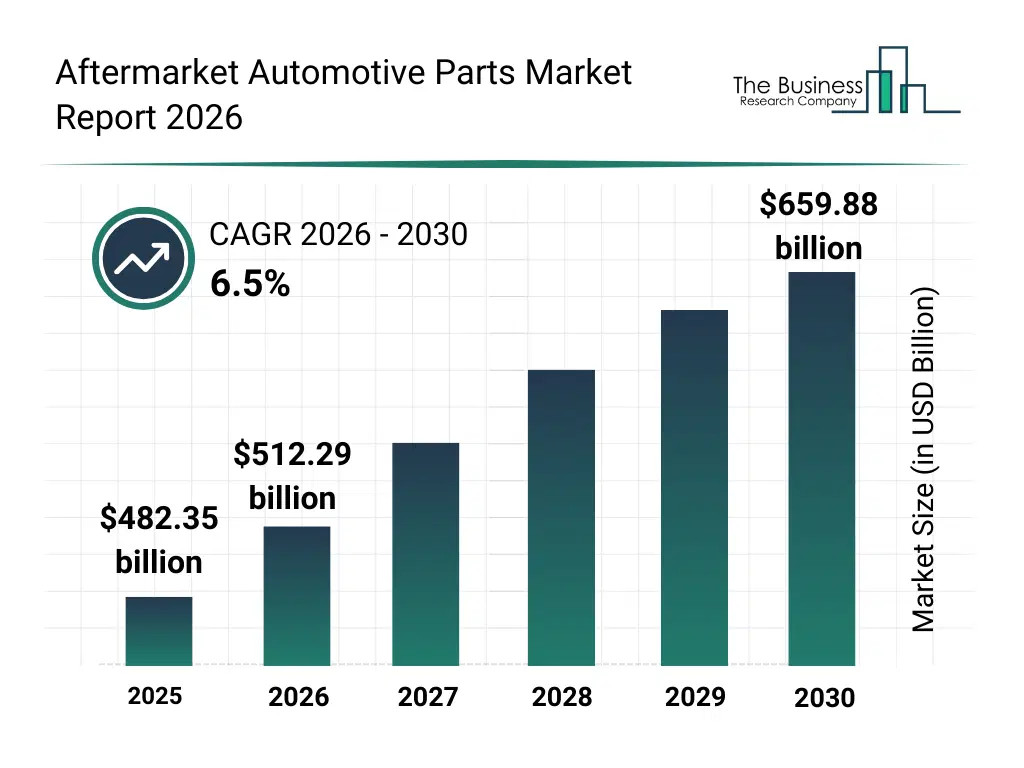
What Is The Aftermarket Automotive Parts Market Size and Share 2026?
The aftermarket automotive parts market size has grown strongly in recent years. It will grow from $482.35 billion in 2025 to $512.29 billion in 2026 at a compound annual growth rate (CAGR) of 6.2%. The growth in the historic period can be attributed to growth in global vehicle parc, increasing vehicle aging trends, expansion of independent repair shops, availability of diverse aftermarket suppliers, rising demand for affordable maintenance solutions.What Is The Aftermarket Automotive Parts Market Growth Forecast?
The aftermarket automotive parts market size is expected to see strong growth in the next few years. It will grow to $659.88 billion in 2030 at a compound annual growth rate (CAGR) of 6.5%. The growth in the forecast period can be attributed to increasing adoption of electric vehicle aftermarket components, rising digitalization of auto parts retail, expansion of performance tuning culture, growing demand for sustainable automotive parts, increasing integration of smart vehicle components. Major trends in the forecast period include increasing demand for cost-effective replacement parts, rising adoption of online aftermarket sales channels, growing focus on vehicle performance enhancement, expansion of customization and styling products, enhanced emphasis on vehicle longevity.
Global Aftermarket Automotive Parts Market Segmentation
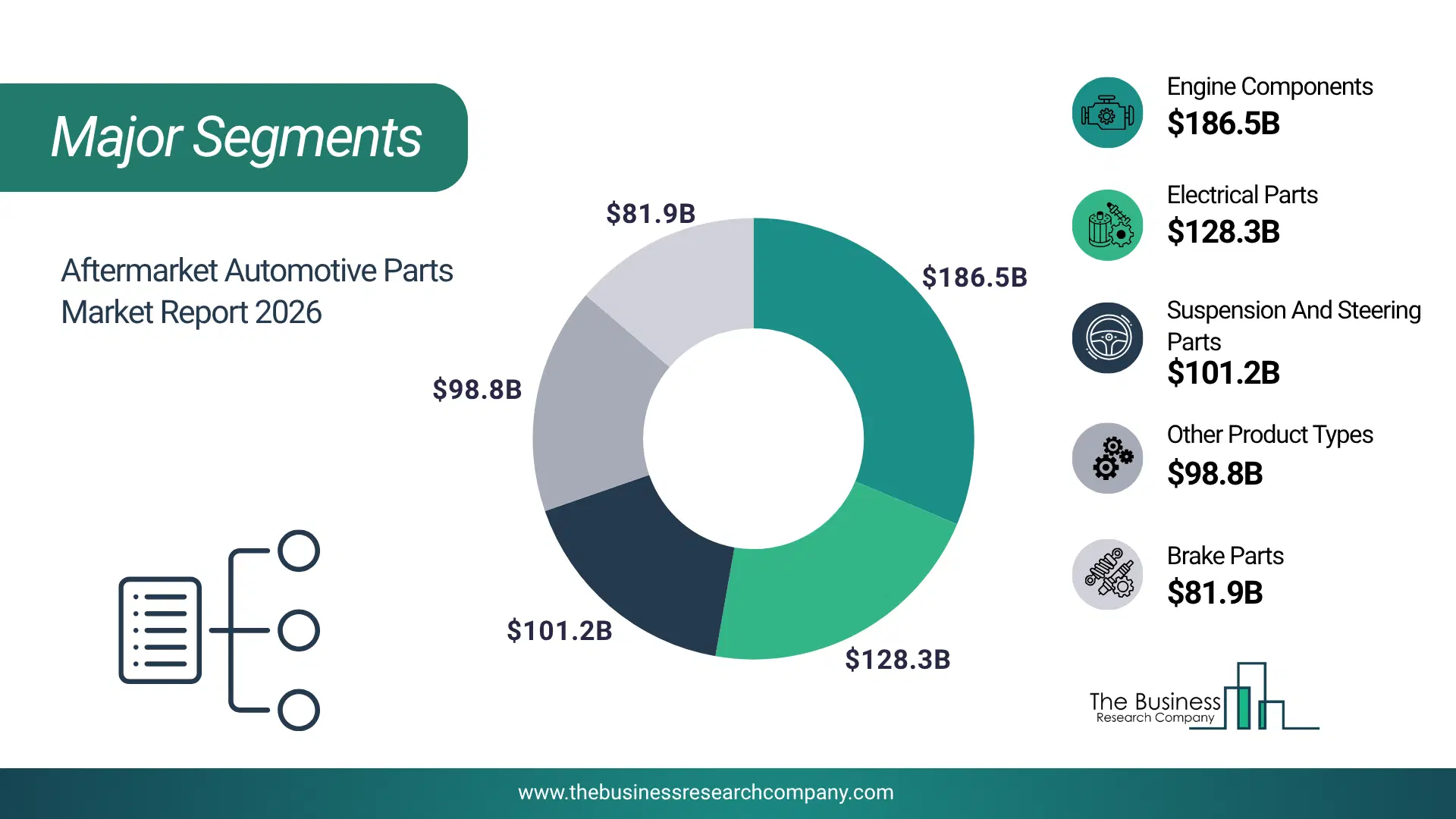
1) By Product Type: Engine Components, Electrical Parts, Suspension And Steering Parts, Brake Parts, Exhaust Parts, Other Product Types 2) By Vehicle Type: Passenger Cars, Commercial Vehicles, Two-Wheelers 3) By Application: Replacement And Wear-And-Tear, Performance, Customization And Aesthetic Enhancements, Collision Repair And Structural Replacement 4) By Distribution Channel: Online Retailers, Offline Retailers, Original Equipment Suppliers (OES) Subsegments: 1) By Engine Components: Pistons, Piston Rings, Oil Pumps, Gaskets, Cylinder Heads, Timing Belts, Valves 2) By Electrical Parts: Alternators, Starters, Spark Plugs, Batteries, Ignition Coils, Wiring Harnesses, Sensors 3) By Suspension And Steering Parts: Shock Absorbers, Struts, Control Arms, Ball Joints, Tie Rod Ends, Steering Racks, Bushings 4) By Brake Parts: Brake Pads, Brake Shoes, Brake Rotors, Brake Calipers, Brake Drums, Master Cylinders, Brake Lines 5) By Exhaust Parts: Mufflers, Catalytic Converters, Exhaust Manifolds, Resonators, Exhaust Pipes, Oxygen Sensor 6) By Other Product Types: Filters, Lighting Systems, Wiper Blades, Clutch Assemblies, Fuel Pumps, Cooling Systems The top segments in the aftermarket automotive parts market will be: • Engine Components will reach $186.47 billion by 2030. • Electrical Parts will reach $128.27 billion by 2030. • Suspension And Steering Parts will reach $101.16 billion by 2030. • Other Product Types will reach $98.76 billion by 2030. • Brake Parts will reach $81.84 billion by 2030.What Is The Driver Of The Aftermarket Automotive Parts Market?
The integration of smart and connected vehicle components is expected to propel the growth of aftermarket automotive parts going forward. Smart and connected vehicle components are sensors, software, and connected systems that enable vehicles to communicate, monitor performance, and enhance safety and efficiency. The increase of smart and connected vehicle components is driven by real-time data communication, as they enable vehicles to share information with other systems, improving safety and driving efficiency. Aftermarket automotive parts help integrate smart and connected vehicle components by providing cost-effective, compatible replacements that maintain or enhance vehicle connectivity and advanced system functionality. For instance, in December 2024, according to the Baker Institute for Public Policy, a US-based nonpartisan think tank, Chinese electric vehicle production and connected vehicle software or hardware are expected to remain absent in Mexico by 2026, while Mexico’s automotive sector, responsible for 22% of USMCA trade and 17.4% of global vehicle production, exports about 88% of its 3.5 million annual vehicles to the United States, and on September 23, 2024. Therefore, integration of smart and connected vehicle components is driving the growth of the aftermarket automotive parts industry.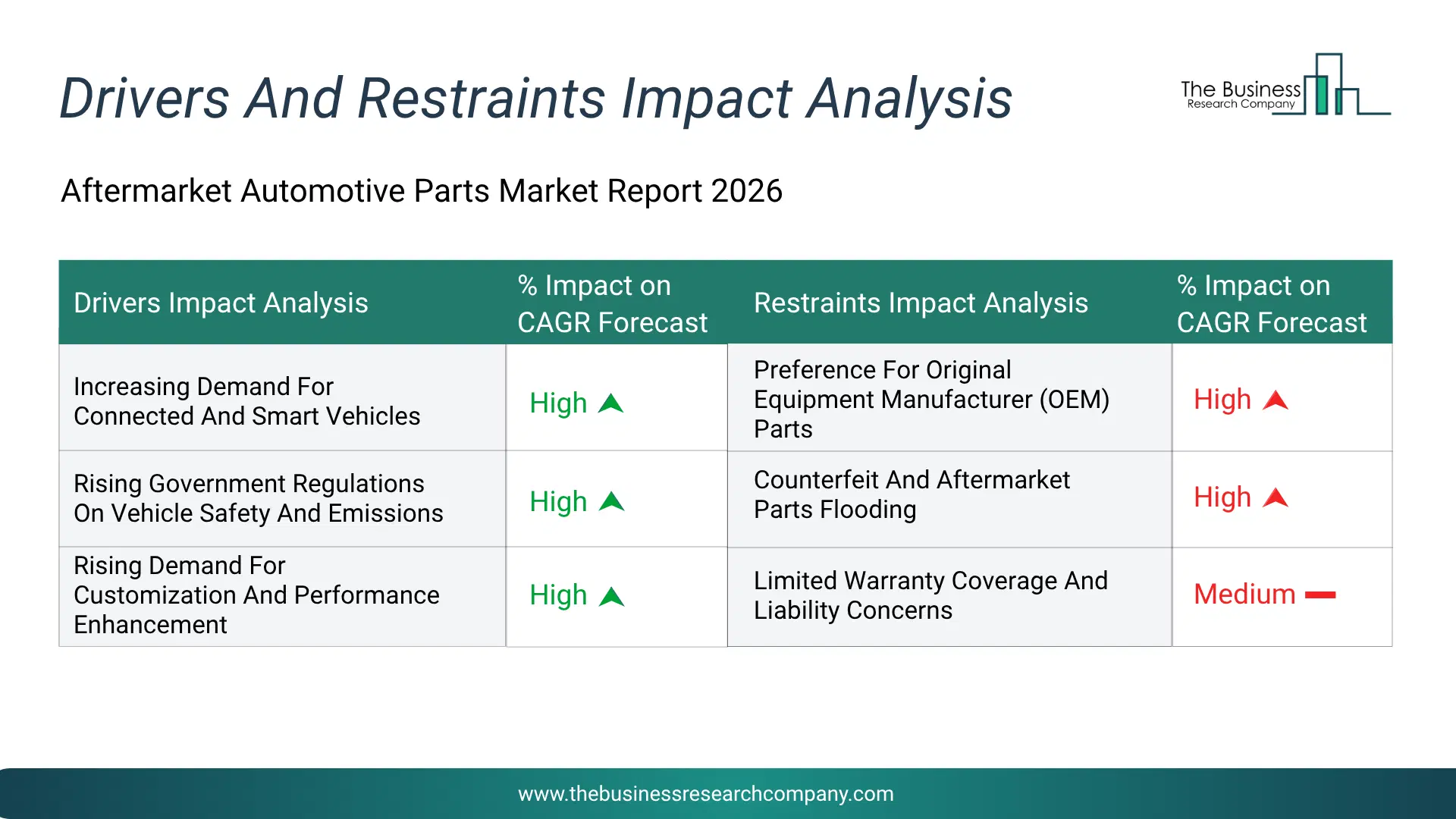
Infographic Chart Showing Key Market Drivers Analysis And Restraints For Aftermarket Automotive Parts Market
The chart presents an impact analysis of key drivers and restraints, quantifying their relative influence on the market's growth rate and helping assess the balance between growth enablers and limiting factors. This chart offers a high-level perspective; the full report contains more detailed insights.
How Will The Drivers Impact Growth In The Global Aftermarket Automotive Parts Market?
• Increasing Demand For Connected And Smart Vehicles (High) – During the forecast period, the increasing demand for connected and smart vehicles is expected to become a key growth driver for the aftermarket automotive parts market by 2030. As modern vehicles integrate advanced digital technologies such as sensors, infotainment systems, telematics units, and connectivity modules, the need for compatible replacement and upgrade components is rising significantly. Vehicle owners increasingly seek to enhance connectivity, improve user experience, and maintain compatibility with evolving technological standards. This trend encourages aftermarket manufacturers to develop advanced and technologically compatible parts to support modern vehicle architectures. Additionally, the growing penetration of connected vehicle technologies is expanding the scope of aftermarket services beyond traditional mechanical components. Collectively, these factors support steady market growth by directly linking vehicle digitalization with increased aftermarket parts demand. • Rising Government Regulations On Vehicle Safety And Emissions (High) – During the forecast period, rising government regulations on vehicle safety and emissions are expected to emerge as a major factor driving the expansion of the aftermarket automotive parts market by 2030. Regulatory authorities worldwide are implementing stricter standards to improve vehicle safety, reduce emissions, and enhance environmental sustainability. These regulations require periodic replacement or upgrading of critical components such as exhaust systems, catalytic converters, braking systems, and fuel management systems. Aftermarket suppliers provide cost-effective and compliant alternatives to original equipment manufacturer (oem) parts, making regulatory compliance more accessible to vehicle owners. Additionally, ongoing regulatory updates and inspection requirements are increasing the frequency of component replacement. • Rising Demand For Customization And Performance Enhancement (High) – During the forecast period, the rising demand for customization and performance enhancement is expected to act as a key growth catalyst for the aftermarket automotive parts market by 2030. Vehicle owners increasingly seek to improve vehicle aesthetics, functionality, and performance through customized and upgraded components. Aftermarket parts such as performance exhaust systems, suspension systems, lighting solutions, and electronic upgrades provide opportunities to enhance vehicle performance and appearance. This trend is particularly strong among automotive enthusiasts and commercial fleet operators seeking improved efficiency and operational performance. Additionally, the growing availability of advanced aftermarket solutions is making customization more accessible and affordable.How Will The Restraints Impact Growth In The Global Aftermarket Automotive Parts Market?
• Preference For Original Equipment Manufacturer (OEM) Parts (High) – During the forecast period, the consumer preference for original equipment manufacturer (oem) parts acts as a restraint on the aftermarket automotive parts market. Many vehicle owners perceive oem parts as more reliable, durable, and better aligned with manufacturer standards compared to aftermarket alternatives. This trust in oem quality reduces the willingness of customers to shift toward third-party options, even if they are more affordable. In addition, dealerships and service centers often promote oem parts, further limiting aftermarket adoption. As a result, strong oem loyalty creates a barrier to aftermarket growth. • Counterfeit And Aftermarket Parts Flooding (High) – During the forecast period, the presence of counterfeit and low-quality aftermarket parts poses a significant restraint on the legitimate aftermarket automotive parts market. These fake components undermine consumer trust, as they often fail to meet safety and performance standards, leading to potential vehicle damage or accidents. Customers may become hesitant to purchase genuine aftermarket parts due to fear of receiving substandard products. Additionally, the proliferation of counterfeit parts can tarnish the reputation of reputable aftermarket manufacturers. Consequently, this issue limits market growth and discourages wider adoption of certified aftermarket components. • Limited Warranty Coverage And Liability Concerns (Medium) – During the forecast period, the limited warranty coverage and liability concerns act as a significant restraint on the aftermarket automotive parts market. Many aftermarket components offer shorter or less comprehensive warranties compared to oem parts, which reduces consumer confidence in their long-term reliability. Additionally, vehicle owners and repair shops may face liability issues if non-oem parts fail and cause damage or safety risks. Insurance providers and service networks also tend to favor oem-certified components to minimize risk exposure. As a result, these concerns discourage adoption of aftermarket parts and restrict overall market expansion.Key Players In The Global Aftermarket Automotive Parts Market
Major companies operating in the aftermarket automotive parts market are Robert Bosch GmbH, DENSO Corporation, Continental AG, ZF Friedrichshafen AG, Valeo, BorgWarner Inc., Aisin Corporation, Hyundai Mobis Company Limited, Schaeffler AG, Marelli Holdings Co., Ltd., Bridgestone Corporation, Forvia SE, Cardone Industries, ABC Technologies, Dayco, Edelbrock LLC, Centric Parts, Wilwood Engineering, Sanden International, Shelby American, Inc., Specialty Vehicle Engineering, RENNtech, Overfinch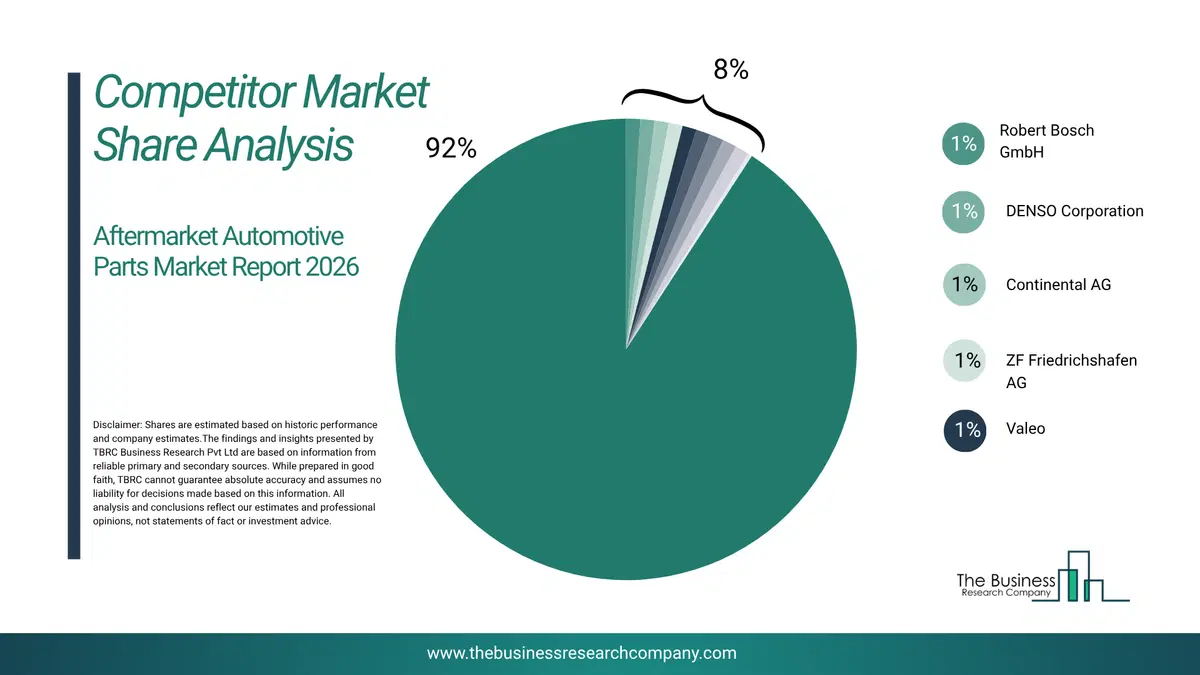
This chart is for illustrative purposes; the full report includes a detailed competitor analysis and comprehensive overview of the top 10 companies in the market.
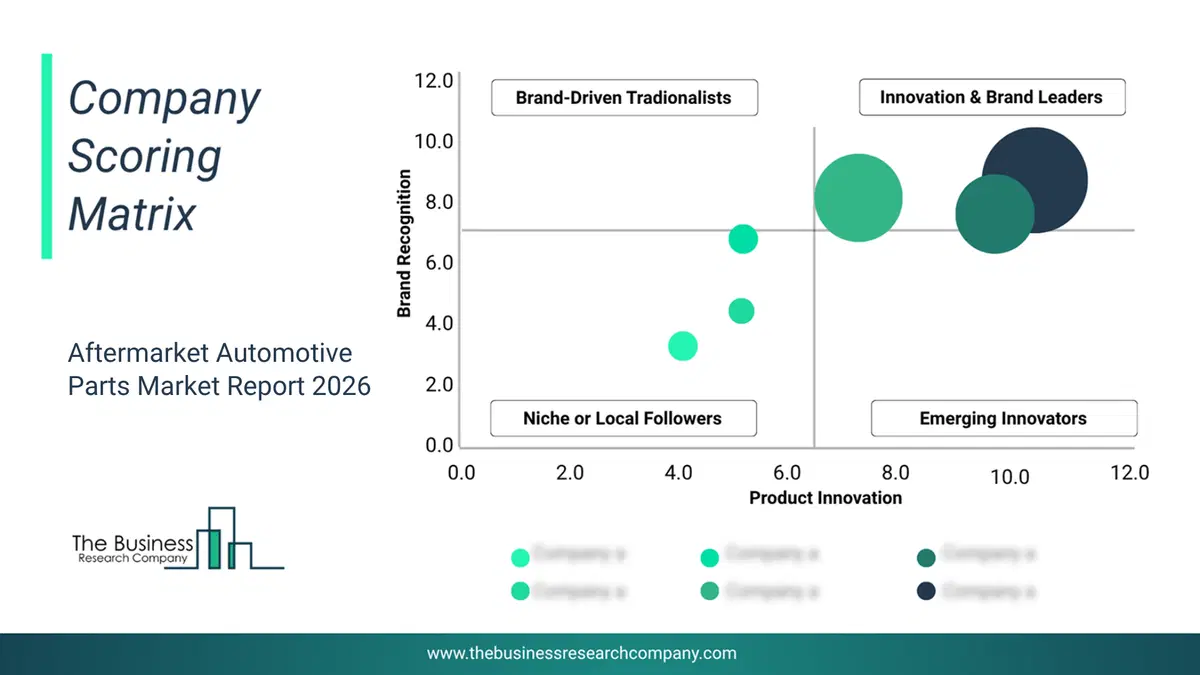
This chart maps companies by product innovation and brand strength, with bubble size indicating relative revenue, helping identify market leaders, challengers, and niche players. This is an illustrative chart; the full report provides a complete and accurate competitive analysis.
Global Aftermarket Automotive Parts Market Trends and Insights
Major companies operating in the aftermarket automotive parts market are focusing on developing innovative solutions, such as advanced driver assistance system sensors, to enhance vehicle safety and driving automation. Advanced driver assistance system sensors are electronic devices in vehicles that detect and monitor the surroundings to help drivers with functions such as collision avoidance, lane keeping, and adaptive cruise control. For instance, in September 2024, Continental AG, a Germany-based manufacturing company, launched a major expansion of its aftermarket product range in original equipment quality. This expansion targets the growing technical demands of workshops, especially with the rise of electric vehicles and advanced driver assistance systems. The expansion includes new product groups such as sensors for driver assistance systems (cameras, radar), chassis and steering components (wheel bearings, wishbone bushings, ball joints), high-pressure fuel pumps, and an expanded line of brake discs and pads under the ATE New Original brand tailored for electric vehicles and Euro 7 emission standards.What Are Latest Mergers And Acquisitions In The Aftermarket Automotive Parts Market?
In November 2024, Standard Motor Products Inc., a US-based manufacturer and distributor of automotive parts, acquired Nissens Automotive A/S for $390 million. With this acquisition, Standard Motor Products aims to strengthen its presence in the European aftermarket, expand its thermal management product portfolio, and drive growth through cross-selling and operational synergies. Nissens Automotive A/S is a Denmark-based company that specializes in aftermarket automotive parts.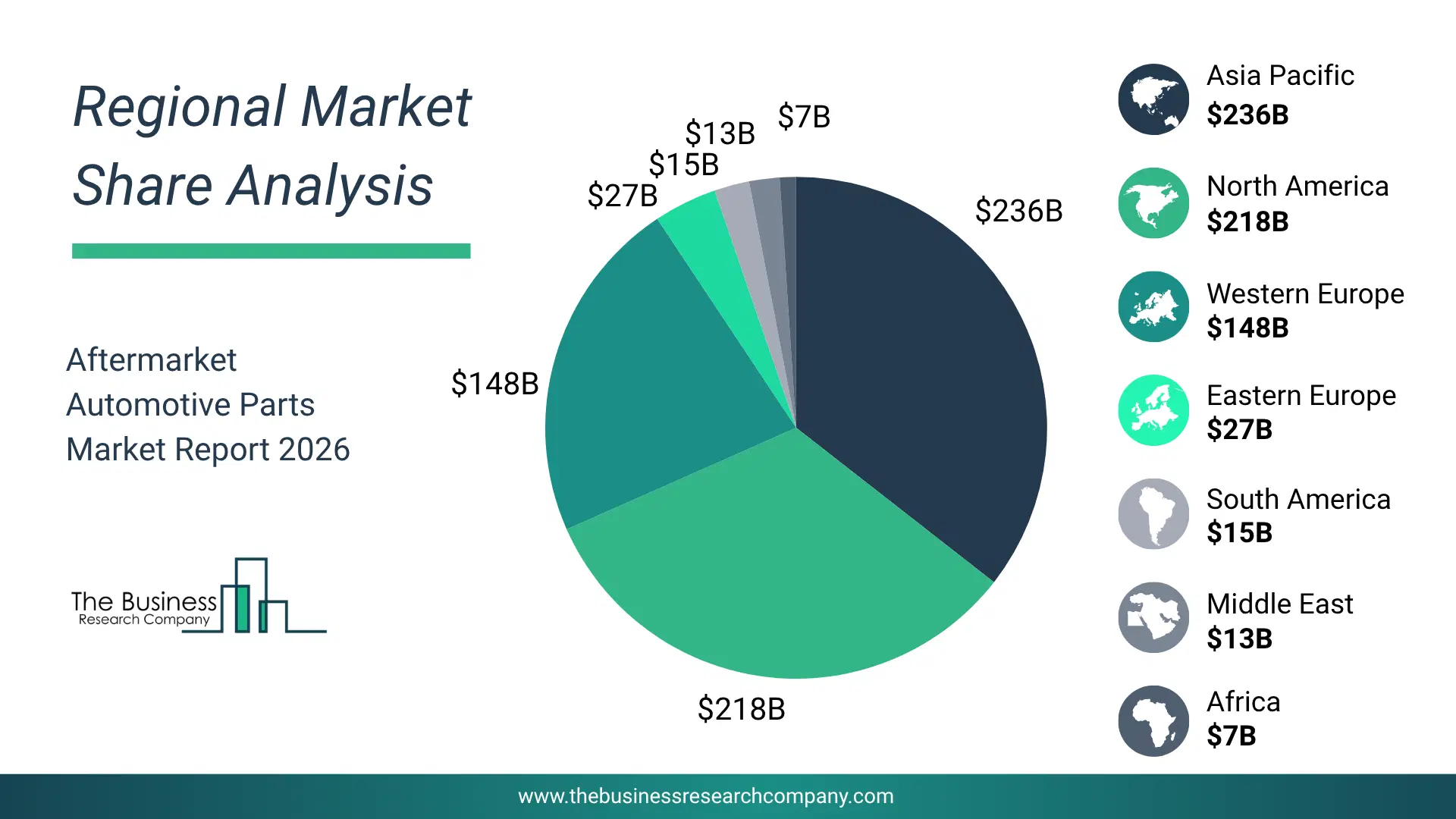
Regional Outlook
North America was the largest region in the aftermarket automotive parts market in 2025. Asia-Pacific is expected to be the fastest-growing region in the forecast period. The regions covered in this market report are Asia-Pacific, South East Asia, Western Europe, Eastern Europe, North America, South America, Middle East, Africa The countries covered in this market report are Australia, Brazil, China, France, Germany, India, Indonesia, Japan, Taiwan, Russia, South Korea, UK, USA, Canada, Italy, Spain.What Defines the Aftermarket Automotive Parts Market?
The aftermarket automotive parts market consists of sales of cooling system components, fuel system parts, transmission components, body and exterior parts, and lighting and signal systems. Values in this market are ‘factory gate’ values, that is, the value of goods sold by the manufacturers or creators of the goods, whether to other entities (including downstream manufacturers, wholesalers, distributors, and retailers) or directly to end customers. The value of goods in this market includes related services sold by the creators of the goods.How is Market Value Defined and Measured?
The market value is defined as the revenues that enterprises gain from the sale of goods and/or services within the specified market and geography through sales, grants, or donations in terms of the currency (in USD unless otherwise specified). The revenues for a specified geography are consumption values that are revenues generated by organizations in the specified geography within the market, irrespective of where they are produced. It does not include revenues from resales along the supply chain, either further along the supply chain or as part of other products.
This chart presents market attractiveness based on a quantitative evaluation of growth, competition, strategic alignment, and risk, offering a clear view of opportunity areas for decision-making. This chart is for illustrative purposes; the full report contains the complete analysis.

This chart highlights the Total Addressable Market (TAM) by estimating the maximum revenue opportunity using an assumption-driven approach, supporting strategic planning and opportunity sizing across markets. The chart is illustrative; the full report provides a more comprehensive analysis.
What Key Data and Analysis Are Included in the Aftermarket Automotive Parts Market Report 2026?
The aftermarket automotive parts market research report is one of a series of new reports from The Business Research Company that provides market statistics, including industry global market size, regional shares, competitors with the market share, detailed market segments, market trends and opportunities, and any further data you may need to thrive in the aftermarket automotive parts industry. The market research report delivers a complete perspective of everything you need, with an in-depth analysis of the current and future state of the industry.Aftermarket Automotive Parts Market Report Forecast Analysis
| Report Attribute | Details |
|---|---|
| Market Size Value In 2026 | $512.29 billion |
| Revenue Forecast In 2030 | $659.88 billion |
| Growth Rate | CAGR of 6.5% from 2026 to 2030 |
| Base Year For Estimation | 2025 |
| Actual Estimates/Historical Data | 2020-2025 |
| Forecast Period | 2026 - 2030 |
| Market Representation | Revenue in USD Billion and CAGR from 2026 to 2030 |
| Segments Covered | Product Type, Vehicle Type, Application, Distribution Channel |
| Regional Scope | Asia-Pacific, Western Europe, Eastern Europe, North America, South America, Middle East, Africa |
| Country Scope | The countries covered in the report are Australia, Brazil, China, France, Germany, India, ... |
| Key Companies Profiled | Robert Bosch GmbH, DENSO Corporation, Continental AG, ZF Friedrichshafen AG, Valeo, BorgWarner Inc., Aisin Corporation, Hyundai Mobis Company Limited, Schaeffler AG, Marelli Holdings Co., Ltd., Bridgestone Corporation, Forvia SE, Cardone Industries, ABC Technologies, Dayco, Edelbrock LLC, Centric Parts, Wilwood Engineering, Sanden International, Shelby American, Inc., Specialty Vehicle Engineering, RENNtech, Overfinch |
| Customization Scope | Request for Customization |
| Pricing And Purchase Options | Explore Purchase Options |