

Artificial Intelligence (AI)-Enhanced Digital Twin Quality Index Market Report 2026
Global Outlook – By Component (Software, Hardware, Services), By Deployment Mode (On-Premises, Cloud), By Enterprise Size (Small And Medium Enterprises, Large Enterprises), By Application (Manufacturing, Healthcare, Automotive, Aerospace And Defense, Energy And Utilities, Construction, Other Applications), By End-User (Industrial, Commercial, Government, Other End-Users) – Market Size, Trends, Strategies, and Forecast to 2035
Artificial Intelligence (AI)-Enhanced Digital Twin Quality Index Market Overview
• Artificial Intelligence (AI)-Enhanced Digital Twin Quality Index market size has reached to $3.74 billion in 2025 • Expected to grow to $12 billion in 2030 at a compound annual growth rate (CAGR) of 26.2% • Growth Driver: Surge In Transition Towards Smart Factories Fueling Growth Of The Market Due To Enhanced Operational Efficiency And Real-Time Data-Driven Decision-Making • Market Trend: Use Of Intelligent Virtual Twin Technologies To Enhance System Simulation, Optimization, And Decision-Making • North America was the largest region in 2025 and Asia-Pacific is the fastest growing region.What Is Covered Under Artificial Intelligence (AI)-Enhanced Digital Twin Quality Index Market?
The artificial intelligence (AI)-enhanced digital twin quality index is a performance measurement framework that integrates artificial intelligence with digital twin models to assess and optimise the accuracy, reliability, and efficiency of physical-to-digital asset representation. It provides real-time quality insights by analysing data streams, predictive simulations, and intelligent feedback loops. This index helps ensure that digital twins remain aligned with evolving conditions and deliver high-value decision-making support. The main components of artificial intelligence (AI)-enhanced digital twin quality indexes include software, hardware, and services. Software refers to programs and applications that enable devices and systems to perform specific tasks, process data, and support decision-making. Various deployment modes include on-premises and cloud and are used by different sizes of enterprises, such as small and medium enterprises and large enterprises. It is applied for manufacturing, healthcare, automotive, aerospace and defense, energy and utilities, construction, and others by several end-users, including industrial, commercial, government, and others.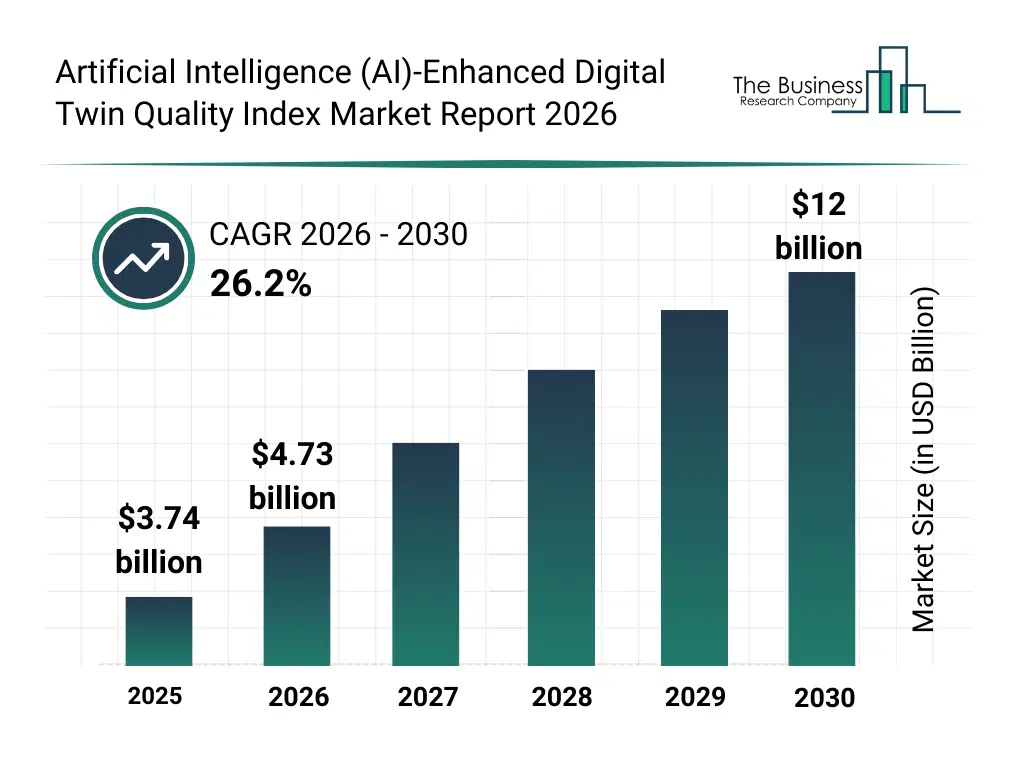
What Is The Artificial Intelligence (AI)-Enhanced Digital Twin Quality Index Market Size and Share 2026?
The artificial intelligence (AI)-enhanced digital twin quality index market size has grown exponentially in recent years. It will grow from $3.74 billion in 2025 to $4.73 billion in 2026 at a compound annual growth rate (CAGR) of 26.5%. The growth in the historic period can be attributed to growth of industrial iot deployments, need for higher asset uptime and reliability, adoption of digital twin platforms in manufacturing, increasing use of predictive maintenance programs, availability of high-frequency sensor data.What Is The Artificial Intelligence (AI)-Enhanced Digital Twin Quality Index Market Growth Forecast?
The artificial intelligence (AI)-enhanced digital twin quality index market size is expected to see exponential growth in the next few years. It will grow to $12 billion in 2030 at a compound annual growth rate (CAGR) of 26.2%. The growth in the forecast period can be attributed to expansion of autonomous quality optimization loops, growing adoption of real-time twin governance, increasing use of edge AI for twin validation, need for standardized twin quality benchmarks, rising investments in smart factory modernization. Major trends in the forecast period include real-time twin quality scoring dashboards, standardized digital twin validation frameworks, continuous calibration using live sensor streams, automated drift detection in simulation models, cross-plant benchmarking of twin accuracy metrics.
Global Artificial Intelligence (AI)-Enhanced Digital Twin Quality Index Market Segmentation
1) By Component: Software, Hardware, Services 2) By Deployment Mode: On-Premises, Cloud 3) By Enterprise Size: Small And Medium Enterprises, Large Enterprises 4) By Application: Manufacturing, Healthcare, Automotive, Aerospace And Defense, Energy And Utilities, Construction, Other Applications 5) By End-User: Industrial, Commercial, Government, Other End-Users Subsegments: 1) By Software: Simulation Platforms, Data Analytics Tools, Machine Learning Algorithms, Cloud Integration Systems, Visualization Dashboards, Predictive Modelling Solutions 2) By Hardware: Sensors And Actuators, Edge Computing Devices, Networking Equipment, Industrial Controllers, Embedded Systems, Data Storage Units 3) By Services: Consulting Services, Implementation And Integration, Maintenance And Support, Training And Education, Managed Services, System Upgradation ServicesWhat Is The Driver Of The Artificial Intelligence (AI)-Enhanced Digital Twin Quality Index Market?
The growing transition towards smart factories is expected to propel the growth of the artificial intelligence (AI)-enhanced digital twin quality index market going forward. Smart factories refer to the integration of advanced digital technologies, such as the Internet of Things (IoT), artificial intelligence (AI), robotics, and data analytics, into manufacturing processes to create highly automated, interconnected, and efficient production environments. The rising transition towards smart factories is due to enhanced operational efficiency, as they enable real-time monitoring and data-driven decision-making to optimize production processes and reduce downtime. Artificial intelligence (AI)-enhanced digital twin quality index helps smart factories by enabling real-time simulations and predictive analytics to optimize operations and improve efficiency. For instance, in September 2025, according to the International Federation of Robotics, a Germany-based non-profit organization, China installed a record 542,000 industrial robots in 2024, accounting for 74% of global installations, up from 505,000 units in 2023. Therefore, the growing transition towards smart factories is driving the growth of the artificial intelligence (AI)-enhanced digital twin quality index industry.Key Players In The Global Artificial Intelligence (AI)-Enhanced Digital Twin Quality Index Market
Major companies operating in the artificial intelligence (AI)-enhanced digital twin quality index market are Microsoft Corporation, Bosch Global Software Technologies Pvt. Ltd., Siemens AG, General Electric Company, Accenture Plc, IBM Corporation, Oracle Corporation, Schneider Electric SE, Honeywell International Inc., SAP SE, ABB Ltd., Emerson Electric Co., Rockwell Automation Inc., Dassault Systèmes, Hexagon AB, Synopsys Inc., Autodesk Inc., PTC Inc., AVEVA Group Plc, Bentley Systems Incorporated, Akselos.Global Artificial Intelligence (AI)-Enhanced Digital Twin Quality Index Market Trends and Insights
Major companies operating in the artificial intelligence (AI)-enhanced digital twin quality index market are focusing on developing virtual twin experience as a service (VTaaS), to enhance real-time simulation, predictive analytics, and optimization of complex systems while securely managing intellectual property and enhancing decision-making across industries. Virtual twin experience as a service (VTaaS) allows organizations to create, simulate, and optimize digital twins while training multiple AI engines in a secure environment, ensuring intellectual property protection and enhanced decision-making. For instance, in February 2025, Dassault Systems, a France-based software company, launched 3D UNIV+RSES. It is a platform that integrates multiple generative artificial intelligence technologies into a unified environment for creating intelligent Virtual Twin Experiences as a Service. It allows organizations to combine modelling, simulation, real-world data, and AI-generated content to develop high-fidelity digital twins. The platform enables cross-simulation of virtual twins and the training of multiple artificial intelligence engines while ensuring secure protection of intellectual property. It supports innovation across industries by improving predictive accuracy, operational efficiency, and decision-making capabilities.What Are Latest Mergers And Acquisitions In The Artificial Intelligence (AI)-Enhanced Digital Twin Quality Index Market?
In February 2025, CoStar Group, a US-based provider of online real estate analytics, acquired Matterport for an undisclosed amount. Through this acquisition, CoStar aims to enhance AI-driven property analytics and accelerate the integration of digital twin technology across commercial and residential real estate. Matterport is a US-based company specializing in artificial intelligence (AI)-enhanced digital twin quality index solutions.Regional Insights
North America was the largest region in the artificial intelligence (AI)-enhanced digital twin quality index market in 2025. Asia-Pacific is expected to be the fastest-growing region in the forecast period. The regions covered in this market report are Asia-Pacific, South East Asia, Western Europe, Eastern Europe, North America, South America, Middle East, Africa. The countries covered in this market report are Australia, Brazil, China, France, Germany, India, Indonesia, Japan, Taiwan, Russia, South Korea, UK, USA, Canada, Italy, Spain.What Defines the Artificial Intelligence (AI)-Enhanced Digital Twin Quality Index Market?
The artificial intelligence (AI)-enhanced digital twin quality index market consists of revenues earned by entities by providing services such as predictive analytics, data integration, model validation, performance monitoring, and simulation optimisation. The market value includes the value of related goods sold by the service provider or included within the service offering. The artificial intelligence (AI)-enhanced digital twin quality index market also includes sales of sensors, Internet of Things (IoT) devices, servers, edge computing devices, control panels, and testing equipment. Values in this market are ‘factory gate’ values, that is the value of goods sold by the manufacturers or creators of the goods, whether to other entities (including downstream manufacturers, wholesalers, distributors and retailers) or directly to end customers. The value of goods in this market includes related services sold by the creators of the goods.How is Market Value Defined and Measured?
The market value is defined as the revenues that enterprises gain from the sale of goods and/or services within the specified market and geography through sales, grants, or donations in terms of the currency (in USD unless otherwise specified). The revenues for a specified geography are consumption values that are revenues generated by organizations in the specified geography within the market, irrespective of where they are produced. It does not include revenues from resales along the supply chain, either further along the supply chain or as part of other products.What Key Data and Analysis Are Included in the Artificial Intelligence (AI)-Enhanced Digital Twin Quality Index Market Report 2026?
The artificial intelligence (ai)-enhanced digital twin quality index market research report is one of a series of new reports from The Business Research Company that provides market statistics, including industry global market size, regional shares, competitors with the market share, detailed market segments, market trends and opportunities, and any further data you may need to thrive in the artificial intelligence (ai)-enhanced digital twin quality index industry. The market research report delivers a complete perspective of everything you need, with an in-depth analysis of the current and future state of the industry.Artificial Intelligence (AI)-Enhanced Digital Twin Quality Index Market Report Forecast Analysis
| Report Attribute | Details |
|---|---|
| Market Size Value In 2026 | $4.73 billion |
| Revenue Forecast In 2035 | $12 billion |
| Growth Rate | CAGR of 26.5% from 2026 to 2035 |
| Base Year For Estimation | 2025 |
| Actual Estimates/Historical Data | 2020-2025 |
| Forecast Period | 2026 - 2030 - 2035 |
| Market Representation | Revenue in USD Billion and CAGR from 2026 to 2035 |
| Segments Covered | Component, Deployment Mode, Enterprise Size, Application, End-User |
| Regional Scope | Asia-Pacific, Western Europe, Eastern Europe, North America, South America, Middle East, Africa |
| Country Scope | The countries covered in the report are Australia, Brazil, China, France, Germany, India, ... |
| Key Companies Profiled | Microsoft Corporation, Bosch Global Software Technologies Pvt. Ltd., Siemens AG, General Electric Company, Accenture Plc, IBM Corporation, Oracle Corporation, Schneider Electric SE, Honeywell International Inc., SAP SE, ABB Ltd., Emerson Electric Co., Rockwell Automation Inc., Dassault Systèmes, Hexagon AB, Synopsys Inc., Autodesk Inc., PTC Inc., AVEVA Group Plc, Bentley Systems Incorporated, Akselos. |
| Customization Scope | Request for Customization |
| Pricing And Purchase Options | Explore Purchase Options |