

Automotive Microprocessor Market Report 2026
Global Outlook – By Type (General-Purpose Central Processing Units (CPUs), Application-Specific System On Chips (SoCs), Artificial Intelligence (AI)-Enabled Processors ), By Application (Adaptive Cruise Control (ACC), Blind Spot Detection, Park Assist, Tire Pressure Monitoring System (TPMS) ), By Integration Architecture (Monolithic System-On-Chip (SoC), Heterogeneous Integration (Chiplet-Based), Modular Multi-Die Packages ), By End User (Original Equipment Manufacturers (OEMs) And Tier-1 Suppliers, Aftermarket Service Providers, Electric-Vehicle Manufacturers ) – Market Size, Trends, Strategies, and Forecast to 2030
Automotive Microprocessor Market Overview
• Automotive Microprocessor market size has reached to $12.48 billion in 2025 • Expected to grow to $19.33 billion in 2030 at a compound annual growth rate (CAGR) of 9.1% • Growth Driver: Increasing Use Of Advanced Driver-Assistance Systems (ADAS) Driving The Market Growth Due To Rising Demand For Real-Time Thermal Monitoring And Vehicle Safety Optimization • Market Trend: Technological Advancements In Automotive Microprocessors Enhance In-Vehicle Human-Machine Interfaces • Asia-Pacific was the largest region and fastest growing region.What Is Covered Under Automotive Microprocessor Market?
Automotive microprocessors are semiconductor integrated circuits designed to execute processing, control, and computational functions within vehicles. They enable the operation of electronic control units (ECUs) by processing data from sensors, managing communication between vehicle systems, and supporting functions such as powertrain control, safety, infotainment, connectivity, and advanced driver assistance. These processors are engineered to deliver high performance, reliability, and energy efficiency under demanding automotive operating conditions. The main types of automotive microprocessors include general-purpose central processing units (CPUs), application-specific system on chips (SoCs), and artificial intelligence (AI)-enabled processors. General-purpose central processing units (CPUs) refer to programmable processing units that execute a broad range of computational tasks and control functions within automotive electronic systems. These microprocessors support technologies including adaptive cruise control (ACC), blind spot detection, park assist, and tire pressure monitoring systems (TPMS). They are available in monolithic system-on-chip (SoC), heterogeneous integration (chiplet-based), and modular multi-die package architectures and are used end users by original equipment manufacturers (OEMs) and tier-1 suppliers, aftermarket service providers, and electric-vehicle manufacturers.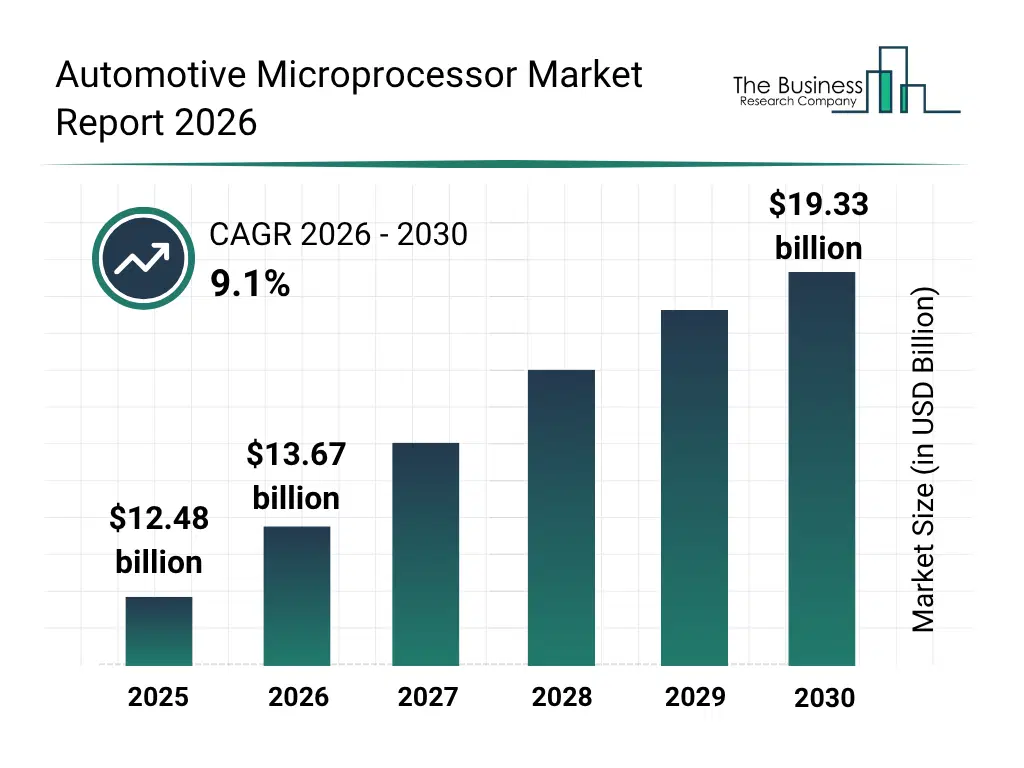
What Is The Automotive Microprocessor Market Size and Share 2026?
The automotive microprocessor market size has grown strongly in recent years. It will grow from $12.48 billion in 2025 to $13.67 billion in 2026 at a compound annual growth rate (CAGR) of 9.5%. The growth in the historic period can be attributed to increasing vehicle electronics content, rising adoption of electronic control units, growing demand for vehicle safety and control systems, increasing deployment of automotive infotainment systems, rising need for reliable in-vehicle processing.What Is The Automotive Microprocessor Market Growth Forecast?
The automotive microprocessor market size is expected to see strong growth in the next few years. It will grow to $19.33 billion in 2030 at a compound annual growth rate (CAGR) of 9.1%. The growth in the forecast period can be attributed to increasing demand for higher automotive computing performance, rising adoption of domain and zonal vehicle architectures, growing demand for advanced processor integration across vehicle systems, increasing need for energy-efficient automotive computing, rising demand for high-reliability processors for next-generation vehicles. Major trends in the forecast period include increasing adoption of high-performance automotive microprocessors, rising demand for multi-core automotive processors, growing use of centralized vehicle computing architectures, increasing demand for energy-efficient automotive processors, rising adoption of high-reliability processors for demanding vehicle operating conditions.
Global Automotive Microprocessor Market Segmentation
1) By Type: General-Purpose Central Processing Units (CPUs), Application-Specific System On Chips (SoCs), Artificial Intelligence (AI)-Enabled Processors 2) By Application: Adaptive Cruise Control (ACC), Blind Spot Detection, Park Assist, Tire Pressure Monitoring System (TPMS) 3) By Integration Architecture: Monolithic System-On-Chip (SoC), Heterogeneous Integration (Chiplet-Based), Modular Multi-Die Packages 4) By End User: Original Equipment Manufacturers (OEMs) And Tier-1 Suppliers, Aftermarket Service Providers, Electric-Vehicle Manufacturers Subsegments: 1) By General-Purpose Central Processing Units (CPUs): Single-Core General-Purpose Central Processing Units (CPUs), Multi-Core General-Purpose Central Processing Units (CPUs), Real-Time Automotive Central Processing Units (CPUs), High Performance Automotive Central Processing Units (CPUs) 2) By Application-Specific System On Chips (SoCs): Advanced Driver Assistance System (ADAS) System On Chips (SoCs), Infotainment System On Chips (SoCs), Body Control System On Chips (SoCs), Domain Controller System On Chips (SoCs) 3) By Artificial Intelligence (AI)-Enabled Processors: Neural Processing Unit (NPU)-Based Automotive Processors, Machine Learning Automotive Processors, Autonomous Driving Artificial Intelligence (AI) Processors, Edge Artificial Intelligence (AI) Automotive ProcessorsWhat Is The Driver Of The Automotive Microprocessor Market?
The increasing adoption of advanced driver assistance systems (ADAS) is expected to propel the growth of the automotive microprocessor market going forward. ADAS refers to electronic systems in vehicles that use sensors, cameras, and control units to assist drivers in driving and parking functions, improving safety and reducing human error. The adoption of ADAS is rising due to growing demand for enhanced road safety, automation, and reduced accident rates, which require highly reliable and real-time monitoring of vehicle operating conditions. Advanced driver assistance systems (ADAS) are driving the adoption of automotive microprocessors by increasing the need for high-performance, multi-core, and AI-enabled processors capable of performing real-time sensor fusion, image processing, object detection, decision-making, functional safety, and low-latency data processing to support features such as adaptive cruise control, automatic emergency braking, lane-keeping assistance, traffic sign recognition, driver monitoring, and increasingly sophisticated autonomous driving capabilities. For instance, in October 2024, according to the MITRE Corporation, a US-based not-for-profit organization, by the 2023 model year, 10 of the 14 Advanced Driver Assistance Systems (ADAS) features achieved over 50% market penetration, with five features surpassing 90%. Therefore, the increasing adoption of advanced driver assistance systems (ADAS) is driving the growth of the automotive microprocessor industry.Key Players In The Global Automotive Microprocessor Market
Major companies operating in the automotive microprocessor market are Taiwan Semiconductor Manufacturing Company Limited, NVIDIA Corporation, Qualcomm Incorporated, Intel Corporation, Advanced Micro Devices Inc, Texas Instruments Incorporated, NXP Semiconductors NV, STMicroelectronics NV, Infineon Technologies AG, Renesas Electronics Corporation, MediaTek Inc, Samsung Electronics Co Ltd, Analog Devices Inc, Microchip Technology Incorporated, ON Semiconductor Corporation, Mobileye Global Inc, Toshiba Corporation, ROHM Co Ltd, Silicon Laboratories Inc, Ambarella Inc, Melexis NV, Horizon Robotics Inc, Black Sesame Technologies Inc, Chipone Technology Beijing Co Ltd
This chart is for illustrative purposes; the full report includes a detailed competitor analysis and comprehensive overview of the top 10 companies in the market.

This chart maps companies by product innovation and brand strength, with bubble size indicating relative revenue, helping identify market leaders, challengers, and niche players. This is an illustrative chart; the full report provides a complete and accurate competitive analysis.
Global Automotive Microprocessor Market Trends and Insights
Major companies operating in the automotive microprocessor market are focusing on developing innovative products, such as automotive-grade System-in-Package (SiP) microprocessors to enhance in-vehicle display performance, processing efficiency, compact system design, and supply chain reliability. Automotive-grade system-in-package microprocessors integrate a processor and memory into a single semiconductor package, reducing printed circuit board complexity, minimizing component count, and providing higher processing performance and memory density compared to traditional discrete processor and memory solutions. For instance, in March 2026, Microchip Technology Incorporated, a US-based semiconductor company, launched the SAM9X75D5M, an automotive-grade System-in-Package (SiP) chip designed for vehicle display applications. The device combines an Arm926EJ-S processor with 512 Mbit DDR2 SDRAM in a single package and supports displays up to 10 inches at XGA (1024 × 768) resolution through MIPI DSI, LVDS, and parallel RGB interfaces. It also features CAN FD, USB, Gigabit Ethernet with Time-Sensitive Networking (TSN), integrated 2D graphics, and audio capabilities, while supporting Linux, FreeRTOS, and Eclipse ThreadX operating systems for advanced digital cockpit clusters, HVAC controls, EV chargers, and smart two- and three-wheeler display systems. This innovation reflects the increasing adoption of highly integrated automotive microprocessors to support next-generation human-machine interface (HMI) applications.What Are Latest Mergers And Acquisitions In The Automotive Microprocessor Market?
In April 2024, Microchip Technology Incorporated, a US-based semiconductor manufacturing company, acquired VSI Co. Ltd. for an undisclosed amount. With this acquisition, Microchip Technology Incorporated aimed to strengthen its automotive networking portfolio by integrating VSI Co. Ltd.’s Automotive SerDes Alliance Motion Link (ASA-ML) connectivity technologies into its existing Ethernet and PCIe solutions, enabling next-generation software-defined vehicles, enhancing high-speed camera, sensor, and display connectivity capabilities, and expanding its position in the rapidly growing advanced driver-assistance systems (ADAS) and digital cockpit markets. VSI Co. Ltd. is a South Korea-based fabless semiconductor company that specializes in developing high-speed automotive connectivity solutions, including asymmetric camera, sensor, and display link technologies.
Regional Insights
Asia-Pacific was the largest region in the automotive microprocessor market in 2025. Asia-Pacific is expected to be the fastest-growing region in the forecast period. The regions covered in this market report are Asia-Pacific, South East Asia, Western Europe, Eastern Europe, North America, South America, Middle East, Africa. The countries covered in this market report are Australia, Brazil, China, France, Germany, India, Indonesia, Japan, Taiwan, Russia, South Korea, UK, USA, Canada, Italy, Spain.What Defines the Automotive Microprocessor Market?
The automotive microprocessor market consists of sales of microcontroller units (MCUs), microprocessors (MPUs), digital signal processors (DSPs), automotive system-on-chip (SoC) devices, application processors, and domain and zonal controllers with integrated processing capabilities. Values in this market are ‘factory gate’ values, that is, the value of goods sold by the manufacturers or creators of the goods, whether to other entities (including downstream manufacturers, wholesalers, distributors, and retailers) or directly to end customers. The value of goods in this market includes related services sold by the creators of the goods.How is Market Value Defined and Measured?
The market value is defined as the revenues that enterprises gain from the sale of goods and/or services within the specified market and geography through sales, grants, or donations in terms of the currency (in USD unless otherwise specified). The revenues for a specified geography are consumption values that are revenues generated by organizations in the specified geography within the market, irrespective of where they are produced. It does not include revenues from resales along the supply chain, either further along the supply chain or as part of other products.
This chart presents market attractiveness based on a quantitative evaluation of growth, competition, strategic alignment, and risk, offering a clear view of opportunity areas for decision-making. This chart is for illustrative purposes; the full report contains the complete analysis.

This chart highlights the Total Addressable Market (TAM) by estimating the maximum revenue opportunity using an assumption-driven approach, supporting strategic planning and opportunity sizing across markets. The chart is illustrative; the full report provides a more comprehensive analysis.
What Key Data and Analysis Are Included in the Automotive Microprocessor Market Report 2026?
The automotive microprocessor market research report is one of a series of new reports from The Business Research Company that provides market statistics, including industry global market size, regional shares, competitors with the market share, detailed market segments, market trends and opportunities, and any further data you may need to thrive in the automotive microprocessor industry. The market research report delivers a complete perspective of everything you need, with an in-depth analysis of the current and future state of the industry.Automotive Microprocessor Market Report Forecast Analysis
| Report Attribute | Details |
|---|---|
| Market Size Value In 2026 | $13.67 billion |
| Revenue Forecast In 2030 | $19.33 billion |
| Growth Rate | CAGR of 9.1% from 2026 to 2030 |
| Base Year For Estimation | 2025 |
| Actual Estimates/Historical Data | 2020-2025 |
| Forecast Period | 2026 - 2030 |
| Market Representation | Revenue in USD Billion and CAGR from 2026 to 2030 |
| Segments Covered | Type, Application, Integration Architecture, End User |
| Regional Scope | Asia-Pacific, Western Europe, Eastern Europe, North America, South America, Middle East, Africa |
| Country Scope | The countries covered in the report are Australia, Brazil, China, France, Germany, India, Indonesia, Japan, Taiwan, Russia, South Korea, UK, USA, Canada, Italy, Spain. |
| Key Companies Profiled | Taiwan Semiconductor Manufacturing Company Limited, NVIDIA Corporation, Qualcomm Incorporated, Intel Corporation, Advanced Micro Devices Inc, Texas Instruments Incorporated, NXP Semiconductors NV, STMicroelectronics NV, Infineon Technologies AG, Renesas Electronics Corporation, MediaTek Inc, Samsung Electronics Co Ltd, Analog Devices Inc, Microchip Technology Incorporated, ON Semiconductor Corporation, Mobileye Global Inc, Toshiba Corporation, ROHM Co Ltd, Silicon Laboratories Inc, Ambarella Inc, Melexis NV, Horizon Robotics Inc, Black Sesame Technologies Inc, Chipone Technology Beijing Co Ltd |
| Customization Scope | Request for Customization |
| Pricing And Purchase Options | Explore Purchase Options |