

Bag In Box Containers Market 2025
By Material Type (Low Density Polyethylene, Ethylene Vinyl Acetate, Ethylene Vinyl Alcohol, Other Material Types), By Capacity (Less Than 5 Liters, 5-10 Liters, 10-15 Liters, 15-20 Liters, More Than 20 Liters), By Application (Food And Beverages, Industrial Liquids, Household Products, Other Applications), By Product Type (Film, Molded), And By Region, Opportunities And Strategies – Global Forecast To 2035
Bag-In-Box Containers Market Definition
Bag-in-box containers are a form of flexible packaging that consist of a plastic bag, typically made from multi-layer films, housed within a corrugated fiberboard box. These containers are primarily used to store and dispense liquid and semi-liquid products. The bag is usually equipped with a tap, valve, or spout that allows for controlled dispensing while minimizing exposure to air, thus preserving product freshness and extending shelf life. The bag-in-box containers market consists of sales, by entities such as organizations, sole traders, and partnerships, of packaging systems designed with a flexible bag inside a rigid box, primarily for the safe storage and transportation of liquids and semi-liquids. These containers offer advantages such as lightweight construction, space efficiency, and reduced transportation costs compared to traditional rigid packaging. Commonly used for beverages like wine, juice, and water, they are also adopted for food products, detergents, chemicals, and other liquids, owing to their ability to preserve freshness and facilitate easy dispensing.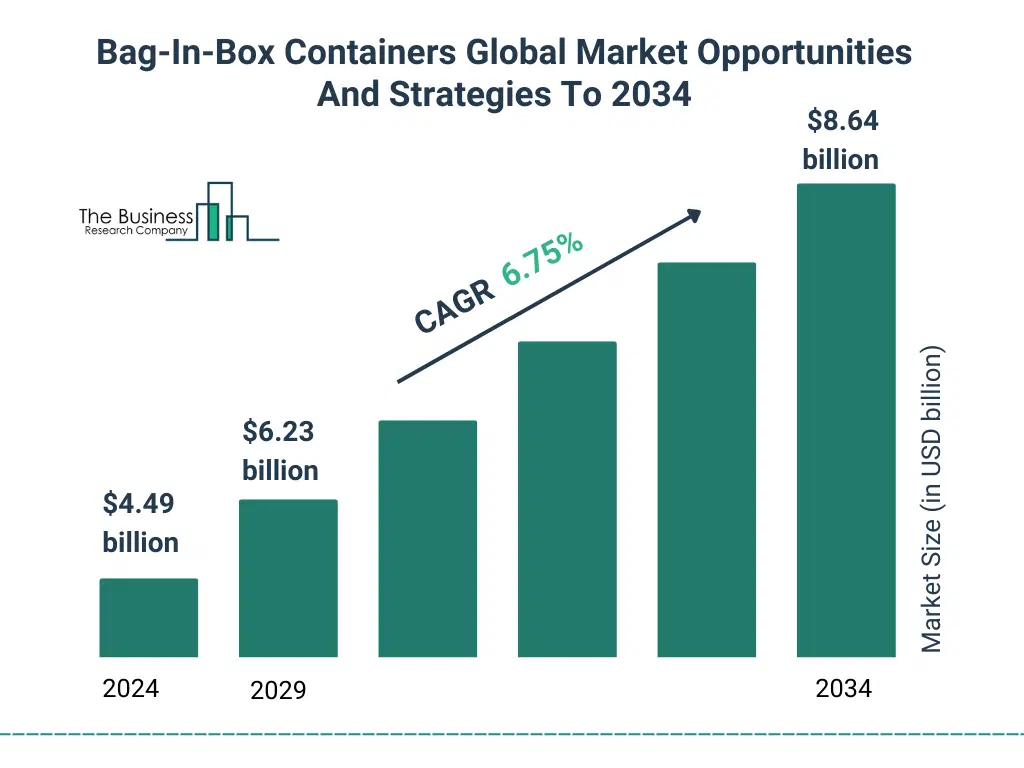
Bag-In-Box Containers Market Size
The global bag-in-box containers market reached a value of nearly $4,488.26 million in 2024, having grown at a compound annual growth rate (CAGR) of 5.52% since 2019. The market is expected to grow from $4,488.26 million in 2024 to $6,228.37 million in 2029 at a rate of 6.77%. The market is then expected to grow at a CAGR of 6.75% from 2029 and reach $8,635.30 million in 2034. Growth in the historic period resulted from growth in food and beverage consumption, increasing number of restaurants, foodservice and institutional buyers, rise in alcohol demand and increasing adoption in dairy and liquid food products. Factors that negatively affected growth in the historic period were risk of leakage and puncture in transport and concerns over recyclability and plastic waste. Going forward, growth of organized retail and e-commerce, surge in pharmaceutical and healthcare, growth of the packaging industry and rise of online food delivery and meal kit will drive growth. Factors that could hinder the growth of the bag-in-box containers market in the future include fluctuating raw material prices, impact of trade war and tariffs and high competition from alternative rigid packaging solution.Bag-In-Box Containers Market Drivers
The key drivers of the bag-in-box containers market include: Growth Of Organized Retail And E-Commerce The expansion of organized retail and e-commerce is anticipated to drive the growth of the bag-in-box (BIB) containers market. These sectors demand packaging solutions that are convenient, durable, and easy to transport—qualities that BIB containers offer. Organized retail chains benefit from the standardized and space-efficient design of BIB packaging, which is ideal for bulk storage and shelf display. Meanwhile, e-commerce platforms favor BIB containers for their lightweight, spill-resistant nature, which helps minimize shipping damage and product returns. Additionally, growing consumer preference for ready-to-use and portion-controlled packaging continues to support increased adoption of BIB containers across both retail and online channels. The growth of organized retail and e-commerce contribution during the forecast period in 2024 is 2.00%.Bag-In-Box Containers Market Restraints
The key restraints on the bag-in-box containers market include: Fluctuating Raw Material Prices Fluctuating raw material prices are anticipated to hinder the growth of the bag-in-box (BIB) containers market during the forecast period by driving up production costs and compressing profit margins for manufacturers. Price volatility in essential materials such as polyethylene, paperboard, and other polymers introduces uncertainty in cost forecasting and supply chain management. As a result, manufacturers may be forced to raise product prices, which could reduce affordability for end-users and dampen overall market demand. Growth affected by fluctuating raw material prices during the forecast period in 2024 is -2.48%.Bag-In-Box Containers Market Trends
Major trends shaping the bag-in-box containers market include: Eco-Friendly Recycle-Ready Bag-in-Box for Water Major companies in the bag-in-box containers market are developing recycle-ready Bag-in-Box for water to reduce environmental impact and meet growing consumer demand for sustainable packaging. These innovations focus on easy component separation, use of mono-materials, and compatibility with existing recycling streams. For instance, in July 2024, SIG, a Switzerland-based packaging company, launches a recycle-ready Bag-in-Box for water in Australia, named SIG Terra RecShield, featuring a new mono-polymer design that removes the need for aluminium in the bag structure. The packaging is fully recyclable and supports sustainable packaging initiatives. Its lightweight yet durable design ensures safe transport and handling. The bag maintains product freshness and prevents leaks or contamination. SIG manufactures this packaging locally at its Adelaide facility, providing a convenient and eco-friendly solution for bottled water brands. This innovation reflects a shift toward environmentally responsible packaging without compromising performance. Portable Wine Juice Boxes Revolutionize On-the-Go and Home Wine Experiences Companies operating in the bag-in-box containers market are deploying portable wine juice boxes to cater to on-the-go consumers and outdoor events. These compact, lightweight boxes offer convenience, easy pouring, and spill-free handling while maintaining the beverage’s freshness and quality. For instance, in April 2024, Alileo, a US-based company that produces natural, low-intervention boxed wines, launches its “Best Boxed Wine” lineup featuring portable Wine Juice Boxes in a compact 1.5L format, equivalent to two standard bottles. These boxed wines are crafted from indigenous Sicilian varietals, offering a natural and authentic wine experience. The packaging features Bag-in-Box technology, ensuring extended freshness, convenient pouring, and easy storage. Designed for on-the-go consumption and home use, these portable wine juice boxes combine sustainability, convenience, and quality, appealing to a broader consumer base seeking flexible liquid packaging solutions.Opportunities And Recommendations In The Bag-In-Box Containers Market
Opportunities – The top opportunities in the bag-in-box containers market segmented by material type will arise in the ethylene vinyl alcohol segment, which will gain $664.21 million of global annual sales by 2029. The top opportunities in the bag-in-box containers market segmented by capacity will arise in the less than 5 liters segment, which will gain $490.42 million of global annual sales by 2029. The top opportunities in the bag-in-box containers market segmented by application will arise in the food and beverages segment, which will gain $961.65 million of global annual sales by 2029. The top opportunities in the bag-in-box containers market segmented by product type will arise in the film segment, which will gain $950.32 million of global annual sales by 2029. The bag-in-box containers market size will gain the most in the USA at $302.18 million. Recommendations- To take advantage of the opportunities, The Business Research Company recommends the bag-in-box containers companies to focus on developing recyclable and sustainable packaging, focus on expanding portable and convenient packaging solutions, focus on developing durable and fully recyclable packaging for long-distance transport, focus on developing space-saving and efficient packaging, focus on ethylene vinyl alcohol segment for growth, focus on 5–10 liters segment for growth, focus on molded segment for growth, focus on expanding distribution channels for bag-in-box containers, focus on competitive and value-based pricing for bag-in-box containers, focus on integrated promotional campaigns for bag-in-box containers, focus on customer-centric educational promotion for bag-in-box containers, focus on other applications segment for growth.
Bag-In-Box Containers Market Segmentation
The bag-in-box containers market is segmented by material type, by capacity, by application, and by product type.By Material Type –
The bag-in-box containers market is segmented by material type into:
- a) Low Density Polyethylene
- b) Ethylene Vinyl Acetate
- a) Ethylene Vinyl Alcohol
- b) Other Material Types
By Capacity –
The bag-in-box containers market is segmented by capacity into:
- a) Less Than 5 Liters
- b) 5-10 Liters
- c) 10-15 Liters
- b) 15-20 Liters
- c) More Than 20 Liters
By Application –
The bag-in-box containers market is segmented by application into:
- a) Food And Beverages
- b) Industrial Liquids (Includes Chemicals)
- c) Household Products
- c) Other Applications
By Product Type –
The bag-in-box containers market is segmented by product type into:
- a) Film
- b) Molded
By Geography - The bag-in-box containers market is segmented by geography into:
- • China
- • India
- • Japan
- • Australia
- • Indonesia
- • South Korea
- • USA
- • Canada
- • Brazil
- • France
- • Germany
- • UK
- • Italy
- • Spain
- • Russia
-
o Asia Pacific
o Africa