

Bioprocess Automation Market Report 2026
Global Outlook – By Component Of Process Control System (Sensors, Actuators, Controllers), By Scale Of Operation (Preclinical Operations, Clinical Operations, Commercial Operations), By Mode Of Operation (Batch, Fed-Batch, Perfusion), By Compatibility With Bioprocessing Systems (Single-Use Systems, Stainless Steel, Other Bioprocessing Systems) – Market Size, Trends, Strategies, and Forecast to 2030
Bioprocess Automation Market Overview
• Bioprocess Automation market size has reached to $6.4 billion in 2025 • Expected to grow to $11.52 billion in 2030 at a compound annual growth rate (CAGR) of 12.4% • Growth Driver: The Role Of Personalized Medicine In Driving Bioprocess Automation Market Growth • Market Trend: Innovative Bioreactor Solutions Revolutionizing Bioprocessing Operations • North America was the largest region in 2025 and Asia-Pacific is the fastest growing region.Market Gains By 2030 – Top Opportunities By Segment
Market Gain identifies the most promising market opportunities by highlighting the segments or products expected to generate the highest incremental revenue growth over the next five years.
What Is Covered Under Bioprocess Automation Market?
Bioprocess automation is using automated systems to monitor and control the bioprocessing workflow, which involves living cells, organisms, or components to produce biological products such as biopharmaceuticals. Biopharmaceutical businesses use bioprocess automation for better process control and optimization, higher product quality, decreased variability, increased throughput and efficiency, cost savings, and scalability. The main components of bioprocess automation are sensors, actuators, and controllers. Sensors are devices that detect and respond to inputs from the physical environment, converting them into electronic signals, which are used to monitor various parameters such as temperature, pH, dissolved oxygen, and pressure. The scale of operation includes preclinical operations, clinical operations, and commercial operations with batch, fed-batch, and perfusion modes of compatibility with bioprocessing systems include single-use systems, stainless steel, and others.
What Is The Bioprocess Automation Market Size and Share 2026?
The bioprocess automation market size has grown rapidly in recent years. It will grow from $6.4 billion in 2025 to $7.21 billion in 2026 at a compound annual growth rate (CAGR) of 12.6%. The growth in the historic period can be attributed to growth of biopharmaceutical manufacturing, increasing complexity of biologics production, adoption of programmable control systems, demand for consistent product quality, expansion of clinical manufacturing operations.What Is The Bioprocess Automation Market Growth Forecast?
The bioprocess automation market size is expected to see rapid growth in the next few years. It will grow to $11.52 billion in 2030 at a compound annual growth rate (CAGR) of 12.4%. The growth in the forecast period can be attributed to increasing investments in continuous bioprocessing, rising demand for scalable automation platforms, growth of cell and gene therapy manufacturing, integration of AI-driven process optimization, expansion of smart biomanufacturing facilities. Major trends in the forecast period include increasing adoption of automated bioprocess control platforms, rising integration of real-time process analytics, growing use of single-use bioprocessing automation, expansion of closed-loop process control systems, enhanced focus on data integrity and compliance.

Global Bioprocess Automation Market Segmentation
1) By Component Of Process Control System: Sensors, Actuators, Controllers 2) By Scale Of Operation: Preclinical Operations, Clinical Operations, Commercial Operations 3) By Mode Of Operation: Batch, Fed-Batch, Perfusion 4) By Compatibility With Bioprocessing Systems: Single-Use Systems, Stainless Steel, Other Bioprocessing Systems Subsegments: 1) By Sensors: Temperature Sensors, Pressure Sensors, Flow Sensors, Level Sensors, PH Sensors, Other Sensors 2) By Actuators: Electric Actuators, Pneumatic Actuators, Hydraulic Actuators, Other Actuators 3) By Controllers: Programmable Logic Controllers (PLC), Distributed Control Systems (DCS), Supervisory Control And Data Acquisition (SCADA), Other Controllers The top segments in the bioprocess automation market will be: • Commercial Operations will reach $7386.13 Million by 2030. • Fed-Batch will reach $5518.71 Million by 2030. • Single-Use Systems will reach $6162.08 Million by 2030. • Controllers will reach $4280.87 Million by 2030. • Stainless Steel will reach $4056.3 Million by 2030.What Is The Driver Of The Bioprocess Automation Market?
The increasing number of personalized medicines is expected to drive the growth of the bioprocess automation market going forward. Personalized medicine is a medical approach that customizes healthcare decisions, practices, interventions, and treatments according to the unique characteristics of each patient. Bioprocess automation supports personalized medicine by enabling precise and scalable production of patient-specific therapies. For instance, in February 2024, according to the Personalised Medicine Coalition, a US-based healthcare organization, the FDA approved 16 new personalized treatments for rare disease patients in 2023, up from six approvals in 2022. Therefore, the rising number of personalized medicines is fueling the growth of the bioprocess automation industry.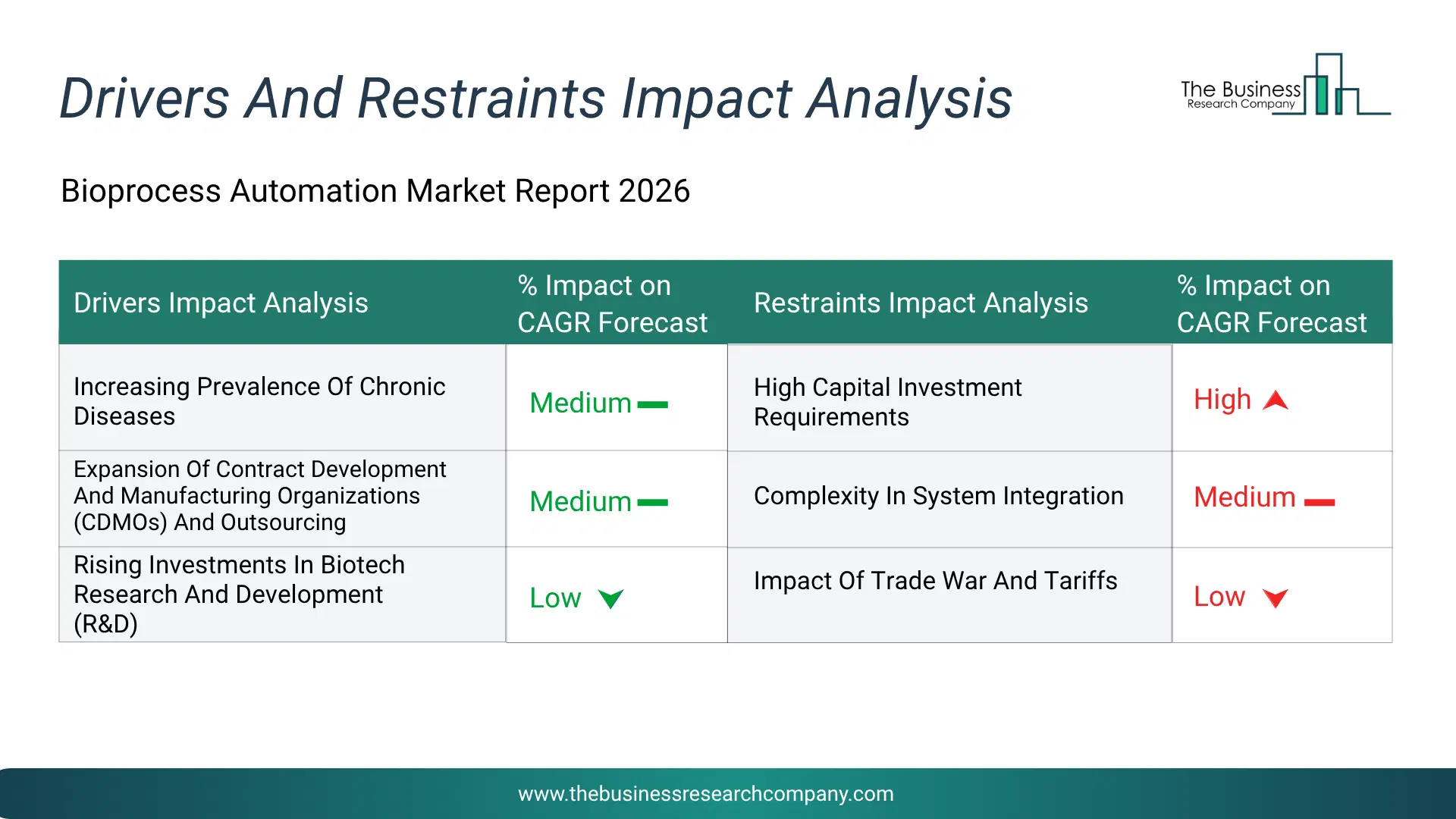
Infographic Chart Showing Key Market Drivers Analysis And Restraints For Bioprocess Automation Market
The chart presents an impact analysis of key drivers and restraints, quantifying their relative influence on the market's growth rate and helping assess the balance between growth enablers and limiting factors. This chart offers a high-level perspective; the full report contains more detailed insights.
How Will The Drivers Impact Growth In The Global Bioprocess Automation Market?
• Increasing Prevalence Of Chronic Diseases (Medium) – During the forecast period, increasing prevalence of chronic diseases is expected to be a key driver of the growth of the bioprocess automation market in the forecast period. the growing burden of chronic diseases such as diabetes, cardiovascular disorders, autoimmune conditions, and cancers is driving demand for biologic therapies, including insulin, monoclonal antibodies, recombinant proteins, and cell and gene therapies. these biologics are highly complex to manufacture and require precise control of living systems, which cannot be reliably achieved through manual processes alone. bioprocess automation ensures reproducibility, reduces variability, and maintains compliance with stringent regulatory standards, making it a critical enabler of scalable production. as more patients globally require advanced biologics to manage chronic conditions, automation will become indispensable for meeting both quality and volume requirements. the growth in increasing prevalence of chronic diseases growth contribution during the forecast period in 2025 is 1.3%. • Expansion Of Contract Development And Manufacturing Organizations (CDMOs) And Outsourcing (Medium) – During the forecast period, the increase in the expansion of contract development and manufacturing organizations (CDMOs) and outsourcing will propel the growth of the bioprocess automation market. The rising reliance on CDMOs for biopharmaceutical manufacturing is fueling adoption of automation technologies. CDMOs cater to multiple clients simultaneously, each requiring consistent, high-quality, and regulatory-compliant production. To manage diverse projects efficiently, CDMOs increasingly turn to bioprocess automation tools like robotic sample handling, automated chromatography, SCADA (supervisory control and data acquisition) or DCS (distributed control system) systems, and advanced analytics. These tools allow them to improve throughput, minimize error, shorten timelines, and enhance scalability. As outsourcing continues to grow, CDMOs’ investments in automation will be critical in maintaining competitiveness and meeting biopharma clients’ expectations for cost-effective and reliable production. The growth in increase in the expansion of contract development and manufacturing organizations (CDMOs) and outsourcing growth contribution during the forecast period in 2025 is 1.0%. • Rising Investments In Biotech Research And Development (R&D) (Low) – During the forecast period, rising investments in biotech research and development (r&d) is expected to be a key driver of the growth of the bioprocess automation market in the forecast period. as biotech r&d funding expands, more novel therapeutic modalities are entering the pipeline, including next-generation vaccines, cell therapies, gene therapies, and advanced protein therapeutics. these products demand new approaches to process development, optimization, and scale-up. automation plays a key role here by enabling high-throughput experimentation, process analytical technologies (pat), digital twins, and ai (artificial intelligence) and ml (machine learning)-driven optimization. by reducing time from discovery to clinical manufacturing and increasing the success rate of scale-up, automation helps translate r&d into commercially viable therapies faster. thus, higher r&d investment naturally accelerates demand for advanced bioprocess automation solutions to support innovation. the growth in rising investments in biotech research and development (r&d) growth contribution during the forecast period in 2025 is 0.5%. • Expansion Of Vaccine Production (Low) – During the forecast period, the expansion of vaccine production will propel the growth of the bioprocess automation market. Vaccine production will continue to expand as new vaccine platforms, such as mRNA, recombinant protein, and viral vector technologies, move beyond COVID-19 applications into areas like influenza, RSV (respiratory syncytial virus), cancer immunotherapy, and emerging infectious diseases. This growth will create sustained demand for highly scalable and flexible manufacturing systems. Bioprocess automation will play a central role by enabling faster changeovers between vaccine types, reducing the risk of contamination, and ensuring consistent quality at high volumes. Automated bioreactors, filtration and chromatography systems, and robotic fill-finish operations will allow manufacturers to rapidly adjust to fluctuating global health needs. Moreover, automation platforms integrated with process analytical technology (PAT) and data-driven control systems will support regulatory compliance while improving efficiency and throughput. The growth in expansion of vaccine production growth contribution during the forecast period in 2025 is 0.3%.How Will The Restraints Impact Growth In The Global Bioprocess Automation Market?
• High Capital Investment Requirements (Medium) – During the forecast period, high capital investment requirements are restricting the growth of the bioprocess automation market during the forecast period. bioprocess automation systems involve significant upfront costs for equipment, software, integration, and validation. many biopharmaceutical manufacturers, especially smaller firms or those in emerging markets, may struggle to allocate such resources. this financial barrier can slow adoption and limit broader market penetration, particularly when balancing investment against uncertain product pipelines. in addition, long return-on-investment timelines can make stakeholders hesitant to commit funds. this creates a gap where larger global players adopt faster while smaller players lag behind. growth affected by high capital investment requirements during the forecast period in 2025 is -2.0%. • Complexity In System Integration (Medium) – During the forecast period, complexity in system integration is restricting the growth of the bioprocess automation market during the forecast period. integrating diverse automation technologies, such as robotics, sensors, mes, scada, and ai-driven analytics, into existing manufacturing environments can be technically challenging. legacy infrastructure often lacks compatibility with advanced systems, creating obstacles in achieving seamless data flow and coordinated process control. this integration complexity can delay implementation and discourage companies from fully committing to automation upgrades. it also requires specialized expertise, adding further costs and risks of project delays. as a result, some organizations prefer incremental upgrades rather than adopting end-to-end automation. growth affected by complexity in system integration during the forecast period in 2025 is -1.0%. • Impact Of Trade War And Tariffs (Low) – During the forecast period, trade wars and tariffs are restricting the growth of the bioprocess automation market during the forecast period. geopolitical tensions and trade disputes increase risks of tariffs, supply chain disruptions, and restrictions on critical components required for bioprocess automation systems. these factors can raise costs, delay delivery timelines, and complicate global collaboration. trade uncertainties also discourage long-term strategic planning and cross-border investments. furthermore, reliance on specific suppliers or regions can create vulnerabilities that slow automation adoption globally. growth affected by trade wars and tariffs during the forecast period in 2025 is -0.3%.Key Players In The Global Bioprocess Automation Market
Major companies operating in the bioprocess automation market are Thermo Fisher Scientific Inc., Danaher Corporation, Merck KGaA, Parker-Hannifin Corporation, Rockwell Automation Inc., Agilent Technologies Inc., Lonza Group AG, Waters Corporation, Getinge AB, Eppendorf SE, Repligen Corporation, BIONET Engineering, Pierre Guerin Technologies, Bioengineering AG, Genedata AG, ILS Automation LLC, INFORS HT AG, Synthace Ltd., Automated Control Concepts Inc., BlueSens gas sensor GmbH, Securecell AG, Flownamics Analytical Instruments Inc., PendoTECH LLC, Sartorius Stedim Biotech S.A.
This chart is for illustrative purposes; the full report includes a detailed competitor analysis and comprehensive overview of the top 10 companies in the market.

This chart maps companies by product innovation and brand strength, with bubble size indicating relative revenue, helping identify market leaders, challengers, and niche players. This is an illustrative chart; the full report provides a complete and accurate competitive analysis.
Global Bioprocess Automation Market Trends and Insights
Major companies operating in the bioprocess automation market are developing innovative solutions, such as bioreactors to simplify bioprocessing operations. A bioreactor is an engineered system or device that provides an optimal and controlled environment for biological and chemical reactions. For instance, in April 2023, Cytiva, a US-based technology company that provides technologies and services that help advance and accelerate the development and manufacture of therapeutics, launched X-platform bioreactors to simplify single-use upstream bioprocessing operations. It is easy to operate, flexible, and more efficient in the process. It was first offered in 50 and 200 L capacities. They can increase process efficiency through ergonomic improvements, production capability, and simplified supply chain operations. The X-platform bioreactors can be used to manufacture cell and gene therapies as well as viral vectors, in addition to monoclonal antibodies (mAbs).What Are Latest Mergers And Acquisitions In The Bioprocess Automation Market?
In September 2025, Thermo Fisher Scientific, a US-based life sciences and biopharma supplies leader, acquired the purification and filtration business of Solventum for an undisclosed amount. Through this acquisition, Thermo Fisher aims to strengthen its bioprocess automation offerings by expanding its downstream processing capabilities, enabling more comprehensive solutions for biologics, cell therapies, and drug manufacturing. Solventum’s purification & filtration business is a US-based international entity that provides critical filtration technologies across multiple geographies.
Regional Outlook
North America was the largest region in the bioprocess automation market in 2025. Asia-Pacific is expected to be the fastest-growing region in the forecast period. The regions covered in this market report are Asia-Pacific, South East Asia, Western Europe, Eastern Europe, North America, South America, Middle East, Africa The countries covered in this market report are Australia, Brazil, China, France, Germany, India, Indonesia, Japan, Taiwan, Russia, South Korea, UK, USA, Canada, Italy, Spain.What Defines the Bioprocess Automation Market?
The bioprocess automation market includes revenues earned by entities by providing services such as process automation, instrumentation and control systems, training and support services, and maintenance and upgrades. The market value includes the value of related goods sold by the service provider or included within the service offering. The bioprocess automation market also includes sales of bioreactors, fermenters, laboratory information management systems (LIMS), and integrated bioprocess platforms. Values in this market are ‘factory gate’ values, that is, the value of goods sold by the manufacturers or creators of the goods, whether to other entities (including downstream manufacturers, wholesalers, distributors, and retailers) or directly to end customers. The value of goods in this market includes related services sold by the creators of the goods.How is Market Value Defined and Measured?
The market value is defined as the revenues that enterprises gain from the sale of goods and/or services within the specified market and geography through sales, grants, or donations in terms of the currency (in USD unless otherwise specified). The revenues for a specified geography are consumption values that are revenues generated by organizations in the specified geography within the market, irrespective of where they are produced. It does not include revenues from resales along the supply chain, either further along the supply chain or as part of other products.
This chart presents market attractiveness based on a quantitative evaluation of growth, competition, strategic alignment, and risk, offering a clear view of opportunity areas for decision-making. This chart is for illustrative purposes; the full report contains the complete analysis.

This chart highlights the Total Addressable Market (TAM) by estimating the maximum revenue opportunity using an assumption-driven approach, supporting strategic planning and opportunity sizing across markets. The chart is illustrative; the full report provides a more comprehensive analysis.
What Key Data and Analysis Are Included in the Bioprocess Automation Market Report 2026?
The bioprocess automation market research report is one of a series of new reports from The Business Research Company that provides market statistics, including industry global market size, regional shares, competitors with the market share, detailed market segments, market trends and opportunities, and any further data you may need to thrive in the bioprocess automation industry. The market research report delivers a complete perspective of everything you need, with an in-depth analysis of the current and future state of the industry.Bioprocess Automation Market Report Forecast Analysis
| Report Attribute | Details |
|---|---|
| Market Size Value In 2026 | $7.21 billion |
| Revenue Forecast In 2030 | $11.52 billion |
| Growth Rate | CAGR of 12.6% from 2026 to 2030 |
| Base Year For Estimation | 2025 |
| Actual Estimates/Historical Data | 2020-2025 |
| Forecast Period | 2026 - 2030 - 2035 |
| Market Representation | Revenue in USD Billion and CAGR from 2026 to 2030 |
| Segments Covered | Component Of Process Control System, Scale Of Operation, Mode Of Operation, Compatibility With Bioprocessing Systems |
| Regional Scope | Asia-Pacific, Western Europe, Eastern Europe, North America, South America, Middle East, Africa |
| Country Scope | The countries covered in the report are Australia, Brazil, China, France, Germany, India, Indonesia, Japan, Taiwan, Russia, South Korea, UK, USA, Canada, Italy, Spain. |
| Key Companies Profiled | Thermo Fisher Scientific Inc., Danaher Corporation, Merck KGaA, Parker-Hannifin Corporation, Rockwell Automation Inc., Agilent Technologies Inc., Lonza Group AG, Waters Corporation, Getinge AB, Eppendorf SE, Repligen Corporation, BIONET Engineering, Pierre Guerin Technologies, Bioengineering AG, Genedata AG, ILS Automation LLC, INFORS HT AG, Synthace Ltd., Automated Control Concepts Inc., BlueSens gas sensor GmbH, Securecell AG, Flownamics Analytical Instruments Inc., PendoTECH LLC, Sartorius Stedim Biotech S.A. |
| Customization Scope | Request for Customization |
| Pricing And Purchase Options | Explore Purchase Options |