
Bioprocess Automation Market 2026
By Component Of Process Control System (Sensors, Actuators, Controllers), By Scale Of Operation (Preclinical Operations, Clinical Operations, Commercial Operations), By Mode Of Operation (Batch, Fed-Batch, Perfusion), By Compatibility With Bioprocessing Systems (Single-Use Systems, Stainless Steel, Other Bioprocessing Systems), And By Region, Opportunities And Strategies – Global Forecast To 2035
Bioprocess Automation Market Definition
Bioprocess automation refers to the use of advanced control systems, sensors, robotics and software to monitor, manage and optimize biological manufacturing processes. These processes include cell culture, fermentation, purification and formulation in the production of biopharmaceuticals, vaccines and other biotechnology products. The primary purpose of bioprocess automation is to enhance process efficiency, consistency and product quality while reducing human error and operational costs. The bioprocess automation market consists of sales, by entities (organizations, sole traders, or partnerships), of bioprocess automation that is used whenever there is a need to control critical process parameters such as pH, temperature, dissolved oxygen and nutrient levels. It is commonly applied in cleanroom and Good Manufacturing Practices (GMP)-compliant manufacturing environments. The main complementary products to bioprocess automation include process analytical technologies (PAT), digital twin models and manufacturing execution systems (MES), while substitute products may include manual or semi-automated control systems.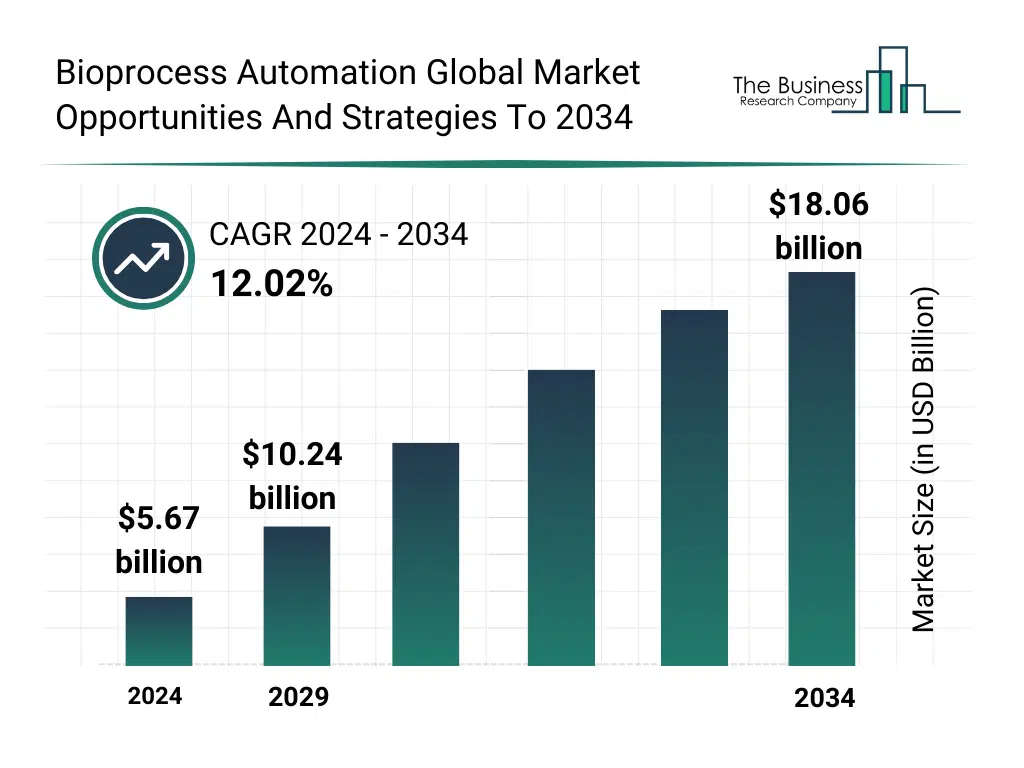
Bioprocess Automation Market Size
The global bioprocess automation market reached a value of nearly $5,672.39 million in 2024, having grown at a compound annual growth rate (CAGR) of 13.37% since 2019. The market is expected to grow from $5,672.39 million in 2024 to $10,237.74 million in 2029 at a rate of 12.53%. The market is then expected to grow at a CAGR of 12.02% from 2029 and reach $18,059.34 million in 2034. Growth in the historic period resulted from the growing demand for personalized medicine, rising global demand for biologics, growth of cell and gene therapies and shortage of skilled workforce. Factors that negatively affected growth in the historic period were data security and cybersecurity concerns and limited standardization across platforms. Going forward, the increasing prevalence of chronic diseases, expansion of contract development and manufacturing organizations (CDMOs) and outsourcing, rising investments in biotech research and development (R&D) and expansion of vaccine production will drive the growth. Factors that could hinder the growth of the bioprocess automation market in the future include high capital investment requirements, complexity in system integration and impact of trade war and tariff.Bioprocess Automation Market Drivers
The key drivers of the bioprocess automation market include: Increasing Prevalence Of Chronic Diseases Increasing prevalence of chronic diseases is expected to be a key driver of the growth of the bioprocess automation market in the forecast period. The growing burden of chronic diseases such as diabetes, cardiovascular disorders, autoimmune conditions and cancers is driving demand for biologic therapies, including insulin, monoclonal antibodies, recombinant proteins and cell and gene therapies. These biologics are highly complex to manufacture and require precise control of living systems, which cannot be reliably achieved through manual processes alone. Bioprocess automation ensures reproducibility, reduces variability and maintains compliance with stringent regulatory standards, making it a critical enabler of scalable production. As more patients globally require advanced biologics to manage chronic conditions, automation will become indispensable for meeting both quality and volume requirements. The increasing prevalence of chronic diseases contribution during the forecast period in 2024 is 1.00%.Bioprocess Automation Market Restraints
The key restraints on the bioprocess automation market include: High Capital Investment Requirements High capital investment requirements are restricting the growth of the bioprocess automation market during the forecast period. Bioprocess automation systems involve significant upfront costs for equipment, software, integration and validation. Many biopharmaceutical manufacturers, especially smaller firms or those in emerging markets, may struggle to allocate such resources. This financial barrier can slow adoption and limit broader market penetration, particularly when balancing investment against uncertain product pipelines. In addition, long return-on-investment timelines can make stakeholders hesitant to commit funds. This creates a gap where larger global players adopt faster while smaller players lag behind. Growth affected by high capital investment requirements during the forecast period in 2024 is -2.07%.Bioprocess Automation Market Trends
Major trends shaping the bioprocess automation market include: Increasing Integration Of Artificial Intelligence And Machine Learning In Bioprocess Control Companies operating in the bioprocess automation market are focusing on integrating artificial intelligence (AI) and machine learning (ML) into bioprocess control systems to enable predictive modelling, real-time decision-making and adaptive feedback control of upstream and downstream operations. These innovations are designed to improve yield consistency, reduce batch failures, minimize manual interventions and accelerate time-to-market while maintaining regulatory compliance and product quality. For instance, in July 2025, CPI (The Centre for Process Innovation), a UK-based technology and innovation center, joined the Canada-UK collaboration BALANCE (Bioreactor Automation for Learning and Adaptive Networked Control of Experiments), which combines real-time sensing via Nicoya, automation via Labman, AI (artificial intelligence) and digital twins via Basetwo and bioreactor technologies via CPI to deliver a demonstrator platform for AI-optimized bioreactor control for biologics manufacturing. Nicoya is a Canadian company specializing in biosensors, notably the Alto SPR biosensor. Labman Automation is a UK-based developer of automation and robotics; and Basetwo is a Canadian technology company focused on artificial intelligence and digital twin platforms. AI-Driven Multi-Channel Biosensing Transforming Real-Time Bioprocess Monitoring and Optimization Major companies operating in the advanced bioprocessing systems market are increasingly leveraging AI-driven technologies and multi-channel biosensing platforms to improve production efficiency, accuracy and consistency in cell culture and fermentation processes. For instance, in February 2025, The Cultivated B, a Germany-based an innovative biotechnology and bioengineering company, launched advanced AI-driven multi-channel biosensors that revolutionize bioreactor monitoring by integrating real-time data analytics and machine learning into the core of bioprocessing workflows. This new technology offers continuous, high-resolution monitoring of cell culture and fermentation processes, delivering actionable insights to bioprocess engineers and operators for improved accuracy, efficiency and product quality. The biosensors track a wide array of chemicals and metabolites including glucose, amino acids and lactic acid at concentrations below picomolar levels, allowing precise analysis even under demanding conditions. Sensor data is continuously analyzed by AI algorithms, providing real-time recommendations and optimizing key parameters such as media formulation, process control strategies and resource consumption.Opportunities And Recommendations In The bioprocess automation Market
Opportunities – The top opportunities in the bioprocess automation markets segmented by component of process control system will arise in the sensors segment, which will gain $1,792.47 million of global annual sales by 2029. The top opportunities in the bioprocess automation markets segmented by scale of operation will arise in the commercial operations segment, which will gain $2,882.03 million of global annual sales by 2029. The top opportunities in the bioprocess automation markets segmented by mode of operation will arise in the fed-batch segment, which will gain $2,299.75 million of global annual sales by 2029. The top opportunities in the bioprocess automation markets segmented by compatibility with bioprocessing systems will arise in the single-use systems segment, which will gain $2,806.03 million of global annual sales by 2029. The bioprocess automation market size will gain the most in the USA at $1,709.64 million. Recommendations- To take advantage of the opportunities, The Business Research Company recommends the bioprocess automation companies to focus on ai and machine learning integration to enhance bioprocess performance, focus on ai-enabled multi-channel biosensing to strengthen real-time process control, focus on intelligent cell processing systems to improve quality and safety, focus on advanced bioprocess development systems to accelerate scale-up and optimize control, focus on distributed control systems to manage complex bioprocess operations, focus on high-growth sensors to strengthen competitive position, expand in emerging markets, continue to focus on developed markets, provide competitively priced offerings, continue to use b2b promotions, participate in trade shows and events, focus on single-use systems to capture highest growth and flexibility demand.
Bioprocess Automation Market Segmentation
The bioprocess automation market is segmented by component of process control system, by scale of operation, by mode of operation and by compatibility with bioprocessing systems.By Component Of Process Control System –
The bioprocess automation market is segmented by component of process control system into:
- a) Sensors
- b) Actuators
- c) Controllers
By Scale Of Operation –
The bioprocess automation market is segmented by scale of operation into:
- a) Preclinical Operations
- b) Clinical Operations
- b) Commercial Operations
By Mode Of Operation –
The bioprocess automation market is segmented by mode of operation into:
- a) Batch
- b) Fed-Batch
- c) Perfusion
By Compatibility With Bioprocessing Systems –
The bioprocess automation market is segmented by compatibility with bioprocessing systems into:
- a) Single-Use Systems
- b) Stainless Steel
- b) Other Bioprocessing Systems
- • China
- • India
- • Japan
- • Australia
- • Indonesia
- • South Korea
- • USA
- • Canada
- • Brazil
- • France
- • Germany
- • UK
- • Italy
- • Spain
- • Russia
- Thermo Fisher Scientific Inc
- Danaher Corporation (Cytia)
- Sartorius AG
- Lonza Group AG
- Merck KGaA (MilliporeSigma)
- F. Hoffmann-La Roche Ltd.
- Siemens AG
- Rockwell Automation Inc.
- Emerson Electric Co.
- Waters Corporation
- WuXi Biologics
- Sino-Biocan (Shanghai) Biotech Ltd.
- Körber AG
- Bailun Biotechnology Co., Ltd.
- Shanghai Baoxing Bio-Engineering Equipment (BXBIO)
- MIKEBIO (Jiangsu Mike Biotechnology)
- Jichen Bio
- Nanjing BioWill Biological Engineering
- TIANGEN Biotech (TEasy Lab Automation)
- Marubishi Bioengineering Co. Ltd.
- BIOTEC Co., Ltd.
- Yokogawa Electric Corporation
- ABB Robotics
- Ajinomoto Co. Inc.
- Micro Digital Co.
- BioSystemENG Co. Ltd.
- Biostream Co. Ltd.
- Syntegon
- Solaris Biotech
- BIONET
- Parker-Hannifin Corporation
- Eppendorf AG
- Infors AG
- DISTek Integration
- SyVento Biotech
- Adapta Robotics
- Curi Bio, Inc.
- Repligen Corporation
- Flotek Industries Inc.
- Automated Control Concepts Inc.
- Flownamics Analytical Instruments Inc.
- Beckman Coulter Life Sciences
- Molecular Devices
- Nirrin Technologies
- New Wave Biotech
- Bio-Rad Laboratories, Inc.
- PerkinElmer
- Pall Corporation
- Bruker Corporation
- ATS Life Sciences
- Everest Automation
- Amgen
- Pharmaconex
- Anasia Process Automation
- INTECH Process Automation Nigeria LTD
By Geography - The bioprocess automation market is segmented by geography into:
-
o Asia Pacific
o Africa