

Building-To-Grid Technology Market 2026
By Technology (Smart Sensing, Smart Metering, Control Technology, Energy Storage, Other Technologies), By Component (Hardware, Software), By End-Use (Commercial, Residential, Industrial), And By Region, Opportunities And Strategies – Global Forecast To 2035
Building-To-Grid Technology Market Definition
Building-to-Grid (BtG) technology refers to an advanced energy management approach that enables buildings to interact dynamically with the electrical grid. It utilizes smart controls, sensors, and energy storage systems to adjust power consumption, generation, and storage in response to grid signals, helping to balance energy supply and demand in real-time. The primary purpose of BtG technology is to enhance grid stability, energy efficiency, and sustainability. It allows buildings to act as active participants in the energy ecosystem, reducing peak load, integrating renewable energy sources, and supporting decarbonization and resilience goals in modern power systems. The building-to-grid technology market consists of sales, by entities (organizations, sole traders, or partnerships), of advanced systems that enable buildings to interact dynamically with the electrical grid through two-way energy and information exchange. These technologies empower buildings not only to consume electricity but also to produce, store, and supply excess energy back to the grid, supporting grid stability and enhancing energy efficiency.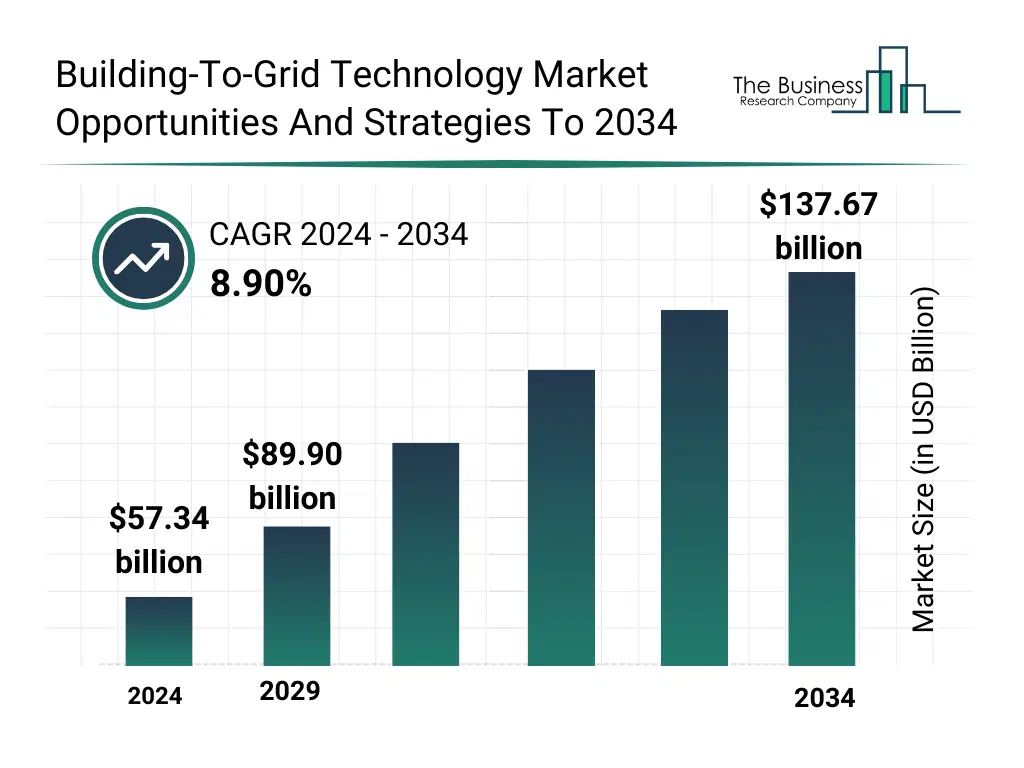
Building-To-Grid Technology Market Size
The global building-to-grid technology market reached a value of nearly $57,339.92 million in 2024, having grown at a compound annual growth rate (CAGR) of 6.54% since 2019. The market is expected to grow from $57,339.92 million in 2024 to $89,899.20 million in 2029 at a rate of 9.41%. The market is then expected to grow at a CAGR of 8.90% from 2029 and reach $137,667.01 million in 2034. Growth in the historic period resulted from rise in smart cities projects, increasing electricity demand, favorable government investments and increasing focus on grid modernization. Factors that negatively affected growth in the historic period were data privacy and security concerns and limited awareness and technical expertise. Going forward, increasing adoption of electric vehicles (EVs), rising renewable energy integration, rising deployment of smart grids and smart meters and increasing carbon emission reduction will drive the growth. Factors that could hinder the growth of the building-to-grid technology market in the future include high initial implementation and integration costs, complexity of system integration and maintenance and impact of trade war and tariff.Building-To-Grid Technology Market Drivers
The key drivers of the building-to-grid technology market include: Increasing Adoption Of Electric Vehicles (EVS) The growing adoption of electric vehicles (EVs) is expected to play a major role in driving the expansion of the building-to-grid (B2G) technology market in the coming years. As EV usage increases worldwide, there is a corresponding rise in the demand for charging infrastructure across residential, commercial, and industrial buildings. B2G systems allow these buildings to interact intelligently with the power grid by managing EV charging loads, optimizing overall energy use, and enabling vehicle-to-grid (V2G) functionality—where energy stored in EV batteries can be returned to the grid during times of high demand. This bidirectional energy exchange enhances grid stability and increases energy flexibility. Furthermore, as buildings transition into active participants in the energy ecosystem, EV integration supports the shift toward a decentralized power grid, enabling real-time balancing and reducing dependence on traditional fossil fuel generation. The integration of EVs and B2G technologies transforms buildings into dynamic energy hubs that contribute to a more resilient and sustainable grid. The increasing adoption of electric vehicles (EVS) growth contribution during the forecast period in 2024 is 2.00%.Building-To-Grid Technology Market Restraints
The key restraints on the building-to-grid technology market include: High Initial Implementation And Integration Costs High initial implementation and integration costs are limiting the growth of the building-to-grid (B2G) technology market during the forecast period. Establishing a functional B2G ecosystem involves significant upfront investment in hardware—such as smart meters, sensors, control systems, and energy storage—as well as in software platforms for energy management and grid communication. These costs can be particularly prohibitive for small and medium-sized enterprises or residential users, where the return on investment may be delayed or uncertain. Additionally, integrating B2G technologies into existing buildings often requires retrofitting outdated infrastructure, which adds to installation complexity and expense. The reliance on skilled professionals for installation, commissioning, and maintenance further increases the overall cost, making adoption more difficult—especially in developing regions with constrained budgets for advanced energy infrastructure. These financial and technical barriers continue to hinder the widespread deployment of B2G systems. Growth affected by high initial implementation and integration costs during the forecast period in 2024 is -2.00%.Building-To-Grid Technology Market Trends
Major trends shaping the building-to-grid technology market include: Emerging Power Infrastructure Innovations For AI Data Centers Major companies in the market are driving power infrastructure innovations such as high-voltage DC systems and intelligent energy management to enhance efficiency and resilience in AI data centers. These advancements support the growth of the building-to-grid (B2G) technology market by enabling energy-intensive buildings to interact more dynamically with the grid. Improved energy efficiency, seamless integration of on-site renewables, and enhanced demand response capabilities position buildings as active grid participants. As adoption rises, these technologies lay the groundwork for scalable, flexible, and smarter energy ecosystems. For example, in October 2025, Eaton, an Ireland-based intelligent power management company, announced the delivery of a new reference architecture designed to accelerate the adoption of 800 VDC power in artificial intelligence (AI) data centers. Eaton’s new design, built in support of the 800 VDC architecture announced by NVIDIA (US-based technology company), leverages Eaton’s innovative power management technology to protect and optimize high-density computing infrastructure and serves as a critical milestone in Eaton’s grid-to-chip strategy for meeting the increasing energy demands of AI data centers. Expansion Of Grid-Interactive Efficient Buildings (GEBs) Companies operating in building-to-grid technology are seeing growing emphasis on Grid-Interactive Efficient Buildings (GEBs), which combine energy efficiency, demand flexibility, smart controls, and DER (distributed energy resources) integration so buildings can respond dynamically to grid conditions, reduce peak loads, and improve overall system resilience. For example, in November 2024, Edo Energy, a US-based company that serves as the base for its grid-interactive community initiatives, together with Avista Utilities and Urbanova launched the Spokane Connected Communities Project, funded by the US Department of Energy. This project will optimize up to 75 residential and commercial buildings using energy-efficiency technologies and distributed energy resources (DERs) to expand the network of grid-interactive efficient building communities nationwide. Avista Utilities is a US-based company that operates hydroelectric, thermal, and wind generation facilities, etc. Urbanova is a US-based nonprofit civic research hub.Opportunities And Recommendations In The Building-To-Grid Technology Market
Opportunities – The top opportunities in the building-to-grid technology market segmented by technology will arise in the energy storage segment, which will gain $11,759.86 million of global annual sales by 2029. The top opportunities in the building-to-grid technology market segmented by component will arise in the hardware segment, which will gain $18,166.24 million of global annual sales by 2029. The top opportunities in the building-to-grid technology market segmented by end use will arise in the commercial segment, which will gain $13,900.10 million of global annual sales by 2029. The building-to-grid technology market size will gain the most in the USA at $6,726.00 million. Recommendations- To take advantage of the opportunities, The Business Research Company recommends the building-to-grid technology companies to focus on advancing power infrastructure and grid integration, focus on expanding grid-interactive efficient buildings (gebs), focus on ai-driven energy optimization platforms, focus on control technology for market growth, focus on software solutions for growth, focus on expanding distribution channels, focus on value-driven and flexible pricing models, focus on policy-aligned value communication, focus on targeted engagement through institutional channels, focus on industrial segment for growth.
Building-To-Grid Technology Market Segmentation
The building-to-grid technology market is segmented by technology, by component, and by end-use.By Technology –
The building-to-grid technology market is segmented by technology into:
- a) Smart Sensing
- b) Smart Metering
- c) Control Technology
- d) Energy Storage
- e) Other Technologies
By Component –
The building-to-grid technology market is segmented by component into:
- a) Hardware
- b) Software
By End-User –
The building-to-grid technology market is segmented by end-user into:
- a) Commercial
- b) Residential
- c) Industrial
By Geography - The building-to-grid technology market is segmented by geography into:
- • China
- • India
- • Japan
- • Australia
- • Indonesia
- • South Korea
- • Bangladesh
- • Thailand
- • Vietnam
- • Malaysia
- • Singapore
- • Phillipines
- • Hong kong
- • New Zealand
- • USA
- • Canada
- • Mexico
- • Brazil
- • Argentina
- • Chile
- • Colombiia
- • Peru
- • France
- • Germany
- • UK
- • Italy
- • Spain
- • Austria
- • Belgium
- • Denmark
- • Finland
- • Ireland
- • Netherland
- • Norway
- • Portugal
- • Sweden
- • Switzerland
- • Russia
- • Czech Republic
- • Poland
- • Romania
- • Ukraine
- • Saudi Arabia
- • Israel
- • Iran
- • Turkey
- • UAE o Africa
- • Egypt
- • Nigeria
- • South Africa
-
o Asia Pacific