

Commercial Space Station Market Report 2026
Global Outlook – By Component (Structure, Life Support Systems, Power Systems, Communication Systems, Propulsion Systems, Other Components), By Orbit (Low Earth Orbit, Medium Earth Orbit, Other Orbits), By Application (Research And Development, Space Tourism, Manufacturing, Earth Observation, Other Applications), By End-User (Government, Commercial, Defense, Other End-Users) – Market Size, Trends, Strategies, and Forecast to 2035
Commercial Space Station Market Overview
• Commercial Space Station market size has reached to $5.95 billion in 2025 • Expected to grow to $12.93 billion in 2030 at a compound annual growth rate (CAGR) of 16.7% • Growth Driver: Rising Investments In Space Exploration Fueling The Growth Of The Market Due To Enhancing Satellite Capabilities And Real-Time Data Collection • Market Trend: Advancing Commercial Space Stations With State-Of-The-Art Research Facilities, Modular Design, And Enhanced On-Orbit Capabilities • North America was the largest region in 2025 and Asia-Pacific is the fastest growing region.
What Is Covered Under Commercial Space Station Market?
A commercial space station is a privately developed orbital facility designed to support research, manufacturing, tourism, and other commercial activities in microgravity environments. It provides infrastructure for long-term human habitation, scientific experiments, and technology demonstrations beyond Earth’s atmosphere. These stations leverage advanced life-support systems, modular habitats, and space-grade materials to enable sustainable operations and continuous innovation in space-based applications. The main components of commercial space stations include structure, life support systems, power systems, communication systems, propulsion systems, and others. Structure refers to the physical framework that provides shape, strength, and integrity to a commercial space station while supporting onboard systems and modules. The various orbits, including low earth orbit, medium earth orbit, and others. The applications include research and development, space tourism, manufacturing, earth observation, and others, catering to key end users such as government agencies, commercial organizations, defense entities, and others.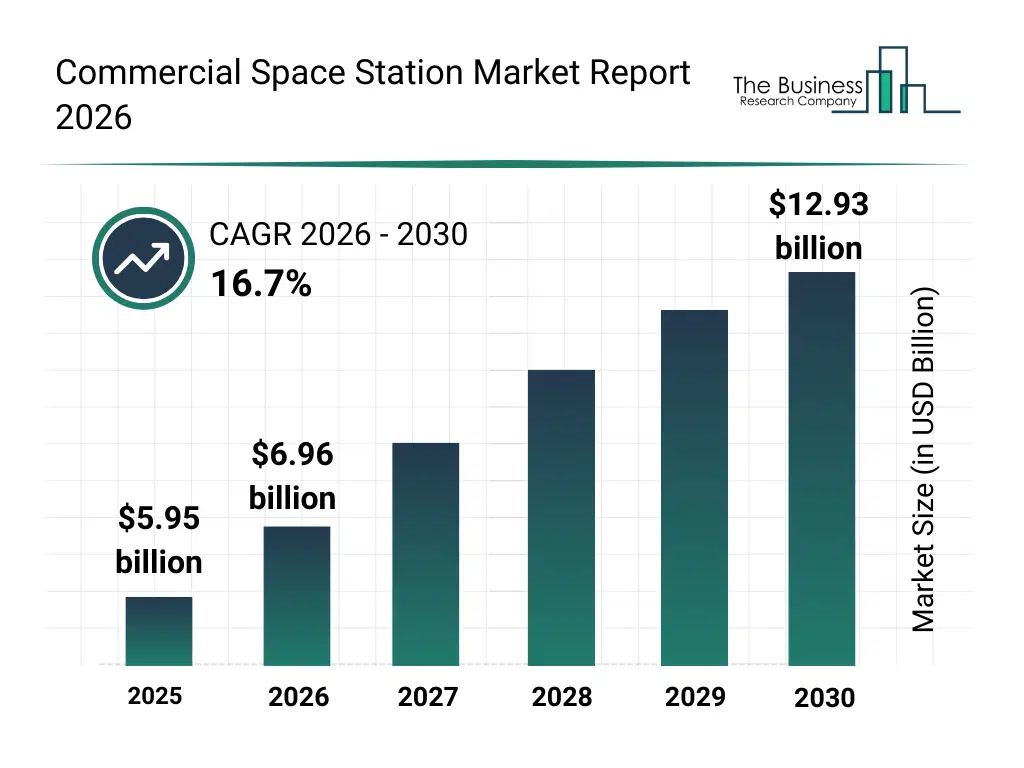
What Is The Commercial Space Station Market Size and Share 2026?
The commercial space station market size has grown rapidly in recent years. It will grow from $5.95 billion in 2025 to $6.96 billion in 2026 at a compound annual growth rate (CAGR) of 17.1%. The growth in the historic period can be attributed to increasing government support for orbital infrastructure programs, growing demand for microgravity research activities, rising private sector participation in space initiatives, expansion of international collaborations for space exploration, and increasing reliance on space-based logistics and payload hosting.What Is The Commercial Space Station Market Growth Forecast?
The commercial space station market size is expected to see rapid growth in the next few years. It will grow to $12.93 billion in 2030 at a compound annual growth rate (CAGR) of 16.7%. The growth in the forecast period can be attributed to growing demand for space tourism experiences, increasing investment in commercial low earth orbit habitats, rising need for in-space manufacturing capabilities, expansion of public-private partnerships for orbital stations, and increasing requirement for orbital servicing and refueling nodes. Major trends in the forecast period include technology advancements in modular orbital station design, innovations in autonomous and robotic maintenance systems, developments in in-space manufacturing processes, research and developments in advanced life support technologies, and advancements in commercial crew and cargo transport systems.Global Commercial Space Station Market Segmentation
1) By Component: Structure, Life Support Systems, Power Systems, Communication Systems, Propulsion Systems, Other Components 2) By Orbit: Low Earth Orbit, Medium Earth Orbit, Other Orbits 3) By Application: Research And Development, Space Tourism, Manufacturing, Earth Observation, Other Applications 4) By End-User: Government, Commercial, Defense, Other End-Users Subsegments: 1) By Structure: Primary Load-Bearing Trusses, Pressurized Habitat Modules, Unpressurized Logistics Carriers, Docking Ports and Adapters, External Experiment Platforms, Robotic Arm Attachment Points, Meteoroid and Debris Shielding 2) By Life Support Systems: Atmospheric Control and Revitalization, Water Recovery and Management, Waste Management and Sanitation, Fire Detection and Suppression, Temperature and Humidity Control, Air Composition Monitoring 3) By Power Systems: Solar Photovoltaic Arrays, Battery Energy Storage, Power Management and Distribution Units, Electrical Conversion and Regulation, Thermal Power Rejection Systems 4) By Communication Systems: Space to Ground Communication Links, Inter-Satellite Communication Links, Internal Station Data Networks, Audio and Video Communication Systems, Navigation and Timing Systems 5) By Propulsion Systems: Attitude Control Thrusters, Orbital Reboost Thrusters, Reaction Control Systems, Propellant Storage and Transfer Systems 6) By Other Components: Thermal Control Systems, Robotic Manipulator Systems, Scientific Payload Racks, Internal Outfitting and Crew Systems, External Stowage PlatformsWhat Is The Driver Of The Commercial Space Station Market?
The rising investments in space exploration are expected to propel the growth of the commercial space station market going forward. Space exploration is the discovery and study of outer space through spacecraft, satellites, and advanced technologies, both crewed and uncrewed. The increasing investment in space exploration is driven by heightened geopolitical competition as nations seek strategic dominance and technological superiority in space. Investments in space exploration enhance commercial space stations by funding advanced infrastructure, life-support systems, and sustainable operations. They improve research capabilities and commercial opportunities by enabling long-duration missions, private sector participation, and the development of innovative space-based services. For instance, in September 2023, according to Novaspace, a France-based space governance provider, government spending on space exploration reached $27 billion in 2024 and is anticipated to grow to almost $31 billion by 2034. Therefore, the rising investments in space exploration are driving the growth of the commercial space station industry.Key Players In The Global Commercial Space Station Market
Major companies operating in the commercial space station market are The Boeing Company, Northrop Grumman Corporation, Blue Origin LLC, Thales Alenia Space, OHB System AG, Airbus SE, MDA Ltd., Sierra Space Corporation, Redwire Space Inc., Axiom Space Inc., Bigelow Aerospace LLC, Starlab Space LLC, Nanoracks LLC, Vast Space Inc., Genesis Engineering Solutions Inc., Gravitics Inc., ThinkOrbital Inc., Orbital Assembly CorporationGlobal Commercial Space Station Market Trends and Insights
Major companies operating in the commercial space station market are focusing on developing advanced habitation technologies, such as human-centric interior design and novel life support systems, to enhance crew comfort, well-being, and scientific productivity in microgravity. Human-centric design in this context refers to the intentional structuring of living and working spaces to address the unique physical and psychological needs of astronauts on long-term missions. For instance, in October 2024, Vast Space LLC, a US-based space habitation technology company, unveiled its Final Haven-1 space station design, featuring state-of-the-art facilities for scientific research. The station features a sleek, single-module architecture designed for a SpaceX Falcon 9 launch, offering a 1.1-meter domed window for Earth observation, communal areas for crew interaction, and integrated microgravity research facilities, setting a new standard for comfort and utility in low Earth orbit habitation. It provides a robust platform for biotechnology, materials science, and other experimental domains, broadening opportunities for on-orbit innovation and scientific discovery.What Are Latest Mergers And Acquisitions In The Commercial Space Station Market?
In January 2024, Voyager Space Holdings Inc., a US-based space exploration company, partnered with Airbus SE to finalize the creation of Starlab Space LLC, a transatlantic joint venture dedicated to designing, building, and operating the Starlab commercial space station. With this agreement, the partners seek to establish a continuously crewed, free-flying space station to serve global space agencies and commercial researchers in the post-International Space Station era. Airbus SE is a Netherlands-based aerospace and defense company specializing in the design, manufacture, and delivery of commercial aircraft, helicopters, satellites, and related services.Regional Insights
North America was the largest region in the commercial space station market in 2025. Asia-Pacific is expected to be the fastest-growing region in the forecast period. The regions covered in this market report are Asia-Pacific, South East Asia, Western Europe, Eastern Europe, North America, South America, Middle East, Africa. The countries covered in this market report are Australia, Brazil, China, France, Germany, India, Indonesia, Japan, Taiwan, Russia, South Korea, UK, USA, Canada, Italy, Spain.What Defines the Commercial Space Station Market?
The commercial space station market consists of revenues earned by entities by providing services such as orbital research and experimentation, in-space manufacturing, space tourism experiences, astronaut training programs, payload transportation and logistics, satellite deployment support, technology demonstration and testing, life-support system management, and mission planning and operational support. The market value includes the value of related goods sold by the service provider or included within the service offering. The commercial space station market also includes sales of products such as orbital modules, habitation units, life-support systems, docking ports, communication systems, power generation and storage units, scientific experiment racks, robotic arms, and spacecraft components for crew and cargo transport. Values in this market are ‘factory gate’ values, that is the value of goods sold by the manufacturers or creators of the goods, whether to other entities (including downstream manufacturers, wholesalers, distributors and retailers) or directly to end customers. The value of goods in this market includes related services sold by the creators of the goods.How is Market Value Defined and Measured?
The market value is defined as the revenues that enterprises gain from the sale of goods and/or services within the specified market and geography through sales, grants, or donations in terms of the currency (in USD unless otherwise specified). The revenues for a specified geography are consumption values that are revenues generated by organizations in the specified geography within the market, irrespective of where they are produced. It does not include revenues from resales along the supply chain, either further along the supply chain or as part of other products.What Key Data and Analysis Are Included in the Commercial Space Station Market Report 2026?
The commercial space station market research report is one of a series of new reports from The Business Research Company that provides market statistics, including industry global market size, regional shares, competitors with the market share, detailed market segments, market trends and opportunities, and any further data you may need to thrive in the commercial space station industry. The market research report delivers a complete perspective of everything you need, with an in-depth analysis of the current and future state of the industry.Commercial Space Station Market Report Forecast Analysis
| Report Attribute | Details |
|---|---|
| Market Size Value In 2026 | $6.96 billion |
| Revenue Forecast In 2035 | $12.93 billion |
| Growth Rate | CAGR of 17.1% from 2026 to 2035 |
| Base Year For Estimation | 2025 |
| Actual Estimates/Historical Data | 2020-2025 |
| Forecast Period | 2026 - 2030 - 2035 |
| Market Representation | Revenue in USD Billion and CAGR from 2026 to 2035 |
| Segments Covered | Component, Orbit, Application, End-User |
| Regional Scope | Asia-Pacific, Western Europe, Eastern Europe, North America, South America, Middle East, Africa |
| Country Scope | The countries covered in the report are Australia, Brazil, China, France, Germany, India, ... |
| Key Companies Profiled | The Boeing Company, Northrop Grumman Corporation, Blue Origin LLC, Thales Alenia Space, OHB System AG, Airbus SE, MDA Ltd., Sierra Space Corporation, Redwire Space Inc., Axiom Space Inc., Bigelow Aerospace LLC, Starlab Space LLC, Nanoracks LLC, Vast Space Inc., Genesis Engineering Solutions Inc., Gravitics Inc., ThinkOrbital Inc., Orbital Assembly Corporation |
| Customization Scope | Request for Customization |
| Pricing And Purchase Options | Explore Purchase Options |