
Direct Air Carbon Capture Technology Market 2026
By Technology Type (Solid-Direct Air Carbon Capture (DAC), Liquid-Direct Air Carbon Capture (DAC), Electrochemical-Direct Air Carbon Capture (DAC)), By Operating Temperature (Low-Temperature Direct Air Carbon Capture (DAC), High-Temperature Direct Air Carbon Capture (DAC)), By Number Of Collectors (Less Than 10 Collectors, More Than 10 Collectors), By Application (Carbon Capture And Storage (CCS), Carbon Capture, Utilization, And Storage (CCUS)), By End-Use Industry (Energy Industry, Industrial Sector, Transportation, Other End-Use Industries), And By Region, Opportunities And Strategies – Global Forecast To 2035
Direct Air Carbon Capture Technology Market Definition
Direct air capture (DAC) is a climate technology that uses chemical or physical processes to capture carbon dioxide (CO₂) directly from ambient air. The captured CO₂ can then be permanently stored underground in geological formations or reused in applications such as synthetic fuels, building materials, or beverages. DAC systems typically use sorbents or filters that selectively bind with CO₂ molecules and release them upon heating or processing. The primary purpose of Direct Air Capture is to help mitigate climate change by reducing atmospheric CO₂ levels. The direct air capture (DAC) market consists of sales, by entities including organizations, sole traders and partnerships, of direct air capture (DAC) systems that draw in air and pass it through materials or solvents that bind CO₂, which is subsequently released and captured upon material regeneration. Direct air capture (DAC) systems are deployed by corporations, governments and carbon-removal service providers aiming to offset unavoidable emissions, achieve net-zero goals, or generate CO₂ for industrial feedstocks or sequestration.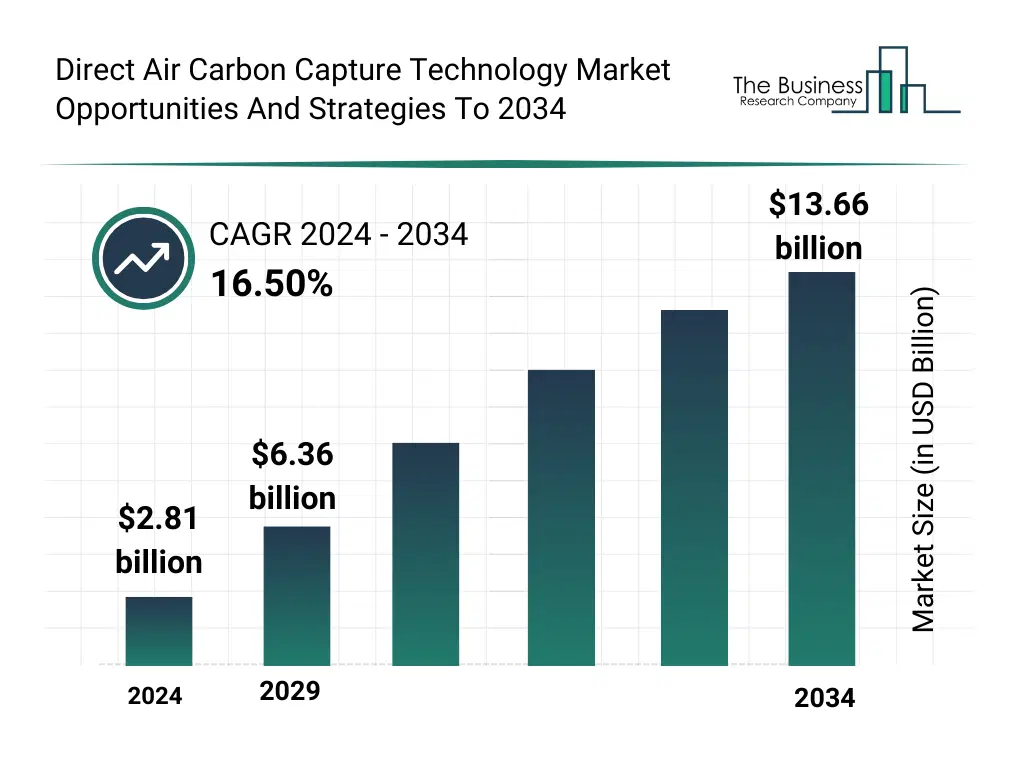
Direct Air Carbon Capture Technology Market Size
The global direct air carbon capture technology market reached a value of nearly $2,810.00 million in 2024, having grown at a compound annual growth rate (CAGR) of 16.28% since 2019. The market is expected to grow from $2,810.00 million in 2024 to $6,363.86 million in 2029 at a rate of 17.76%. The market is then expected to grow at a CAGR of 16.50% from 2029 and reach $13,655.35 million in 2034. Growth in the historic period resulted from rising carbon emissions, growing corporate net-zero and carbon-neutrality goals, rising effort towards international climate agreements and emergence of carbon credit trading. Factors that negatively affected growth in the historic period were the high capital and operating costs and large energy intensity. Going forward, growing adoption of renewable energy, supportive government policies, increasing awareness to reduce greenhouse gas emissions and accelerating climate change impacts will drive growth. Factor that could hinder the growth of the direct air carbon capture technology market in the future include limited renewable energy availability, limited low-carbon energy supply and grid constraints and trade war and tariffs.Direct Air Carbon Capture Technology Market Drivers
The key drivers of the direct air carbon capture technology market include: Growing Adoption Of Renewable Energy During forecast period, the growing adoption of renewable energy is expected to propel the growth of the direct air carbon capture technology market. As governments and industries worldwide prioritize carbon neutrality and decarbonization, there is heightened demand for innovative solutions that can effectively remove CO₂ from the atmosphere. Direct air carbon capture (DAC) technology, which complements renewable energy by enabling large-scale carbon mitigation, is gaining traction as a strategic tool in achieving sustainability goals. The alignment of renewable energy deployment with carbon capture initiatives is expected to create new investment opportunities, foster technological advancements and accelerate the commercial adoption of DAC solutions across multiple sectors. The growing adoption of renewable energy contribution during the forecast period in 2024 is 2.50%.Direct Air Carbon Capture Technology Market Restraints
The key restraints on the direct air carbon capture technology market include: Limited Renewable Energy Availability Limited renewable energy availability is expected to hinder the growth of the direct air carbon capture technology market in forecast period. Direct air capture (DAC) processes require substantial energy inputs and reliance on conventional fossil-based power sources can reduce the environmental benefits and cost-effectiveness of carbon capture solutions. In regions where renewable energy infrastructure is underdeveloped or inconsistent, scaling direct air carbon capture (DAC) technologies becomes more challenging, slowing adoption rates. Additionally, energy limitations may increase operational costs and deter investments in large-scale projects. Consequently, insufficient access to reliable and sustainable energy sources is likely to act as a key barrier to the widespread implementation and market expansion of DAC technologies. Growth affected by limited renewable energy availability during the forecast period in 2024 is -2.25%.Direct Air Carbon Capture Technology Market Trends
Major trends shaping the direct air carbon capture technology market include: Advanced Ceramic Innovations Drive Energy-Efficient Carbon Capture And Global Neutrality Efforts Companies operating in the direct air carbon capture technology market are focusing on developing advanced material and system innovations, such as energy-efficient sorbents and ceramic-based capture structures, to enhance CO₂ removal efficiency, reduce operational costs and accelerate large-scale deployment toward global carbon neutrality goals. For instance, in September 2025, NGK Insulators, a Japan-based ceramics company, announced major progress in applying its century-long ceramic expertise to direct air capture (DAC) technology, advancing its role in global carbon neutrality efforts. The company unveiled innovative ceramic honeycomb structures that significantly reduce pressure loss and energy consumption while efficiently capturing CO₂. These thin-walled, large-surface designs derived from NGK’s automotive exhaust purification technology enable efficient regeneration at low temperatures (80–100°C). NGK is engaging with over 30 global manufacturers and preparing large-scale demonstrations by 2030. By leveraging proven ceramic manufacturing capabilities, NGK aims to lead Japan’s DAC advancement and support the transition toward a carbon-neutral industrial ecosystem. Integrated Carbon Capture Solutions Transform CO₂ For Net-Zero Advancement Major companies operating in the direct air carbon capture technology market are focusing on integrating CO₂ capture with value-added applications, such as converting captured carbon into construction materials, enhancing scalability, enabling permanent storage and supporting decarbonization of industrial sectors while advancing national net-zero objectives. For instance, in May 2025, Mission Zero Technologies, a UK-based environmental services company, has inaugurated its second direct air capture (DAC) plant in Norfolk, marking the world’s first fully integrated DAC-to-building materials demonstration facility. Developed in partnership with O.C.O Technology, a UK-based, environmental services company and the UK Department for Energy Security and Net Zero, a UK-based government organization, the plant captures up to 250 tonnes of CO₂ annually and converts it into carbon-negative limestone for use in construction materials like bricks and concrete. This innovation enables permanent CO₂ storage while decarbonizing the building sector. The launch highlights the scalability of DAC integration into existing industrial processes and demonstrates the UK’s leadership in advancing carbon removal technologies to support its net zero objectives.Opportunities And Recommendations In The Direct Air Carbon Capture Technology Market
Opportunities – The top opportunities in the direct air carbon capture technology market segmented by technology type will arise in the solid-direct air carbon capture (DAC) segment, which will gain $2,203.82 million of global annual sales by 2029. The top opportunities in the direct air carbon capture technology market segmented by application will arise in the carbon capture and storage (CCS) segment, which will gain $2,671.24 million of global annual sales by 2029. The top opportunities in the direct air carbon capture technology market segmented by end-use industry will arise in the energy industry (including clear energy industry) segment, which will gain $1,695.16 million of global annual sales by 2029. The top opportunities in the direct air carbon capture technology market segmented by operating temperature will arise in the low-temperature direct air carbon capture (DAC) segment, which will gain $2,344.36 million of global annual sales by 2029. The top opportunities in the direct air carbon capture technology market segmented by number of collectors will arise in the less than 10 collectors’ segment, which will gain $2,997.38 million of global annual sales by 2029. The direct air carbon capture technology market size will gain the most in the USA at $2,020.02 million. Recommendations- To take advantage of the opportunities, The Business Research Company recommends the direct air carbon capture technology companies to focus on material innovation that lowers cost and enables scale, focus on integrating capture with durable end uses, focus on pilot and demonstration projects that de-risk scale-up and prove regional viability, focus on pilot and demonstration projects that de-risk scale-up and prove regional viability, focus on modular system design that enables mass manufacturing and rapid scale, focus on next-generation sorbents that cut energy use and enable scale, focus on solid direct air carbon capture to drive scalable growth, focus on carbon capture, utilization and storage to maximize commercial returns, focus on low-temperature direct air carbon capture to accelerate scale and adoption, focus on less than 10 collectors to accelerate adoption and de-risk scale-up, expand in emerging markets, continue to focus on developed markets, focus on value-based and risk-adjusted pricing discipline, build credibility through evidence-based promotion, drive conversion with targeted, use-case-led promotion, focus on transportation applications for accelerated growth.
Direct Air Carbon Capture Technology Market Segmentation
The direct air carbon capture technology market is segmented by technology type, by application, by end-use industry, by operating temperature and by number of collectors.By Technology Type –
The direct air carbon capture technology market is segmented by technology type into:
- a) Solid-Direct Air Carbon Capture (DAC)
- b) Liquid-Direct Air Carbon Capture (DAC)
- c) Electrochemical-Direct Air Carbon Capture (DAC)
By Application –
The direct air carbon capture technology market is segmented by application into:
- a) Carbon Capture And Storage (CCS)
- b) Carbon Capture
- c) Utilization And Storage (CCUS)
By End-Use Industry –
The direct air carbon capture technology market is segmented by end-use industry into:
- a) Into Energy Industry (Including Clear Energy Industry)
- b) Industrial Sector
- c) Transportation
- d) Other End-Use Industries
By Operating Temperature –
The direct air carbon capture technology market is segmented by operating temperature into:
- a) Low-Temperature Direct Air Carbon Capture (DAC)
- b) High-Temperature Direct Air Carbon Capture (DAC)
By Number Of Collectors –
The direct air carbon capture technology market is segmented by number of collectors into:
- a) Into Less Than 10 Collectors
- b) More Than 10 Collectors
By Geography - The direct air carbon capture technology market is segmented by geography into:
- • China
- • India
- • Japan
- • Australia
- • Indonesia
- • South Korea
- • Bangladesh
- • Thailand
- • Vietnam
- • Malaysia
- • Singapore
- • Phillipines
- • Hong kong
- • New Zealand
- • USA
- • Canada
- • Mexico
- • Brazil
- • Argentina
- • Chile
- • Colombiia
- • Peru
- • France
- • Germany
- • UK
- • Italy
- • Spain
- • Austria
- • Belgium
- • Denmark
- • Finland
- • Ireland
- • Netherland
- • Norway
- • Portugal
- • Sweden
- • Switzerland
- • Russia
- • Czech Republic
- • Poland
- • Romania
- • Ukraine
- • Saudi Arabia
- • Israel
- • Iran
- • Turkey
- • UAE o Africa
- • Egypt
- • Nigeria
- • South Africa
-
o Asia Pacific