

Drone Communication Market 2026
By Component (Transmitter, Receiver, Antenna, Data Link), By Technology (Radio Frequency, Cellular, Satellite, Meshed Network), By Application (Agriculture, Construction And Mining, Inspection, Oil And Gas, Other Applications), By End-Use (Government And Defense Organizations, Commercial Enterprises, Private Operators), And By Region, Opportunities And Strategies – Global Forecast To 2035
Drone Communication Market Definition
Drone communication refers to the integrated systems, components, and technologies that enable drones to transmit and receive data, commands, and telemetry between the aircraft and ground control stations, other drones, or networked platforms. These systems are essential for enabling remote piloting, autonomous operations, and real-time data transmission, and are used by a wide range of users including defense organizations, commercial enterprises, government agencies, and private operators. The drone communication market consists of sales, by entities (organizations, sole traders or partnerships) that are used when drones are deployed in missions that require real-time video streaming, data collection, surveillance, delivery, or inspection over wide areas. These systems include transmitters, receivers, antennas, and data links that collectively support the two-way flow of data and control instructions. Drones equipped with communication systems are used in a variety of settings such as agriculture, construction, mining, infrastructure inspection, oil and gas operations, emergency response, and surveillance, often operating beyond visual line-of-sight (BVLOS).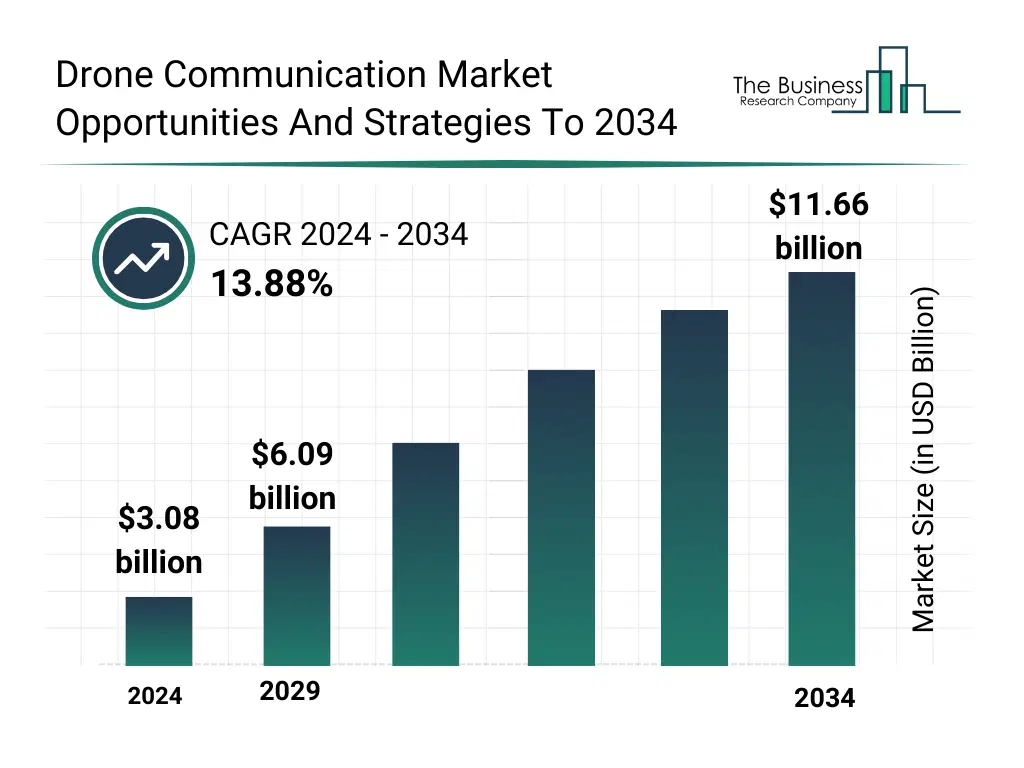
Drone Communication Market Size
The global drone communication market reached a value of nearly $3,080.00 million in 2024, having grown at a compound annual growth rate (CAGR) of 12.56% since 2019. The market is expected to grow from $3,080.00 million in 2024 to $6,086.02 million in 2029 at a rate of 14.59%. The market is then expected to grow at a CAGR of 13.88% from 2029 and reach $11,655.89 million in 2034. Growth in the historic period resulted from increasing adoption of drones for commercial applications, rising uses in public safety and disaster response, rising demand for unmanned delivery services and expansion of oil and gas pipeline and infrastructure inspection. Factors that negatively affected growth in the historic period were airspace regulation and flight restrictions and vulnerabilities to cyberattacks and hacking. Going forward, government support and policies favoring drone deployment, increasing applications in logistics and parcel delivery, high demand for security and surveillance applications and increasing focus on precision agriculture will drive the growth. Factors that could hinder the growth of the drone communication market in the future include certification and licensing requirements, high infrastructure and integration costs and impact of trade war and tariff.Drone Communication Market Drivers
The key drivers of the drone communication market include: Increasing Applications in Logistics and Parcel Delivery During the forecast period, expanding applications in logistics and parcel delivery are expected to significantly drive the growth of the drone communication market. Delivery drones rely on continuous, reliable connectivity to receive navigation updates, avoid obstacles, interact with traffic management systems, and send real-time telemetry and status data back to control centers. As logistics companies scale up drone fleets to accelerate delivery operations, communication networks must adapt to support higher drone volumes, dynamic routing, and smooth integration with ground-based systems. This trend is accelerating demand for advanced BVLOS (beyond visual line of sight) communication capabilities, low-latency cellular networks, and AI-enhanced data links that can handle complex delivery workflows. As drones take on a larger role in last-mile logistics, the need for secure, resilient, and scalable communication technologies grows accordingly. The increasing applications in logistics and parcel delivery growth contribution during the forecast period in 2024 is 1.00%.Drone Communication Market Restraints
The key restraints on the drone communication market include: High Infrastructure and Integration Costs High infrastructure and integration costs are expected to restrict the growth of the drone communication market during the forecast period. Deploying advanced communication technologies—such as LTE/5G networks, satellite-based links, BVLOS (beyond visual line of sight) data systems, and real-time video transmission architectures—requires significant capital investment. Integrating these solutions with existing IT infrastructures, ground control stations, and airspace management platforms introduces additional technical challenges and expenses. For smaller companies and emerging markets, these costs can be prohibitive, limiting the broader adoption of drone communication technologies. Moreover, ongoing maintenance, software updates, and essential cybersecurity measures add to long-term operational costs, further complicating deployment. As a result, these high financial requirements slow market penetration and hinder uptake in cost-sensitive industries. Growth affected by high infrastructure and integration costs production during the forecast period in 2024 is -0.50%.Drone Communication Market Trends
Major trends shaping the drone communication market include: Advancement Of AI-Integrated Encrypted Communication Systems For Secure Drone Operations Major companies in the drone communication market are focusing on embedding artificial intelligence (AI) alongside advanced encryption protocols into their communication systems to ensure secure, real-time data exchange between drones and ground stations. These innovations aim to combat interception, spoofing, and cyber threats by enabling drones to encrypt telemetry, command and control (C2) links and video feeds, while simultaneously using AI to detect anomalous transmission behaviors or threats. For instance, in February 2025, ZenaDrone, a Ireland-based specializing in developing and manufacturing drone solutions that incorporate machine learning, AI, predictive modeling, announced the development of its proprietary “DroneNet” communications management system, which enables direct, secure drone communications in situations without reliable internet, cellular or satellite connectivity, leveraging AI to manage the links and encryption to protect the transmissions. This system was developed primarily to support defense-grade secure operations and ensure robust mission continuity even in communication-denied environments. Integrations Of GPS And Telemetry Receivers For Real-Time Precision Tracking And Control Major companies in the drone communication market are focusing on the integration of high-precision GPS modules and advanced telemetry receivers into their communication systems to enable real-time tracking, location awareness, and control of drones under dynamic and complex mission conditions. These innovations aim to deliver highly accurate geolocation (often multi-constellation GNSS), seamless telemetry capture of flight status (altitude, attitude, speed, battery, link quality) and robust data links to the ground control station. For instance, in September 2025, Dronetag, a Czech Republic-based, technology company specializing in drone safety and compliance solutions, launched its “Scout” remote-ID (identification) and telemetry receiver module with up to 25 km (kilometer) range that simultaneously captures high-accuracy GNSS (global navigation satellite system) data and real-time flight telemetry for drones operating in commercial and public-safety sectors. The module supports integration with ground control systems, offers real-time map-based tracking of unmanned aircraft, and is designed especially for operations requiring precision location and compliance with airspace regulations.Opportunities And Recommendations In The Drone Communication Market
Opportunities – The top opportunities in the drone communication market segmented by component will arise in the data link segment, which will gain $859.89 million of global annual sales by 2029. The top opportunities in the drone communication market segmented by technology will arise in the cellular segment, which will gain $1,586.91 million of global annual sales by 2029. The top opportunities in the drone communication market segmented by application will arise in the other applications segment, which will gain $1,011.38 million of global annual sales by 2029. The top opportunities in the drone communication market segmented by end use will arise in the commercial enterprises segment, which will gain $1,247.22 million of global annual sales by 2029. The drone communication market size will gain the most in the USA at $881.64 million. Recommendations- To take advantage of the opportunities, The Business Research Company recommends the drone communication companies to focus on AI-enabled secure communications for mission-critical drone operations, focus on multi-frequency communication systems for resilient drone connectivity, focus on high-precision GNSS and telemetry integration for compliant drone operations, focus on satellite-based communications to enable reliable BVLOS operations, focus on high-growth data link solutions, focus on cellular-based drone communication, expand in emerging markets, focus on structured channel expansion and regional coverage, focus on mission-critical value and scalable pricing control, promotion strategy focused on credibility and mission relevance, partnership-driven and account-oriented promotion framework, focus on construction and mining applications and focus on commercial enterprise adoption.
Drone Communication Market Segmentation
The drone communication market is segmented by component, by technology, by application and by end user.By Component –
The drone communication market is segmented by component into:
- a) Transmitter
- b) Receiver
- c) Antenna
- d) Data Link
By Application –
The drone communication market is segmented by application into:
- a) Agriculture
- b) Construction And Mining
- c) Inspection
- d) Oil And Gas
- e) Other Applications
By Technology –
The drone communication market is segmented by technology into:
- a) Radio Frequency
- b) Cellular
- c) Satellite
- d) Meshed Network
By End User –
The drone communication market is segmented by end user into:
- a) Government And Defense Organizations
- b) Commercial Enterprises
- c) Private Operators
By Geography - The drone communication market is segmented by geography into:
- • China
- • India
- • Japan
- • Australia
- • Indonesia
- • South Korea
- • USA
- • Canada
- • Brazil
- • France
- • Germany
- • UK
- • Italy
- • Spain
- • Russia
-
o Asia Pacific
o Africa