

Electronic Bill Presentment And Payment Market Report 2026
Global Outlook – By Component (Software, Services), By Product (Electronic Bill Presentment, Electronic Bill Payment, Electronic Bill Posting), By Deployment Mode (On-Premises, Cloud-Based), By Payment Methods (Credit Or Debit Cards, Direct Bank Transfers, Electronic-Wallets, Mobile Payments, Cryptocurrencies), By End Use Industries (Banking, Financial Services And Insurance (BFSI), Healthcare, Information Technology (IT) And Telecom, Retail And E-Commerce, Education, Media And Entertainment, Manufacturing, Government And Public Sector, Other End Use Industries) – Market Size, Trends, Strategies, and Forecast to 2030
Electronic Bill Presentment And Payment Market Overview
• Electronic Bill Presentment And Payment market size has reached to $30.1 billion in 2025 • Expected to grow to $55.03 billion in 2030 at a compound annual growth rate (CAGR) of 12.8% • Growth Driver: Increasing Adoption Of Digital Payment Solutions Fueling The Growth Of The Market Due To Enhancing Accessibility And Convenience • Market Trend: Innovations In Artificial Intelligence (AI) Technology Enhance Automation And Digital Efficiency In Electronic Bill Presentment And Payment • North America was the largest region in 2025 and Asia-Pacific is the fastest growing region.Market Gains By 2030 – Top Opportunities By Segment
Market Gain identifies the most promising market opportunities by highlighting the segments or products expected to generate the highest incremental revenue growth over the next five years.
What Is Covered Under Electronic Bill Presentment And Payment Market?
Electronic bill presentment and payment is a digital system that allows organizations to present invoices and bills to customers electronically and enables secure online payment through various channels such as websites, mobile apps, or email. Its primary purpose is to streamline the billing process, reduce paper usage, enhance payment convenience, improve cash flow, and provide real-time tracking and record-keeping for both businesses and customers. The main components of electronic bill presentment and payment are software and services. Software is a digital solution that enables businesses and consumers to send, receive, and pay bills online securely, streamlining billing and payment processes. It includes various product types such as electronic bill presentment, electronic bill payment, and electronic bill posting, and is deployed through on-premises and cloud-based methods. It supports multiple payment methods, such as credit or debit cards, direct bank transfers, electronic wallets, mobile payments, and cryptocurrencies, and caters to a wide range of end-user industries, including banking, financial services and insurance (BFSI), healthcare, information technology (IT) and telecom, retail and e-commerce, education, media and entertainment, manufacturing, government and public sector, and others.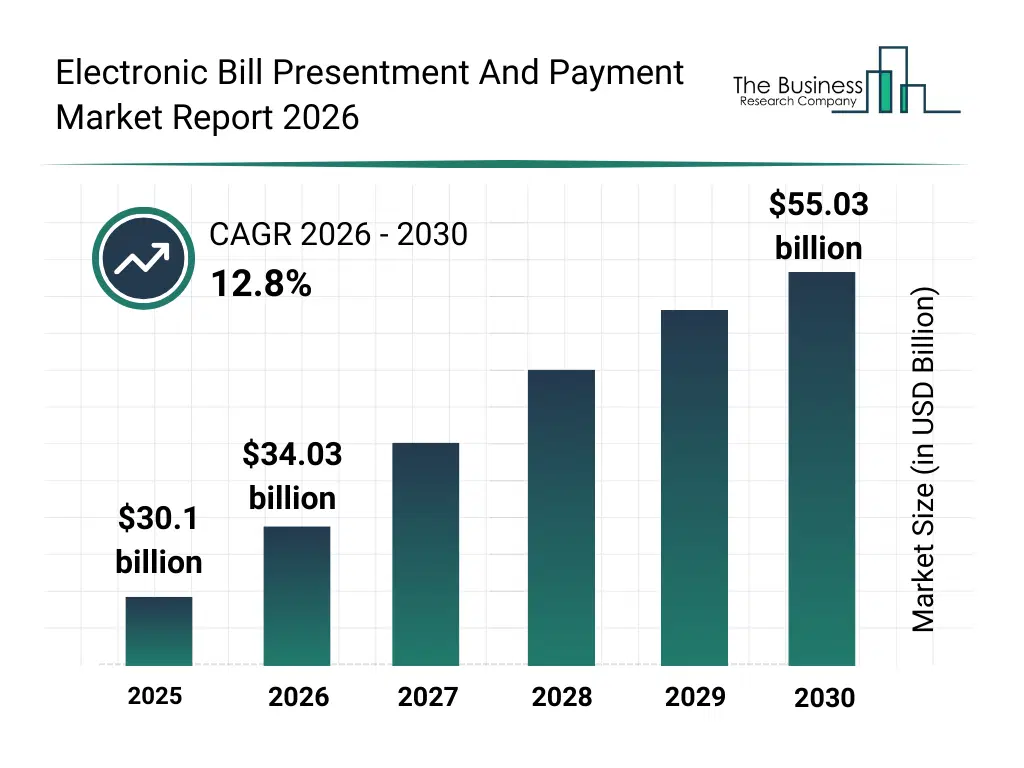
What Is The Electronic Bill Presentment And Payment Market Size and Share 2026?
The electronic bill presentment and payment market size has grown rapidly in recent years. It will grow from $30.1 billion in 2025 to $34.03 billion in 2026 at a compound annual growth rate (CAGR) of 13.1%. The growth in the historic period can be attributed to growth in digital banking adoption, increasing volume of recurring bill payments, expansion of e-commerce and online services, rising demand for automated billing solutions, early adoption of online payment gateways.What Is The Electronic Bill Presentment And Payment Market Growth Forecast?
The electronic bill presentment and payment market size is expected to see rapid growth in the next few years. It will grow to $55.03 billion in 2030 at a compound annual growth rate (CAGR) of 12.8%. The growth in the forecast period can be attributed to increasing integration of ai-based billing analytics, rising demand for instant and mobile payments, expansion of blockchain-enabled billing systems, growing regulatory focus on secure digital transactions, increasing adoption across public sector billing. Major trends in the forecast period include increasing adoption of cloud-based billing platforms, rising integration of real-time payment tracking, expansion of multi-channel digital payment options, growing focus on paperless billing systems, enhanced emphasis on data security and compliance.
Global Electronic Bill Presentment And Payment Market Segmentation
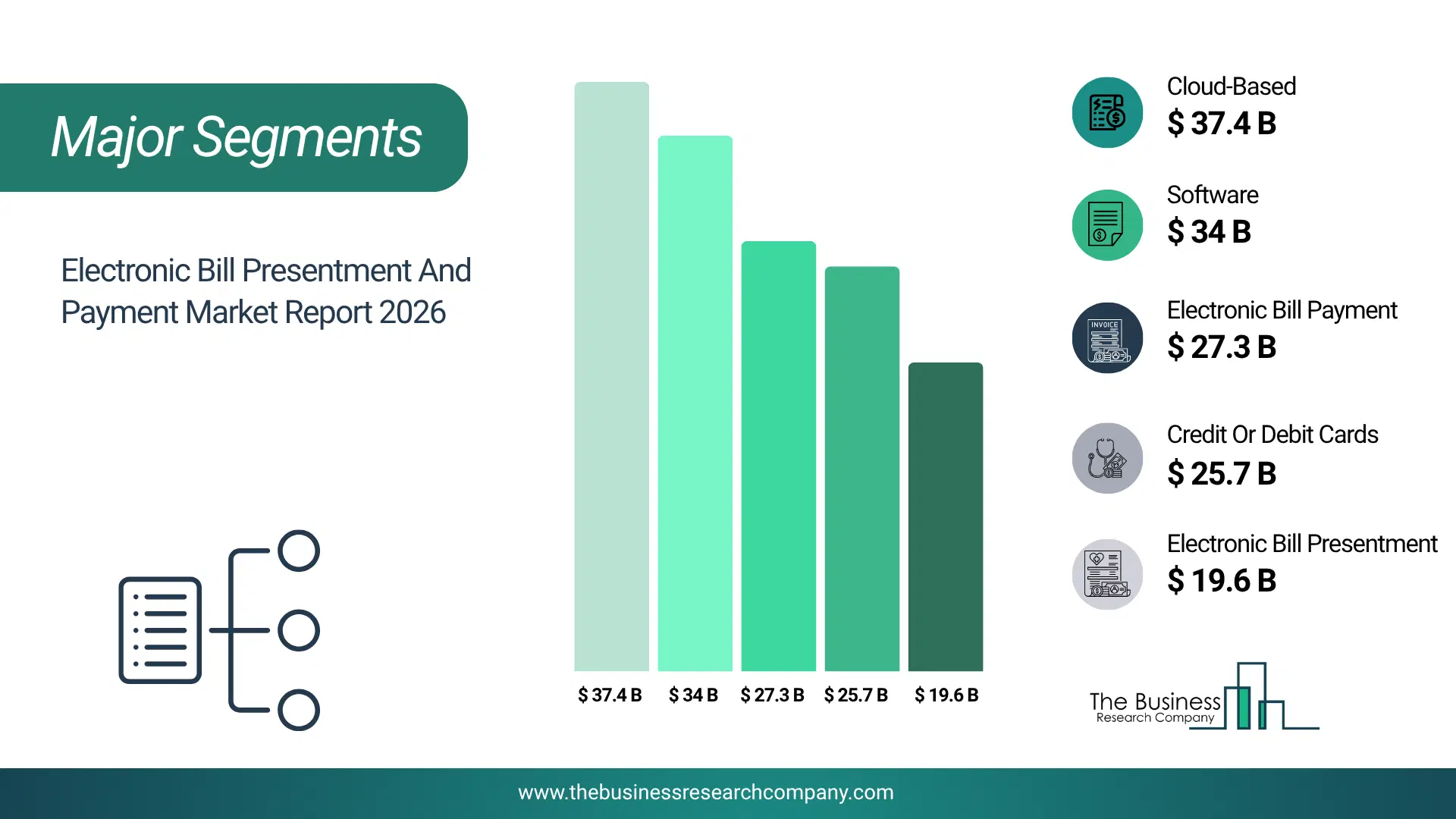
1) By Component: Software, Services 2) By Product: Electronic Bill Presentment, Electronic Bill Payment, Electronic Bill Posting 3) By Deployment Mode: On-Premises, Cloud-Based 4) By Payment Methods: Credit Or Debit Cards, Direct Bank Transfers, Electronic-Wallets, Mobile Payments, Cryptocurrencies 5) By End Use Industries: Banking, Financial Services And Insurance (BFSI), Healthcare, Information Technology (IT) And Telecom, Retail And E-Commerce, Education, Media And Entertainment, Manufacturing, Government And Public Sector, Other End Use Industries Subsegments: 1) By Software: On-Premise Software, Cloud-Based Software, Mobile Applications 2) By Services: Professional Services, Managed Services, Support And Maintenance Services The top segments in the electronic bill presentment and payment market will be: • Cloud-Based will reach $37473.24 Million by 2030. • Software will reach $34038.92 Million by 2030. • Credit Or Debit Cards will reach $25708.52 Million by 2030. • Electronic Bill Payment will reach $27376.58 Million by 2030. • Electronic Bill Presentment will reach $19593.8 Million by 2030.What Is The Driver Of The Electronic Bill Presentment And Payment Market?
The increasing adoption of digital payment solutions is expected to propel the growth of the electronic bill presentment and payment market going forward. Digital payment solutions refer to electronic methods and platforms that facilitate the transfer of money between parties without using physical cash. The rise in digital payment solutions is driven by growing smartphone and internet penetration, thereby making electronic transactions more accessible and convenient for users. Electronic bill presentment and payment enhance financial workflows by enabling secure digital invoice delivery and online payments. It reduces manual processing, speeds up payment cycles, and improves convenience for both businesses and customers. For instance, in January 2024, according to the European Central Bank, a Germany-based central banking institution, the number of contactless card payments rose by 24.3% to 20.9 billion in 2023 compared to 2022. Therefore, the increasing adoption of digital payment solutions is driving the growth of the electronic bill presentment and payment industry.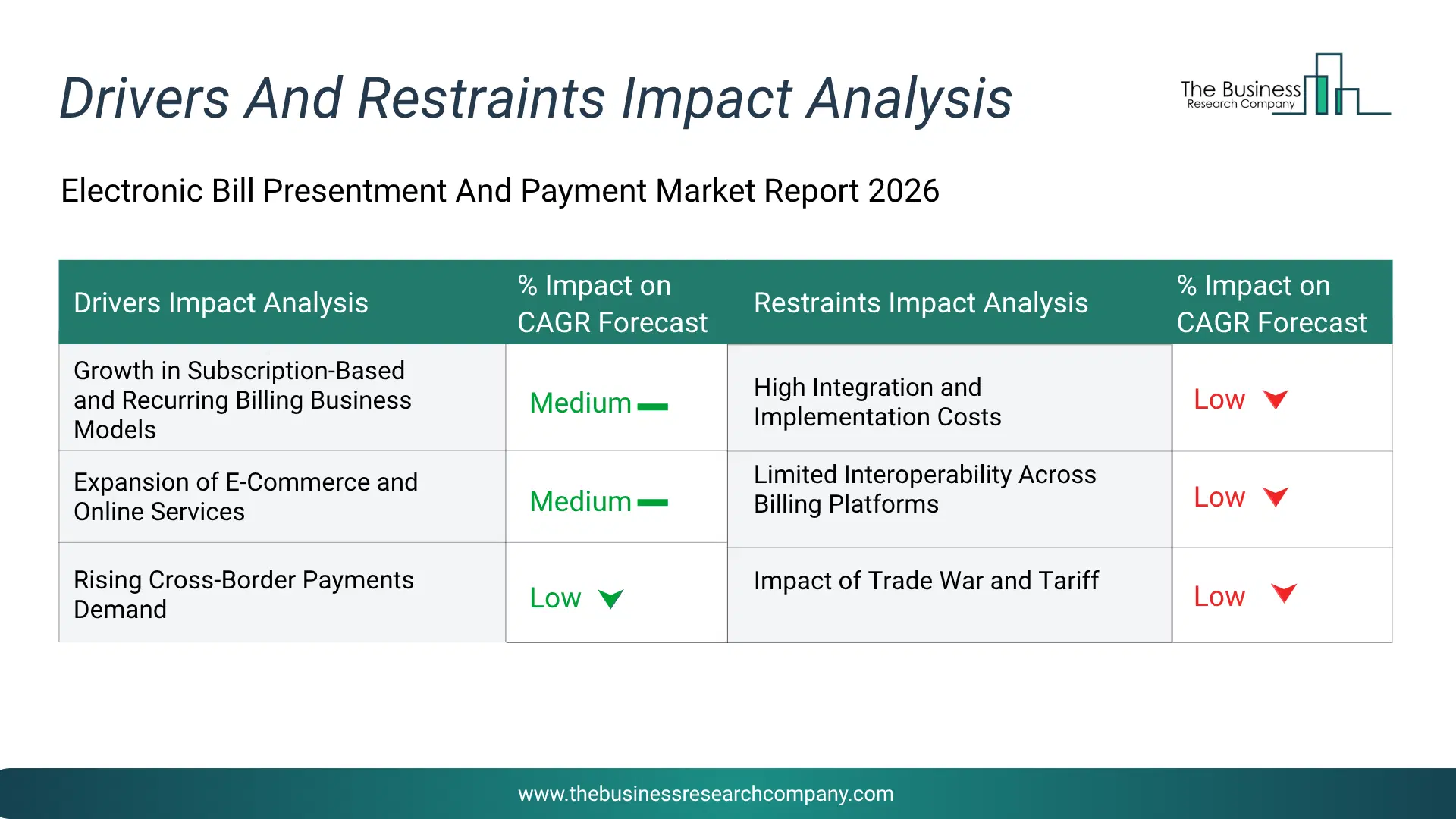
Infographic Chart Showing Key Market Drivers Analysis And Restraints For Electronic Bill Presentment And Payment Market
The chart presents an impact analysis of key drivers and restraints, quantifying their relative influence on the market's growth rate and helping assess the balance between growth enablers and limiting factors. This chart offers a high-level perspective; the full report contains more detailed insights.
How Will The Drivers Impact Growth In The Global Electronic Bill Presentment And Payment Market?
• Growth in Subscription-Based and Recurring Billing Business Models (Medium) – During the forecast period, growth in subscription-based and recurring billing business models is expected to be a key driver of the growth of the electronic bill presentment and payment market in the forecast period. recurring payments require high-frequency invoice generation, real-time payment tracking, and error-free reconciliation, all of which are core strengths of modern electronic bill presentment and payment systems. as organizations scale their subscription offerings, manual billing becomes inefficient, causing delays, inconsistent invoicing, and higher operational costs. electronic bill presentment and payment solutions address these gaps by supporting automated recurring bill generation, securely storing payment credentials, and enabling customers to manage billing preferences through self-service portals or mobile apps. the flexibility of electronic bill presentment and payment platforms to integrate with subscription engines, apply usage-based pricing rules, and handle dynamic billing scenarios increases their attractiveness. the growth in subscription-based and recurring billing business models contribution during the forecast period in 2025 is 1.5%. • Expansion of E-Commerce and Online Services (Medium) – During the forecast period, the expansion of e-commerce and online services will propel the growth of the electronic bill presentment and payment market. As more transactions occur online, customers expect instant access to invoices, frictionless payment options, and a clear record of their purchase and billing history. Traditional or semi-digital billing methods fail to meet the speed, transparency, and convenience demanded by online shoppers and service users. Electronic bill presentment and payment platforms enable automated bill generation now of purchase, support diverse payment methods such as cards, bank transfers, mobile payments, and wallets, and offer real-time updates on payment status, refunds, or disputes. For online merchants and digital service providers, electronic bill presentment and payment systems reduce operational overhead by removing the need for manual invoice distribution, enhance cash flow by accelerating collection cycles, and improve the customer experience with centralized dashboards and instant notifications. The expansion of e-commerce and online services contribution during the forecast period in 2025 is 1.2%. • Rising Cross-Border Payments Demand (Low) – During the forecast period, the rising cross-border payments demand efforts as a major factor driving the expansion of the electronic bill presentment and payment market by 2030. cross-border transactions come with complexities such as varying tax rules, fluctuating exchange rates, diverse payment preferences, and differing regulatory environments. electronic bill presentment and payment solutions help businesses manage these complexities by providing integrated invoicing engines that support global currencies, standardized digital payment workflows, and automated reconciliation across regions. they also enhance compliance through built-in safeguards aligned with international data and payment regulations. as companies increasingly sell products or services to international customers, electronic bill presentment and payment systems become essential in managing timely collection, reducing billing errors, and supporting customers with region-specific billing interfaces and payment options. additionally, ebpp’s ability to streamline high-volume international transactions helps businesses improve operational efficiency while avoiding delays caused by manual cross-border payment processes. therefore, rising cross-border payments is projected to contributing to a 1.0% annual growth in the market. • Growing Use of Digital Wallets (Low) – During the forecast period, the growing use of digital wallets will propel the growth of the electronic bill presentment and payment market. As consumers increasingly shift toward mobile-first payment behaviors, businesses must integrate wallet-based payment capabilities within their billing and invoicing processes to meet customer expectations for speed and convenience. Digital wallets simplify the payment experience by allowing one-click or biometric-authorized transactions, reducing friction in bill settlement and increasing on-time payment rates. For businesses, integrating wallets into electronic bill presentment and payment platforms improves cash flow predictability, reduces abandoned payments, and supports a broader range of customer payment preferences. The rise of wallet-based payments also aligns with electronic bill presentment and payment’s real-time processing capabilities, enabling immediate invoice updates, instant receipts, and automated reconciliation. Furthermore, digital wallets often include built-in security and tokenization features that enhance the safety of electronic billing environments, which strengthens customer trust. The growing use of digital wallets contribution during the forecast period in 2025 is 0.5%.How Will The Restraints Impact Growth In The Global Electronic Bill Presentment And Payment Market?
• High Integration and Implementation Costs (Medium) – During the forecast period, high integration and implementation costs is restricting the growth of the electronic bill presentment and payment market during the forecast period. implementing electronic bill presentment and payment systems requires aligning them with existing accounting software, erp platforms, crm systems, and payment gateways, which often involves complex customization and technical expertise. these processes can demand substantial upfront investment, ongoing maintenance expenses, and specialized it support, creating financial and operational barriers to adoption. in some industries, businesses rely on outdated or fragmented legacy systems that require significant modernization before ebpp solutions can even be considered. this increases the cost of transition and may lead companies to defer or abandon digital billing initiatives altogether. furthermore, long deployment timelines and potential disruptions during system integration can deter enterprises that are cautious about operational interruptions. growth affected by high integration and implementation costs during the forecast period in 2025 is -1.0%. • Limited Interoperability Across Billing Platforms (Medium) – During the forecast period, limited interoperability across billing platforms is restricting the growth of the electronic bill presentment and payment market during the forecast period. when platforms are built on incompatible standards or architectures, businesses face difficulties connecting their electronic bill presentment and payment solutions with other digital tools they rely on. this reduces the ability to automate workflows, hinders seamless reconciliation, and creates inconsistencies in invoice formatting, payment tracking, and customer account management. for organizations operating across multiple regions or subsidiaries, lack of interoperability makes it challenging to maintain unified billing processes or consolidate reporting, leading to inefficiencies and redundant processes. additionally, interoperability issues create friction for customers who may face inconsistent digital experiences depending on the platform their service provider uses. growth affected by limited interoperability across billing platforms during the forecast period in 2025 is -0.5%. • Impact of Trade War and Tariff (Low) – During the forecast period, impact of trade war and tariffs restricting the growth of the electronic bill presentment and payment market during the forecast period. when tariffs increase operational costs for companies engaged in global trade, businesses often shift their focus toward cost containment rather than investing in new digital billing infrastructure. heightened volatility in financial markets also causes organizations to delay long-term technology projects, including cloud migration and billing system modernization. for financial institutions and payment providers, tariff-driven disruptions in international supply chains can lead to reduced transaction volumes, lower credit appetite, and increased risk management burdens, all of which indirectly dampen the urgency to adopt advanced electronic bill presentment and payment systems. cross-border billing becomes more complex during trade tensions, requiring stricter compliance checks, additional processing layers, and increased due diligence, which may discourage firms from introducing new electronic bill presentment and payment workflows. growth affected by trade war and tariffs across regions during the forecast period in 2025 is -0.3%.Key Players In The Global Electronic Bill Presentment And Payment Market
Major companies operating in the electronic bill presentment and payment market are Oracle Corporation, SAP SE, PayPal Holdings Inc., Mastercard Incorporated, Fiserv Inc., Fidelity National Information Services Inc., Broadridge Financial Solutions Inc., Jack Henry & Associates Inc., BTRS Holdings Inc., Temenos AG, CyberSource Corporation, Paymentus Holdings Inc., Bottomline Technologies Inc., Striata, Pagero AB, ACI Worldwide Inc., Enterprise jBilling Software Ltd., Jopari Solutions Inc., MaxBill s.r.o., AMCS Group, MuniBilling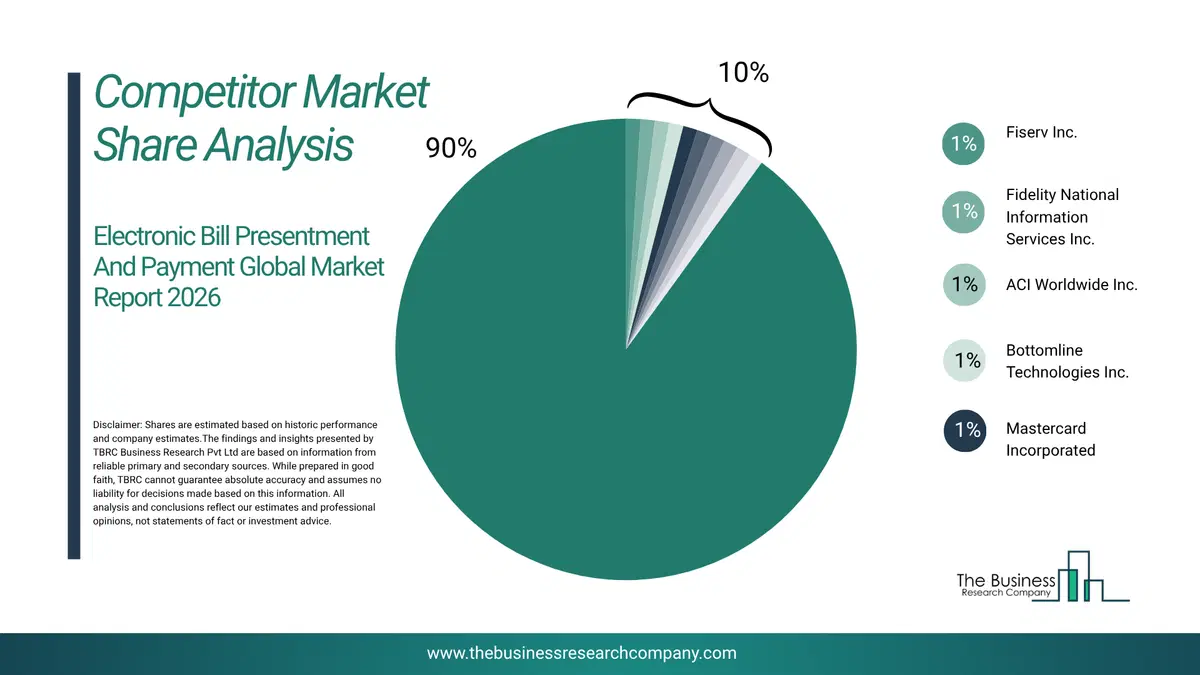
This chart is for illustrative purposes; the full report includes a detailed competitor analysis and comprehensive overview of the top 10 companies in the market.
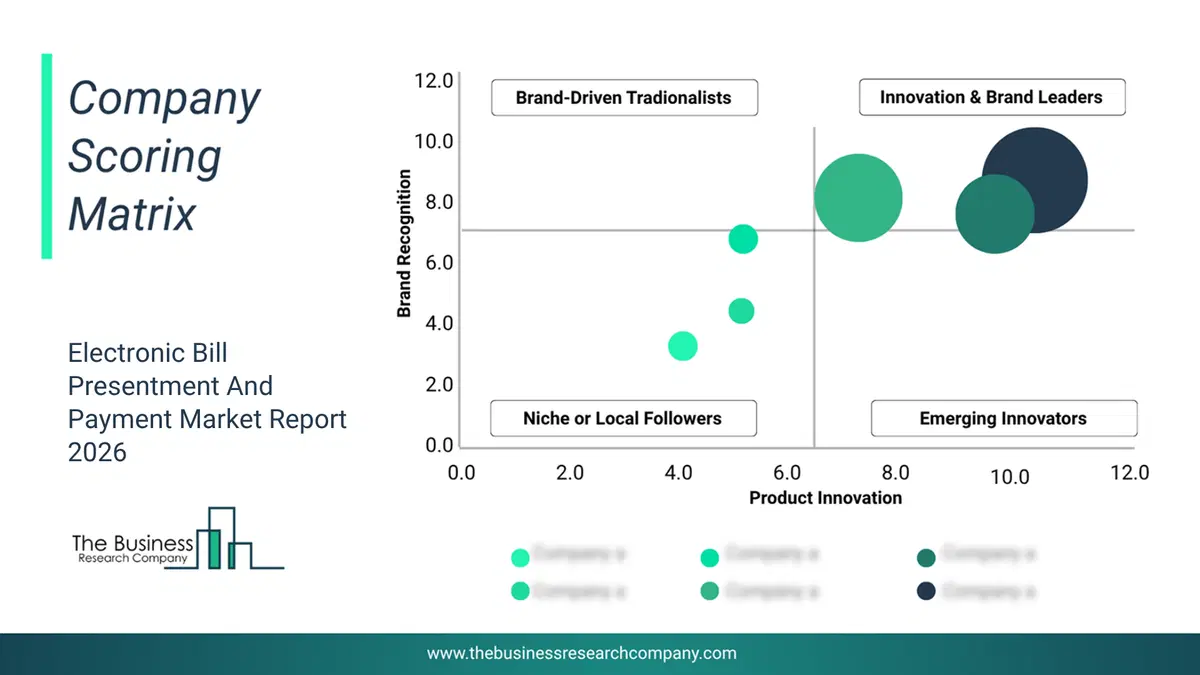
This chart maps companies by product innovation and brand strength, with bubble size indicating relative revenue, helping identify market leaders, challengers, and niche players. This is an illustrative chart; the full report provides a complete and accurate competitive analysis.
Global Electronic Bill Presentment And Payment Market Trends and Insights
Major companies operating in the electronic bill presentment and payment market are focusing on developing advanced AI-powered capabilities, such as generative AI and agentic automation, to improve workflow efficiency, minimize manual intervention, and elevate the overall digital payment experience. AI-driven billing automation refers to intelligent technological features that streamline complex tasks, including report generation, payment processing, and customer service interactions, allowing organizations to operate with greater speed, accuracy, and responsiveness. For instance, in May 2025, InvoiceCloud, Inc. a US-based provider of online billing and payment services, introduced a suite of new AI initiatives integrated into its electronic bill presentment and payment platform, designed to make billing and payment workflows smarter and more efficient. These enhancements include a natural language, enabled report builder that lets billers generate detailed reports instantly using simple text prompts, as well as AI-powered agentic tools that automate payment-related tasks and proactively address customer inquiries. Developed to optimize accuracy and streamline daily operations, these features enhance workflow efficiency and improve user experience, supporting faster decision-making and more seamless digital payment interactions across the EBPP ecosystem.What Are Latest Mergers And Acquisitions In The Electronic Bill Presentment And Payment Market?
In July 2024, Serrala Group, a Germany-based developer of financial automation software, acquired Payference Inc. for an undisclosed amount. With this acquisition, Serrala aims to strengthen its cloud-based finance automation suite by adding advanced accounts receivable capabilities, moving closer to a comprehensive platform for automating accounts receivable (AR), accounts payable (AP), and payments for the CFO’s office. Payference Inc. is a US-based technology company that provides electronic bill presentment and payment services as part of its AI-powered cash management.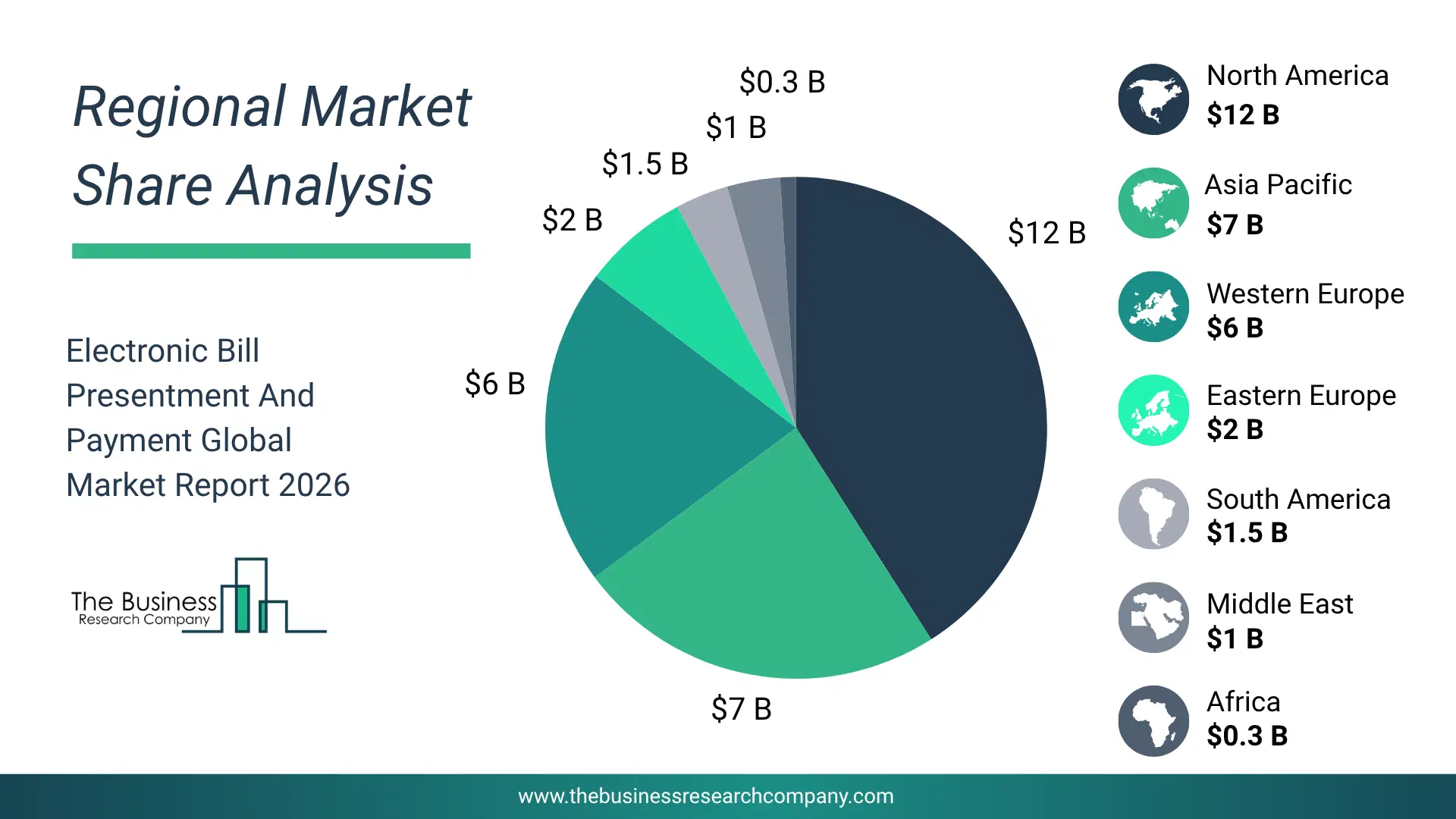
Regional Outlook
North America was the largest region in the electronic bill presentment and payment market in 2025. Asia-Pacific is expected to be the fastest-growing region in the forecast period. The regions covered in this market report are Asia-Pacific, South East Asia, Western Europe, Eastern Europe, North America, South America, Middle East, Africa. The countries covered in this market report are Australia, Brazil, China, France, Germany, India, Indonesia, Japan, Taiwan, Russia, South Korea, UK, USA, Canada, Italy, Spain.What Defines the Electronic Bill Presentment And Payment Market?
The electronic bill presentment and payment market consists of revenues earned by entities by providing services such as electronic bill creation, bill delivery, payment processing, real-time data synchronization, and integration with external financial systems. The market value includes the value of related goods sold by the service provider or included within the service offering. The electronic bill presentment and payment market also includes sales of electronic bill presentment software platforms, web-based billing applications, mobile billing applications, custom billing solutions, and embedded payment modules. Values in this market are ‘factory gate’ values, that is, the value of goods sold by the manufacturers or creators of the goods, whether to other entities (including downstream manufacturers, wholesalers, distributors, and retailers) or directly to end customers. The value of goods in this market includes related services sold by the creators of the goods.How is Market Value Defined and Measured?
The market value is defined as the revenues that enterprises gain from the sale of goods and/or services within the specified market and geography through sales, grants, or donations in terms of the currency (in USD unless otherwise specified). The revenues for a specified geography are consumption values that are revenues generated by organizations in the specified geography within the market, irrespective of where they are produced. It does not include revenues from resales along the supply chain, either further along the supply chain or as part of other products.
This chart presents market attractiveness based on a quantitative evaluation of growth, competition, strategic alignment, and risk, offering a clear view of opportunity areas for decision-making. This chart is for illustrative purposes; the full report contains the complete analysis.

This chart highlights the Total Addressable Market (TAM) by estimating the maximum revenue opportunity using an assumption-driven approach, supporting strategic planning and opportunity sizing across markets. The chart is illustrative; the full report provides a more comprehensive analysis.
What Key Data and Analysis Are Included in the Electronic Bill Presentment And Payment Market Report 2026?
The electronic bill presentment and payment market research report is one of a series of new reports from The Business Research Company that provides market statistics, including Market Report 2026?global market size, regional shares, competitors with the market share, detailed market segments, market trends and opportunities, and any further data you may need to thrive in the electronic bill presentment and payment Market Report 2026? The market research report delivers a complete perspective of everything you need, with an in-depth analysis of the current and future state of the Market Report 2026?Electronic Bill Presentment And Payment Market Report Forecast Analysis
| Report Attribute | Details |
|---|---|
| Market Size Value In 2026 | $34.03 billion |
| Revenue Forecast In 2030 | $55.03 billion |
| Growth Rate | CAGR of 13.1% from 2026 to 2030 |
| Base Year For Estimation | 2025 |
| Actual Estimates/Historical Data | 2020-2025 |
| Forecast Period | 2026 - 2030 - 2035 |
| Market Representation | Revenue in USD Billion and CAGR from 2026 to 2030 |
| Segments Covered | Component, Product, Deployment Mode, Payment Methods, End Use Industries |
| Regional Scope | Asia-Pacific, Western Europe, Eastern Europe, North America, South America, Middle East, Africa |
| Country Scope | The countries covered in the report are Australia, Brazil, China, France, Germany, India, Indonesia, Japan, Taiwan, Russia, South Korea, UK, USA, Canada, Italy, Spain. |
| Key Companies Profiled | Oracle Corporation, SAP SE, PayPal Holdings Inc., Mastercard Incorporated, Fiserv Inc., Fidelity National Information Services Inc., Broadridge Financial Solutions Inc., Jack Henry & Associates Inc., BTRS Holdings Inc., Temenos AG, CyberSource Corporation, Paymentus Holdings Inc., Bottomline Technologies Inc., Striata, Pagero AB, ACI Worldwide Inc., Enterprise jBilling Software Ltd., Jopari Solutions Inc., MaxBill s.r.o., AMCS Group, MuniBilling |
| Customization Scope | Request for Customization |
| Pricing And Purchase Options | Explore Purchase Options |