
Energy Efficient Devices Market Report 2026
Global Outlook – By Component (Hardware, Software, Services), By System Type (Industrial Energy Management Systems (IEMS), Building Energy Management Systems (BEMS), Home Energy Management Systems (HEMS)), By Vertical (Residential, Energy And Power, Telecom And Information Technology (IT), Manufacturing, Retail, Healthcare, Other Verticals) – Market Size, Trends, Strategies, and Forecast to 2030
Energy Efficient Devices Market Overview
• Energy Efficient Devices market size has reached to $1221.14 billion in 2025 • Expected to grow to $2017.82 billion in 2030 at a compound annual growth rate (CAGR) of 10.4% • Growth Driver: Government Energy Efficiency Initiatives Driving Growth In The Energy-Efficient Lighting Market • Market Trend: Smart Internet of Things (IoT) Solutions Transforming Markets • North America was the largest region in 2025 and Asia-Pacific is the fastest growing region.What Is Covered Under Energy Efficient Devices Market?
Energy efficient devices refer to appliances, equipment, or systems designed to consume less energy while delivering comparable performance to traditional counterparts. These are designed with the primary purpose of minimizing energy consumption while maintaining or improving performance and reducing the overall demand on energy production. The main components of energy efficient devices are hardware, software, and services. Energy-efficient devices hardware refers to the physical components and technologies used in appliances, equipment, and systems designed to reduce energy consumption. They are used in industrial energy management systems (IEMS), building energy management systems (BEMS), and home energy management systems (HEMS) by residential, energy and power, telecom and information technology (IT), manufacturing, retail, healthcare, and others.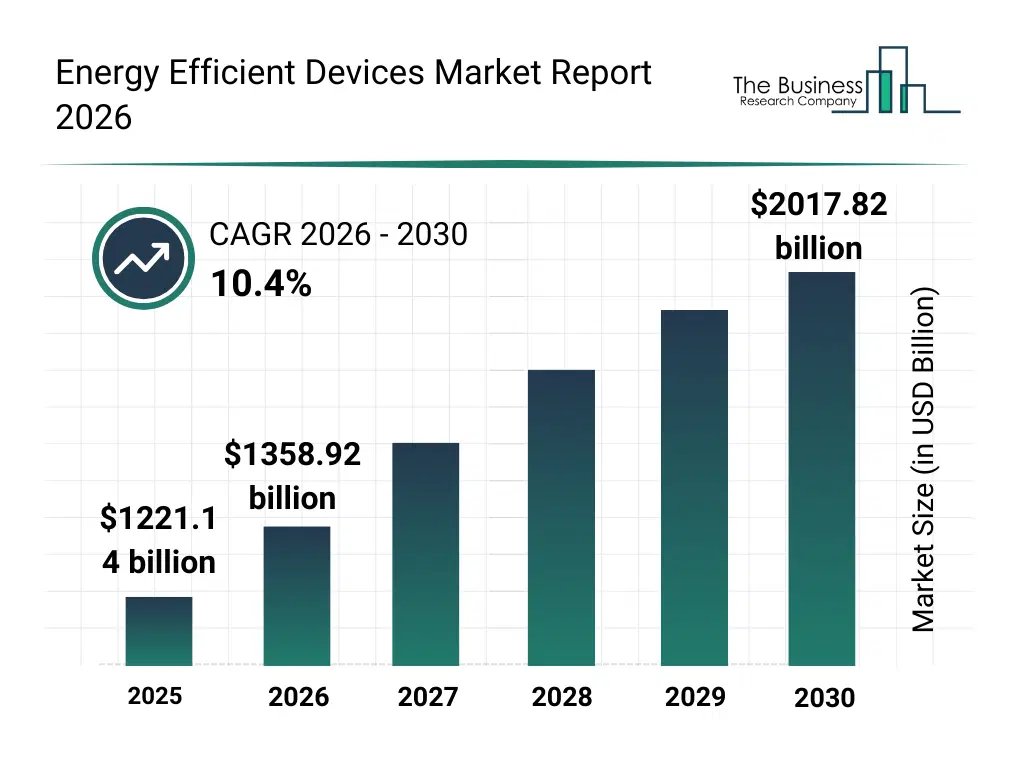
What Is The Energy Efficient Devices Market Size and Share 2026?
The energy efficient devices market size has grown rapidly in recent years. It will grow from $1221.14 billion in 2025 to $1358.92 billion in 2026 at a compound annual growth rate (CAGR) of 11.3%. The growth in the historic period can be attributed to rising energy costs across industries, implementation of energy efficiency regulations, increased deployment of smart building systems, availability of efficient power electronics, growth in industrial automation.What Is The Energy Efficient Devices Market Growth Forecast?
The energy efficient devices market size is expected to see rapid growth in the next few years. It will grow to $2017.82 billion in 2030 at a compound annual growth rate (CAGR) of 10.4%. The growth in the forecast period can be attributed to increasing adoption of renewable energy integration, expansion of smart grid infrastructure, rising demand for net-zero buildings, growing investments in digital energy platforms, increasing focus on carbon footprint reduction. Major trends in the forecast period include increasing adoption of smart energy management systems, rising demand for low-power consumption devices, growing integration of iot-enabled energy monitoring, expansion of predictive maintenance solutions, enhanced focus on lifecycle energy efficiency.Tariff Impact On Energy Efficient Devices Market
Tariffs are affecting the energy efficient devices market by increasing the cost of imported semiconductors, sensors, power electronics, batteries, and advanced control hardware used in energy management systems. Industrial, commercial, and residential deployments in North America and Europe are most impacted due to dependence on imported electronic components, while Asia-Pacific manufacturers face pricing pressure in export markets. These tariffs are raising system installation costs and slowing large-scale energy efficiency retrofits. At the same time, tariffs are encouraging domestic electronics manufacturing, local assembly of energy-efficient devices, and accelerated innovation in cost-optimized hardware and software solutions.
Global Energy Efficient Devices Market Segmentation
1) By Component: Hardware, Software, Services 2) By System Type: Industrial Energy Management Systems (IEMS), Building Energy Management Systems (BEMS), Home Energy Management Systems (HEMS) 3) By Vertical: Residential, Energy And Power, Telecom And Information Technology (IT), Manufacturing, Retail, Healthcare, Other Verticals Subsegments: 1) By Hardware: Sensors, Actuators, Power Supplies, Controllers, Batteries, LED Lighting, Energy-efficient Appliances 2) By Software: Energy Management Software, Automation Software, Monitoring And Analytics Software, Smart Grid Software, Predictive Maintenance Software 3) By Services: Installation Services, Maintenance And Support Services, Consulting And Advisory Services, Managed Services, System Integration ServicesWhat Is The Driver Of The Energy Efficient Devices Market?
The government's energy-efficiency initiatives are expected to fuel the growth of the energy-efficient devices market going forward. Energy-efficiency initiatives refer to programs, policies, or actions implemented to reduce energy consumption and increase energy efficiency. Government energy-efficiency initiatives are pivotal in advancing energy-efficient devices through the establishment of standards, incentivizing adoption, increasing awareness, supporting research and development, implementing building codes, and promoting cross-sector collaboration. For instance, in March 2024, according to the Department for Energy Security and Net Zero, a UK-based government department, during 2023, around 318,600 energy efficiency measures were installed through government schemes, an increase of 49% compared with 2022. Therefore, the government's energy-efficiency initiatives are driving the energy-efficient devices market.Key Players In The Global Energy Efficient Devices Market
Major companies operating in the energy efficient devices market are Samsung Electronics, Siemens AG, GE Electric, Panasonic Corporation, Mitsubishi Electric Corporation, Schneider Electric SE, Honeywell International Inc., ABB Ltd., Daikin Industries Ltd., Toshiba Corporation, Johnson Controls International plc, Eaton Corporation, Carrier Global Corporation, Koninklijke Philips N.V., Trane Technologies, Emerson Electric Co., Legrand Group, Osram Group, Acuity Brands Inc., Itron Inc., Zumtobel Group, Cree Inc., Crompton Greaves Consumer Electricals Limited, Danfoss Group
This chart is for illustrative purposes; the full report includes a detailed competitor analysis and comprehensive overview of the top 10 companies in the market.
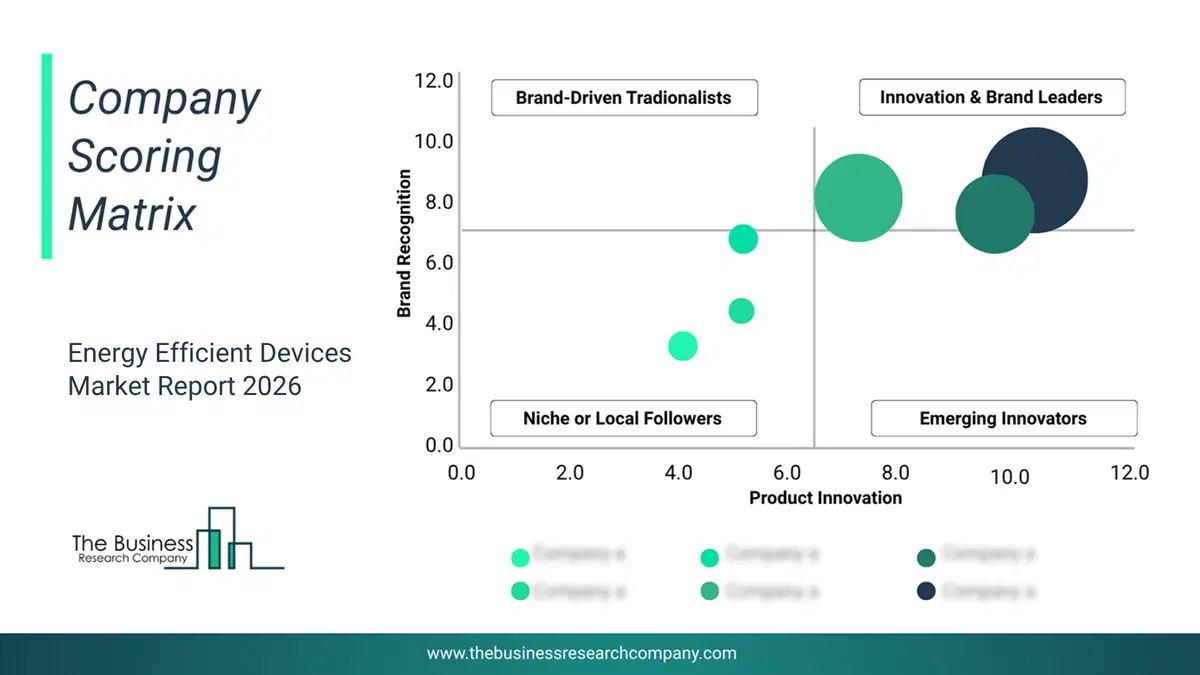
This chart maps companies by product innovation and brand strength, with bubble size indicating relative revenue, helping identify market leaders, challengers, and niche players. This is an illustrative chart; the full report provides a complete and accurate competitive analysis.
Global Energy Efficient Devices Market Trends and Insights
Major companies operating in the energy-efficient devices market are focused on developing innovative products with advanced technologies, such as smart IoT solutions, to increase their profitability in the market. Smart IoT solutions are crucial in promoting energy efficiency across various domains, including homes, buildings, industries, and cities, ultimately contributing to sustainability and environmental conservation efforts. For instance, in March 2023, Siemens AG, a Germany-based energy technology and manufacturing company, launched Connect Box. Connect Box is an IoT solution for small to medium-sized buildings, seamlessly integrating wired/wireless devices. It optimizes energy usage, monitors performance, and enhances indoor air quality through real-time analysis. With a plug-and-play setup, diverse licensing options, and user-friendly interfaces, it caters to varied needs while ensuring compliance with sustainability regulations and delivering up to 30% energy savings.What Are Latest Mergers And Acquisitions In The Energy Efficient Devices Market?
In June 2023, ABB Group, a Switzerland-based technology company, acquired Eve Systems for an undisclosed amount. This acquisition enhances ABB's position as an energy-efficient smart home solutions expert and underscores its commitment to innovation and sustainability in the electrification sector. Eve Systems is a Germany-based company specializing in energy-efficient devices, such as the smart plug and power meter, which offers built-in schedules, voice control, and bluetooth low-energy connectivity.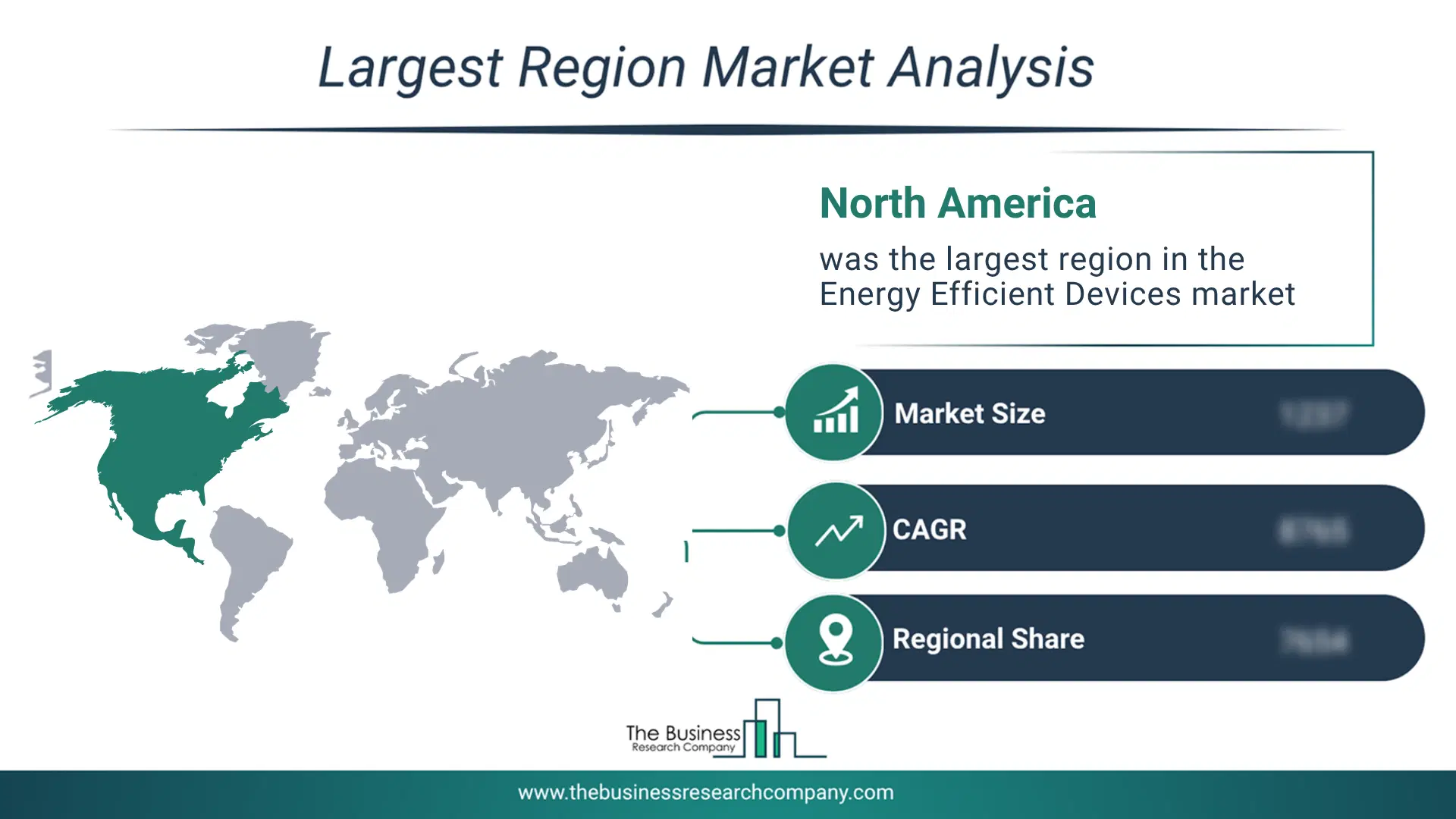
Regional Outlook
North America was the largest region in the energy efficient devices market in 2025. Asia-Pacific is expected to be the fastest-growing region in the forecast period. The regions covered in this market report are Asia-Pacific, South East Asia, Western Europe, Eastern Europe, North America, South America, Middle East, Africa The countries covered in this market report are Australia, Brazil, China, France, Germany, India, Indonesia, Japan, Taiwan, Russia, South Korea, UK, USA, Canada, Italy, Spain.What Defines the Energy Efficient Devices Market?
The energy efficient devices market consists of sales of lighting solutions, HVAC (heating, ventilation, and air conditioning) systems, smart appliances, and energy-efficient motors. Values in this market are ‘factory gate’ values, that is the value of goods sold by the manufacturers or creators of the goods, whether to other entities (including downstream manufacturers, wholesalers, distributors and retailers) or directly to end customers. The value of goods in this market includes related services sold by the creators of the goods.How is Market Value Defined and Measured?
The market value is defined as the revenues that enterprises gain from the sale of goods and/or services within the specified market and geography through sales, grants, or donations in terms of the currency (in USD unless otherwise specified). The revenues for a specified geography are consumption values that are revenues generated by organizations in the specified geography within the market, irrespective of where they are produced. It does not include revenues from resales along the supply chain, either further along the supply chain or as part of other products.
This chart presents market attractiveness based on a quantitative evaluation of growth, competition, strategic alignment, and risk, offering a clear view of opportunity areas for decision-making. This chart is for illustrative purposes; the full report contains the complete analysis.

This chart highlights the Total Addressable Market (TAM) by estimating the maximum revenue opportunity using an assumption-driven approach, supporting strategic planning and opportunity sizing across markets. The chart is illustrative; the full report provides a more comprehensive analysis.
What Key Data and Analysis Are Included in the Energy Efficient Devices Market Report 2026?
The energy efficient devices market research report is one of a series of new reports from The Business Research Company that provides market statistics, including industry global market size, regional shares, competitors with the market share, detailed market segments, market trends and opportunities, and any further data you may need to thrive in the energy efficient devices industry. The market research report delivers a complete perspective of everything you need, with an in-depth analysis of the current and future state of the industry.Energy Efficient Devices Market Report Forecast Analysis
| Report Attribute | Details |
|---|---|
| Market Size Value In 2026 | $1358.92 billion |
| Revenue Forecast In 2030 | $2017.82 billion |
| Growth Rate | CAGR of 10.4% from 2026 to 2030 |
| Base Year For Estimation | 2025 |
| Actual Estimates/Historical Data | 2020-2025 |
| Forecast Period | 2026 - 2030 |
| Market Representation | Revenue in USD Billion and CAGR from 2026 to 2030 |
| Segments Covered | Component, System Type, Vertical |
| Regional Scope | Asia-Pacific, Western Europe, Eastern Europe, North America, South America, Middle East, Africa |
| Key Companies Profiled | Samsung Electronics, Siemens AG, GE Electric, Panasonic Corporation, Mitsubishi Electric Corporation, Schneider Electric SE, Honeywell International Inc., ABB Ltd., Daikin Industries Ltd., Toshiba Corporation, Johnson Controls International plc, Eaton Corporation, Carrier Global Corporation, Koninklijke Philips N.V., Trane Technologies, Emerson Electric Co., Legrand Group, Osram Group, Acuity Brands Inc., Itron Inc., Zumtobel Group, Cree Inc., Crompton Greaves Consumer Electricals Limited, Danfoss Group |
| Customization Scope | Request for Customization |
| Pricing And Purchase Options | Explore Purchase Options |