

Healthcare Buildings Market Report 2026
Global Outlook – By Facility Type (Hospitals, Ambulatory Surgery Centers, Long Term Care Facilities And Nursing Homes, Academic Institutes, Other Facility Types), By Service Type (New Construction, Refurbishment ), By Healthcare Type (Public Healthcare, Private Healthcare) – Market Size, Trends, Strategies, and Forecast to 2030
Healthcare Buildings Market Overview
• Healthcare Buildings market size has reached to $299.48 billion in 2025 • Expected to grow to $353.62 billion in 2030 at a compound annual growth rate (CAGR) of 3.5% • Growth Driver: Rising Healthcare Expenditure Fuels Growth In The Healthcare Buildings Market • Market Trend: Innovative Product Developments Reshaping Hospital Buildings Market • North America was the largest region in 2025.Market Gains By 2030 – Top Opportunities By Segment
Market Gain identifies the most promising market opportunities by highlighting the segments or products expected to generate the highest incremental revenue growth over the next five years.
What Is Covered Under Healthcare Buildings Market?
Healthcare buildings refer to structures used for medical procedures. It is further defined as a building that houses a hospital and associated operations, such as laboratories, laundries, outpatient departments, nurse homes, training activities, and central service operations linked to a hospital, in addition to a building that houses educational or training programs for medical professionals that is operated as an essential element of a hospital. The main facility type of healthcare buildings include hospitals, ASCs, long-term care facilities and nursing homes, academic institutes, and others. A hospital is a type of healthcare building that offers patients specialized medical and nursing care along with medicinal supplies. These facilities include halls, waiting rooms, labs, surgical rooms, and other areas where people's health is treated. The service types included are new construction and refurbishment for public healthcare and private healthcare buildings.
What Is The Healthcare Buildings Market Size and Share 2026?
The healthcare buildings market size has grown steadily in recent years. It will grow from $299.48 billion in 2025 to $307.69 billion in 2026 at a compound annual growth rate (CAGR) of 2.7%. The growth in the historic period can be attributed to growth in hospital infrastructure development, rising demand for acute care facilities, expansion of public healthcare investments, reliance on conventional construction methods, increasing need for specialized medical spaces.What Is The Healthcare Buildings Market Growth Forecast?
The healthcare buildings market size is expected to see steady growth in the next few years. It will grow to $353.62 billion in 2030 at a compound annual growth rate (CAGR) of 3.5%. The growth in the forecast period can be attributed to growing demand for technologically advanced healthcare facilities, expansion of refurbishment and modernization programs, rising investment in outpatient and specialty care centers, increasing emphasis on sustainable healthcare design, development of modular and prefabricated medical buildings. Major trends in the forecast period include growth in hospital infrastructure expansion, increasing demand for specialized care facilities, rising focus on infection-control architectural design, expansion of refurbishment and modernization projects, higher emphasis on patient-centric building layouts.
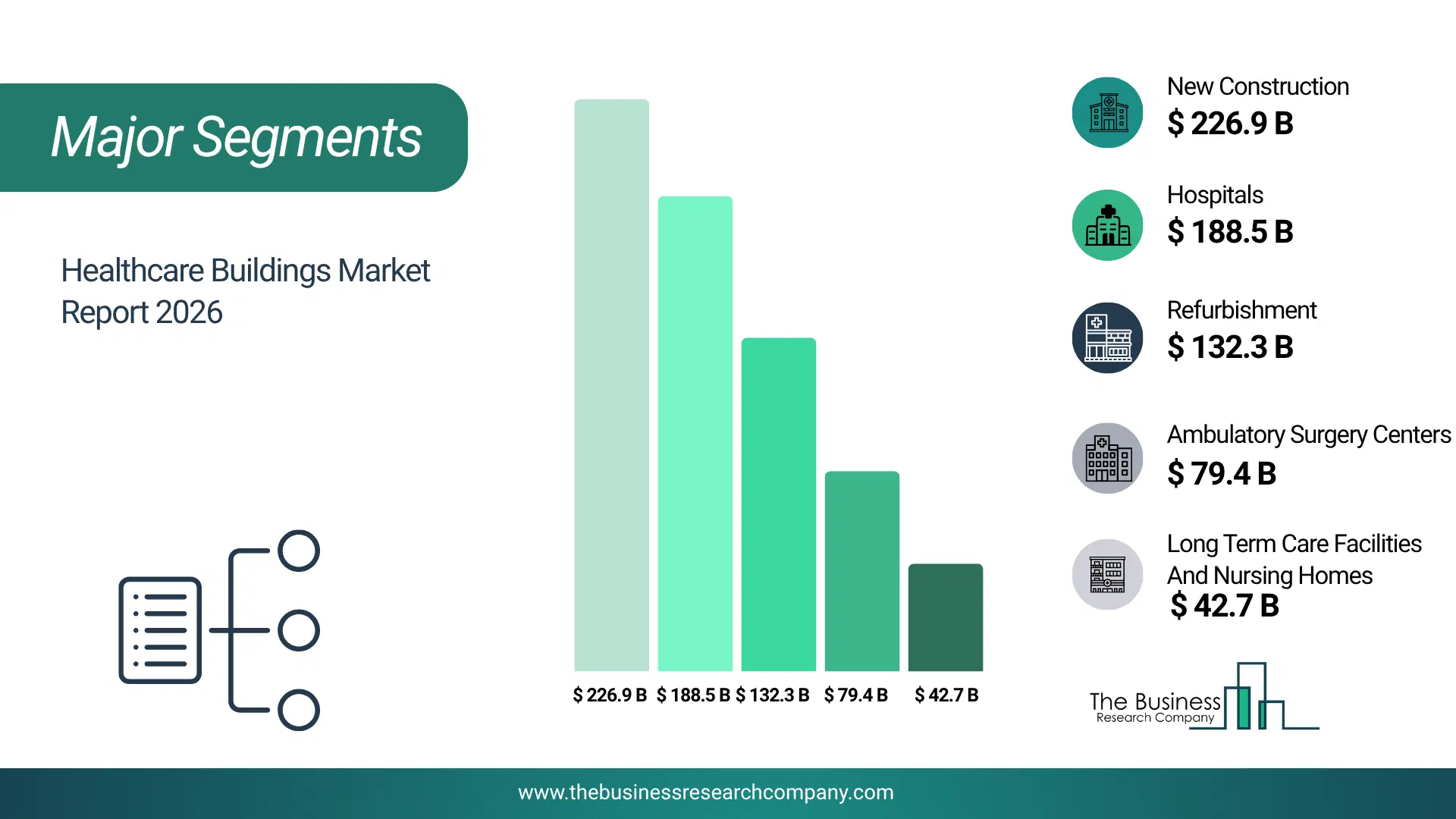
Global Healthcare Buildings Market Segmentation
1) By Facility Type: Hospitals, Ambulatory Surgery Centers, Long Term Care Facilities And Nursing Homes, Academic Institutes, Other Facility Types 2) By Service Type: New Construction, Refurbishment 3) By Healthcare Type: Public Healthcare, Private Healthcare Subsegments: 1) By Hospitals: General Hospitals, Specialty Hospitals 2) By Ambulatory Surgery Centers: Outpatient Surgery Centers, Same-Day Surgery Centers 3) By Long Term Care Facilities And Nursing Homes: Skilled Nursing Facilities, Assisted Living Facilities 4) By Academic Institutes: Medical Schools, Research Institutions 5) By Other Facility Types: Urgent Care Centers, Rehabilitation Facilities, Diagnostic Imaging Centers The top segments in the healthcare buildings market will be: • New Construction will reach $226952.9 Million by 2030. • Hospitals will reach $188511.6 Million by 2030. • Refurbishment will reach $132331.1 Million by 2030. • Ambulatory Surgery Centers will reach $79421.2 Million by 2030. • Long Term Care Facilities And Nursing Homes will reach $42742.12 Million by 2030.What Is The Driver Of The Healthcare Buildings Market?
The increasing healthcare expenditure is expected to propel the growth of the healthcare buildings market going forward. Healthcare expenditure refers to the total amount of money spent on healthcare goods and services, including medical equipment, hospital services, physician services, prescription drugs, and public health activities. Healthcare expenditure, or the investment in healthcare infrastructure and services, is beneficial for healthcare buildings in several ways. For instance, in 2023, according to the American Medical Association, a US-based professional association for physicians and medical students, Healthcare spending increased by 7.5% in 2023, marking a notable rise compared to the 4.6% growth recorded in 2022. Therefore, the increasing healthcare expenditure is driving the growth of the healthcare-building market.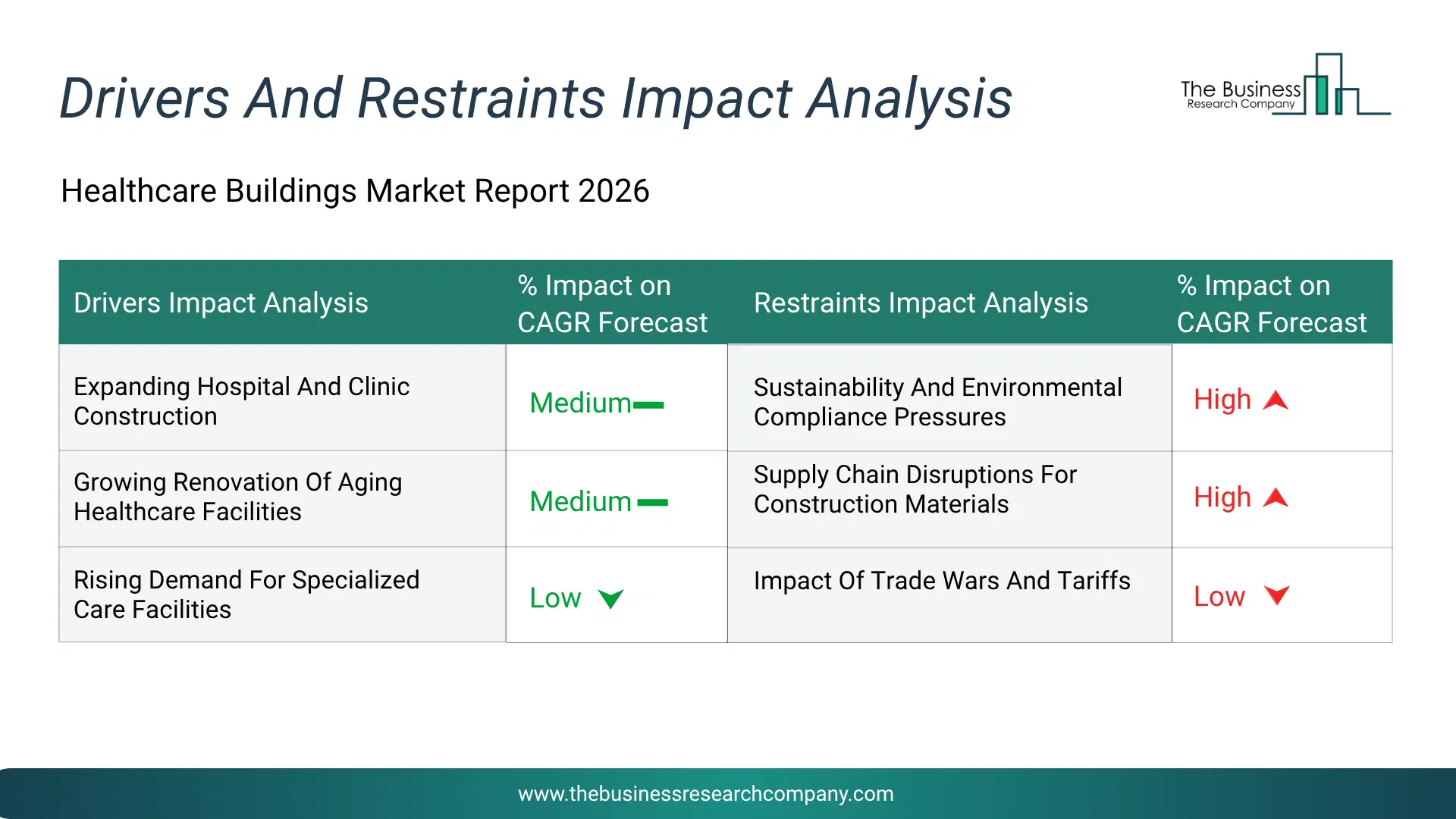
Infographic Chart Showing Key Market Drivers Analysis And Restraints For Healthcare Buildings Market
The chart presents an impact analysis of key drivers and restraints, quantifying their relative influence on the market's growth rate and helping assess the balance between growth enablers and limiting factors. This chart offers a high-level perspective; the full report contains more detailed insights.
How Will The Drivers Impact Growth In The Global Healthcare Buildings Market?
• Expanding Hospital And Clinic Construction (Medium) – During the forecast period, the expanding hospital and clinic construction is expected to driver growth in the healthcare buildings market. As governments and private healthcare providers continue to increase investments in healthcare infrastructure to address rising patient populations, aging demographics, and the growing prevalence of chronic diseases, the demand for modern medical facilities is increasing significantly. Hospital and clinic construction refers to the development of specialized healthcare infrastructure designed to deliver medical diagnosis, treatment, surgical care, and outpatient services, including general hospitals, specialty clinics, diagnostic centers, and community health facilities. These facilities are built with advanced medical layouts, patient-centric designs, infection control systems, and integrated medical technologies to support efficient healthcare delivery. The rapid expansion of hospital and clinic construction projects is increasing the demand for new healthcare facilities, infrastructure upgrades, and technologically advanced medical environments. Consequently, the growing development of hospitals and clinics is driving greater demand for specialized construction services, medical infrastructure planning, facility expansion, and healthcare-focused building solutions in the healthcare buildings market. The growth in expanding hospital and clinic construction growth contribution during the forecast period in 2026 is 1.0%. • Growing Renovation Of Aging Healthcare Facilities (Medium) – During the forecast period, the growing renovation of aging healthcare facilities is expected to propel growth in the healthcare buildings market. As hospitals, clinics, and other medical institutions continue to modernize outdated infrastructure to meet evolving healthcare standards and patient care requirements, the demand for advanced healthcare building development and renovation is increasing significantly. Healthcare facility renovation refers to the process of upgrading, repairing, and modernizing existing medical buildings to improve functionality, safety, energy efficiency, and compliance with regulatory standards, while incorporating new medical technologies and patient-centered design features. Many healthcare facilities constructed decades ago are now facing structural wear, outdated layouts, and limited capacity to accommodate modern medical equipment and digital health systems, creating a strong need for large-scale renovation and infrastructure upgrades. The increasing focus on improving patient experience, infection control measures, energy-efficient systems, and flexible treatment spaces is encouraging healthcare providers to invest heavily in the refurbishment and expansion of existing healthcare infrastructure. The growing number of renovation and modernization projects across hospitals, outpatient centers, and specialized treatment facilities is driving greater demand for construction services, architectural design, advanced building materials, and integrated healthcare infrastructure solutions in the healthcare buildings market. The growth in growing renovation of aging healthcare facilities growth contribution during the forecast period in 2026 is 1.0%. • Rising Demand For Specialized Care Facilities (Low) – During the forecast period, the rising demand for specialized care facilities is expected to propel growth in the healthcare buildings market. As healthcare systems increasingly focus on delivering targeted medical services for specific patient groups, the need for purpose-built healthcare infrastructure is growing significantly. Specialized care facilities refer to medical buildings designed to provide focused treatment and long-term management for particular health conditions or patient populations, including rehabilitation center, oncology treatment center, maternity hospitals, mental health facilities, and long-term care institutions. These facilities are equipped with specialized medical technologies, patient-centred layouts, and advanced clinical support systems that enable healthcare providers to deliver more efficient and tailored care compared to general hospitals. The growing prevalence of chronic diseases, aging populations, and the increasing emphasis on specialized treatment pathways are accelerating the demand for dedicated medical environments. As a result, healthcare providers and investors are expanding and constructing specialized healthcare facilities to enhance treatment capacity and improve patient outcomes, which is driving greater demand for modern hospitals, ambulatory surgical centres, long-term care facilities, rehabilitation centres, and specialty clinics within the healthcare buildings market. The growth in rising demand for specialized care facilities growth contribution during the forecast period in 2026 is 0.8%. • Growth In Private Healthcare Investments And PPP Models (Low) – During the forecast period, the growth in private healthcare investments and public–private partnership (PPP) models is expected driver the expansion of the healthcare buildings market. As governments and private sector stakeholders increasingly collaborate to expand healthcare infrastructure, the demand for modern hospitals, specialty care centres, and integrated medical campuses is rising significantly. Private healthcare investments refer to capital funding provided by private hospitals, healthcare chains, real estate developers, and institutional investors to develop and upgrade medical infrastructure, while public–private partnership (PPP) models involve collaborative agreements between government bodies and private organizations to finance, build, and operate healthcare facilities. These investment approaches enable faster infrastructure development, improved access to advanced medical services, and enhanced operational efficiency in healthcare systems. The growing emphasis on strengthening healthcare capacity through privately funded projects and PPP initiatives is increasing the construction of new hospitals, outpatient facilities, long-term care centres, and research hospitals. Consequently, the expansion of private healthcare funding and PPP-driven infrastructure projects is driving greater demand for modern healthcare facility design, construction, and infrastructure development in the healthcare buildings market. The growth in growth in private healthcare investments and public–private partnership growth contribution during the forecast period in 2026 is 0.5%.How Will The Restraints Impact Growth In The Global Healthcare Buildings Market?
• Sustainability And Environmental Compliance Pressures (Medium) – During the forecast period, the sustainability and environmental compliance pressures are expected to restrict the growth of the healthcare buildings market. As healthcare infrastructure expands to accommodate rising patient volumes and advanced medical technologies, developers and healthcare organizations are increasingly required to comply with strict environmental regulations, energy efficiency standards, and green building certifications. The growing emphasis on reducing carbon emissions, managing construction waste, improving energy efficiency, and integrating sustainable materials makes the design and construction of healthcare facilities more complex and costly compared to conventional buildings. The presence of stringent environmental compliance requirements can extend project approval timelines, increase construction and operational expenses, and require additional investments in energy-efficient systems, water management infrastructure, and sustainable construction practices, thereby raising the overall cost of healthcare infrastructure development and slowing the pace of new facility construction, ultimately constraining the growth of the healthcare buildings market. Growth affected by sustainability and environmental compliance pressures during the forecast period in 2026 is -2.8%. • Supply Chain Disruptions For Construction Materials (Medium) – During the forecast period, supply chain disruptions for construction materials are expected to restrict the growth of the healthcare buildings market. As governments, private healthcare providers, and construction firms continue to invest in expanding hospitals, clinics, and specialized care facilities, interruptions in the supply of essential construction materials such as steel, cement, glass, and mechanical equipment create significant challenges for project execution. The increasing complexity of modern healthcare infrastructure, which requires advanced building systems, specialized medical-grade materials, and strict compliance with safety and regulatory standards, makes construction projects highly dependent on consistent and timely material availability. The presence of supply chain disruptions can delay project timelines, increase procurement and transportation costs, and create uncertainty in construction planning, thereby raising overall development expenses and slowing the completion of new healthcare facilities, ultimately constraining the growth of construction activities across the healthcare buildings market. Growth affected by supply chain disruptions for construction materials during the forecast period in 2026 is -2.0%. • Impact Of Trade Wars And Tariffs (Low) – During the forecast period, the impact of trade wars and tariffs is expected to restrict the growth of the healthcare buildings market. As governments around the world implement protective trade policies and impose tariffs on imported construction materials, medical equipment, and specialized building components, healthcare infrastructure projects face increasing cost pressures and supply chain disruptions. Healthcare buildings rely heavily on high-quality materials such as steel, aluminum, advanced HVAC systems, medical-grade equipment, and specialized electrical components, many of which are sourced through global supply chains. The presence of trade restrictions and higher import duties can increase the cost of these essential materials and technologies, making large-scale healthcare construction projects more expensive for governments, private healthcare providers, and investors. Rising material costs and procurement delays can slow down project approvals, extend construction timelines, and force developers to reconsider or postpone planned healthcare infrastructure expansions, thereby limiting the pace of new facility development and restraining the overall growth of the healthcare buildings market during the forecast period. Growth affected by impact of trade wars and tariffs during the forecast period in 2026 is -0.3%.Key Players In The Global Healthcare Buildings Market
Major companies operating in the healthcare buildings market are Hochtief AG, Skanska AB, Balfour Beatty plc, DPR Construction, Royal BAM Group, AECOM Technology, Kier Group plc, McCarthy Holdings Inc, Vaughn Construction, JE Dunn Construction, Hiranandani Constructions, Taisei Corporation, Sungdo Engineering & Construction Co. Ltd., Hansen Yuncken, PORR, Bouygues Construction, Eiffage, Turner Construction, Brasfield & Gorrie, The Boldt Company, Bechtel, Techint Engineering & Construction, Acciona, Arabtec Construction LLC, Saudi Binladin Group (SBG), Olayan Group, Aveng Group, Orascom Construction, Hassan Allam Holding, Arbico Plc.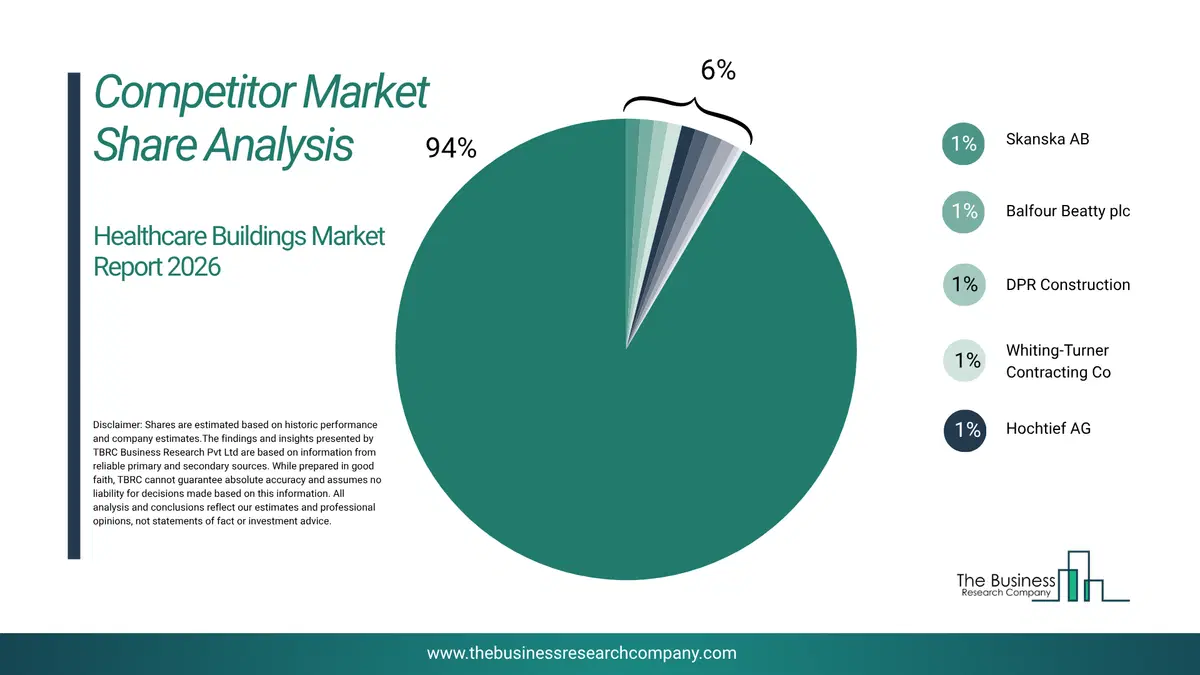
This chart is for illustrative purposes; the full report includes a detailed competitor analysis and comprehensive overview of the top 10 companies in the market.
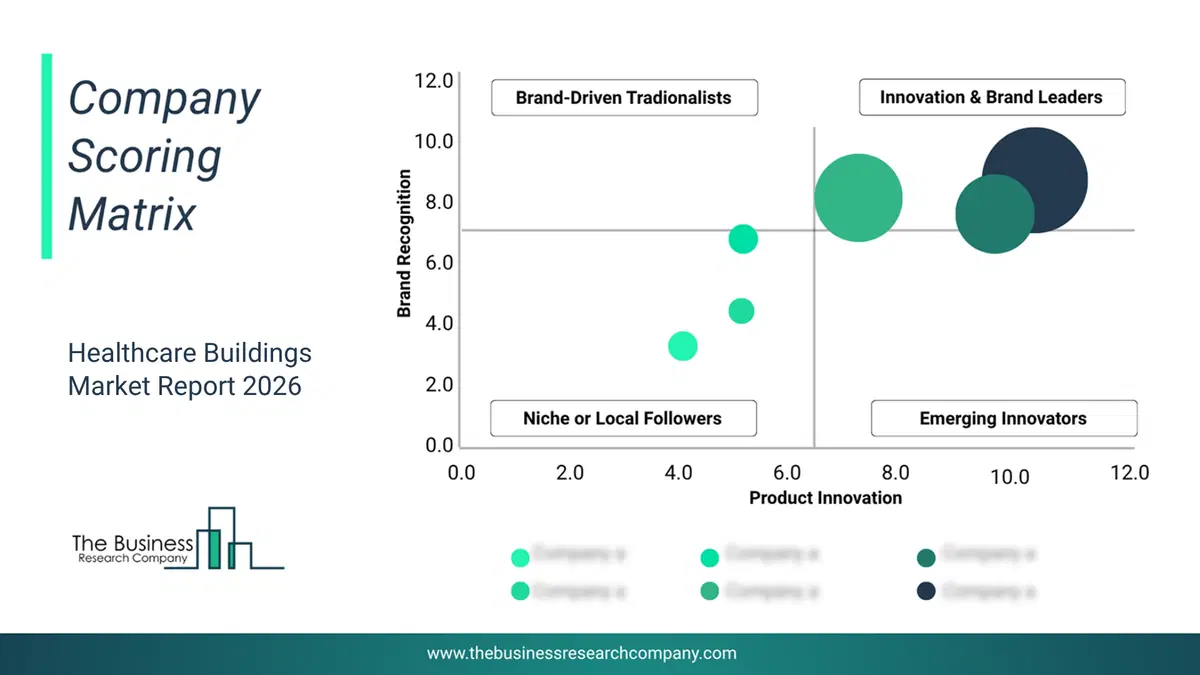
This chart maps companies by product innovation and brand strength, with bubble size indicating relative revenue, helping identify market leaders, challengers, and niche players. This is an illustrative chart; the full report provides a complete and accurate competitive analysis.
Global Healthcare Buildings Market Trends and Insights
Product innovation is the key trend gaining popularity in the hospital buildings market. Major companies operating in the hospital buildings market are focused on developing innovative products to strengthen their position in the market. For instance, in February 2023, RSC Architects, a US-based architectural firm, unveiled the Helena Theurer Pavilion, a 530,000-square-foot Helena Theurer Pavilion at Hackensack University Medical Center. This innovative nine-story surgical and intensive care tower is increasing the bar for patient care expertise in the New York metropolitan area. The Pavilion has all-private patient rooms and the newest 'smart hospital' technology, and every aspect has been carefully considered to provide patients with a fantastic experience.What Are Latest Mergers And Acquisitions In The Healthcare Buildings Market?
In May 2024, Healthcare Realty Trust Incorporated, a US-based real estate investment trust (REIT) focused on owning, managing, and developing medical outpatient buildings, partnered with KKR & Co. Inc. to own and invest in medical outpatient properties across the United States. Through this collaboration, Healthcare Realty Trust aims to expand its investment capacity, strengthen its portfolio diversification, and enhance its access to long-term capital for healthcare real estate development. KKR & Co. Inc. is a US-based investment firm that provides alternative asset management, private equity, and real estate investment services.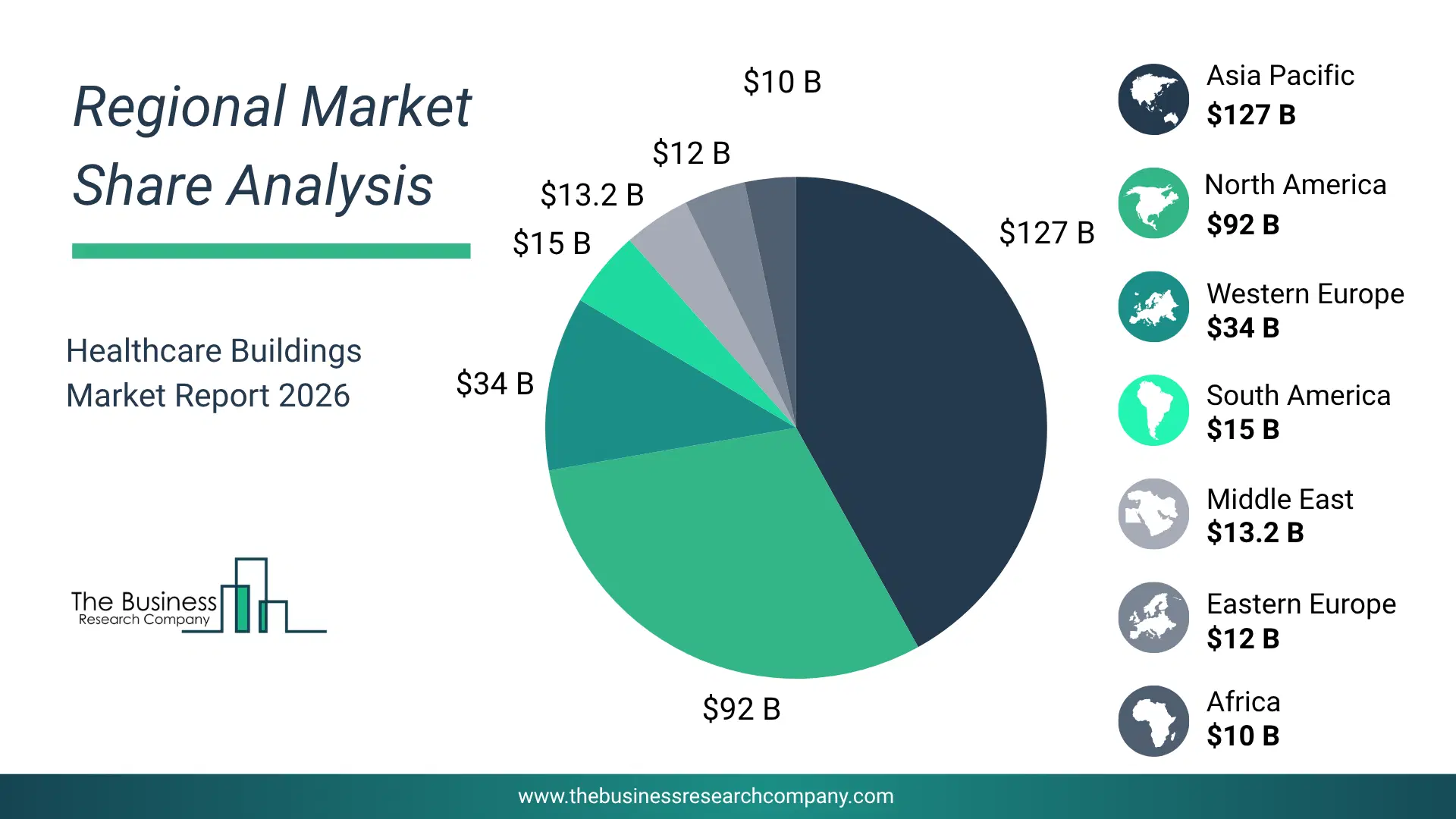
Regional Insights
North America was the largest region in the healthcare buildings market in 2025. The regions covered in this market report are Asia-Pacific, South East Asia, Western Europe, Eastern Europe, North America, South America, Middle East, Africa. The countries covered in this market report are Australia, Brazil, China, France, Germany, India, Indonesia, Japan, Taiwan, Russia, South Korea, UK, USA, Canada, Italy, Spain.What Defines the Healthcare Buildings Market?
The healthcare buildings market includes revenues earned by entities by constructing hospitals, birth centers, ambulatory surgical centers, mental health, and addiction treatment centers. The market value includes the value of related goods sold by the service provider or included within the service offering. Only goods and services traded between entities or sold to end consumers are included.How is Market Value Defined and Measured?
The market value is defined as the revenues that enterprises gain from the sale of goods and/or services within the specified market and geography through sales, grants, or donations in terms of the currency (in USD unless otherwise specified). The revenues for a specified geography are consumption values that are revenues generated by organizations in the specified geography within the market, irrespective of where they are produced. It does not include revenues from resales along the supply chain, either further along the supply chain or as part of other products.
This chart presents market attractiveness based on a quantitative evaluation of growth, competition, strategic alignment, and risk, offering a clear view of opportunity areas for decision-making. This chart is for illustrative purposes; the full report contains the complete analysis.

This chart highlights the Total Addressable Market (TAM) by estimating the maximum revenue opportunity using an assumption-driven approach, supporting strategic planning and opportunity sizing across markets. The chart is illustrative; the full report provides a more comprehensive analysis.
What Key Data and Analysis Are Included in theHealthcare Buildings Market Report 2026?
The healthcare buildings market research report is one of a series of new reports from The Business Research Company that provides market statistics, including industry global market size, regional shares, competitors with the market share, detailed market segments, market trends and opportunities, and any further data you may need to thrive in the healthcare buildings industry. The market research report delivers a complete perspective of everything you need, with an in-depth analysis of the current and future state of the industry.Healthcare Buildings Market Report Forecast Analysis
| Report Attribute | Details |
|---|---|
| Market Size Value In 2026 | $307.69 billion |
| Revenue Forecast In 2030 | $353.62 billion |
| Growth Rate | CAGR of 2.7% from 2026 to 2030 |
| Base Year For Estimation | 2025 |
| Actual Estimates/Historical Data | 2020-2025 |
| Forecast Period | 2026 - 2030 - 2035 |
| Market Representation | Revenue in USD Billion and CAGR from 2026 to 2030 |
| Segments Covered | Facility Type, Service Type, Healthcare Type |
| Regional Scope | Asia-Pacific, Western Europe, Eastern Europe, North America, South America, Middle East, Africa |
| Country Scope | The countries covered in the report are Australia, Brazil, China, France, Germany, India, Indonesia, Japan, Taiwan, Russia, South Korea, UK, USA, Canada, Italy, Spain. |
| Key Companies Profiled | Hochtief AG, Skanska AB, Balfour Beatty plc, DPR Construction, Royal BAM Group, AECOM Technology, Kier Group plc, McCarthy Holdings Inc, Vaughn Construction, JE Dunn Construction, Hiranandani Constructions, Taisei Corporation, Sungdo Engineering & Construction Co. Ltd., Hansen Yuncken, PORR, Bouygues Construction, Eiffage, Turner Construction, Brasfield & Gorrie, The Boldt Company, Bechtel, Techint Engineering & Construction, Acciona, Arabtec Construction LLC, Saudi Binladin Group (SBG), Olayan Group, Aveng Group, Orascom Construction, Hassan Allam Holding, Arbico Plc. |
| Customization Scope | Request for Customization |
| Pricing And Purchase Options | Explore Purchase Options |