

Indoor 5G Market Report 2026
Global Outlook – By Component (Hardware, Software, Services), By Infrastructure (Distributed Antenna System, Multiple Antennas, Single Antenna, Distributed Antenna System (DAS) Technology), By Frequency Band (Sub-6 GHz, Millimeter Wave (MmWave), Other Frequency Bands), By Deployment Mode (Private 5G Networks, Hybrid Networks, Carrier-Provided Indoor Solutions, Neutral Host Networks, Network-As-A-Service (NaaS)), By End Use (Enterprises, Telecom Operators, Government, Healthcare Providers, Manufacturers, Hospitality And Retail, Other End Uses) – Market Size, Trends, Strategies, and Forecast to 2035
Indoor 5G Market Overview
• Indoor 5G market size has reached to $19.36 billion in 2025 • Expected to grow to $54.89 billion in 2030 at a compound annual growth rate (CAGR) of 23.1% • Growth Driver: Increasing High-Speed Internet Connectivity Fueling The Growth Of The Market Due To Wider Access And Reliable Low-Latency Data Transmission • Market Trend: Energy-Efficient Small-Cell Hardware Enables Affordable Networks • Asia-Pacific was the largest region in 2025.Market Gains By 2030 – Top Opportunities By Segment
Market Gain identifies the most promising market opportunities by highlighting the segments or products expected to generate the highest incremental revenue growth over the next five years.
What Is Covered Under Indoor 5G Market?
Indoor 5G is a high-speed wireless communication technology designed to deliver fast, low-latency connectivity within enclosed environments. It supports seamless data transmission for dense device usage, enabling smart applications, real-time communication, and enhanced indoor user experiences. The main components of indoor 5G are hardware, software, and services. Hardware refers to the physical equipment that enables high-speed 5G wireless connectivity within indoor environments. It includes various infrastructure types, such as distributed antenna systems (DAS), multiple antennas, single antennas, and DAS technology, supporting different frequency bands, including sub-6 GHz, millimeter wave (mmWave), and others. Indoor 5G is deployed in different modes, such as private 5G networks, hybrid networks, carrier-provided indoor solutions, neutral host networks, and network-as-a-service (NaaS), with key end-users including enterprises, telecom operators, government agencies, healthcare providers, manufacturers, hospitality and retail sectors, and others.
What Is The Indoor 5G Market Size and Share 2026?
The indoor 5G market size has grown exponentially in recent years. It will grow from $19.36 billion in 2025 to $23.89 billion in 2026 at a compound annual growth rate (CAGR) of 23.4%. The growth in the historic period can be attributed to growth in mobile data usage, expansion of smart building projects, rising enterp.What Is The Indoor 5G Market Growth Forecast?
The indoor 5G market size is expected to see exponential growth in the next few years. It will grow to $54.89 billion in 2030 at a compound annual growth rate (CAGR) of 23.1%. The growth in the forecast period can be attributed to expansion of private 5G adoption, growth in industrial automation connectivity, rising demand for real time communication, integration with smart city infrastructure, increasing enterprise digitalization. Major trends in the forecast period include private indoor 5G network deployment, high density small cell installations, low latency indoor connectivity, smart building network integration, seamless enterprise wireless coverage.
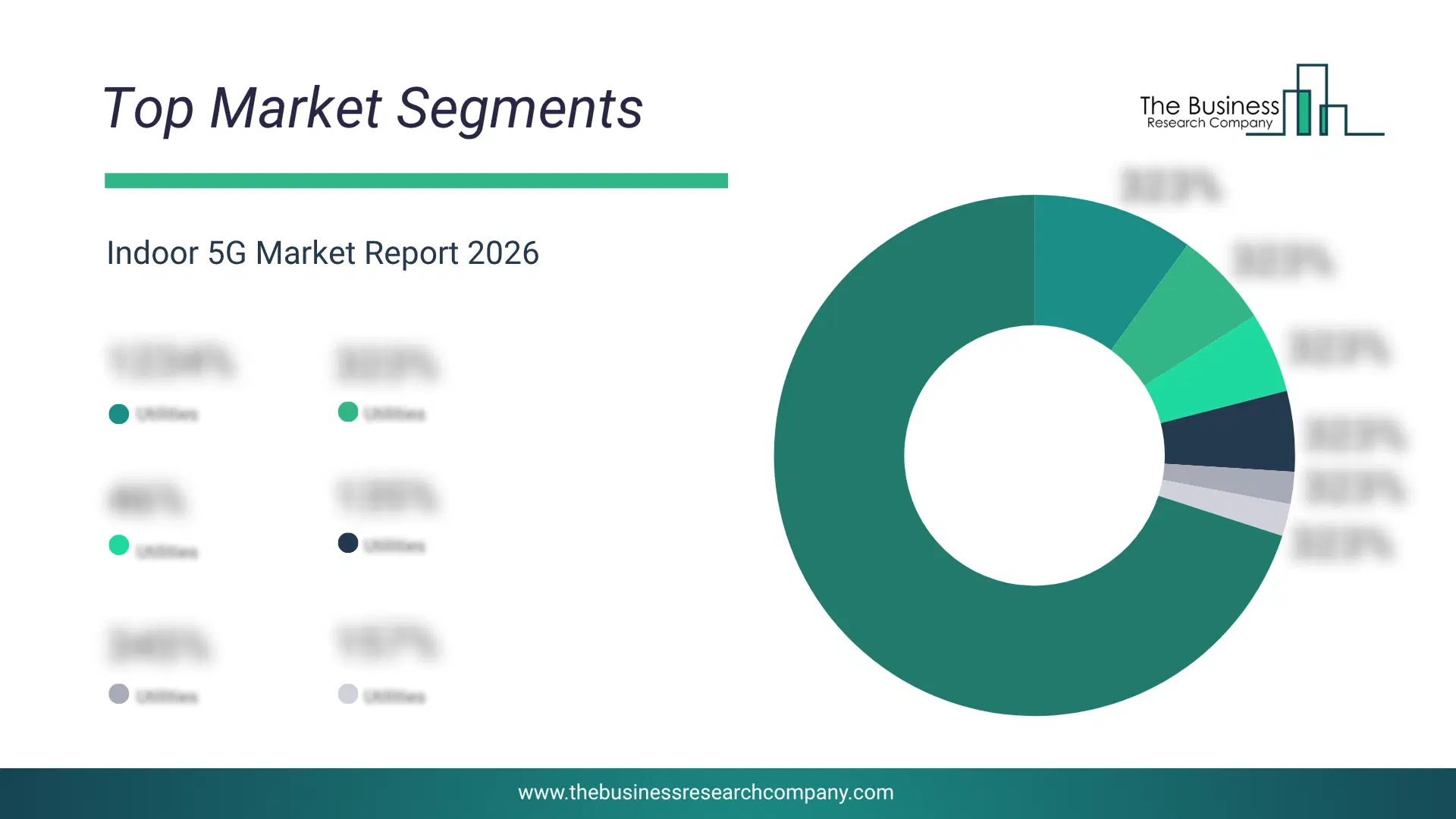
Global Indoor 5G Market Segmentation
1) By Component: Hardware, Software, Services 2) By Infrastructure: Distributed Antenna System, Multiple Antennas, Single Antenna, Distributed Antenna System (DAS) Technology 3) By Frequency Band: Sub-6 GHz, Millimeter Wave (MmWave), Other Frequency Bands 4) By Deployment Mode: Private 5G Networks, Hybrid Networks, Carrier-Provided Indoor Solutions, Neutral Host Networks, Network-As-A-Service (NaaS) 5) By End Use: Enterprises, Telecom Operators, Government, Healthcare Providers, Manufacturers, Hospitality And Retail, Other End Uses Subsegments: 1) By Hardware: Small Cells, Distributed Antenna Systems, Repeaters, Routers, Switches 2) By Software: Network Management Software, Cloud-Based 5G Platforms, Data Analytics Software, Security Software 3) By Services: Installation And Integration Services, Consulting Services, Maintenance And Support Services, Managed Services The top segments in the indoor 5g market will be: • Sub-6 GHz will reach $14097.8 Million by 2025. • Hardware will reach $12239.3 Million by 2025. • Commercial Buildings will reach $5785.4 Million by 2025. • Millimeter Wave (MmWave) will reach $4984.3 Million by 2025. • Software will reach $4408.9 Million by 2025.What Is The Driver Of The Indoor 5G Market?
The increasing high-speed internet connectivity is expected to propel the growth of the indoor 5G market going forward. High-speed internet connectivity refers to a fast and reliable internet connection that enables the quick transmission of large amounts of data through various networks and technologies. The increasing penetration of internet connectivity is primarily due to the expansion of mobile networks, which enable wider and more affordable access to online services, especially in remote and underserved areas. High-speed internet connectivity enhances indoor 5G ecosystems by providing reliable, low-latency data transfer, making them ideal for enterprises, hospitals, and high-density indoor environments. It supports seamless communication by enabling faster data processing and real-time applications, improving overall network performance and user experience. For instance, in 2023, according to the International Telecommunication Union, a Switzerland-based specialized agency of the United Nations, the number of internet users rose from 5.1 billion (64% penetration) in 2022 to 5.4 billion (67% penetration) in 2023. Therefore, the increasing high-speed internet connectivity is driving the growth of the indoor 5G industry.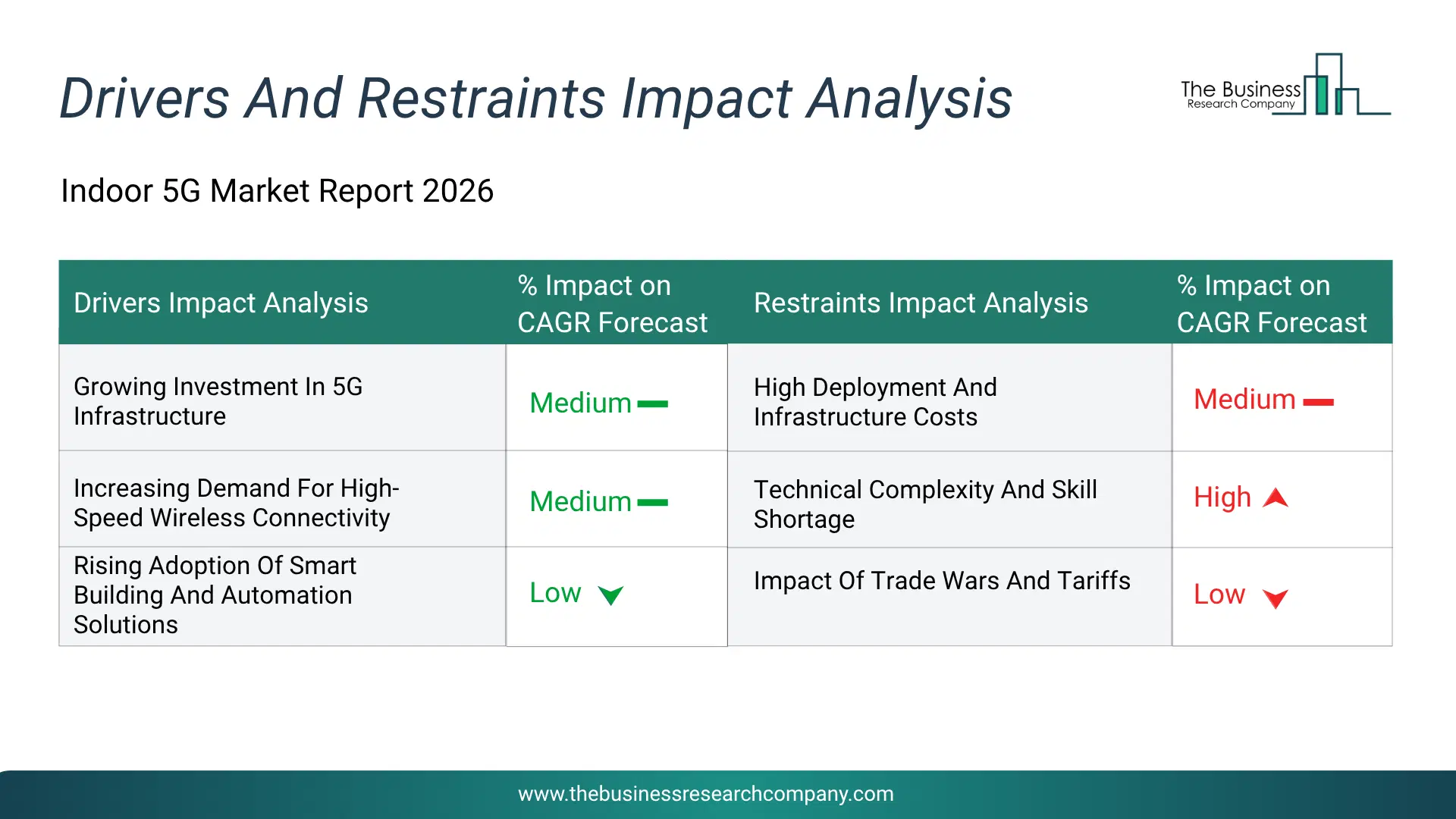
Infographic Chart Showing Key Market Drivers Analysis And Restraints For Indoor 5G Market
The chart presents an impact analysis of key drivers and restraints, quantifying their relative influence on the market's growth rate and helping assess the balance between growth enablers and limiting factors. This chart offers a high-level perspective; the full report contains more detailed insights.
How Will The Drivers Impact Growth In The Global Indoor 5G Market?
• Growing Investment In 5G Infrastructure (Medium) – The growing investment in 5G infrastructure will become a key driver of growth in the indoor 5G market by 2030. Substantial funding in 5G infrastructure, including small cell deployment, fiber backhaul, and indoor network equipment, creates the foundation for ultra-fast, low-latency wireless services within buildings. Telecom operators and enterprises are upgrading existing networks to support high-capacity indoor coverage, enabling seamless connectivity in offices, hospitals, and commercial spaces. This investment reduces signal dead zones and allows deployment of advanced applications like AR/VR, IoT, and AI-driven automation indoors, fostering widespread adoption of localized 5G solutions. As a result, the growing investment in 5G infrastructure is anticipated to contributing to a 1.5% annual growth in the market. • Increasing Demand For High-Speed Wireless Connectivity (Medium) – The increasing demand for high-speed wireless connectivity will emerge as a major factor driving the expansion of the indoor 5G market by 2030. The rising need for uninterrupted high-speed wireless access in offices, campuses, and public venues drives adoption, as organizations demand reliable connectivity for streaming, cloud computing, and real-time communications. Users expect consistent bandwidth to support multiple devices simultaneously, from smartphones to IoT sensors. Indoor networks equipped with enhanced 5G capabilities satisfy these performance requirements, ensuring low latency and high throughput, which encourages integration into enterprise and public infrastructures. Consequently, the increasing demand for high-speed wireless connectivity is projected to contributing to a 1.0% annual growth in the market. • Rising Adoption Of Smart Building And Automation Solutions (Low) – The rising adoption of smart building and automation solutions will serve as a key growth catalyst for the indoor 5G market by 2030. Increasing implementation of smart building technologies, including automated lighting, HVAC systems, and security solutions, relies heavily on robust indoor connectivity. 5G enables real-time monitoring and control of sensors, actuators, and AI-based building management systems. As automation solutions become more complex, the need for scalable, high-capacity networks indoors rises, making wireless infrastructure a critical enabler for efficient, intelligent building operations and digital transformation initiatives. Therefore, this rising adoption of smart building and automation solutions is projected to supporting to a 0.8% annual growth in the market. • Government Smart City Initiatives And Spectrum Policies (Low) – The government smart city initiatives and spectrum policies will become a significant driver contributing to the growth of the indoor 5G market by 2030. Government-led smart city programs and spectrum allocation policies promote the deployment of indoor 5G networks as part of broader urban modernization strategies. Supportive regulations and incentives encourage operators and enterprises to invest in high-speed infrastructure for public buildings, transportation hubs, and municipal facilities. By facilitating spectrum access and funding initiatives, authorities help accelerate installation of indoor networks that enhance urban connectivity, safety, and digital services for citizens and businesses. Consequently, the government smart city initiatives and spectrum policies is projected to contributing to a 0.5% annual growth in the market.How Will The Restraints Impact Growth In The Global Indoor 5G Market?
• High Deployment And Infrastructure Costs (Medium) – High deployment and infrastructure costs is expected to restrain market growth during the forecast period. It creates operational, financial, regulatory, or commercial challenges that can increase costs, delay projects, reduce investments, or discourage purchasing decisions depending on the market. These challenges can reduce product adoption, affect business confidence, and limit the ability of companies to expand efficiently across key regions. This can disrupt long-term growth strategies and reduce the ability of companies to capitalize on emerging market opportunities. • Technical Complexity And Skill Shortage (Medium) – During the forecast period, technical complexity and skill shortage is likely to limit market expansion. It creates operational, financial, regulatory, or commercial challenges that can increase costs, delay projects, reduce investments, or discourage purchasing decisions depending on the market. These challenges can reduce product adoption, affect business confidence, and limit the ability of companies to expand efficiently across key regions. As a result, organizations may postpone purchasing decisions, limiting demand across both established and emerging markets. • Impact Of Trade Wars And Tariffs (Low) – The market is expected to face challenges due to impact of trade wars and tariffs over the forecast period. It creates operational, financial, regulatory, or commercial challenges that can increase costs, delay projects, reduce investments, or discourage purchasing decisions depending on the market. These challenges can reduce product adoption, affect business confidence, and limit the ability of companies to expand efficiently across key regions. This may reduce production efficiency, extend project timelines, and create challenges in meeting evolving customer requirements.Key Players In The Global Indoor 5G Market
Major companies operating in the indoor 5G market are Samsung Electronics Co Ltd., Verizon Communications Inc., AT And T Inc., Huawei Technologies Co Ltd., Cisco Systems Inc., Qualcomm Technologies Inc., Hewlett Packard Enterprise Company, Nokia Corporation, NEC Corporation, Ericsson AB, ZTE Corporation, Mavenir Systems Inc., Juniper Networks Inc., JMA Wireless Inc., Airspan Networks Holdings Inc., Fujitsu Limited, SOLiD Inc., CommScope Holding Company Inc., Dali Wireless Inc., BTI Wireless Inc., Sercomm Corporation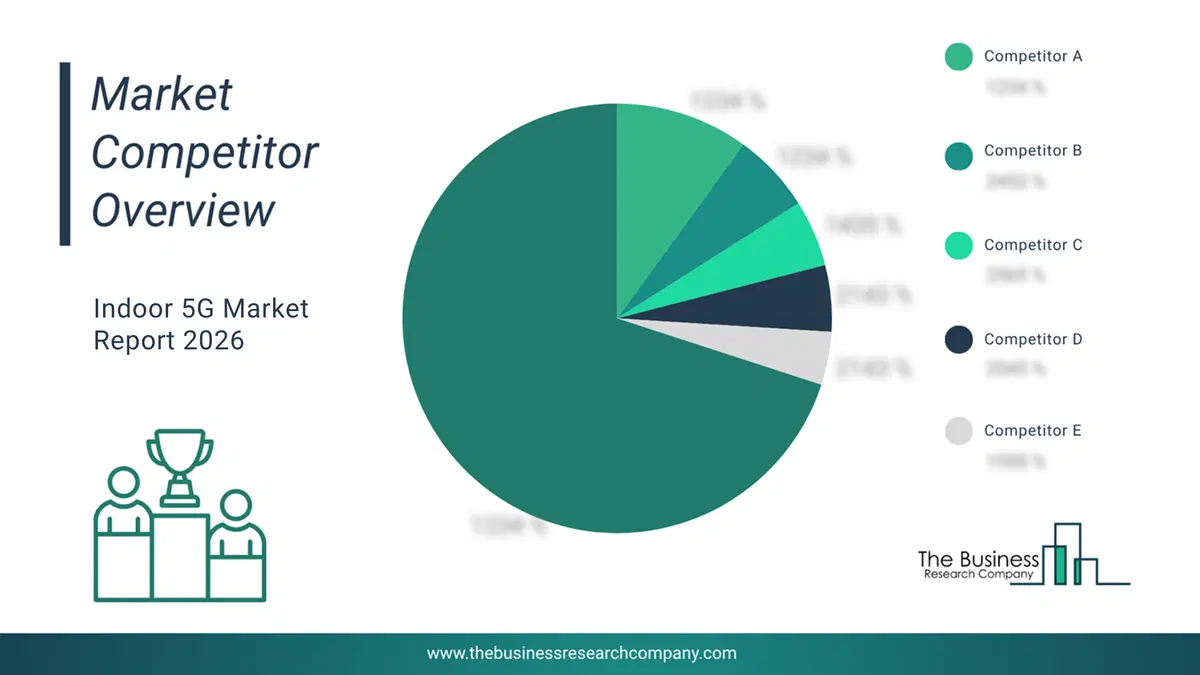
This chart is for illustrative purposes; the full report includes a detailed competitor analysis and comprehensive overview of the top 10 companies in the market.
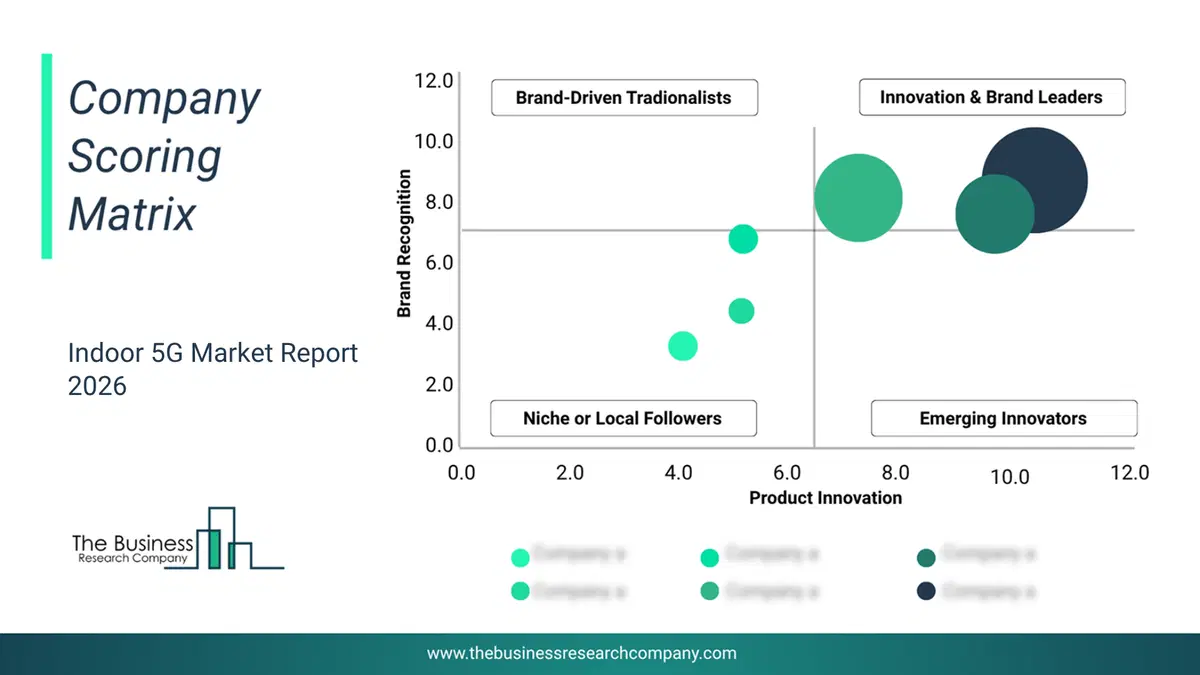
This chart maps companies by product innovation and brand strength, with bubble size indicating relative revenue, helping identify market leaders, challengers, and niche players. This is an illustrative chart; the full report provides a complete and accurate competitive analysis.
Global Indoor 5G Market Trends and Insights
Major companies operating in the indoor 5G market are focusing on reducing deployment costs, such as the use of energy efficient small-cell hardware, to lower capital and operational expenditures and enable more cost-effective network rollouts. Energy-efficient small cells refer to low-power radios designed for indoor environments that minimize power consumption while providing sufficient coverage and capacity. For instance, in February 2023, Ericsson, a Sweden-based telecom-equipment provider, expanded its Indoor Radio Dot System portfolio by introducing the IRU 8850 unit for medium-to-large venues and a compact Indoor Fusion Unit for smaller environments. These units feature low energy consumption, modular installation flexibility, and optimized coverage for high-density indoor environments. By leveraging these energy-efficient solutions, operators can deploy indoor 5G networks more economically while maintaining reliable connectivity and capacity.What Are Latest Mergers And Acquisitions In The Indoor 5G Market?
In April 2025, Airspan Networks Holdings Inc., a US-based wireless technology company, acquired the wireless business from Corning Inc. for an undisclosed amount. With this acquisition, Airspan aims to strengthen its indoor 5G portfolio, gaining Corning’s DAS and small cell solutions to expand enterprise and venue-based 5G coverage in high-density environments. Corning Inc. is a US-based technology company that provides indoor 5G solutions.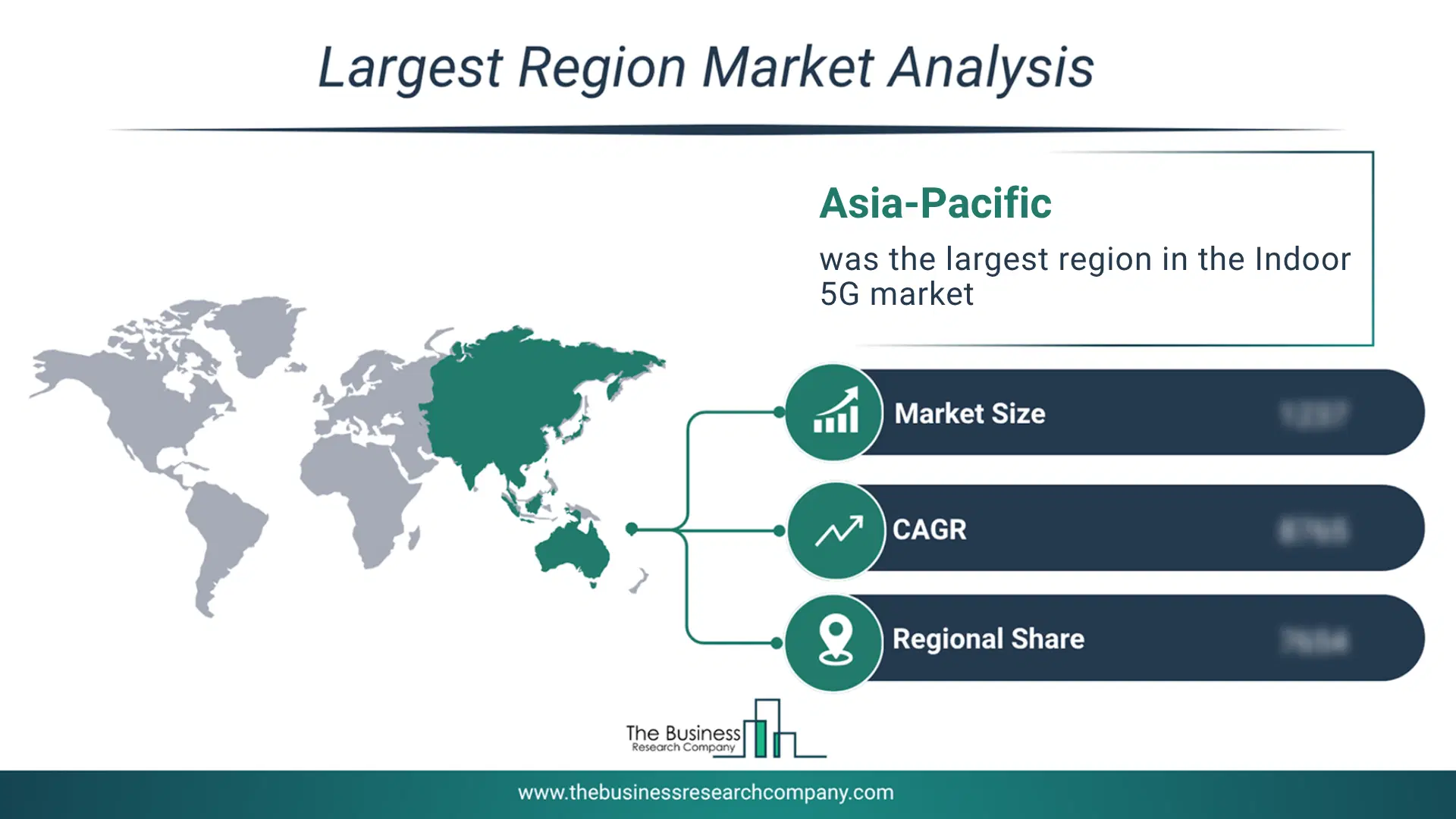
Regional Insights
Asia-Pacific was the largest region in the indoor 5G market in 2025. The regions covered in this market report are Asia-Pacific, South East Asia, Western Europe, Eastern Europe, North America, South America, Middle East, Africa. The countries covered in this market report are Australia, Brazil, China, France, Germany, India, Indonesia, Japan, Taiwan, Russia, South Korea, UK, USA, Canada, Italy, Spain.What Defines the Indoor 5G Market?
The indoor 5G market consists of revenues earned by entities by providing services such as ultra-low latency support for critical applications, deployment of small cell infrastructure, enhanced indoor positioning and tracking, edge computing integration, augmented and virtual reality enablement, and secure network. The market value includes the value of related goods sold by the service provider or included within the service offering. The indoor 5G market also includes sales of small cell base stations, millimeter wave antennas, 5G signal repeaters, indoor femtocells, 5G-compatible internet of things (IoT) sensors, and intelligent network controllers. Values in this market are ‘factory gate’ values, that is, the value of goods sold by the manufacturers or creators of the goods, whether to other entities (including downstream manufacturers, wholesalers, distributors, and retailers) or directly to end customers. The value of goods in this market includes related services sold by the creators of the goods.How is Market Value Defined and Measured?
The market value is defined as the revenues that enterprises gain from the sale of goods and/or services within the specified market and geography through sales, grants, or donations in terms of the currency (in USD unless otherwise specified). The revenues for a specified geography are consumption values that are revenues generated by organizations in the specified geography within the market, irrespective of where they are produced. It does not include revenues from resales along the supply chain, either further along the supply chain or as part of other products.
This chart presents market attractiveness based on a quantitative evaluation of growth, competition, strategic alignment, and risk, offering a clear view of opportunity areas for decision-making. This chart is for illustrative purposes; the full report contains the complete analysis.

This chart highlights the Total Addressable Market (TAM) by estimating the maximum revenue opportunity using an assumption-driven approach, supporting strategic planning and opportunity sizing across markets. The chart is illustrative; the full report provides a more comprehensive analysis.
What Key Data and Analysis Are Included in the Indoor 5G Market Report 2026?
The indoor 5g market research report is one of a series of new reports from The Business Research Company that provides market statistics, including industry global market size, regional shares, competitors with the market share, detailed market segments, market trends and opportunities, and any further data you may need to thrive in the indoor 5g industry. The market research report delivers a complete perspective of everything you need, with an in-depth analysis of the current and future state of the industry.Indoor 5G Market Report Forecast Analysis
| Report Attribute | Details |
|---|---|
| Market Size Value In 2026 | $23.89 billion |
| Revenue Forecast In 2035 | $54.89 billion |
| Growth Rate | CAGR of 23.4% from 2026 to 2035 |
| Base Year For Estimation | 2025 |
| Actual Estimates/Historical Data | 2020-2025 |
| Forecast Period | 2026 - 2030 - 2035 |
| Market Representation | Revenue in USD Billion and CAGR from 2026 to 2035 |
| Segments Covered | Component, Infrastructure, Frequency Band, Deployment Mode, End Use |
| Regional Scope | Asia-Pacific, Western Europe, Eastern Europe, North America, South America, Middle East, Africa |
| Country Scope | The countries covered in the report are Australia, Brazil, China, France, Germany, India, ... |
| Key Companies Profiled | Samsung Electronics Co Ltd., Verizon Communications Inc., AT And T Inc., Huawei Technologies Co Ltd., Cisco Systems Inc., Qualcomm Technologies Inc., Hewlett Packard Enterprise Company, Nokia Corporation, NEC Corporation, Ericsson AB, ZTE Corporation, Mavenir Systems Inc., Juniper Networks Inc., JMA Wireless Inc., Airspan Networks Holdings Inc., Fujitsu Limited, SOLiD Inc., CommScope Holding Company Inc., Dali Wireless Inc., BTI Wireless Inc., Sercomm Corporation |
| Customization Scope | Request for Customization |
| Pricing And Purchase Options | Explore Purchase Options |