

Intelligent Traffic Management System Market Report 2026
Global Outlook – By Offering (Hardware, Software, Services), By Product Type (Integrated Urban Traffic Control, Variable or Dynamic Message Signs, Emergency Response, Border Control System, Electronic Toll Collection, Parking Management, Violation And Measurement, Tunnel Management, Freeway Management), By Spender Type (Infrastructure Enterprises And Public-Private Partnerships(PPPs), Industries And Commercial Enterprise, Federal And Provincial Government) – Market Size, Trends, Strategies, and Forecast to 2030
Intelligent Traffic Management System Market Overview
• Intelligent Traffic Management System market size has reached to $12.99 billion in 2025 • Expected to grow to $23.1 billion in 2030 at a compound annual growth rate (CAGR) of 12.2% • Growth Driver: Growth of Intelligent Traffic Management Systems Driven by Rising Vehicle Numbers • Market Trend: Emerging Innovations Driving Advanced Safety And Efficiency In Next-Generation Traffic Systems • Asia-Pacific was the largest region in 2025 and North America is the fastest growing region.Market Gains By 2030 – Top Opportunities By Segment
Market Gain identifies the most promising market opportunities by highlighting the segments or products expected to generate the highest incremental revenue growth over the next five years.
What Is Covered Under Intelligent Traffic Management System Market?
An intelligent traffic management system (ITMS) refers to a framework of technologies, devices, and algorithms designed to optimize the flow of traffic on roads and highways. The primary goal ITMS is to create a smarter and safer transportation network by leveraging digital tools to manage traffic conditions, detect incidents, and enhance overall traffic control. The main types of offering in intelligent traffic management system are hardware, software, services. Hardware refers to the physical components of a computer or any device, distinct from the software that provides instructions for these components to function. The hardware components in intelligent traffic management systems, including sensors, cameras, IoT devices, and edge processing capabilities, are essential for data collection, surveillance, and real-time monitoring. It includes product types such as integrated urban traffic control, variable or dynamic message signs, emergency response, border control systems, electronic toll collection, parking management, violation and measurement, tunnel management, and freeway management, and are used by various end users such as infrastructure companies and PPPs, industries and commercial enterprises, and federal and provincial governments.
What Is The Intelligent Traffic Management System Market Size and Share 2026?
The intelligent traffic management system market size has grown rapidly in recent years. It will grow from $12.99 billion in 2025 to $14.6 billion in 2026 at a compound annual growth rate (CAGR) of 12.4%. The growth in the historic period can be attributed to growth in urban vehicle population, early traffic signal automation, government congestion control programs, expansion of surveillance infrastructure, public safety concerns.What Is The Intelligent Traffic Management System Market Growth Forecast?
The intelligent traffic management system market size is expected to see rapid growth in the next few years. It will grow to $23.1 billion in 2030 at a compound annual growth rate (CAGR) of 12.2%. The growth in the forecast period can be attributed to smart city traffic projects, AI driven traffic platforms, real time congestion management demand, urban mobility planning needs, investment in digital road infrastructure. Major trends in the forecast period include automated traffic flow optimization, dynamic message sign deployment, AI based incident detection, integrated urban traffic control, real time traffic data analytics.
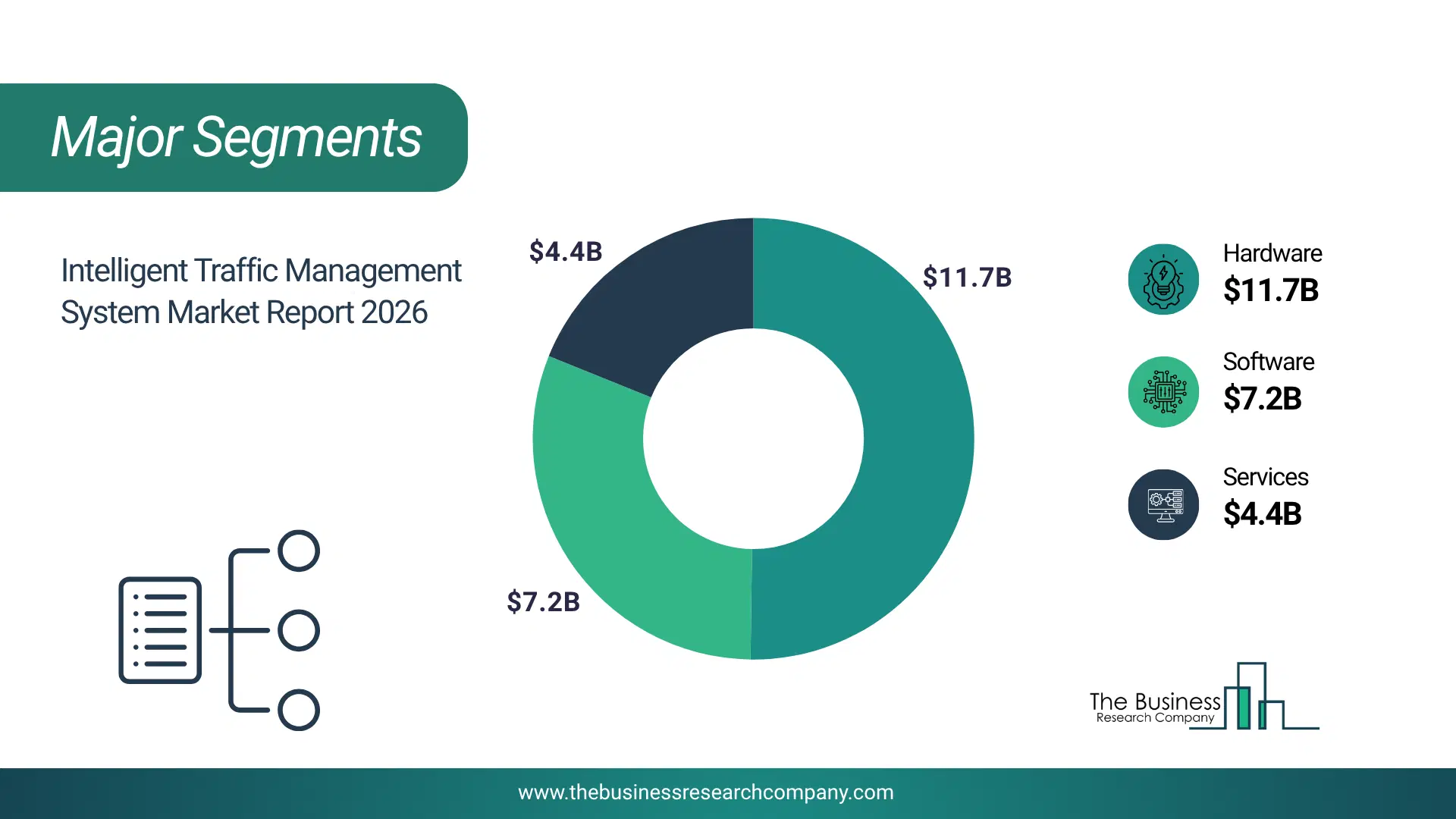
Global Intelligent Traffic Management System Market Segmentation
1) By Offering: Hardware, Software, Services 2) By Product Type: Integrated Urban Traffic Control, Variable or Dynamic Message Signs, Emergency Response, Border Control System, Electronic Toll Collection, Parking Management, Violation And Measurement, Tunnel Management, Freeway Management 3) By Spender Type: Infrastructure Enterprises And Public-Private Partnerships(PPPs), Industries And Commercial Enterprise, Federal And Provincial Government Subsegments: 1) By Hardware: Traffic Sensors, Surveillance Cameras, Signal Controllers, Variable Message Signs (Vms) 2) By Software: Traffic Flow Management Software, Incident Detection and Management Software, Traffic Signal Control Software, Data Analytics and Reporting Software 3) By Services: Installation and Integration Services, Maintenance and Support Services, Consulting and Advisory Services, System Upgrades and Customization Services The top segments in the intelligent traffic management system market will be: • Hardware will reach $11.67 billion by 2030. • Software will reach $7.12 billion by 2030. • Services will reach $4.31 billion by 2030.What Is The Driver Of The Intelligent Traffic Management System Market?
The increasing number of vehicles is expected to propel the growth of the intelligent traffic management system market going forward. The factors responsible for an increased number of vehicles are urbanization, economic growth, affordability, demand for fuel-efficient vehicles, and the increasing focus on sustainability and environmental considerations within the automotive industry. Intelligent traffic management ensure smooth traffic flow, reduce congestion, enhance safety, and optimize transportation systems. For instance, in October 2025, according to the Department for Transport, a UK-based government organisation, as of June 2025, there were 1,625,000 licensed zero-emission vehicles on the road, representing 3.9% of all licensed road-using vehicles. Therefore, the increasing number of vehicles in the road is driving the growth of the intelligent traffic management system industry.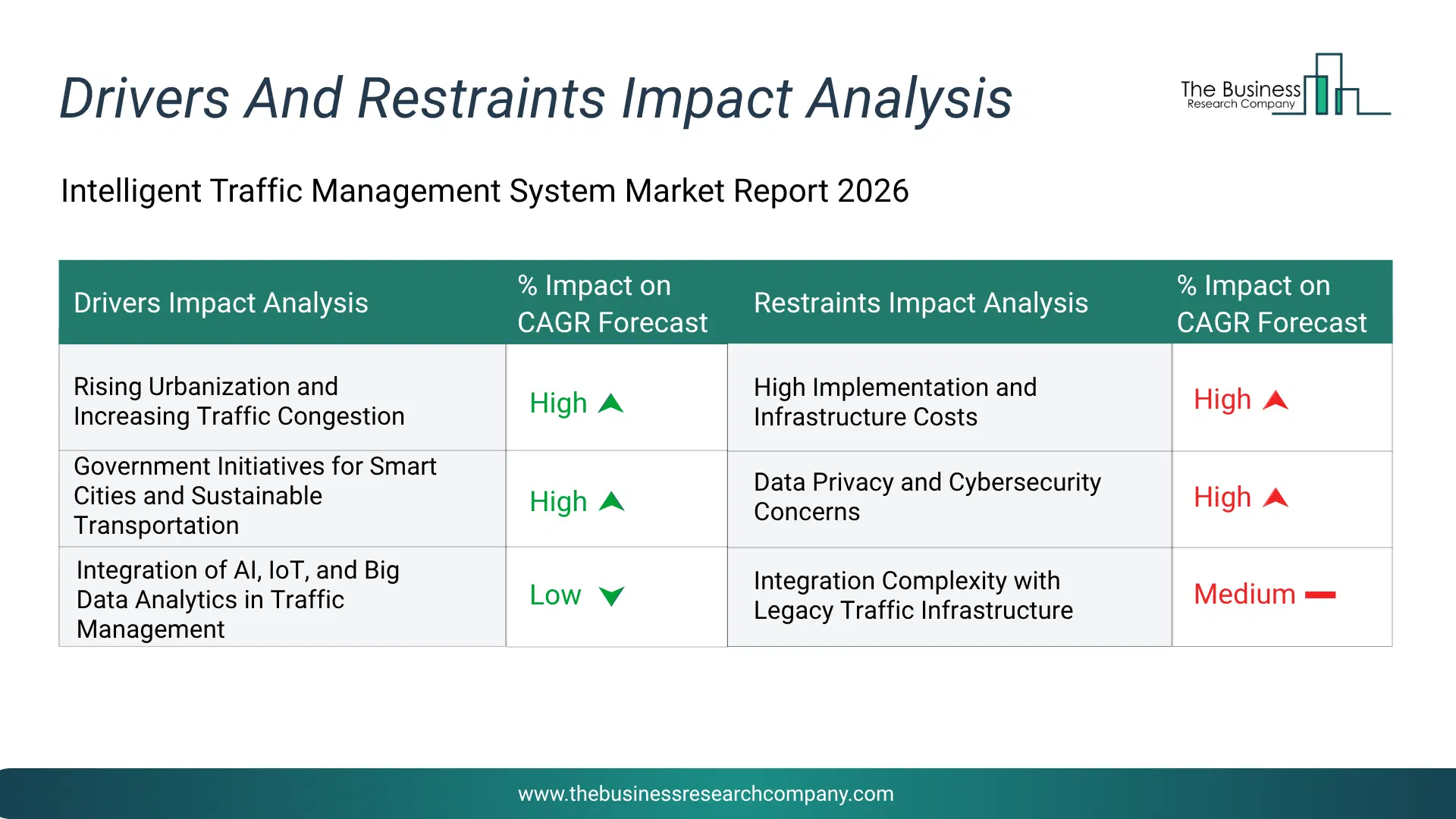
Infographic Chart Showing Key Market Drivers Analysis And Restraints For Intelligent Traffic Management System Market
The chart presents an impact analysis of key drivers and restraints, quantifying their relative influence on the market's growth rate and helping assess the balance between growth enablers and limiting factors. This chart offers a high-level perspective; the full report contains more detailed insights.
How Will The Drivers Impact Growth In The Global Intelligent Traffic Management System Market?
• Rising Urbanization and Increasing Traffic Congestion (High) – During the forecast period, the rising urbanization and increasing traffic congestion are expected to become key growth drivers for the intelligent traffic management system market by 2030. Rapid urbanization and growth in vehicular populations are straining existing traffic infrastructure, creating a critical need for efficient traffic management. Intelligent traffic management systems use ai, iot, and real -time analytics to optimize traffic flow, reduce congestion, and improve road safety. As cities expand and congestion challenges intensify, the adoption of itms solutions accelerates, driving the market forward. • Government Initiatives for Smart Cities and Sustainable Transportation (High) – During the forecast period, the government initiatives for smart cities and sustainable transportation are expected to emerge as a major factor driving the expansion of the intelligent traffic management system market by 2030. Governments worldwide are investing heavily in smart city projects and intelligent transportation systems to enhance mobility, reduce emissions, and improve commuter safety. Funding for traffic monitoring, adaptive signal control, and real-time data analytics supports itms deployment. Policy support and public infrastructure development are key drivers encouraging widespread adoption of intelligent traffic solutions. • Integration of AI, IoT, and Big Data Analytics in Traffic Management (Low) – During the forecast period, the integration of ai, iot, and big data analytics in traffic management is expected to act as a key growth catalyst for the intelligent traffic management system market by 2030. Modern itms leverage ai algorithms, iot-connected sensors, and big data analytics to predict traffic patterns, detect accidents, and optimize signal timings. Such intelligent automation enhances operational efficiency and reduces human intervention, enabling cities to respond proactively to dynamic traffic conditions. Increasing technological integration is a major market driver as municipalities seek smart and adaptive traffic solutions.How Will The Restraints Impact Growth In The Global Intelligent Traffic Management System Market?
• High Implementation and Infrastructure Costs (High) – During the forecast period, the deploying itms requires substantial investments in sensors, cameras, communication networks, and centralized control systems. Maintenance, upgrades, and integration with existing infrastructure further increase costs. For developing countries or smaller municipalities, these high initial and ongoing expenses may limit adoption, acting as a restraint on market growth. • Data Privacy and Cybersecurity Concerns (High) – During the forecast period, the itms collect vast amounts of real-time traffic and personal data, raising concerns over privacy, data protection, and cyber threats. Unauthorized access or system breaches could compromise traffic safety or violate regulatory standards. Such security and compliance concerns may slow adoption, particularly in regions with strict data protection laws. • Integration Complexity with Legacy Traffic Infrastructure (Medium) – During the forecast period, the integration complexity with legacy traffic infrastructure acts as a restraint for the intelligent traffic management system market by making deployment technically challenging and time-consuming. Many cities operate on outdated traffic control systems that are not compatible with modern sensors, ai-based platforms, and centralized control units. Upgrading or replacing existing infrastructure requires significant planning, coordination, and investment, which can delay implementation. Additionally, system interoperability issues between old and new technologies can reduce operational efficiency during transition phases. This complexity slows down large-scale adoption and increases overall project execution risk.Key Players In The Global Intelligent Traffic Management System Market
Major companies operating in the intelligent traffic management system market report include Huawei Technologies Co. Ltd, Siemens, Raytheon Technologies Corporation, International Business Machines Corporation (IBM), Cisco Systems Inc, Schneider Electric SE, Thales Group, Advantech Co. Ltd, FLIR Systems Inc, TransCore LP, Cubic Corporation, SWARCO AG, TomTom N.V, VITRONIC Dr.-Ing. Stein Bildverarbeitungssysteme GmbH, Beijing E-Hualu Information Technology Co. Ltd, Iteris Inc, Global Traffic Technologies LLC (GTT), Q-Free ASA, Econolite Group Inc, Cohda Wireless Pty. Ltd, Sensys Networks Inc, Clearview Intelligence Limited, PTV Group, EFKON AG, Peek Traffic Corporation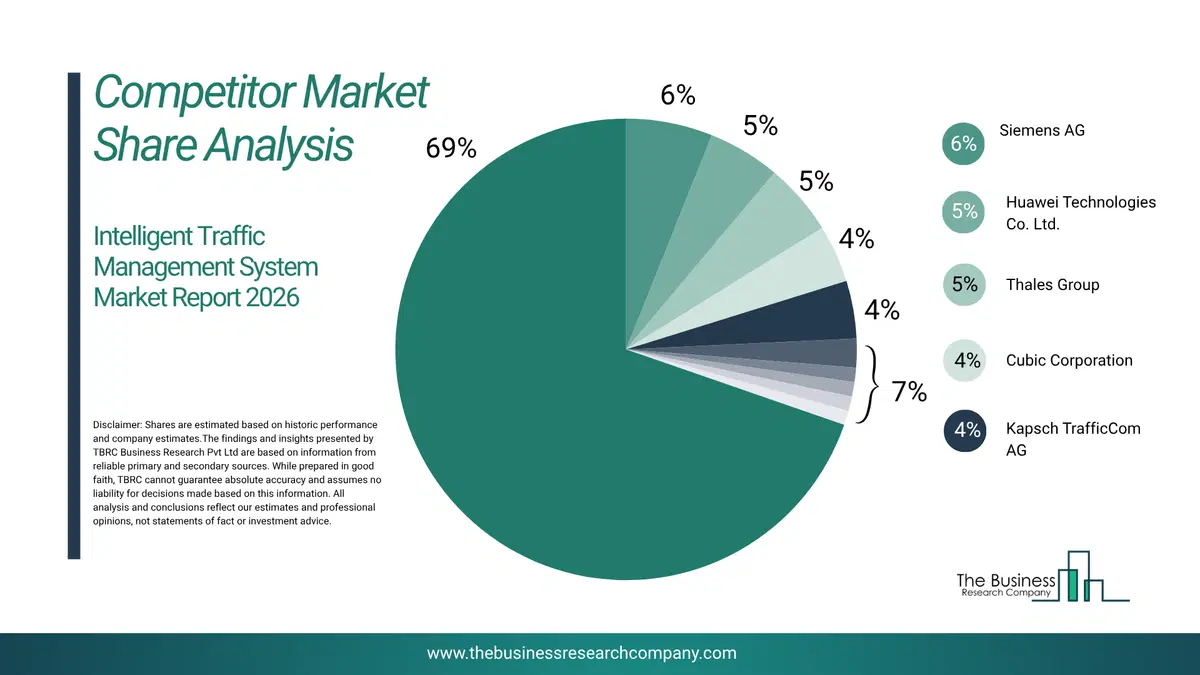
This chart is for illustrative purposes; the full report includes a detailed competitor analysis and comprehensive overview of the top 10 companies in the market.
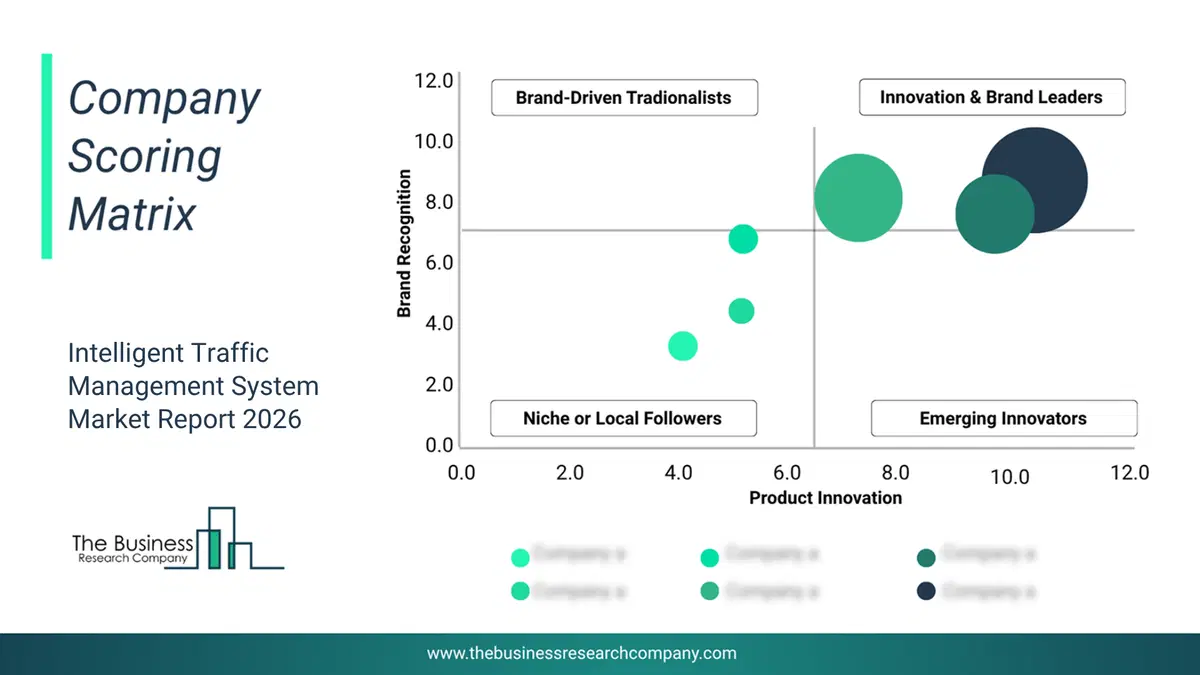
This chart maps companies by product innovation and brand strength, with bubble size indicating relative revenue, helping identify market leaders, challengers, and niche players. This is an illustrative chart; the full report provides a complete and accurate competitive analysis.
Global Intelligent Traffic Management System Market Trends and Insights
Major companies operating in the intelligent traffic management system market are focusing on developing innovative solutions, such as integrated detection and connected vehicle (CV) systems, to enhance traffic safety and optimize flow in real time. Integrated detection and connected vehicle (CV) systems combine real-time traffic sensing with vehicle-to-everything (V2X) communication, helping prevent accidents, reduce congestion, and improve overall traffic efficiency by providing dynamic alerts and optimizing signal timing. For instance, in December 2023, Iteris Inc., a US-based smart-mobility technology company, launched Vantage CV, an integrated detection and connected-vehicle system for safer intersections. Vantage CV combines Iteris’ Vantage Apex or Vantage Next traffic detection hardware and software with C-V2X roadside communications to generate and distribute real-time safety alerts to connected vehicles; it includes in-vehicle deployable technologies so agencies can equip selected fleet vehicles for immediate benefits while the broader vehicle fleet transitions to V2X. The offering also introduces VantageARGUS CV for CV data visualisation, travel-time and corridor analysis, and system monitoring and analytics. Its scalable, end-to-end design delivers complete intersection coverage, advanced safety features, and integration with cloud-based mobility management to help agencies reduce collisions and improve traffic flow.What Are Latest Mergers And Acquisitions In The Intelligent Traffic Management System Market?
In August 2024, NoTraffic Inc., a US-based smart traffic management technology company, partnered with SWARCO McCain Inc. to deliver intelligent transportation solutions. With this partnership, NoTraffic and SWARCO McCain aim to improve urban mobility and traffic safety by combining real-time traffic management software with advanced traffic signal and roadway hardware, enabling more efficient traffic flow and smarter city infrastructure. SWARCO McCain Inc. is a US-based company that specializes in providing traffic management solutions, including traffic signals, controllers, and intelligent roadway systems.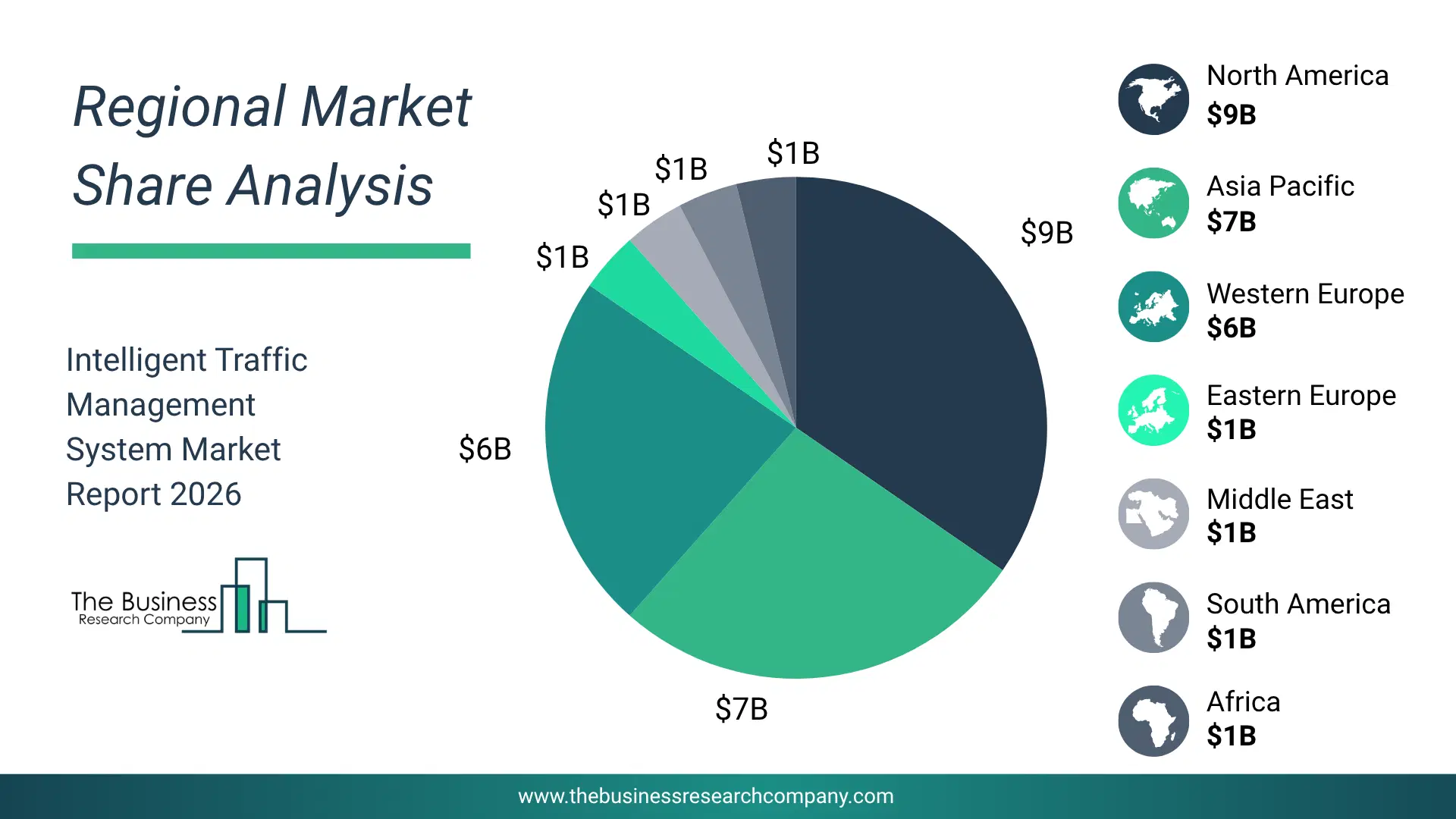
Regional Outlook
Asia-Pacific was the largest region in the intelligent traffic management system market in 2025. North America is expected to be the fastest-growing region in the forecast period. The regions covered in this market report include Asia-Pacific, South East Asia, Western Europe, Eastern Europe, North America, South America, Middle East, Africa. The countries covered in this market report include Australia, Brazil, China, France, Germany, India, Indonesia, Japan, Taiwan, Russia, South Korea, UK, USA, Canada, Italy, SpainWhat Defines the Intelligent Traffic Management System Market?
The intelligent traffic management system market consists of revenues earned by entities by providing services such as traffic data analytics, connected vehicle integration, and GIS for traffic planning. The market value includes the value of related goods sold by the service provider or included within the service offering. The intelligent traffic management system market also includes real-time monitoring, dynamic route guidance systems, and others. Values in this market are ‘factory gate’ values, that is, the value of goods sold by the manufacturers or creators of the goods, whether to other entities (including downstream manufacturers, wholesalers, distributors, and retailers) or directly to end customers. The value of goods in this market includes related services sold by the creators of the goods.How is Market Value Defined and Measured?
The market value is defined as the revenues that enterprises gain from the sale of goods and/or services within the specified market and geography through sales, grants, or donations in terms of the currency (in USD unless otherwise specified). The revenues for a specified geography are consumption values that are revenues generated by organizations in the specified geography within the market, irrespective of where they are produced. It does not include revenues from resales along the supply chain, either further along the supply chain or as part of other products.
This chart presents market attractiveness based on a quantitative evaluation of growth, competition, strategic alignment, and risk, offering a clear view of opportunity areas for decision-making. This chart is for illustrative purposes; the full report contains the complete analysis.

This chart highlights the Total Addressable Market (TAM) by estimating the maximum revenue opportunity using an assumption-driven approach, supporting strategic planning and opportunity sizing across markets. The chart is illustrative; the full report provides a more comprehensive analysis.
What Key Data and Analysis Are Included in the Intelligent Traffic Management System Market Report 2026?
The intelligent traffic management system market research report is one of a series of new reports from The Business Research Company that provides market statistics, including industry global market size, regional shares, competitors with the market share, detailed market segments, market trends and opportunities, and any further data you may need to thrive in the intelligent traffic management system industry. The market research report delivers a complete perspective of everything you need, with an in-depth analysis of the current and future state of the industry.Intelligent Traffic Management System Market Report Forecast Analysis
| Report Attribute | Details |
|---|---|
| Market Size Value In 2026 | $14.6 billion |
| Revenue Forecast In 2030 | $23.1 billion |
| Growth Rate | CAGR of 12.2% from 2026 to 2030 |
| Base Year For Estimation | 2025 |
| Actual Estimates/Historical Data | 2020-2025 |
| Forecast Period | 2026 - 2030 |
| Market Representation | Revenue in USD Billion and CAGR from 2026 to 2030 |
| Segments Covered | Offering, Product Type, Spender Type |
| Regional Scope | Asia-Pacific, Western Europe, Eastern Europe, North America, South America, Middle East, Africa |
| Country Scope | The countries covered in the report are Australia, Brazil, China, France, Germany, India, ... |
| Key Companies Profiled | Huawei Technologies Co. Ltd, Siemens, Raytheon Technologies Corporation, International Business Machines Corporation (IBM), Cisco Systems Inc, Schneider Electric SE, Thales Group, Advantech Co. Ltd, FLIR Systems Inc, TransCore LP, Cubic Corporation, SWARCO AG, TomTom N.V, VITRONIC Dr.-Ing. Stein Bildverarbeitungssysteme GmbH, Beijing E-Hualu Information Technology Co. Ltd, Iteris Inc, Global Traffic Technologies LLC (GTT), Q-Free ASA, Econolite Group Inc, Cohda Wireless Pty. Ltd, Sensys Networks Inc, Clearview Intelligence Limited, PTV Group, EFKON AG, Peek Traffic Corporation |
| Customization Scope | Request for Customization |
| Pricing And Purchase Options | Explore Purchase Options |