
Contact Us
  Search
The Business Research Company Logo
Medical Equipment Global Market Opportunities And Strategies To 2035
Published :June 2026
Pages :633
Format :PDF
Delivery Time :2-3 Business Days
Why 2-3 days? We update the report with the latest data and news before delivery. Let us know if you need us to expedite.
Report Price :$4,490.00

Medical Equipment Global Market Opportunities And Strategies To 2035

By Type (In-Vitro Diagnostics, Dental Equipment And Supplies, Ophthalmic Devices, Diagnostic Imaging Equipment, Cardiovascular Devices, Hospital Supplies, Surgical Equipment, Orthopedic Devices, Patient Monitoring Devices, Diabetes Care Devices, Nephrology And Urology Devices, ENT Devices, Anesthesia And Respiratory Devices, Neurology Devices, Wound Care Devices), By Type Of Expenditure (Public, Private), By Category (Instruments And Equipment, Disposables And Consumables), By End User (Hospitals And Clinics, Homecare And Diagnostic Centers, Other End Users), And By Region, Opportunities And Strategies – Global Forecast To 2035

Medical Equipment Market Definition

Medical equipment refers to a broad range of instruments, devices, machines, implants and supplies that are used in the prevention, diagnosis, monitoring and treatment of medical conditions and diseases. These products are utilized by healthcare professionals such as physicians, surgeons, nurses, laboratory technicians and allied health workers, as well as by patients themselves in homecare settings. The medical equipment market consists of sales of medical equipment by entities (organizations, sole traders and partnerships) that used across the entire continuum of care, from routine health check-ups and diagnostic testing to complex surgical procedures and long-term disease management. It is often used in conjunction with complementary products such as pharmaceuticals, healthcare IT systems and laboratory services, while in some cases it may substitute for invasive treatments through minimally invasive or non-invasive technologies.
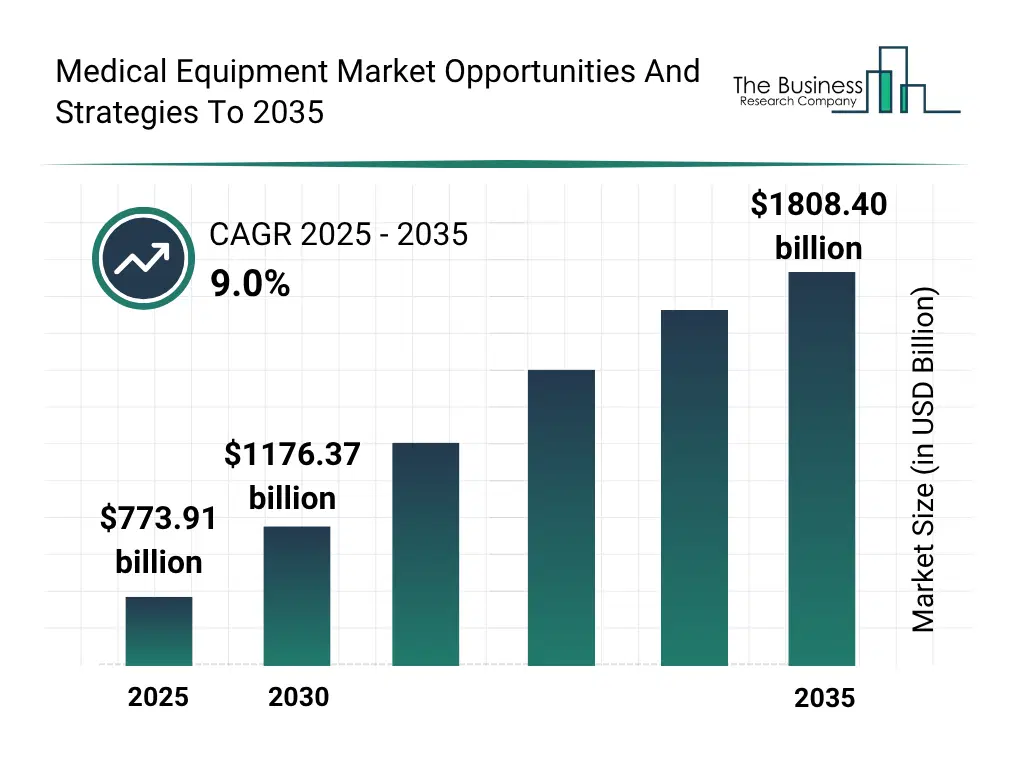
Medical Equipment Global Market Opportunities And Strategies To 2035 Market Size and growth rate 2026 to 2030: Graph

Medical Equipment Market Size

The global medical equipment market reached a value of nearly $773,912.7 million in 2025, having grown at a compound annual growth rate (CAGR) of 9.5% since 2020. The market is expected to grow from $773,912.7 million in 2025 to $1,176,374.2 million in 2030 at a rate of 8.7%. The market is then expected to grow at a CAGR of 9.0% from 2029 and reach $1,808,403.4 million in 2035. Growth in the historic period resulted from growth in diagnostic laboratories and imaging centers, rise of home healthcare & remote monitoring, rising surgical procedure volumes globally and rising prevalence of chronic diseases. Factors that negatively affected growth in the historic period were high cost of advanced medical equipment and stringent regulatory requirements. Going forward, Growth of Internet of Medical Things (IoMT), Government Initiatives & Healthcare Policies, Growing Demand for Rehabilitation and Assistive Devices and Rising Medical Tourism will drive the growth. Factors that could hinder the growth of the medical equipment market in the future include high cost associated with ship repair and maintenance services, volatile raw material prices and impact of trade war and tariff.
Research Expert

Book your 30 minutes free consultation with our research experts

Medical Equipment Market Segmentation The medical equipment market is segmented by type, by type of expenditure, by category and by end user.

By Type –
The medical equipment market is segmented by type into:
    • a) In-Vitro Diagnostics
    • b) Dental Equipment And Supplies
    • c) Ophthalmic Devices
    • d) Diagnostic Imaging Equipment
    • e) Cardiovascular Devices
    • f) Hospital Supplies
    • g) Surgical Equipment
    • h) Orthopedic Devices
    • i) Patient Monitoring Devices
    • j) Diabetes Care Devices
    • k) Nephrology And Urology Devices
    • l) ENT Devices
    • m) Anesthesia And Respiratory Devices
    • n) Neurology Devices
    • o) Wound Care Devices
The in-vitro diagnostics market was the largest segment of the medical equipment market segmented by type, accounting for 17.2% or $132,949.4 million of the total in 2025. Going forward, the anesthesia and respiratory devices segment is expected to be the fastest-growing segment in the medical equipment market segmented by type, at a CAGR of 13.3% during 2025-2030.

By Type Of Expenditure –
The medical equipment market is segmented by type of expenditure into:
    • a) Public
    • b) Private
The private was the largest segment of the medical equipment market segmented by type of expenditure, accounting for 65.6% or $508,053.3 million of the total in 2025. Going forward, the private segment is expected to be the fastest-growing segment in the medical equipment market segmented by type of expenditure, at a CAGR of 9.8% during 2025-2030.

By Category –
The medical equipment market is segmented by category into:
  1. a) Instruments And Equipment
  2. b) Disposables And Consumables
The instruments and equipment market was the largest segment of the medical equipment market segmented by category, accounting for 62.2% or $481,561.1 million of the total in 2025. Going forward, the disposables and consumables segment is expected to be the fastest-growing segment in the medical equipment market segmented by category, at a CAGR of 10.4% during 2025-2030.

By End User –
The medical equipment market is segmented by end user into:
  1. a) Hospitals And Clinics
  2. b) Homecare And Diagnostic Centers
  3. c) Other End Users
The hospitals and clinics market was the largest segment of the medical equipment market segmented by end user, accounting for 58.0% or $448,731.9 million of the total in 2025. Going forward, the homecare and diagnostic centers segment is expected to be the fastest-growing segment in the medical equipment market segmented by end user, at a CAGR of 11.0% during 2025-2030.

By Geography - The medical equipment market is segmented by geography into:
      o Asia Pacific
      • China
      • India
      • Japan
      • Australia
      • Indonesia
      • South Korea
      • Bangladesh
      • Thailand
      • Vietnam
      • Malaysia
      • Singapore
      • Phillipines
      • Hong kong
      • New Zealand
      o North America
      • USA
      • Canada
      • Mexico
      o South America
      • Brazil
      • Argentina
      • Chile
      • Colombiia
      • Peru
      o Western Europe
      • France
      • Germany
      • UK
      • Italy
      • Spain
      • Austria
      • Belgium
      • Denmark
      • Finland
      • Ireland
      • Netherland
      • Norway
      • Portugal
      • Sweden
      • Switzerland
      o Eastern Europe
      • Russia
      • Czech Republic
      • Poland
      • Romania
      • Ukraine
      o Middle East
    • Saudi Arabia
    • Israel
    • Iran
    • Turkey
    • UAE
    • o Africa
    • Egypt
    • Nigeria
    • South Africa
North America was the largest region in the medical equipment market, accounting for 35.3% or $273,219.1 million of the total in 2025. It was followed by Asia Pacific, Western Europe and then the other regions. Going forward, the fastest-growing regions in the medical equipment market will be Middle East and Africa where growth will be at CAGRs of 15.2% and 10.8% respectively. These will be followed by Asia Pacific and Western Europe where the markets are expected to grow at CAGRs of 9.7% and 8.6% respectively.

Medical Equipment Market Drivers

The key drivers of the medical equipment market include: Growth Of Internet Of Medical Things (IoMT) The growth of the Internet of Medical Things (IoMT) is driving increased demand for medical equipment. As hospitals, clinics, and home healthcare increasingly adopt connected devices such as wearable monitors, smart imaging systems, and remote diagnostic tools, the use of IoMT is expanding globally. The growing integration of IoMT devices enables real-time patient monitoring, predictive analytics, and seamless data sharing across healthcare networks, enhancing treatment efficiency and patient outcomes. The increasing adoption of IoMT-enabled devices and the growing emphasis on connected healthcare solutions are driving demand for innovative and efficient medical equipment, supporting sustained growth in the medical equipment market.

Medical Equipment Market Restraints

The key restraints on the medical equipment market include: Lack of Skilled Healthcare Professionals The lack of skilled healthcare professionals is a significant barrier to market expansion. As healthcare delivery increasingly relies on advanced diagnostic and therapeutic technologies, the management of medical equipment requires trained personnel with specialized knowledge and expertise. The growing demand for sophisticated devices, including imaging systems, surgical tools, and monitoring equipment, increases the need for skilled operators and technicians. The shortage of qualified healthcare professionals, coupled with uneven distribution in rural and underserved regions, can limit the effective utilization of medical equipment and slow adoption rates. Consequently, workforce constraints are expected to influence the adoption and implementation strategies of the medical equipment market.

Medical Equipment Market Competitive Landscape

Major Competitors are:

  • Medtronic plc
  • Johnson & Johnson (DePuy Synthes),
  • Abbott Laboratories
  • Siemens Healthineers
  • GE Healthcare Inc.
  • Other Competitors Include:

  • Becton Dickinson and Company (BD)
  • Fresenius Medical Care
  • Roche Diagnostics
  • Boston Scientific SE
  • Stryker Corp
  • Shinva Medical Instrument Company Limited
  • Shandong Weigao Group Medical Polymer Company Limited
  • Lepu Medical Technology Company (Beijing) Co., Ltd
  • Jiangsu Yuyue Medical Equipment & Supply Co., Ltd
  • Terumo Corporation
  • Olympus Medical Systems Corporation
  • Canon Medical Systems Corporation
  • Hitachi Group
  • Nihon Kohden Corporation
  • Sanko Manufacturing Co., Ltd
  • Fukuda Denshi
  • Metran Co., Ltd
  • Drägerwerk AG
  • Koninklijke Philips N.V.
  • Welcare Industries S.p.A
  • F.L. Medical S.r.l
  • Europlaz Technologies Ltd.
  • Medical-Lomza Sp. z o.o.
  • P.H.U. Medical
  • Panop CZ
  • Cardinal Health
  • Baxter International
  • Nipro Medical Ltda
  • LINET Brazil
  • Saudi Mais Co. for Medical Products (SMMP)
  • Qatari German Medical Devices Co.
  • Israeli Hospitals Ltd
  • Need data on a specific region in this market?

    Opportunities And Recommendations In The Medical Equipment Market

    Opportunities – The top opportunities in the medical equipment markets segmented by type will arise in the portable fridge segment, which will gain $565.3 million of global annual sales by 2030. The top opportunities in the medical equipment markets segmented by power source will arise in the electric powered segment, which will gain $655.0 million of global annual sales by 2030. The top opportunities in the medical equipment markets segmented by distribution channel will arise in the online stores segment, which will gain $433.7 million of global annual sales by 2030. The top opportunities in the medical equipment markets segmented by application will arise in the passenger car segment, which will gain $644.2 million of global annual sales by 2030. The medical equipment market size will gain the most in the USA at $328.8 million. Recommendations- To take advantage of the opportunities, The Business Research Company recommends the medical equipment companies to focus on advanced surgical consumables and drainage innovation for post-operative efficiency, focus on AI-enabled imaging and workflow efficiency in diagnostic equipment, focus on wireless handheld and portable diagnostic imaging expansion, focus on portable diagnostic imaging and point-of-care expansion, focus on anesthesia and respiratory devices expansion, expand in emerging markets, continue to focus on developed markets, focus on expanding multi-channel distribution networks for medical equipment access, focus on pricing strategy optimization in medical equipment markets, focus on clinical education and key opinion leader engagement, focus on digital-first multi-channel promotional strategy and focus on people capability building across homecare and diagnostic networks.
    Chat with us