

Plant Factory Market Report 2026
Global Outlook – By Facility Type (Greenhouse, Indoor Farms), By Light Type (Sunlight, Full Artificial Light), By Growing System (Non-Soil-Based, Soil-Based, Hybrid ), By Crop type (Fruits, Vegetables, Flower And Ornamental, Other Crop Types) – Market Size, Trends, Strategies, and Forecast to 2030
Plant Factory Market Overview
• Plant Factory market size has reached to $138.61 billion in 2025 • Expected to grow to $194.72 billion in 2030 at a compound annual growth rate (CAGR) of 7% • Growth Driver: Increasing Urbanization Is Anticipated To Fuel Plant Factory Market • Market Trend: Advancements In Autonomous Climate Control Technology In The Plant Factory Market • Western Europe was the largest region in 2025.Market Gains By 2030 – Top Opportunities By Segment
Market Gain identifies the most promising market opportunities by highlighting the segments or products expected to generate the highest incremental revenue growth over the next five years.
What Is Covered Under Plant Factory Market?
The plant factory refers to agricultural production systems designed to turn crop production into a new model by using bioinformatics and industrial automation. This system enables the supreme yield, harvesting density, and financial impact by controlling the plant growth environment artificially. Plant Factory uses artificial controlled light, moisture, temperature, and carbon dioxide concentrations to grow plants and vegetables. The main facility types in plant factories are greenhouses, indoor farms, and other facility types. Indoor farms refer to the method of growing plants and crops indoors on large scale. Indoor farming is used to cultivate plants and crops and circulate and reuse the water. The light types used in plant factories are sunlight and full artificial light, they are used to cultivate fruits, vegetables, flowers ornamentals, and other crop types.
What Is The Plant Factory Market Size and Share 2026?
The plant factory market size has grown strongly in recent years. It will grow from $138.61 billion in 2025 to $148.53 billion in 2026 at a compound annual growth rate (CAGR) of 7.2%. The growth in the historic period can be attributed to urbanization reducing arable land, demand for consistent crop yields, climate variability affecting traditional farming, early adoption of hydroponic systems, need for pesticide-free produce.What Is The Plant Factory Market Growth Forecast?
The plant factory market size is expected to see strong growth in the next few years. It will grow to $194.72 billion in 2030 at a compound annual growth rate (CAGR) of 7.0%. The growth in the forecast period can be attributed to rising global food demand, growth of urban farming initiatives, advancements in controlled environment technologies, increasing focus on food security, investment in sustainable agriculture solutions. Major trends in the forecast period include growing adoption of fully controlled environment agriculture, rising deployment of vertical and indoor farming systems, increased use of artificial lighting for year-round production, expansion of high-density crop cultivation models, focus on resource efficient food production.
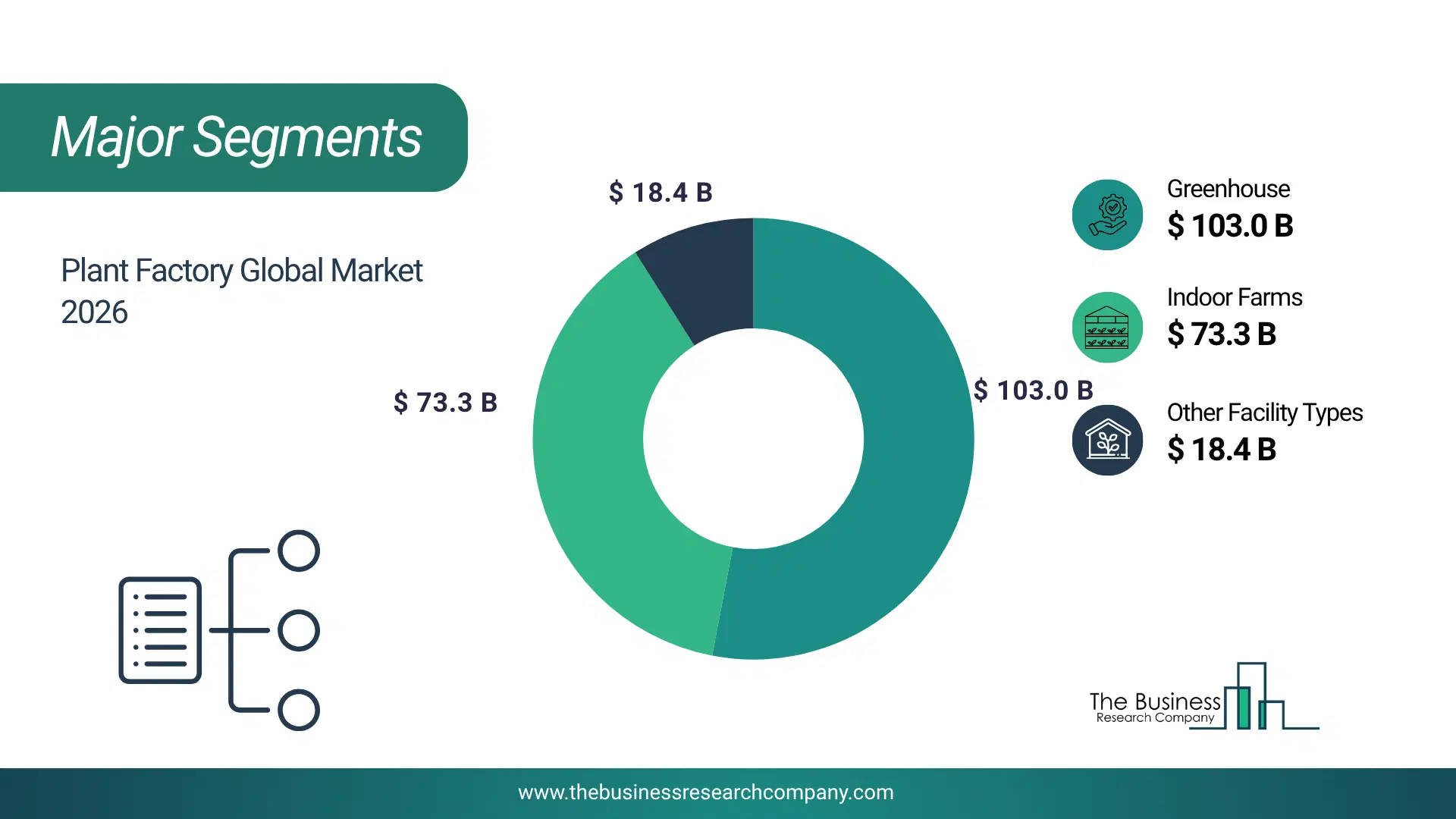
Global Plant Factory Market Segmentation
1) By Facility Type: Greenhouse, Indoor Farms 2) By Light Type: Sunlight, Full Artificial Light 3) By Growing System: Non-Soil-Based, Soil-Based, Hybrid 4) By Crop type: Fruits, Vegetables, Flower And Ornamental, Other Crop Types Subsegments: 1) By Greenhouse: Hydroponic Greenhouses, Aeroponic Greenhouses, Soil-Based Greenhouses 2) By Indoor Farms: Vertical Farms, Container Farms, Controlled Environment Agriculture (CEA) Systems The top segments in the plant factory market will be: • Sunlight will reach $109050.4 Million by 2030. • Indoor Farms will reach $99364.01 Million by 2030. • Non-Soil-Based will reach $98515.45 Million by 2030. • Vegetables will reach $96148.76 Million by 2030. • Full Artificial Light will reach $84848.84 Million by 2030.What Is The Driver Of The Plant Factory Market?
The increasing urbanization is expected to propel the plant factory market going forward. Urbanization refers to the process by which rural areas become urbanized as a result of economic development and industrialization. Increasing urbanization is primarily due to growing industrialization, as the expansion of industries creates more job opportunities in cities, attracting people from rural areas seeking employment and better living standards. Plant factories enable urban areas to produce fresh crops locally, reducing transportation costs and addressing food security concerns. For instance, in April 2023, according to the World Bank Group, a US-based bank, reported that currently, more than half of the global population resides in urban regions. By 2045, this urban population is projected to surge to 6 billion, marking 1.5 times increase. Therefore, the increasing urbanization is driving the plant factory industry.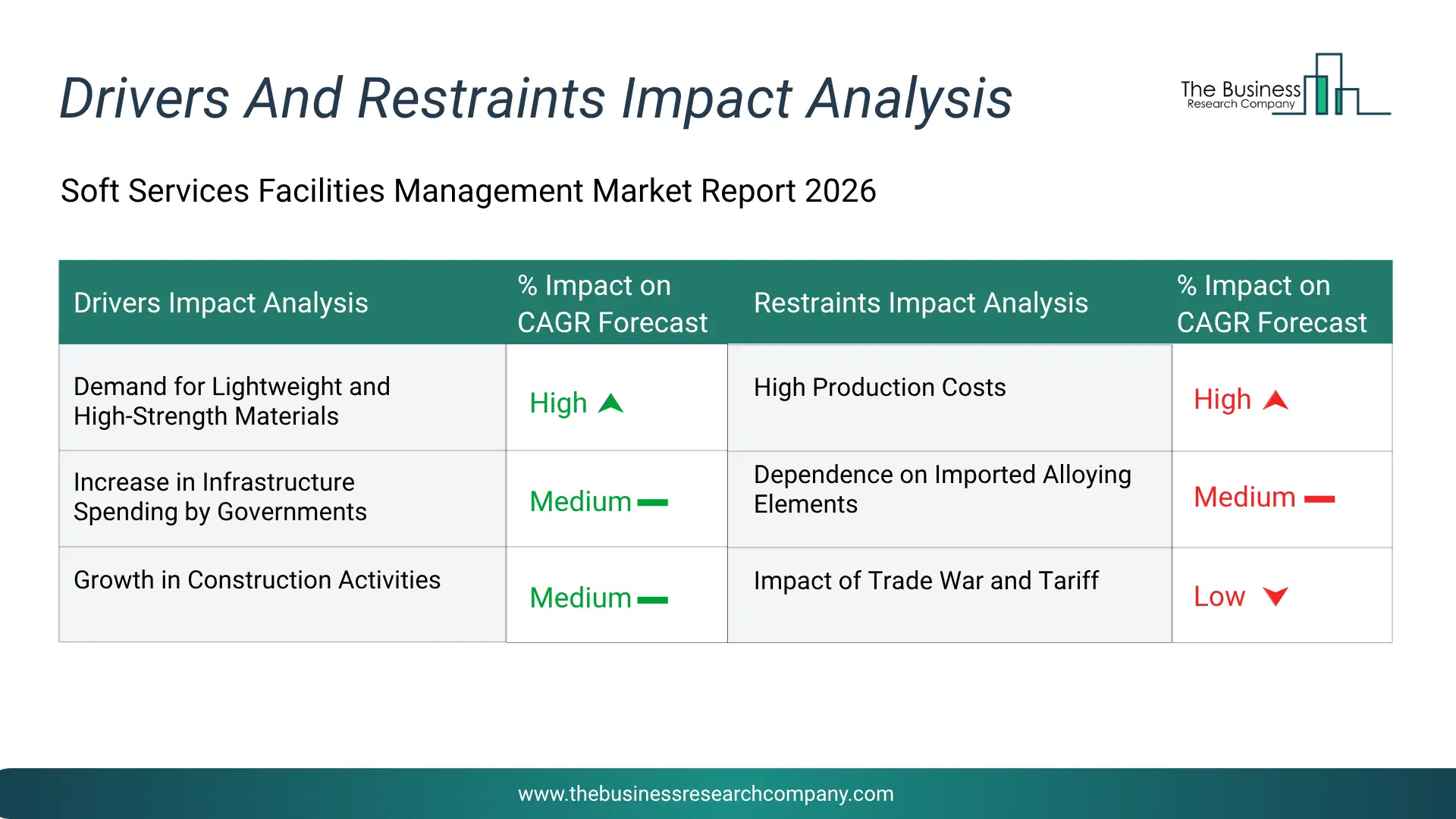
Infographic Chart Showing Key Market Drivers Analysis And Restraints For Plant Factory Market
The chart presents an impact analysis of key drivers and restraints, quantifying their relative influence on the market's growth rate and helping assess the balance between growth enablers and limiting factors. This chart offers a high-level perspective; the full report contains more detailed insights.
How Will The Drivers Impact Growth In The Global Plant Factory Market?
• Shift Toward Sustainable Agriculture Systems (Medium) – During the forecast period, the shift toward sustainable agriculture systems will become a key driver of growth in the plant factory market by 2030. rising demand for resource-efficient, environmentally friendly, and high-yield crop production systems is encouraging businesses and governments to invest in controlled environment agriculture solutions, including plant factories. these systems enable year-round cultivation of high-value crops with minimal water and land usage, reducing dependency on traditional farming methods and mitigating climate-related risks. additionally, advancements in automation, led lighting, and hydroponic technologies are enhancing productivity and cost-efficiency. as sustainability becomes a core priority for the food industry, plant factories are emerging as a strategic solution to meet future food security and environmental goals. therefore, the shift toward sustainable agriculture systems will drive the growth of the plant factory market. as a result, shift toward sustainable agriculture systems is anticipated to contributing to a 1.8% annual growth in the market. • Rising Global Food Demand (Medium) – During the forecast period, the rising global food demand will emerge as a major factor driving the expansion of the plant factory market by 2030. increasing population, urbanization, and changing dietary preferences are putting pressure on traditional agricultural systems, creating a need for innovative, high-efficiency food production solutions. plant factories, with controlled environment technologies such as hydroponics, led lighting, and automation, allow for consistent, year-round cultivation of high-value crops while optimizing resource usage. these systems minimize dependency on land and weather conditions, ensuring stable supply chains. as governments and private players focus on food security and sustainable production, plant factories are positioned as a key solution to address global food demand challenges. therefore, the rising global food demand will drive the growth of the plant factory market. consequently, the rising global food demand is projected to contributing to a 1.3% annual growth in the market. • Government Policies and Spur Toward Plant Factory Adoption (Low) – During the forecast period, the government policies and spur toward plant factory adoption will serve as a key growth catalyst for the plant factory market by 2030. governments across regions are offering incentives, subsidies, and research funding to encourage sustainable and efficient food production systems. such policy support reduces entry barriers for businesses and stimulates investments in advanced plant factory technologies, including hydroponics, vertical farming, and automation solutions. additionally, public-private collaborations are enhancing knowledge sharing and infrastructure development, further accelerating market adoption. as policymakers prioritize food security, resource efficiency, and environmental sustainability, plant factories are increasingly recognized as a strategic solution to meet these objectives. therefore, the government policies and spur towards plant factory adoption will drive the growth of the plant factory market. therefore, government policies and spur toward plant factory adoption is projected to supporting to a 0.8% annual growth in the market. • Rising Demand for Organic and Specialty Crops (Low) – During the forecast period, the rising demand for organic and specialty crops is expected to propel the growth of the plant factory market during forecast period. consumers are increasingly seeking fresh, high-quality, and chemical-free produce, encouraging producers to adopt controlled environment agriculture solutions. plant factories enable precise cultivation of herbs, leafy greens, and other specialty crops, ensuring consistent quality and yield throughout the year. advanced technologies such as hydroponics, vertical farming, and automated climate control allow for efficient resource utilization while meeting stringent quality standards. as the organic and specialty food market expands, plant factories are emerging as a strategic solution for producers to satisfy consumer preferences and maximize profitability. therefore, the rising demand for organic and specialty crops will drive the growth of the plant factory market. the rising demand for organic and specialty crops growth contribution during the forecast period in 2025 is 0.5%.How Will The Restraints Impact Growth In The Global Plant Factory Market?
• Limited Crop Variety (Medium) – During the forecast period, limited crop variety is expected to hinder the growth of the plant factory market in forecast period. currently, plant factories are primarily focused on leafy greens, herbs, and a few high-value vegetables, limiting their ability to address broader agricultural demands. expanding into staple crops or larger fruiting plants remains technically and economically challenging due to space, energy, and resource requirements. this restriction may slow market adoption among commercial growers seeking diversification. additionally, consumer expectations for a wider range of produce could further limit the scalability of plant factories, posing a challenge for long-term market growth despite technological advancements. therefore, limited crop variety may hinder the growth of the plant factory market. growth affected by limited crop variety during the forecast period in 2025 is -1.5%. • Rising Labor Shortages in Conventional Agriculture (Medium) – During the forecast period, rising labor shortages in conventional agriculture is expected to hinder the growth of the plant factory market. Although plant factories offer automation and controlled environment advantages, they still require skilled personnel for system management, maintenance, and monitoring. A shortage of trained labor can increase operational costs, limit scalability, and slow the adoption of these advanced agricultural systems. Additionally, attracting and retaining talent with expertise in hydroponics, climate control, and automation technologies remains a challenge in many regions. As a result, labor constraints could impede the pace at which plant factories expand, affecting overall market growth despite strong demand for sustainable farming solutions. Therefore, rising labor shortages in conventional agriculture may hinder the growth of the plant factory market. Growth affected by rising labor shortages in conventional agriculture during the forecast period in 2025 is -1.0% • Trade War & Tariffs (Low) – During the forecast period, trade wars and tariffs are expected to restrain the growth of the plant factory market during the forecast period by increasing the costs of imported equipment, technology components, and high-quality inputs, thereby limiting affordability for producers and reducing the availability of advanced plant factory solutions for commercial adoption. higher import duties on lighting systems, hydroponic components, and climate control technologies can raise operational expenses, making plant factory setups less affordable for producers. additionally, disruptions in global supply chains may delay project timelines and limit access to cutting-edge solutions, affecting productivity and scalability. as a result, market expansion could be slowed, particularly in regions reliant on imported materials, despite the growing demand for sustainable and efficient food production systems. therefore, trade wars and tariffs may restrain the growth of the plant factory market. growth affected by trade war and tariffs across regions during the forecast period in 2025 is -0.3%.Key Players In The Global Plant Factory Market
Major companies operating in the plant factory market are AeroFarms LLC, BrightFarms Inc., Gotham Greens Holdings LLC, Bowery Farming Inc., AppHarvest Inc., Lufa Farms, Beijing IEDA Protected Horticulture Co. Ltd., Green Sense Farms Holdings Inc., Plenty Unlimited Inc., Mirai Co. Ltd., Farminova Plant Factory, Urban Crops Solutions, Sky Greens, Kalera Inc., TruLeaf Sustainable Agriculture, Wulian, Crop One Holdings Inc., Vertical Harvest Farms, Heliospectra AB, Infarm GmbH, Intelligent Growth Solutions, LettuceGrow, Light Science Technologies, MechaFarm, Phytoponics, SmartFarm Systems, Vertical Greens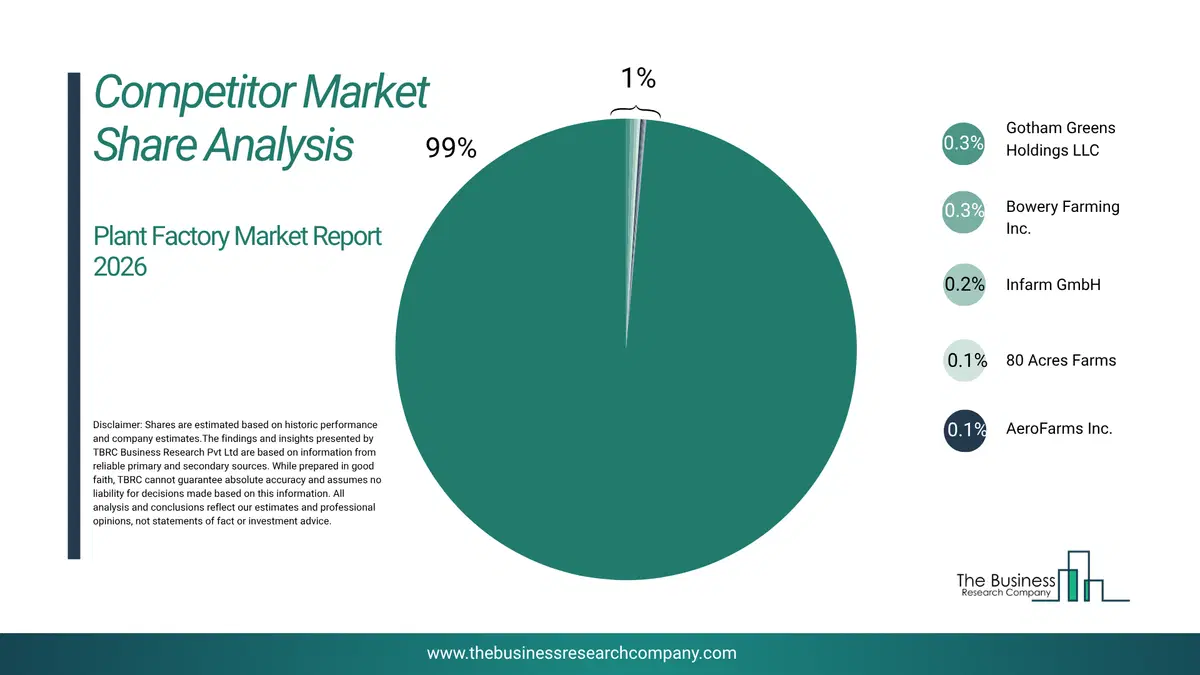
This chart is for illustrative purposes; the full report includes a detailed competitor analysis and comprehensive overview of the top 10 companies in the market.
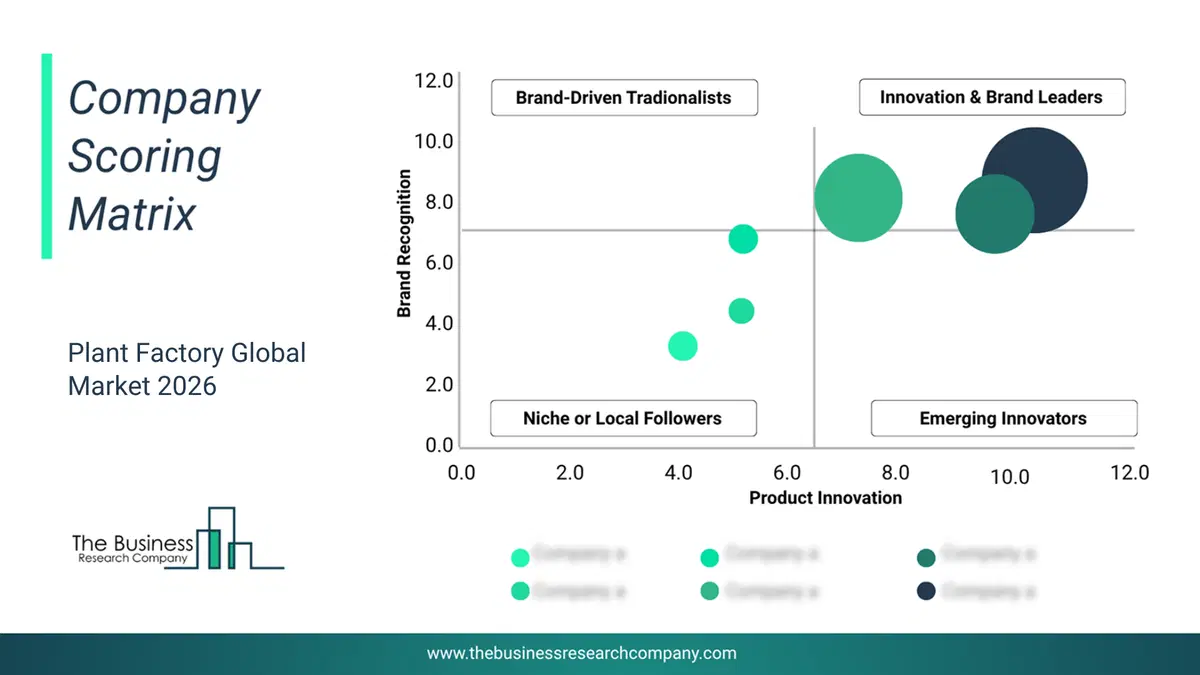
This chart maps companies by product innovation and brand strength, with bubble size indicating relative revenue, helping identify market leaders, challengers, and niche players. This is an illustrative chart; the full report provides a complete and accurate competitive analysis.
Global Plant Factory Market Trends and Insights
Major companies operating in the plant factory market are developing autonomous climate control technology. Autonomous climate control technology refers to self-regulating systems that maintain optimal environmental conditions, such as temperature and humidity, without human intervention. For instance, in June 2023, IUNU, a US-based company that specializes in developing technology for horticulture, launched a new autonomous climate control technology called Intelligent Setpoint Control for LUNA AI. This closed-loop system for autonomous temperature management in horticulture compares actual, thoroughly gathered data with climatic data, then compares that data with experiments conducted on actual plants and in virtual simulations. Utilizing computer vision, the system considers agricultural strategy and places the plant in control.What Are Latest Mergers And Acquisitions In The Plant Factory Market?
In August 2023, Harmoniz Ltd, a Netherlands-based technology company, acquired Plantfactory RCA B.V. for an undisclosed amount. With this acquisition, Harmoniz aims to strengthen its presence in the controlled-environment agriculture sector and expand its innovative solutions in plant cultivation technologies. Plantfactory RCA B.V. is a Netherlands-based company that specializes in developing and providing advanced indoor farming systems and plant growth solutions.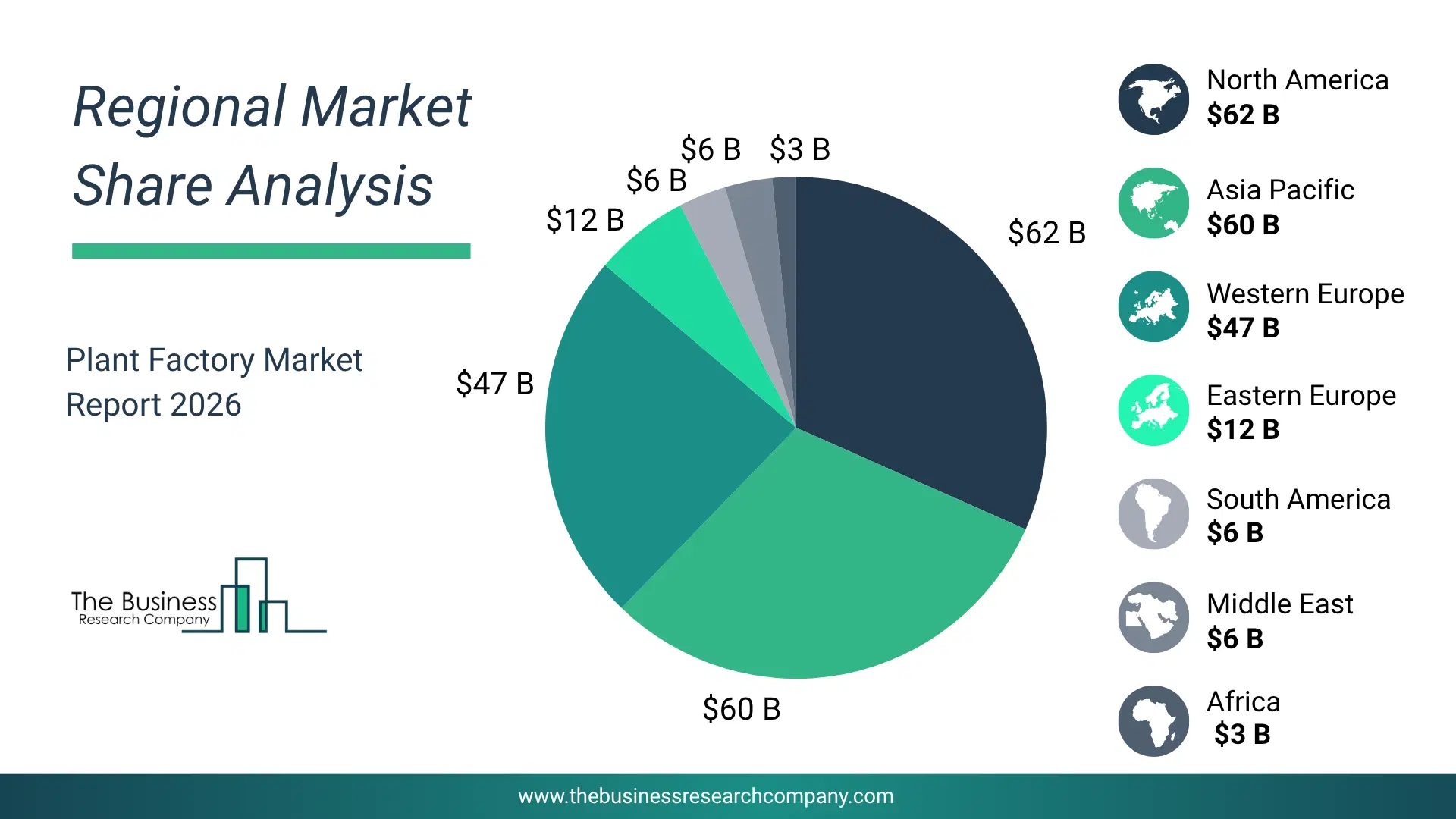
Regional Outlook
Western Europe was the largest region in the plant factory market in 2025. The regions covered in this market report are Asia-Pacific, South East Asia, Western Europe, Eastern Europe, North America, South America, Middle East, Africa The countries covered in this market report are Australia, Brazil, China, France, Germany, India, Indonesia, Japan, Taiwan, Russia, South Korea, UK, USA, Canada, Italy, Spain.What Defines the Plant Factory Market?
The plant factory market includes revenues earned by entities providing services such as hydroponics aquaponics, aeroponics, and vertical planting. The market value includes the value of related goods sold by the service provider or included within the service offering. Only goods and services traded between entities or sold to end consumers are included.How is Market Value Defined and Measured?
The market value is defined as the revenues that enterprises gain from the sale of goods and/or services within the specified market and geography through sales, grants, or donations in terms of the currency (in USD unless otherwise specified). The revenues for a specified geography are consumption values that are revenues generated by organizations in the specified geography within the market, irrespective of where they are produced. It does not include revenues from resales along the supply chain, either further along the supply chain or as part of other products.
This chart presents market attractiveness based on a quantitative evaluation of growth, competition, strategic alignment, and risk, offering a clear view of opportunity areas for decision-making. This chart is for illustrative purposes; the full report contains the complete analysis.

This chart highlights the Total Addressable Market (TAM) by estimating the maximum revenue opportunity using an assumption-driven approach, supporting strategic planning and opportunity sizing across markets. The chart is illustrative; the full report provides a more comprehensive analysis.
What Key Data and Analysis Are Included in the Plant Factory Market Report 2026?
The plant factory market research report is one of a series of new reports from The Business Research Company that provides market statistics, including industry global market size, regional shares, competitors with the market share, detailed market segments, market trends and opportunities, and any further data you may need to thrive in the plant factory industry. The market research report delivers a complete perspective of everything you need, with an in-depth analysis of the current and future state of the industry.Plant Factory Market Report Forecast Analysis
| Report Attribute | Details |
|---|---|
| Market Size Value In 2026 | $148.53 billion |
| Revenue Forecast In 2030 | $194.72 billion |
| Growth Rate | CAGR of 7.2% from 2026 to 2030 |
| Base Year For Estimation | 2025 |
| Actual Estimates/Historical Data | 2020-2025 |
| Forecast Period | 2026 - 2030 - 2035 |
| Market Representation | Revenue in USD Billion and CAGR from 2026 to 2030 |
| Segments Covered | Facility Type, Light Type, Growing System, Crop type |
| Regional Scope | Asia-Pacific, Western Europe, Eastern Europe, North America, South America, Middle East, Africa |
| Country Scope | The countries covered in the report are Australia, Brazil, China, France, Germany, India, Indonesia, Japan, Taiwan, Russia, South Korea, UK, USA, Canada, Italy, Spain. |
| Key Companies Profiled | AeroFarms LLC, BrightFarms Inc., Gotham Greens Holdings LLC, Bowery Farming Inc., AppHarvest Inc., Lufa Farms, Beijing IEDA Protected Horticulture Co. Ltd., Green Sense Farms Holdings Inc., Plenty Unlimited Inc., Mirai Co. Ltd., Farminova Plant Factory, Urban Crops Solutions, Sky Greens, Kalera Inc., TruLeaf Sustainable Agriculture, Wulian, Crop One Holdings Inc., Vertical Harvest Farms, Heliospectra AB, Infarm GmbH, Intelligent Growth Solutions, LettuceGrow, Light Science Technologies, MechaFarm, Phytoponics, SmartFarm Systems, Vertical Greens |
| Customization Scope | Request for Customization |
| Pricing And Purchase Options | Explore Purchase Options |