

Property And Casualty Insurance Software Market Report 2026
Global Outlook – By Type (Cloud-Based, On-Premise), By Functionality (Policy Administration, Claims Management, Risk Management, Analytics And Reporting), By End-User (Insurance Companies, Third-Party Administrators) – Market Size, Trends, Strategies, and Forecast to 2030
Property And Casualty Insurance Software Market Overview
• Property And Casualty Insurance Software market size has reached to $20.96 billion in 2025 • Expected to grow to $34.75 billion in 2030 at a compound annual growth rate (CAGR) of 10.5% • Growth Driver: Cloud Computing Fuels Growth In Property And Casualty Insurance Software Market • Market Trend: Innovation In Property Insurance Valuation Platforms Drives Accuracy And Efficiency In The Property And Casualty Insurance Market • North America was the largest region in 2025.Market Gains By 2030 – Top Opportunities By Segment
Market Gain identifies the most promising market opportunities by highlighting the segments or products expected to generate the highest incremental revenue growth over the next five years.
What Is Covered Under Property And Casualty Insurance Software Market?
Property and casualty (P And C) insurance software refers to specialized technology solutions designed to facilitate the management, underwriting, policy administration, claims processing, and overall operations of property and casualty insurance companies. This type of software is essential for automating and streamlining the various processes involved in the insurance lifecycle, from policy issuance to claims settlement. The main types of property and casualty insurance software are cloud-based and on-premise. Cloud-based solutions are hosted on remote servers accessed over the internet, offering scalability, flexibility, and reduced upfront costs. Various deployment models include the subscription-based model and the ownership-based model for different functionalities such as policy administration, claims management, risk management, analytics, and reporting used for a variety of applications, including small and medium enterprises (SMEs), large enterprises, and many end-users, including insurance companies and third-party administrators.
What Is The Property And Casualty Insurance Software Market Size and Share 2026?
The property and casualty insurance software market size has grown rapidly in recent years. It will grow from $20.96 billion in 2025 to $23.32 billion in 2026 at a compound annual growth rate (CAGR) of 11.3%. The growth in the historic period can be attributed to increasing digital transformation initiatives in insurance, rising operational efficiency requirements, growth in policy volumes, adoption of enterprise insurance software, expansion of regulatory compliance needs.What Is The Property And Casualty Insurance Software Market Growth Forecast?
The property and casualty insurance software market size is expected to see rapid growth in the next few years. It will grow to $34.75 billion in 2030 at a compound annual growth rate (CAGR) of 10.5%. The growth in the forecast period can be attributed to increasing migration to saas-based platforms, rising demand for real-time risk analytics, expansion of automation in underwriting processes, growing focus on customer experience optimization, increasing integration of insurtech ecosystems. Major trends in the forecast period include increasing adoption of cloud-based core insurance platforms, rising use of ai-driven claims automation, growing integration of advanced analytics and reporting tools, expansion of modular and api-based software architectures, enhanced focus on cybersecurity and data protection.
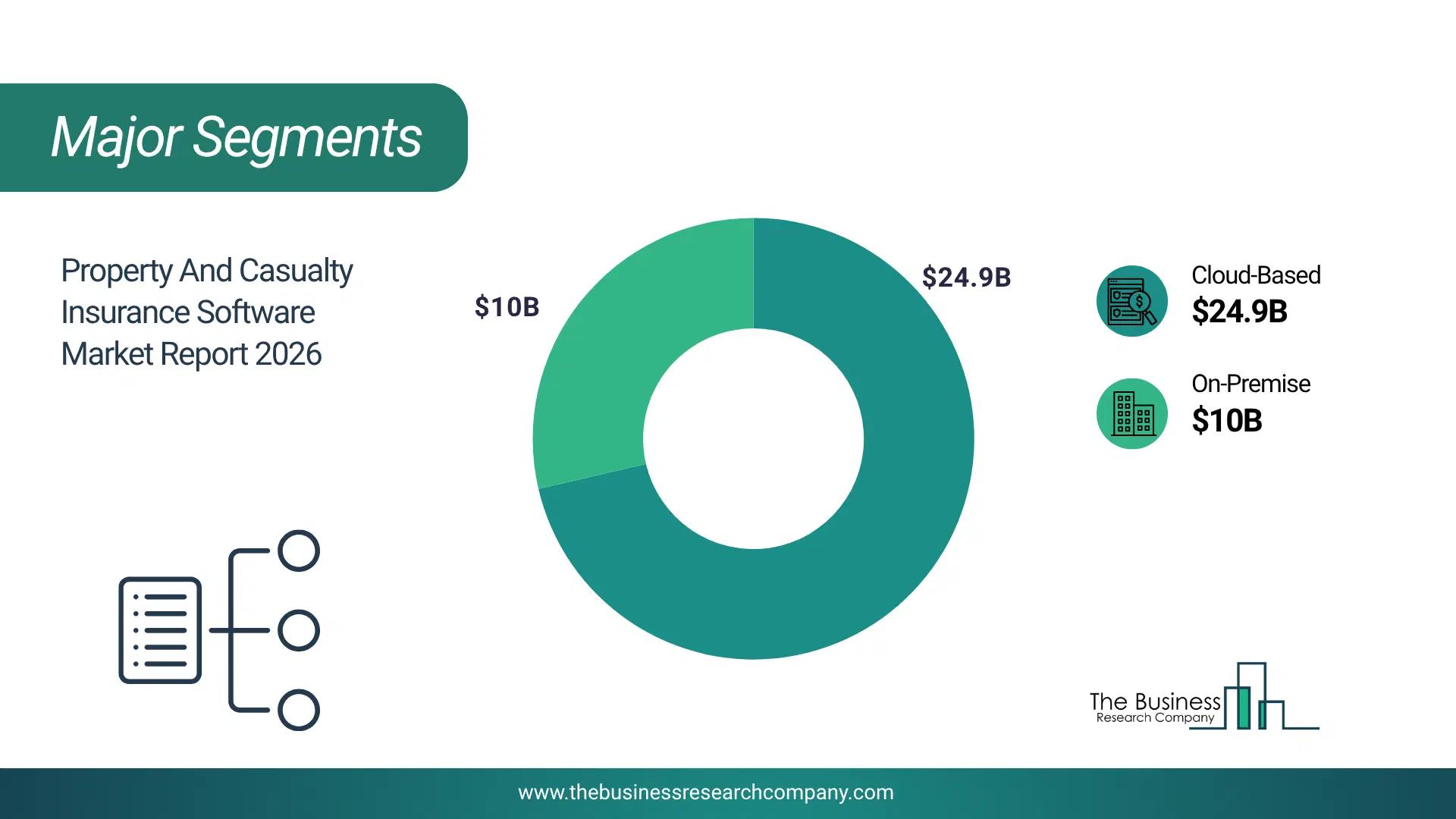
Global Property And Casualty Insurance Software Market Segmentation
1) By Type: Cloud-Based, On-Premise 2) By Functionality: Policy Administration, Claims Management, Risk Management, Analytics And Reporting 3) By End-User: Insurance Companies, Third-Party Administrators Subsegments: 1) By Cloud-Based: Saas (Software As A Service) Property And Casualty Insurance Software, Multi-Tenant Cloud-Based Insurance Software, Private Cloud-Based Property And Casualty Insurance Solutions, Cloud-Based Claims Management Software, Cloud-Based Underwriting Software 2) By On-Premise: On-Premise Property And Casualty Insurance Software, On-Premise Claims Management Software, On-Premise Policy Administration Software, On-Premise Risk Management Software, On-Premise Underwriting And Billing Software The top segments in the property and casualty insurance software market will be: • Cloud-Based will reach $24.83 billion by 2030. • On-Premise will reach $9.93 billion by 2030.What Is The Driver Of The Property And Casualty Insurance Software Market?
The increasing demand for cloud-based solutions is expected to propel the growth of the property and casualty insurance software market going forward. Cloud-based solutions refer to applications, storage, on-demand services, computer networks, or other resources that are accessed via an internet connection. The demand for cloud-based solutions is rising due to the need for scalable, flexible, and cost-effective IT infrastructure. Cloud-based solutions in property and casualty insurance software enhance efficiency, scalability, and data security through streamlined processes and real-time data access. For instance, in December 2023, according to Eurostat, the Luxembourg-based official statistical office of the European Union, 45.2% of businesses across the EU were using cloud computing services, and Finland reported one of the highest adoption levels, with 78.3% of enterprises using cloud technology. Therefore, the increasing demand for cloud-based solutions is driving the growth of the property and casualty insurance software industry.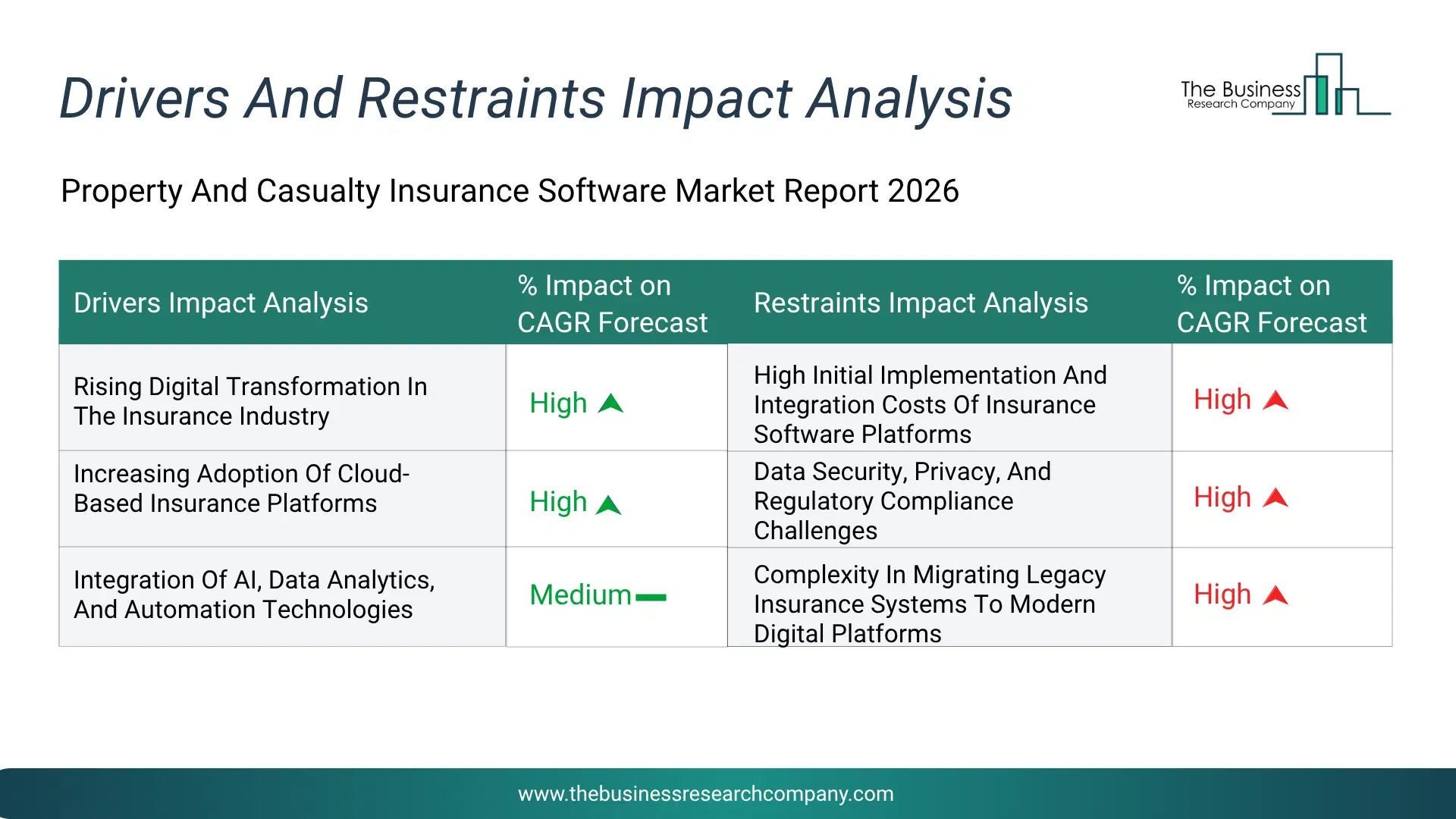
Infographic Chart Showing Key Market Drivers Analysis And Restraints For Property And Casualty Insurance Software Market
The chart presents an impact analysis of key drivers and restraints, quantifying their relative influence on the market's growth rate and helping assess the balance between growth enablers and limiting factors. This chart offers a high-level perspective; the full report contains more detailed insights.
How Will The Drivers Impact Growth In The Global Property And Casualty Insurance Software Market?
• Rising Digital Transformation In The Insurance Industry (High) – During the forecast period, the rising digital transformation in the insurance industry is expected to become a major growth driver for the property and casualty insurance software market by 2030. Increasing digitalization across the insurance sector is significantly accelerating the adoption of advanced software platforms. Insurers are replacing legacy systems with modern digital solutions to streamline policy administration, claims processing, underwriting operations, and customer engagement. These platforms enable automation, faster transaction processing, and improved operational efficiency. As insurance providers focus on delivering seamless digital experiences while enhancing internal workflows, the adoption of specialized p&c insurance software continues to expand rapidly. • Increasing Adoption Of Cloud-Based Insurance Platforms (High) – During the forecast period, the increasing adoption of cloud-based insurance platforms is expected to emerge as a significant factor driving the expansion of the property and casualty insurance software market by 2030. The growing shift toward cloud deployment is substantially supporting market growth. Cloud-based systems allow insurers to enhance scalability, lower it infrastructure expenses, and improve operational flexibility. These platforms also enable faster implementation, real-time access to data, and seamless integration with external applications and services. As insurance organizations increasingly transition from traditional on-premise systems to cloud-native environments, the demand for modern insurance software platforms continues to grow. • Integration Of AI, Data Analytics, And Automation Technologies (Medium) – During the forecast period, the integration of artificial intelligence, data analytics, and automation technologies is expected to act as a key growth catalyst for the property and casualty insurance software market by 2030. Rapid advancements in ai-driven technologies, analytics tools, and automation capabilities are significantly accelerating market expansion. Ai-powered software enables insurers to enhance risk assessment processes, detect fraudulent activities, and improve predictive underwriting capabilities. In addition, advanced data analytics provides deeper customer insights and supports the development of more personalized insurance products. These technological innovations help insurers strengthen decision-making processes and increase operational efficiency throughout the insurance value chain.How Will The Restraints Impact Growth In The Global Property And Casualty Insurance Software Market?
• High Initial Implementation And Integration Costs Of Insurance Software Platforms (High) – During the forecast period, the high initial implementation and integration costs act as a significant restraint for the property and casualty insurance software market. Deploying comprehensive insurance software often requires substantial investments in software licensing, infrastructure upgrades, customization, employee training, and system integration. Many small and medium-sized insurers may face budget limitations that delay or restrict software adoption. Additionally, integrating new solutions with existing systems can increase project complexity and implementation expenses, making organizations cautious about large-scale digital transformation initiatives. • Data Security, Privacy, And Regulatory Compliance Challenges (High) – During the forecast period, the data security, privacy, and regulatory compliance challenges restrain market growth by creating operational and legal concerns for insurers. Property and casualty insurance companies manage highly sensitive customer information, including personal, financial, and claims-related data. Any data breach or cyberattack can result in financial losses, reputational damage, and regulatory penalties. Furthermore, insurers must comply with evolving data protection regulations and industry-specific requirements across different regions. These challenges increase implementation complexity and require continuous investment in cybersecurity and compliance measures, potentially slowing software adoption. • Complexity In Migrating Legacy Insurance Systems To Modern Digital Platforms (High) – During the forecast period, the the complexity involved in migrating legacy insurance systems to modern digital platforms is another key market restraint. Many insurers continue to rely on outdated systems that have been deeply integrated into their operations over several years. Transitioning to modern software platforms often involves extensive data migration, workflow redesign, system testing, and employee retraining. The risk of operational disruptions, data inconsistencies, and implementation delays can discourage organizations from upgrading their systems. Consequently, concerns regarding migration complexity can slow the adoption of advanced property and casualty insurance software solutions.Key Players In The Global Property And Casualty Insurance Software Market
Major companies operating in the property and casualty insurance software market are Guidewire Software Inc., Duck Creek Technologies, Majesco Limited, Sapiens International Corporation, DXC Technology Company, Pegasystems Inc., Ebix Inc., FINEOS Corporation Limited, Insuresoft Inc., Zywave Inc., Waterstreet Company, StoneRiver Inc., Sunlight Solutions, ClarionDoor LLC, VUE Software, AGO Insurance Software, Damco Solutions Inc., A-1 Enterprise Inc., Insurity, OneShield Software, Keylane, Prima Solutions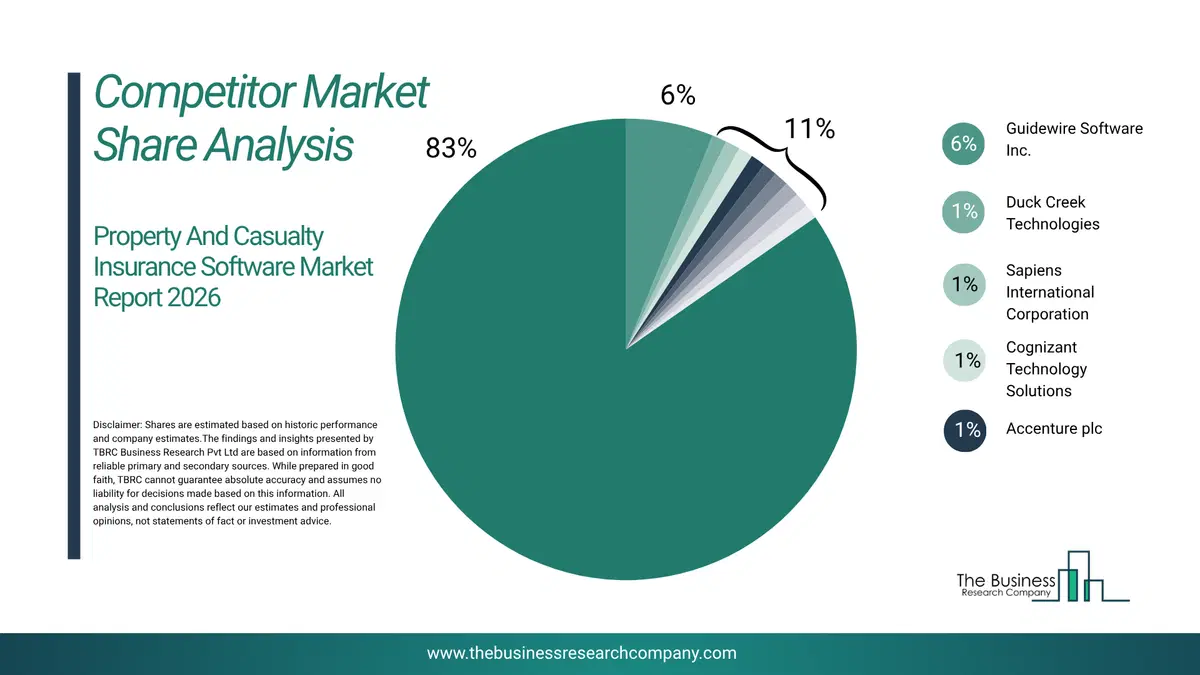
This chart is for illustrative purposes; the full report includes a detailed competitor analysis and comprehensive overview of the top 10 companies in the market.
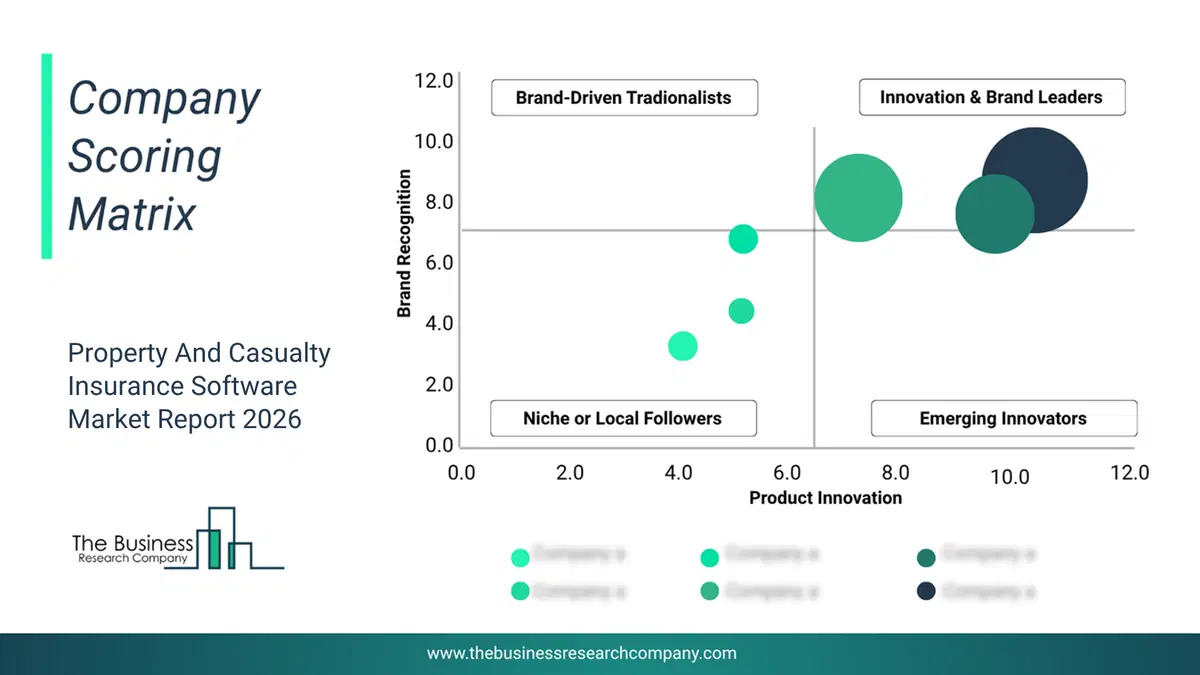
This chart maps companies by product innovation and brand strength, with bubble size indicating relative revenue, helping identify market leaders, challengers, and niche players. This is an illustrative chart; the full report provides a complete and accurate competitive analysis.
Global Property And Casualty Insurance Software Market Trends and Insights
Major companies operating in the property and casualty insurance software market are developing innovative technology platforms, such as property insurance valuation platforms, to improve accuracy, streamline processes, and enhance customer service. Property insurance valuation platforms are digital tools or software solutions that assess the value of properties for insurance purposes, using data analytics, algorithms, and market insights to provide accurate and up-to-date valuations. For instance, in April 2023, Kroll LLC, a US-based financial and risk advisory company, launched a property insurance valuation platform to help clients navigate economic volatility by providing fast, cost-effective, and reliable valuations on property data at scale. The platform leverages Kroll's global proprietary valuation data and deep real estate valuation expertise to deliver high-speed valuations in seconds. It includes advanced analytics and visualization tools to help users identify gaps in insurable value and take strategic action.What Are Latest Mergers And Acquisitions In The Property And Casualty Insurance Software Market?
In March 2023, Vista Equity Partners, a US-based private equity company, acquired Duck Creek Technologies for $2.6 billion. Vista Equity Partners' acquisition of Duck Creek Technologies aims to propel the evolution of next-generation property and casualty insurance technology. Duck Creek Technologies is a US-based software company that provides insurance, property, and casualty software.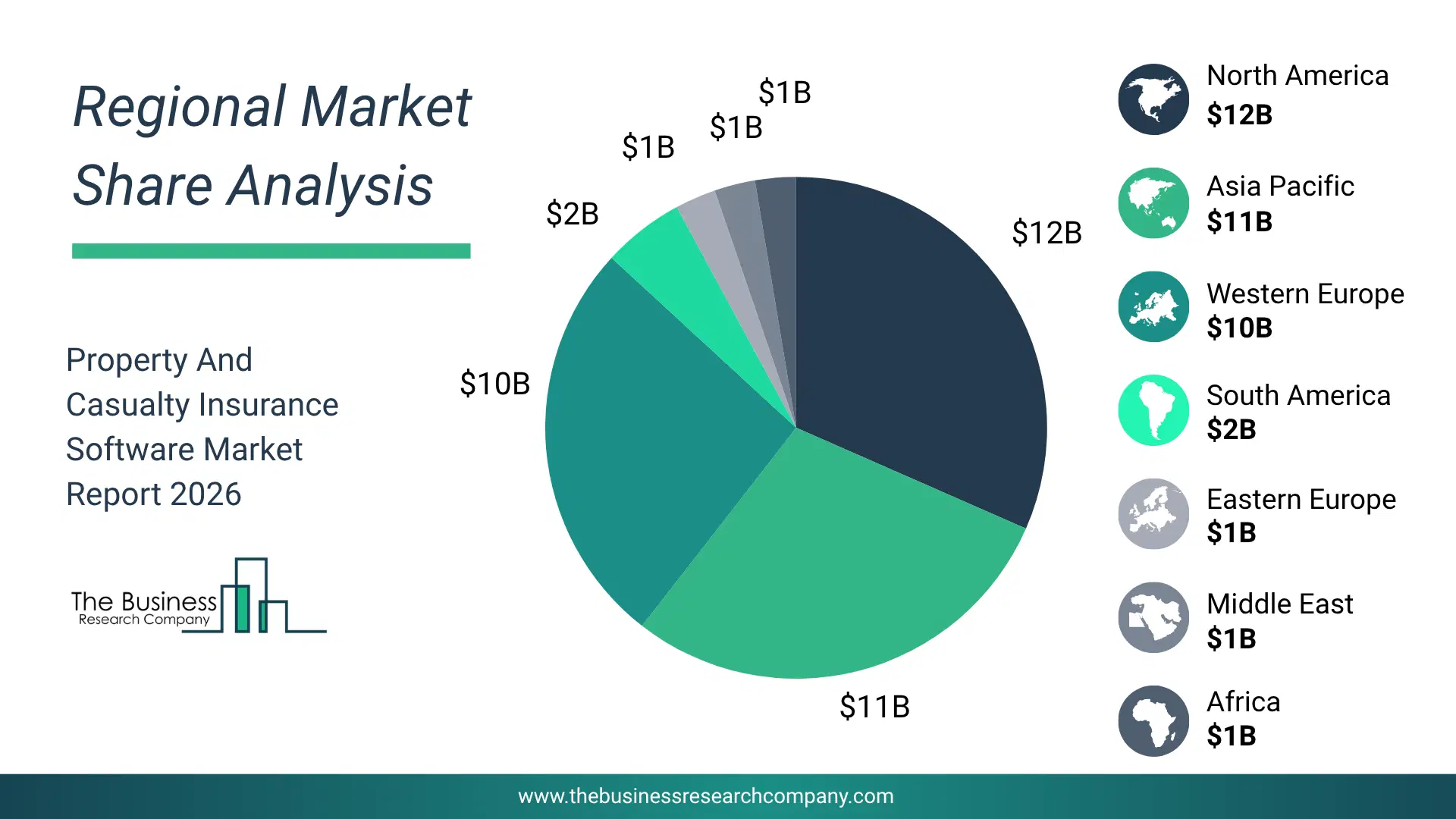
Regional Outlook
North America was the largest region in the property and casualty insurance software market in 2025. The regions covered in this market report are Asia-Pacific, South East Asia, Western Europe, Eastern Europe, North America, South America, Middle East, Africa. The countries covered in this market report are Australia, Brazil, China, France, Germany, India, Indonesia, Japan, Taiwan, Russia, South Korea, UK, USA, Canada, Italy, Spain.What Defines the Property And Casualty Insurance Software Market?
The property and casualty insurance software market includes revenues earned by entities by licenses, subscription fees, transaction fees, data services, analytics tools, or access to aggregated industry data insights. The market value includes the value of related goods sold by the service provider or included within the service offering. Only goods and services traded between entities or sold to end consumers are included.How is Market Value Defined and Measured?
The market value is defined as the revenues that enterprises gain from the sale of goods and/or services within the specified market and geography through sales, grants, or donations in terms of the currency (in USD unless otherwise specified). The revenues for a specified geography are consumption values that are revenues generated by organizations in the specified geography within the market, irrespective of where they are produced. It does not include revenues from resales along the supply chain, either further along the supply chain or as part of other products.
This chart presents market attractiveness based on a quantitative evaluation of growth, competition, strategic alignment, and risk, offering a clear view of opportunity areas for decision-making. This chart is for illustrative purposes; the full report contains the complete analysis.

This chart highlights the Total Addressable Market (TAM) by estimating the maximum revenue opportunity using an assumption-driven approach, supporting strategic planning and opportunity sizing across markets. The chart is illustrative; the full report provides a more comprehensive analysis.
What Key Data and Analysis Are Included in the Property And Casualty Insurance Software Market Report 2026?
The property and casualty insurance software market research report is one of a series of new reports from The Business Research Company that provides market statistics, including Market Report 2026?global market size, regional shares, competitors with the market share, detailed market segments, market trends and opportunities, and any further data you may need to thrive in the property and casualty insurance software Market Report 2026? The market research report delivers a complete perspective of everything you need, with an in-depth analysis of the current and future state of the Market Report 2026?Property And Casualty Insurance Software Market Report Forecast Analysis
| Report Attribute | Details |
|---|---|
| Market Size Value In 2026 | $23.32 billion |
| Revenue Forecast In 2030 | $34.75 billion |
| Growth Rate | CAGR of 10.5% from 2026 to 2030 |
| Base Year For Estimation | 2025 |
| Actual Estimates/Historical Data | 2020-2025 |
| Forecast Period | 2026 - 2030 |
| Market Representation | Revenue in USD Billion and CAGR from 2026 to 2030 |
| Segments Covered | Type, Functionality, End-User |
| Regional Scope | Asia-Pacific, Western Europe, Eastern Europe, North America, South America, Middle East, Africa |
| Country Scope | The countries covered in the report are Australia, Brazil, China, France, Germany, India, ... |
| Key Companies Profiled | Guidewire Software Inc., Duck Creek Technologies, Majesco Limited, Sapiens International Corporation, DXC Technology Company, Pegasystems Inc., Ebix Inc., FINEOS Corporation Limited, Insuresoft Inc., Zywave Inc., Waterstreet Company, StoneRiver Inc., Sunlight Solutions, ClarionDoor LLC, VUE Software, AGO Insurance Software, Damco Solutions Inc., A-1 Enterprise Inc., Insurity, OneShield Software, Keylane, Prima Solutions |
| Customization Scope | Request for Customization |
| Pricing And Purchase Options | Explore Purchase Options |