

Quinine Market Report 2026
Global Outlook – By Product (Quinine Sulphate, Quinine Hydrochloride, Quinine Gluconate, Quinine Bisulphate), By Administration (Oral Administration, Intramuscular Administration, Intravenous Administration, Other Administrations), By Application (Malaria Treatment, Nocturnal Leg Cramps), By Enduser (Hospitals, Clinics, Other Endusers) – Market Size, Trends, Strategies, and Forecast to 2035
Quinine Market Overview
• Quinine market size has reached to $2.45 billion in 2025 • Expected to grow to $3.76 billion in 2030 at a compound annual growth rate (CAGR) of 8.8% • Growth Driver: The Rising Prevalence Of Malaria Driving The Growth Of The Market Due To Increasing Mosquito Habitats And Infected Cases • North America was the largest region in 2025 and Asia-Pacific is the fastest growing region.Market Gains By 2030 – Top Opportunities By Segment
Market Gain identifies the most promising market opportunities by highlighting the segments or products expected to generate the highest incremental revenue growth over the next five years.
What Is Covered Under Quinine Market?
Quinine is a natural compound extracted from the bark of the cinchona tree, traditionally used to treat malaria. It works by interfering with the growth and reproduction of the malaria parasite in red blood cells. Apart from its medical use, quinine is also found in tonic water, giving it a distinct bitter taste. Though effective, quinine can have side effects and is now often replaced by more modern antimalarial drugs. The main products of quinine include quinine sulphate, quinine hydrochloride, quinine gluconate, and quinine bisuphate. Quinine sulfate, derived from the cinchona tree, is mainly used for treating malaria and, occasionally, nocturnal leg cramps. It can be administered orally, intramuscularly, intravenously, or in other ways. Its applications extend to malaria treatment, managing nocturnal leg cramps, muscle pain, and restless leg syndrome, and it is used by end users such as hospitals, clinics, ambulatory surgical centers, and others.
What Is The Quinine Market Size and Share 2026?
The quinine market size has grown strongly in recent years. It will grow from $2.45 billion in 2025 to $2.68 billion in 2026 at a compound annual growth rate (CAGR) of 9.2%. The growth in the historic period can be attributed to traditional reliance on cinchona bark extraction, limited availability of purified quinine, widespread use in malaria treatment, use in home remedies and tonic beverages, adoption in oral formulations.What Is The Quinine Market Growth Forecast?
The quinine market size is expected to see strong growth in the next few years. It will grow to $3.76 billion in 2030 at a compound annual growth rate (CAGR) of 8.8%. The growth in the forecast period can be attributed to technological advancements in quinine synthesis and purification, rising demand for pharmaceutical-grade quinine, expansion of malaria control programs, growth in functional beverages containing quinine, increased investment in antimalarial research and development. Major trends in the forecast period include rising demand for natural antimalarial compounds, increasing use of quinine in tonic beverages and functional drinks, development of pharmaceutical-grade quinine derivatives, growing awareness about malaria prevention and treatment, focus on regulatory compliance and quality standards for quinine products.
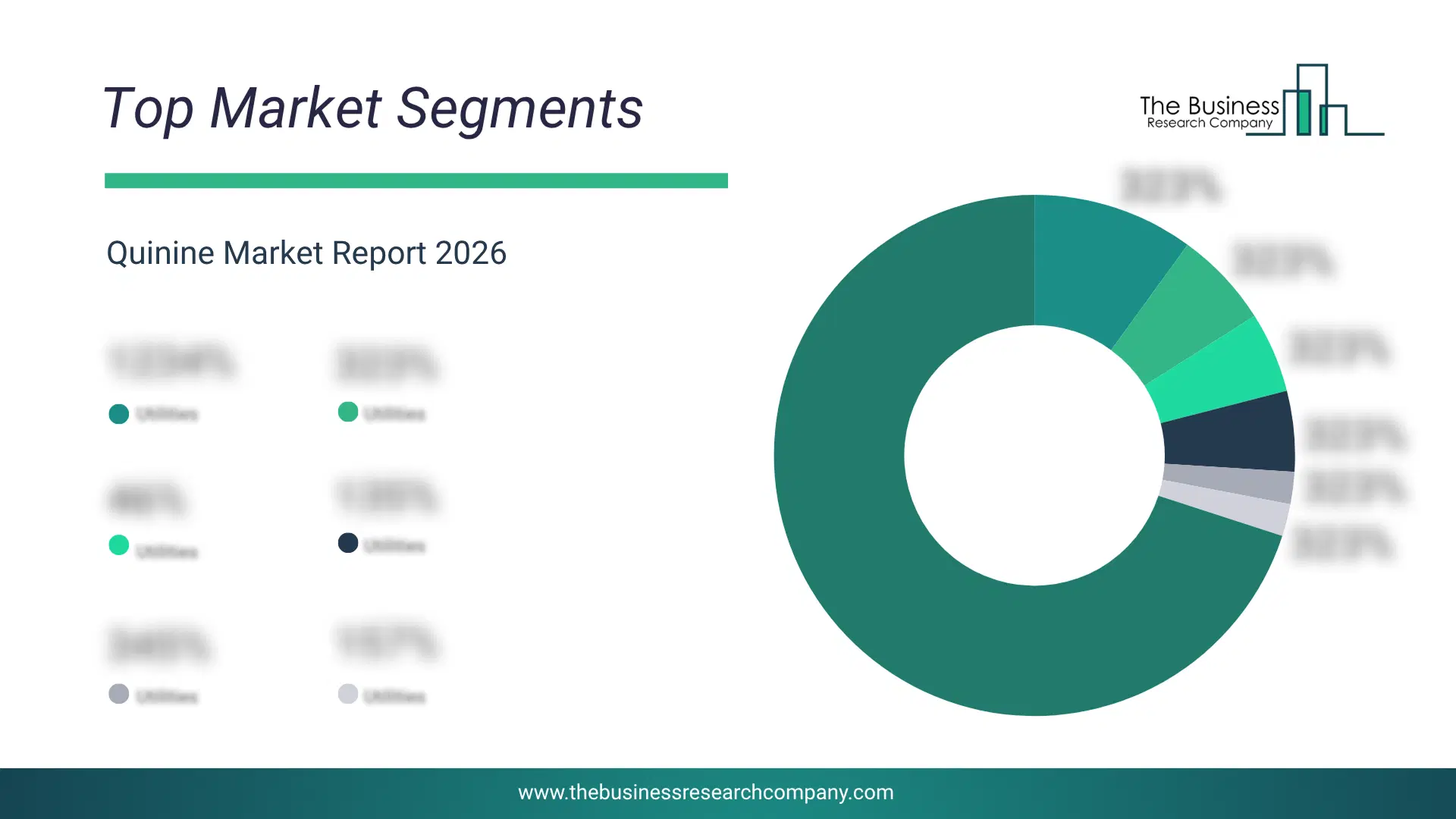
Global Quinine Market Segmentation
1) By Product: Quinine Sulphate, Quinine Hydrochloride, Quinine Gluconate, Quinine Bisulphate 2) By Administration: Oral Administration, Intramuscular Administration, Intravenous Administration, Other Administrations 3) By Application: Malaria Treatment, Nocturnal Leg Cramps 4) By Enduser: Hospitals, Clinics, Other Endusers The top segments in the quinine market will be: • Oral Administration will reach $1701.2 Million by 2025. • Malaria Treatment will reach $1547.2 Million by 2025. • Quinine Sulphate will reach $1342.7 Million by 2025. • Quinine Hydrochloride will reach $608.2 Million by 2025. • Other Applications will reach $484.2 Million by 2025.What Are The Drivers Of The Quinine Market?
The rising prevalence of malaria is expected to propel the growth of the quinine market going forward. Malaria is an infectious disease caused by Plasmodium parasites, which are transmitted to humans through the bite of infected female Anopheles mosquitoes. Malaria is increasing due to rising global temperatures, which expand the habitat range and breeding season of malaria-carrying mosquitoes. Quinine is a potent antimalarial drug that helps treat malaria by interfering with the parasite's ability to digest hemoglobin in red blood cells, ultimately inhibiting its growth and survival. For instance, in April 2024, according to the UK Health Security Agency, a UK-based government agency, in 2023, there were 2,004 confirmed cases of malaria in England, up from 1,369 in 2022. Therefore, the rising prevalence of malaria is driving the growth of the quinine industry. The rising pharmaceutical industry is expected to propel the growth of the quinine market going forward. The pharmaceutical industry is a sector that focuses on the research, development, production, and sale of medications and drugs to improve health and treat various diseases. The increasing pharmaceutical industry is driven by the aging global population, which raises demand for chronic disease treatments due to age-related health conditions. Quinine supports the pharmaceutical industry by serving as an essential antimalarial active ingredient that sustains treatment options in regions with drug resistance while also enabling ongoing formulation, manufacturing, and global health program demand. For instance, in November 2024, according to the European Federation of Pharmaceutical Industries and Associations (EFPIA), a Europe-based pharmaceutical manufacturing company, Europe’s pharmaceutical production increased from $393.3 billion (€363.3 billion) in 2022 to an estimated $422 billion (€390 billion) in 2023, reflecting a growth of approximately 7.3% year over year. This rise highlights the sector’s continued expansion driven by sustained R&D investment, strong manufacturing capabilities, and increasing demand across therapeutic areas. Therefore, the rising pharmaceutical industry will drive the growth of the quinine industry.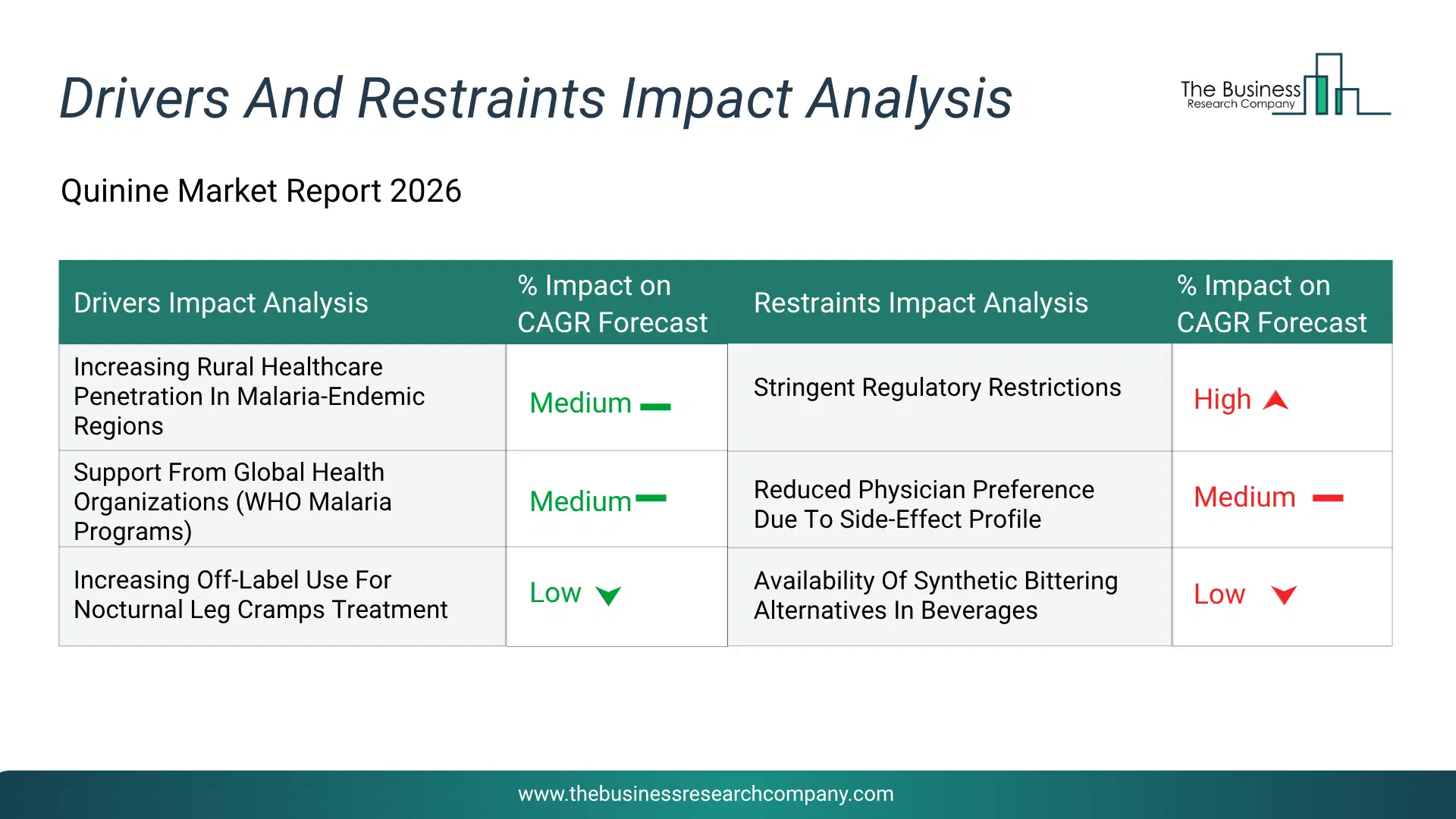
Infographic Chart Showing Key Market Drivers Analysis And Restraints For Quinine Market
The chart presents an impact analysis of key drivers and restraints, quantifying their relative influence on the market's growth rate and helping assess the balance between growth enablers and limiting factors. This chart offers a high-level perspective; the full report contains more detailed insights.
How Will The Drivers Impact Growth In The Global Quinine Market?
• Increasing Rural Healthcare Penetration In Malaria-Endemic Regions (Medium) – The increasing rural healthcare penetration in malaria-endemic regions will become a key driver of growth in the quinine market by 2030. Governments and global health organizations are expanding primary healthcare infrastructure, improving access to diagnosis and treatment in remote areas. Enhanced distribution networks and the availability of essential medicines at rural health centers are supporting timely malaria management. In areas where advanced therapies are limited or cost-prohibitive, quinine remains a viable treatment option. Additionally, awareness campaigns and community health programs are encouraging early treatment-seeking behaviour. As a result, the increasing rural healthcare penetration in malaria-endemic regions is anticipated to contributing to a 1.5% annual growth in the market. • Support From Global Health Organizations (WHO Malaria Programs) (Medium) – The support from global health organizations (WHO malaria programs) will emerge as a major factor driving the expansion of the quinine market by 2030. These organizations play a critical role in funding, policy development, and large-scale procurement of antimalarial drugs, particularly in low- and middle-income countries. Their initiatives focus on improving access to essential treatments, strengthening healthcare infrastructure, and ensuring the availability of life-saving medications in high-burden regions. In cases of severe malaria or drug resistance, quinine remains an important therapeutic option. Consequently, the support from global health organizations (WHO malaria programs) is projected to contributing to a 1.0% annual growth in the market. • Increasing Off-Label Use For Nocturnal Leg Cramps Treatment (Low) – The increasing off-label use for nocturnal leg cramps treatment will serve as a key growth catalyst for the quinine market by 2030 Despite regulatory limitations, quinine continues to be prescribed in certain regions where alternative therapies provide limited relief. The growing prevalence of leg cramps, particularly among the aging population, is contributing to sustained demand. Additionally, patient-reported effectiveness in reducing cramp frequency and severity supports its continued off-label adoption. This trend is further reinforced in markets with less stringent enforcement of prescribing restrictions. As a result, off-label utilization is anticipated to create incremental revenue opportunities for manufacturers. Therefore, this increasing off-label use for nocturnal leg cramps treatment is projected to supporting to a 0.7% annual growth in the market. • Efforts Towards Support For Cinchona Cultivation And Processing (Low) – The efforts towards the support for cinchona cultivation and processing will become a significant driver contributing to the growth of the quinine market by 2030. Government initiatives, agricultural subsidies, and research programs aimed at improving crop yield and disease resistance are encouraging farmers to expand cinchona plantations. Additionally, investments in modern processing technologies enhance extraction efficiency and product quality, reducing production costs. These developments help mitigate supply constraints and price volatility associated with natural sourcing. As a result, a more reliable and cost-effective supply of quinine is anticipated to support increased production. Consequently, the efforts towards the support for cinchona cultivation and processing is projected to contributing to a 0.5% annual growth in the market.How Will The Restraints Impact Growth In The Global Quinine Market?
• Stringent Regulatory Restrictions (Medium) – Stringent regulatory restrictions is expected to restrain market growth during the forecast period. It creates operational, financial, regulatory, or commercial challenges that can increase costs, delay projects, reduce investments, or discourage purchasing decisions depending on the market. These challenges can reduce product adoption, affect business confidence, and limit the ability of companies to expand efficiently across key regions. This can disrupt long-term growth strategies and reduce the ability of companies to capitalize on emerging market opportunities. • Reduced Physician Preference Due To Side-Effect Profile (Medium) – During the forecast period, reduced physician preference due to side-effect profile is likely to limit market expansion. It creates operational, financial, regulatory, or commercial challenges that can increase costs, delay projects, reduce investments, or discourage purchasing decisions depending on the market. These challenges can reduce product adoption, affect business confidence, and limit the ability of companies to expand efficiently across key regions. As a result, organizations may postpone purchasing decisions, limiting demand across both established and emerging markets. • Availability Of Synthetic Bittering Alternatives In Beverages (Low) – The market is expected to face challenges due to availability of synthetic bittering alternatives in beverages over the forecast period. It creates operational, financial, regulatory, or commercial challenges that can increase costs, delay projects, reduce investments, or discourage purchasing decisions depending on the market. These challenges can reduce product adoption, affect business confidence, and limit the ability of companies to expand efficiently across key regions. This may reduce production efficiency, extend project timelines, and create challenges in meeting evolving customer requirements.Key Players In The Global Quinine Market
Major companies operating in the quinine market are Teva Pharmaceutical Industries Ltd., Schweppes Australia Proprietary Limited, The United States Pharmacopeial Convention Inc., Chempro Pharma Private Limited, Taj Pharmaceuticals Ltd., Swiss Parenterals Private Limited, Leocorno Enterprises Private Limited, Healthy Inc., Jai Radhe Sales, Adooq Bioscience LLC, Akhil Healthcare Pvt Ltd., Van Wankum Ingredients B.V., Shreeji Pharma International, Prism Industries Private Limited, Lavina Pharmaceuticals Pvt Ltd., A. B. Enterprises, Spark Lifesciences Private Limited, Sihauli Chemicals Private Limited, Shanghai Nianxing Industrial Co. Ltd., Sakhiya Pharma Chem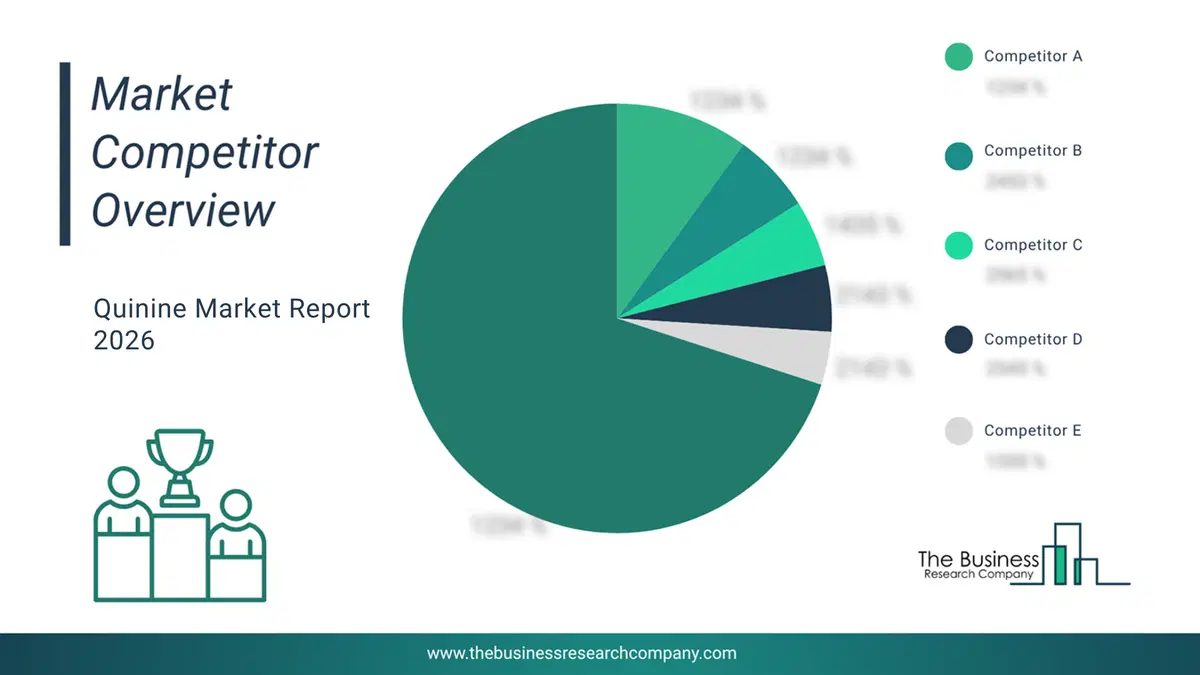
This chart is for illustrative purposes; the full report includes a detailed competitor analysis and comprehensive overview of the top 10 companies in the market.
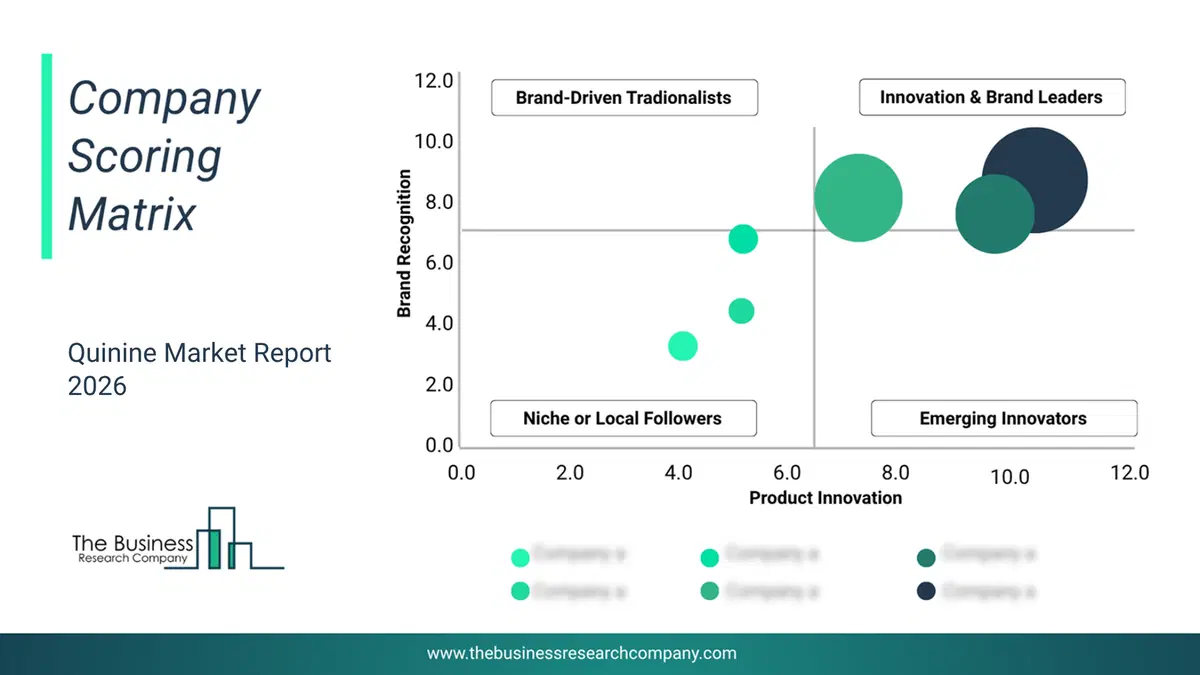
This chart maps companies by product innovation and brand strength, with bubble size indicating relative revenue, helping identify market leaders, challengers, and niche players. This is an illustrative chart; the full report provides a complete and accurate competitive analysis.
Global Quinine Market Trends and Insights
What Are Latest Mergers And Acquisitions In The Quinine Market?
In June 2023, AlphaTalents Africa, an Africa-based investment company, acquired a controlling stake in Pharmakina for an undisclosed amount. With this acquisition, AlphaTalents aims to boost local quinine drug production, support communities, and drive sustainable growth in the DRC. Pharmakina SA is an Africa-based pharmaceutical company that manufactures quinine.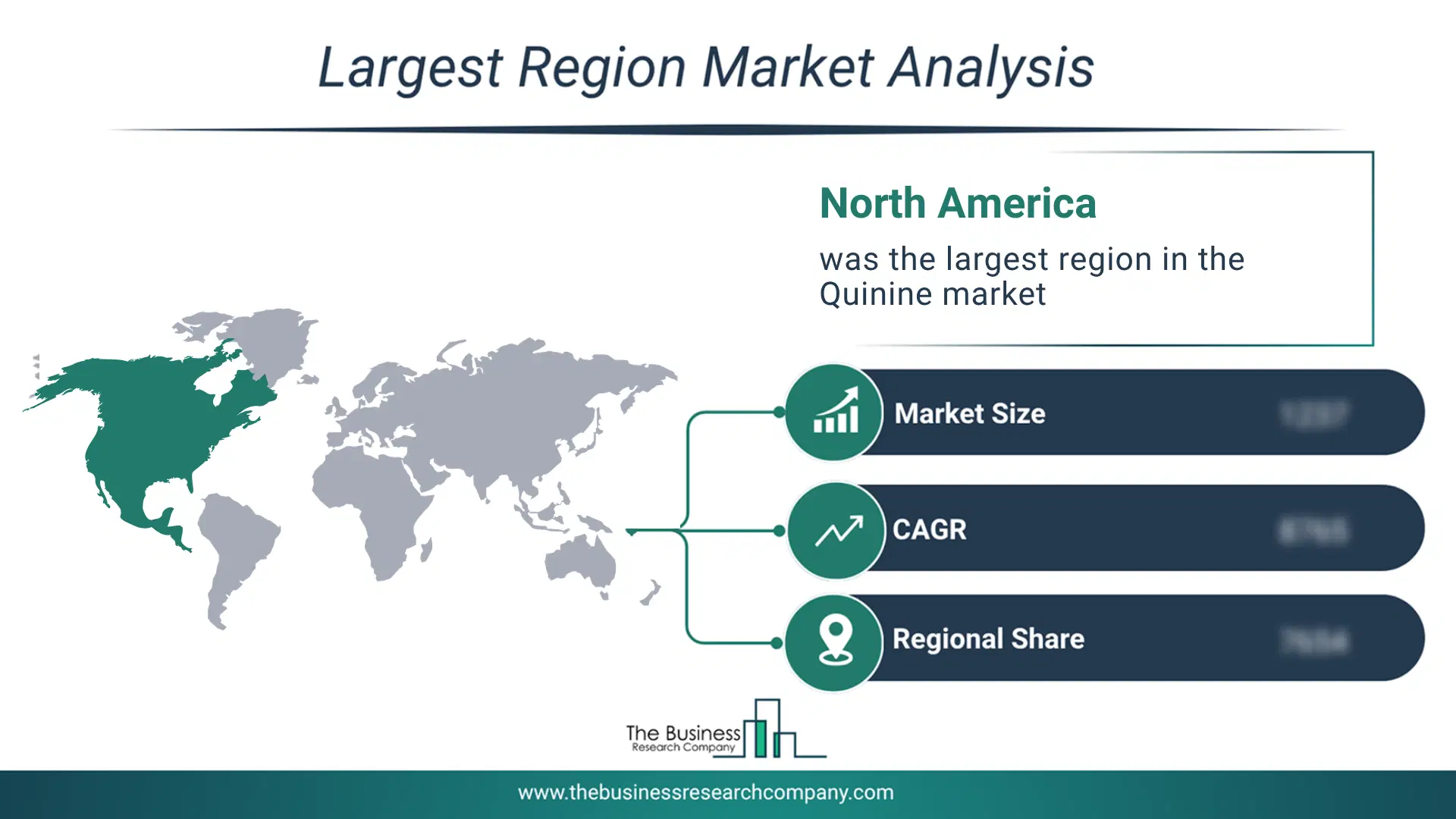
Regional Insights
North America was the largest region in the quinine market in 2025. Asia-Pacific is expected to be the fastest-growing region in the forecast period. The regions covered in this market report are Asia-Pacific, South East Asia, Western Europe, Eastern Europe, North America, South America, Middle East, Africa. The countries covered in this market report are Australia, Brazil, China, France, Germany, India, Indonesia, Japan, Taiwan, Russia, South Korea, UK, USA, Canada, Italy, Spain.What Defines the Quinine Market?
The quinine market consists of sales of products including topical ointments, bisulfate capsules, tonic water, and nutraceuticals. Values in this market are ‘factory gate’ values, that is, the value of goods sold by the manufacturers or creators of the goods, whether to other entities (including downstream manufacturers, wholesalers, distributors, and retailers) or directly to end customers. The value of goods in this market includes related services sold by the creators of the goods.How is Market Value Defined and Measured?
The market value is defined as the revenues that enterprises gain from the sale of goods and/or services within the specified market and geography through sales, grants, or donations in terms of the currency (in USD unless otherwise specified). The revenues for a specified geography are consumption values that are revenues generated by organizations in the specified geography within the market, irrespective of where they are produced. It does not include revenues from resales along the supply chain, either further along the supply chain or as part of other products.
This chart presents market attractiveness based on a quantitative evaluation of growth, competition, strategic alignment, and risk, offering a clear view of opportunity areas for decision-making. This chart is for illustrative purposes; the full report contains the complete analysis.

This chart highlights the Total Addressable Market (TAM) by estimating the maximum revenue opportunity using an assumption-driven approach, supporting strategic planning and opportunity sizing across markets. The chart is illustrative; the full report provides a more comprehensive analysis.
What Key Data and Analysis Are Included in the Quinine Market Report 2026?
The quinine market research report is one of a series of new reports from The Business Research Company that provides market statistics, including industry global market size, regional shares, competitors with the market share, detailed market segments, market trends and opportunities, and any further data you may need to thrive in the quinine industry. The market research report delivers a complete perspective of everything you need, with an in-depth analysis of the current and future state of the industry.Quinine Market Report Forecast Analysis
| Report Attribute | Details |
|---|---|
| Market Size Value In 2026 | $2.68 billion |
| Revenue Forecast In 2035 | $3.76 billion |
| Growth Rate | CAGR of 9.2% from 2026 to 2035 |
| Base Year For Estimation | 2025 |
| Actual Estimates/Historical Data | 2020-2025 |
| Forecast Period | 2026 - 2030 - 2035 |
| Market Representation | Revenue in USD Billion and CAGR from 2026 to 2035 |
| Segments Covered | Product, Administration, Application, Enduser |
| Regional Scope | Asia-Pacific, Western Europe, Eastern Europe, North America, South America, Middle East, Africa |
| Country Scope | The countries covered in the report are Australia, Brazil, China, France, Germany, India, ... |
| Key Companies Profiled | Teva Pharmaceutical Industries Ltd., Schweppes Australia Proprietary Limited, The United States Pharmacopeial Convention Inc., Chempro Pharma Private Limited, Taj Pharmaceuticals Ltd., Swiss Parenterals Private Limited, Leocorno Enterprises Private Limited, Healthy Inc., Jai Radhe Sales, Adooq Bioscience LLC, Akhil Healthcare Pvt Ltd., Van Wankum Ingredients B.V., Shreeji Pharma International, Prism Industries Private Limited, Lavina Pharmaceuticals Pvt Ltd., A. B. Enterprises, Spark Lifesciences Private Limited, Sihauli Chemicals Private Limited, Shanghai Nianxing Industrial Co. Ltd., Sakhiya Pharma Chem |
| Customization Scope | Request for Customization |
| Pricing And Purchase Options | Explore Purchase Options |