

Rare Earth Metals Market Report 2026
Global Outlook – By Product Type (Light Rare Earth Metals, Heavy Earth Metals, Other Product Types), By Metal Type (Neodymium, Yttrium, Dysprosium, Terbium, Europium, Cerium, Lanthanum, Other Metal Types), By Application (Catalysts, Ceramics Or Glass, Glass Polishing, Metallurgy, Other Applications) – Market Size, Trends, Strategies, and Forecast to 2030
Rare Earth Metals Market Overview
• Rare Earth Metals market size has reached to $8.06 billion in 2025 • Expected to grow to $9.86 billion in 2030 at a compound annual growth rate (CAGR) of 4% • Growth Driver: Electric Vehicle Expansion Fuels Rare Earth Metals Market Growth • Market Trend: Strategic Partnerships In Rare Earth Metals Industry Driving Innovation And Supply Chain Stability • Asia-Pacific was the largest region in 2025.Market Gains By 2030 – Top Opportunities By Segment
Market Gain identifies the most promising market opportunities by highlighting the segments or products expected to generate the highest incremental revenue growth over the next five years.
What Is Covered Under Rare Earth Metals Market?
Rare earth metals refer to all the chemical elements from Group 3 that are made up of three other elements that have properties such as fluorescent, conductive, and magnetic and are either silver, silvery-white, or gray in color and play a vital role in a clean-tech-driven economy. The main types of products of rare earth metals are light rare earth metals, heavy earth metals, and others. The lanthanides with the lowest atomic numbers are known as light rare earth metals and include praseodymium, cerium, samarium, lanthanum, scandium, and neodymium. The different types of metals include neodymium, yttrium, dysprosium, terbium, europium, cerium, lanthanum, others and are used in magnets, catalysts, metallurgy, polishing, glass, phosphors, ceramics, others.
What Is The Rare Earth Metals Market Size and Share 2026?
The rare earth metals market size has grown steadily in recent years. It will grow from $8.06 billion in 2025 to $8.43 billion in 2026 at a compound annual growth rate (CAGR) of 4.6%. The growth in the historic period can be attributed to growth in electronics and automotive industries, increasing demand for permanent magnets, expansion of glass and ceramics applications, rising use in catalysts and metallurgical processes, development of large-scale rare earth mining operations.What Is The Rare Earth Metals Market Growth Forecast?
The rare earth metals market size is expected to see steady growth in the next few years. It will grow to $9.86 billion in 2030 at a compound annual growth rate (CAGR) of 4.0%. The growth in the forecast period can be attributed to growth in electric vehicle production, increasing investments in renewable energy technologies, rising demand for high-performance electronics, expansion of recycling and circular economy initiatives, adoption of advanced extraction and processing technologies. Major trends in the forecast period include rising demand for rare earth metals in electric vehicles, increasing use of neodymium and dysprosium in permanent magnets, expansion of rare earth applications in catalysts and ceramics, growing focus on recycling and sustainable sourcing of rare earth metals, rising adoption of rare earth metals in high-performance electronics.
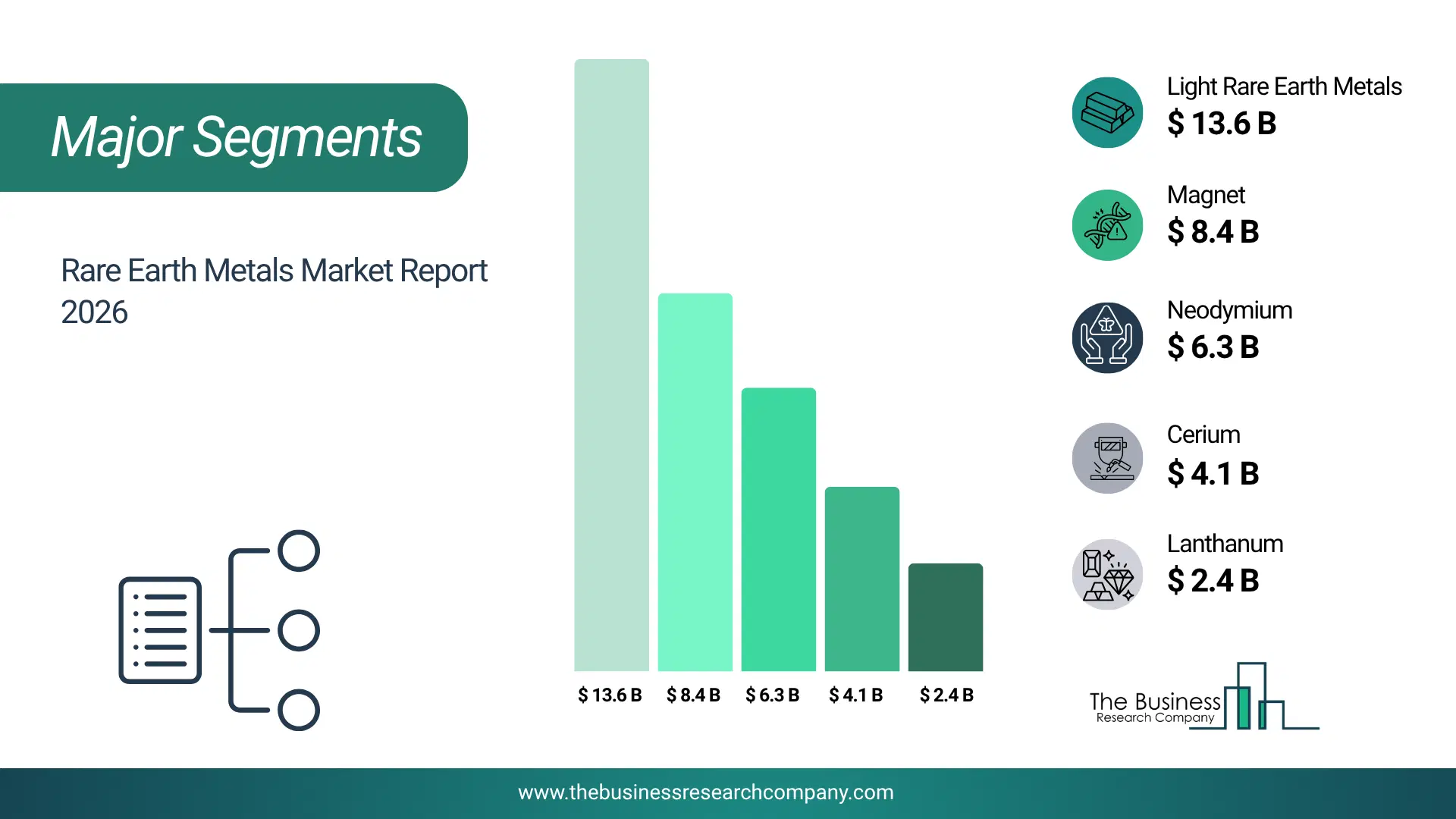
Global Rare Earth Metals Market Segmentation
1) By Product Type: Light Rare Earth Metals, Heavy Earth Metals, Other Product Types 2) By Metal Type: Neodymium, Yttrium, Dysprosium, Terbium, Europium, Cerium, Lanthanum, Other Metal Types 3) By Application: Catalysts, Ceramics Or Glass, Glass Polishing, Metallurgy, Other Applications Subsegments: 1) By Light Rare Earth Metals: Lanthanum, Cerium, Praseodymium, Neodymium, Samarium 2) By Heavy Rare Earth Metals: Europium, Terbium, Dysprosium, Yttrium, Lutetium 3) By Other Product Types: Scandium, Thulium, Holmium, Gadolinium The top segments in the rare earth metals market will be: • Light Rare Earth Metals will reach $13676.64 Million by 2030. • Magnet will reach $8394.53 Million by 2030. • Neodymium will reach $6358.2 Million by 2030. • Cerium will reach $4154.03 Million by 2030. • Lanthanum will reach $2414.42 Million by 2030.What Is The Driver Of The Rare Earth Metals Market?
The growing number of electric vehicles is expected to propel the growth of the rare earth metals market going forward. Electric vehicles (EVs) rely on stored electricity in batteries or similar energy storage systems, obviating the necessity for internal combustion engines. EVs utilize rare earth metals primarily for manufacturing high-performance magnets used in electric motors, notably neodymium, and dysprosium, due to their magnetic properties. For instance, in September 2025, according to the International Council on Clean Transportation, a US-based non-profit organization, in the first half of 2025, global electric vehicle sales surpassed 9 million units, accounting for 23% of all new light-duty vehicle sales worldwide, a notable rise from 19% recorded for the entire year of 2024. Therefore, the growing number of electric vehicles is driving the growth of the rare earth metals industry.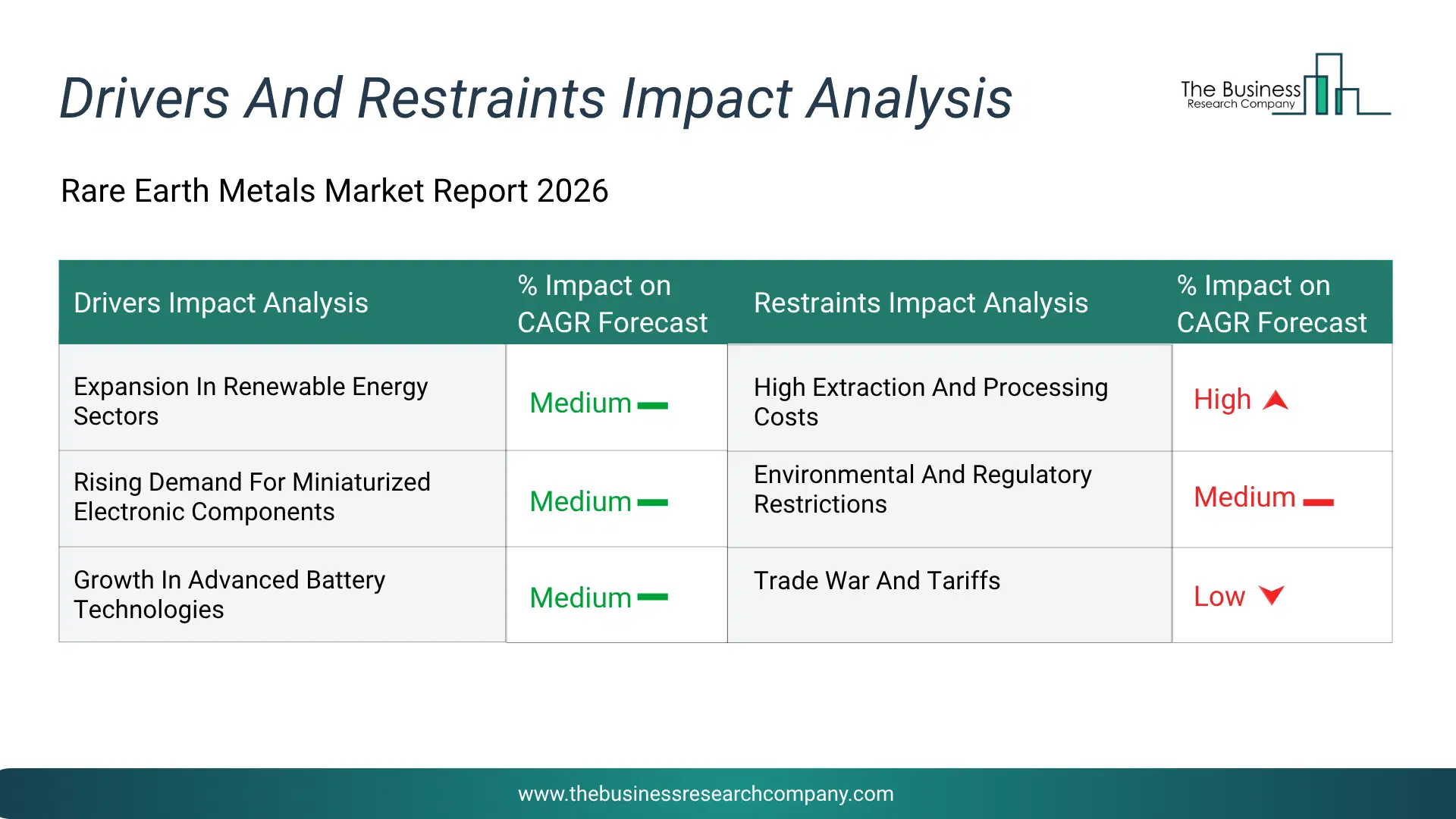
Infographic Chart Showing Key Market Drivers Analysis And Restraints For Rare Earth Metals Market
The chart presents an impact analysis of key drivers and restraints, quantifying their relative influence on the market's growth rate and helping assess the balance between growth enablers and limiting factors. This chart offers a high-level perspective; the full report contains more detailed insights.
How Will The Drivers Impact Growth In The Global Rare Earth Metals Market?
• Expansion In Renewable Energy Sectors (Medium) – During the forecast period, the expansion in renewable energy sectors is expected to propel the growth of the rare earth metals market. Rare earth elements such as neodymium, dysprosium and praseodymium are essential components in high-performance permanent magnets used in wind turbines and electric vehicle motors. As governments and industries accelerate the transition toward clean energy to reduce carbon emissions, investments in wind power, solar energy infrastructure and energy storage systems are increasing rapidly. This rising deployment of renewable technologies directly boosts the demand for rare earth materials. Additionally, supportive government policies, sustainability initiatives and growing electrification trends are further strengthening the need for rare earth metals across the global renewable energy value chain. Therefore, the expansion in renewable energy sectors will drive the growth of the rare earth metals market. The growth in expansion in renewable energy sectors growth contribution during the forecast period in 2025 is 1.5%. • Rising Demand For Miniaturized Electronic Components (Medium) – During the forecast period, rising demand for miniaturized electronic components is expected to propel the growth of the rare earth metals market in the forecast period. rare earth elements such as neodymium, europium, terbium and yttrium are widely used in the production of compact and high-performance electronic devices, including smartphones, wearable devices, sensors and advanced computing systems. as consumer electronics manufacturers continue to focus on reducing device size while enhancing performance and energy efficiency, the need for specialized materials with superior magnetic, optical and conductive properties is increasing. rare earth metals play a crucial role in enabling these capabilities. therefore, rising demand for miniaturized electronic components will drive the growth of the rare earth metals market. the growth in rising demand for miniaturized electronic components growth contribution during the forecast period in 2025 is 1.2%. • Growth In Advanced Battery Technologies (Medium) – During the forecast period, the growth in advanced battery technologies is expected to propel the growth of the rare earth metals market. Rare earth elements such as lanthanum, cerium and neodymium play a significant role in the development of high-performance batteries used in electric vehicles, hybrid vehicles, consumer electronics and energy storage systems. As global demand for efficient and long-lasting energy storage solutions increases, manufacturers are investing in next-generation battery technologies to enhance capacity, durability and charging efficiency. Rare earth metals contribute to improving battery performance and stability, making them essential materials in modern battery systems. Therefore, the growth in advanced battery technologies will drive the growth of the rare earth metals market. The growth in growth in advanced battery technologies growth contribution during the forecast period in 2025 is 1.0%. • Increasing Demand For High-Efficiency Lighting Systems (Low) – During the forecast period, increasing demand for high-efficiency lighting systems is expected to propel the growth of the rare earth metals market in the forecast period. rare earth elements such as europium, terbium and yttrium are essential components in the production of energy-efficient lighting technologies, including light-emitting diodes (leds), compact fluorescent lamps (cfls) and advanced display systems. these materials are used as phosphors to enhance brightness, color quality and energy efficiency in lighting applications. as governments and industries worldwide promote energy conservation and adopt sustainable lighting solutions, the demand for high-efficiency lighting systems continues to rise. therefore, increasing demand for high-efficiency lighting systems will drive the growth of the rare earth metals market. the growth in increasing demand for high-efficiency lighting systems growth contribution during the forecast period in 2025 is 0.5%.How Will The Restraints Impact Growth In The Global Rare Earth Metals Market?
• High Extraction And Processing Costs (Medium) – During the forecast period, high extraction and processing costs is expected to hinder the growth of the rare earth metals market in forecast period. the mining and separation of rare earth elements involve complex and capital-intensive processes due to their low concentration in natural deposits and the need for advanced refining technologies. additionally, the extraction process often requires significant energy consumption and the use of specialized chemicals, increasing overall operational costs. strict environmental regulations related to mining waste and radioactive by-products further add to compliance expenses for producers. therefore, high extraction and processing costs may hinder the growth of the rare earth metals market. growth affected by high extraction and processing costs during the forecast period in 2025 is -2.1%. • Environmental And Regulatory Restrictions (Medium) – During the forecast period, environmental and regulatory restrictions is expected to hinder the growth of the rare earth metals market. The extraction and processing of rare earth elements often generate hazardous waste and radioactive by-products, which pose significant environmental risks. As a result, governments and regulatory authorities across various regions have implemented stringent environmental regulations and compliance requirements for mining and refining activities. These regulations increase operational costs and extend approval timelines for new projects. Additionally, strict monitoring of waste disposal, emissions and land rehabilitation further adds to the financial burden on producers. Therefore, environmental and regulatory restrictions may hinder the growth of the rare earth metals market. Growth affected by environmental and regulatory restrictions during the forecast period in 2025 is -1.6%. • Trade War And Tariffs (Medium) – During the forecast period, trade wars and tariffs are expected to restrain the growth of the rare earth metals market during the forecast period by increasing the costs of imported mining equipment, processing technologies, refining components and critical extraction materials. geopolitical tensions between major economies can lead to the imposition of import and export tariffs on rare earth materials and related products. such trade barriers may disrupt global supply chains, increase raw material costs and create uncertainty for manufacturers that rely on stable access to rare earth elements. in addition, restrictions on cross-border trade can limit the availability of critical materials used in electronics, renewable energy systems and advanced manufacturing. therefore, trade wars and tariffs may restrain the growth of the rare earth metals market during the forecast period. growth affected by trade wars and tariffs during the forecast period in 2025 is -0.3%.Key Players In The Global Rare Earth Metals Market
Major companies operating in the rare earth metals market report are Hastings Technology Metals Limited, Hitachi Metals Ltd., Materion Corporation, Iluka Resources Limited, Neo Performance Materials Inc., Lynas Rare Earths Limited, MP Materials Corp, Alkane Resources Limited, Peak Resources Limited, Pensana Rare Earths PLC, Energy Fuels Inc., Arafura Resources Limited, Northern Minerals Limited, RareX Limited, Australian Strategic Materials Limited, Greenland Minerals Limited, Texas Mineral Resources Corp, Rare Elements Resources Ltd., Ucore Rare Metals Inc., Rainbow Rare Earths Limited, Leading Edge Materials Corp, Ionic Rare Earths Limited, Medallion Resources Ltd., Commerce Resources Corp, Vital Metals Limited, Quest Rare Minerals Ltd., Alces Lake Ltd., Appia Energy Corp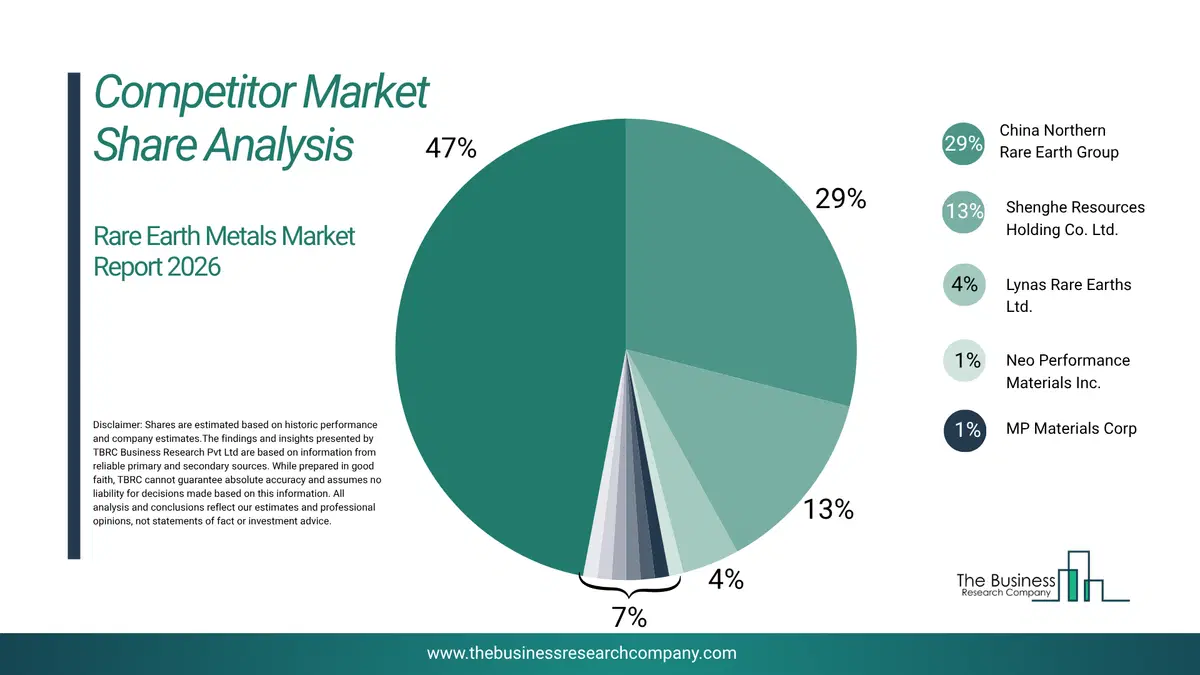
This chart is for illustrative purposes; the full report includes a detailed competitor analysis and comprehensive overview of the top 10 companies in the market.
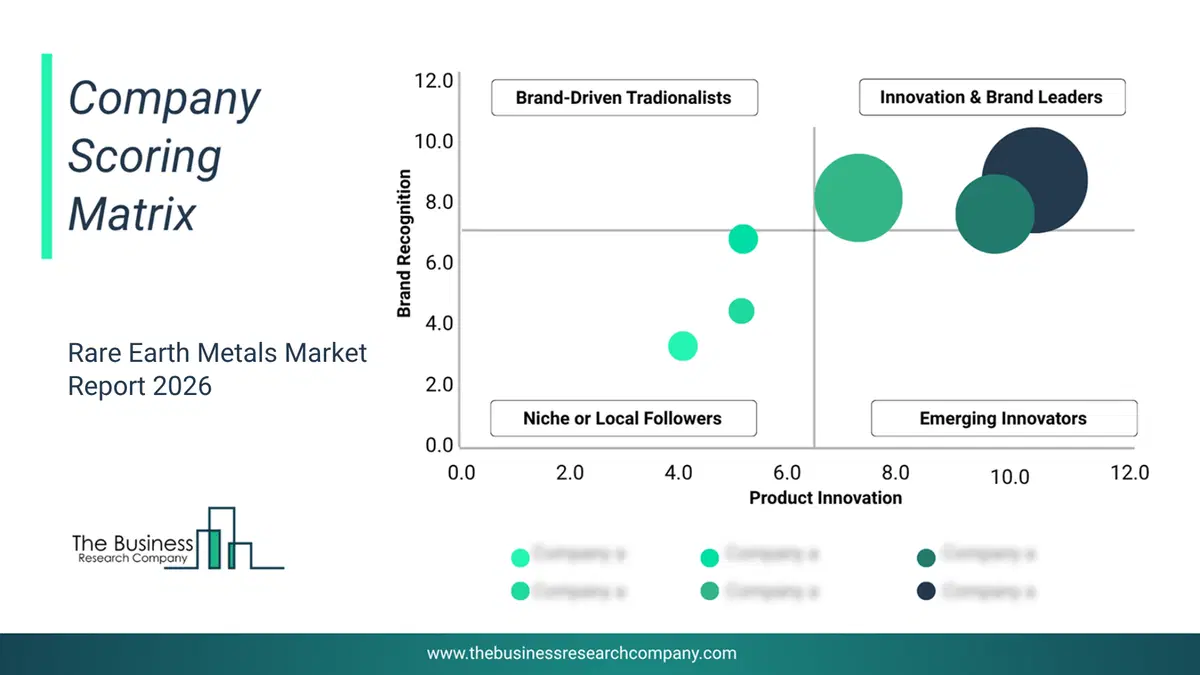
This chart maps companies by product innovation and brand strength, with bubble size indicating relative revenue, helping identify market leaders, challengers, and niche players. This is an illustrative chart; the full report provides a complete and accurate competitive analysis.
Global Rare Earth Metals Market Trends and Insights
Major companies operating in the rare earth metals industry are adopting a strategic partnership approach to secure a consistent supply chain and develop innovative solutions for high-tech applications. Strategic partnerships refer to a process in which companies leverage each other's strengths and resources to achieve mutual benefits and success. For instance, in August 2023, USA Rare Earth LLC, a US-based integrated magnet technology company, partnered with Hatch, a Canada-based professional services firm. Through this partnership, their objective is to maintain excellence in engineering and constructing rare earth magnet operations, demonstrating their commitment through investment in USARE.What Are Latest Mergers And Acquisitions In The Rare Earth Metals Market?
In April 2023, Neo Performance Materials Inc., a Canada-based manufacturer of advanced industrial materials, acquired SG Technologies Group Limited, Ltd. for an undisclosed amount. Through this acquisition, we will launch production in 2025 of sintered rare earth magnet manufacturing in Estonia for the electric vehicle, electronics, energy-saving specialized motor applications markets, and other high-growth-potential nascent technology applications that are critical to the current global energy transition. SG Technologies Group Limited is a UK-based manufacturer of advanced, specialty manufacturers of rare-earth-based and other high-performance magnets for industrial and commercial markets.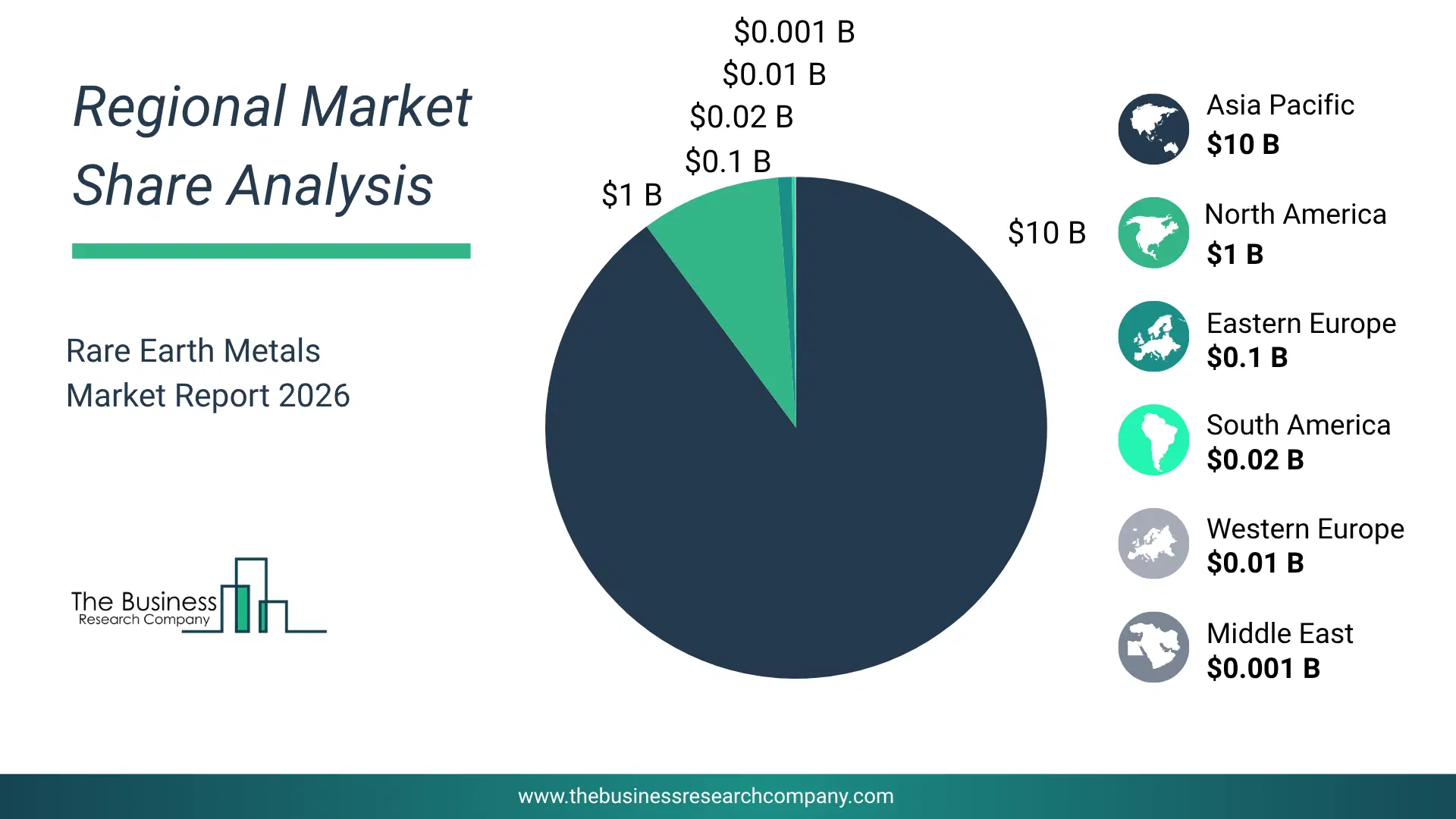
Regional Outlook
Asia-Pacific was the largest region in the rare earth metals market in 2025. The regions covered in the rare earth metals market are Asia-Pacific, South East Asia, Western Europe, Eastern Europe, North America, South America, Middle East, Africa. The countries covered in the rare earth metals market are Australia, Brazil, China, France, Germany, India, Indonesia, Japan, Taiwan, Russia, South Korea, UK, USA, Canada, Italy, Spain.What Defines the Rare Earth Metals Market?
The rare earth metals market consists of sales of lanthanides, scandium, yttrium, and trivalent earth metals. Values in this market are ‘factory gate’ values, that is the value of goods sold by the manufacturers or creators of the goods, whether to other entities (including downstream manufacturers, wholesalers, distributors and retailers) or directly to end customers. The value of goods in this market includes related services sold by the creators of the goods.How is Market Value Defined and Measured?
The market value is defined as the revenues that enterprises gain from the sale of goods and/or services within the specified market and geography through sales, grants, or donations in terms of the currency (in USD unless otherwise specified). The revenues for a specified geography are consumption values that are revenues generated by organizations in the specified geography within the market, irrespective of where they are produced. It does not include revenues from resales along the supply chain, either further along the supply chain or as part of other products.
This chart presents market attractiveness based on a quantitative evaluation of growth, competition, strategic alignment, and risk, offering a clear view of opportunity areas for decision-making. This chart is for illustrative purposes; the full report contains the complete analysis.

This chart highlights the Total Addressable Market (TAM) by estimating the maximum revenue opportunity using an assumption-driven approach, supporting strategic planning and opportunity sizing across markets. The chart is illustrative; the full report provides a more comprehensive analysis.
What Key Data and Analysis Are Included in the Rare Earth Metals Market Report 2026?
The rare earth metals market research report is one of a series of new reports from The Business Research Company that provides market statistics, including Market Report 2026?global market size, regional shares, competitors with the market share, detailed market segments, market trends and opportunities, and any further data you may need to thrive in the rare earth metals Market Report 2026? The market research report delivers a complete perspective of everything you need, with an in-depth analysis of the current and future state of the Market Report 2026?Rare Earth Metals Market Report Forecast Analysis
| Report Attribute | Details |
|---|---|
| Market Size Value In 2026 | $8.43 billion |
| Revenue Forecast In 2030 | $9.86 billion |
| Growth Rate | CAGR of 4.6% from 2026 to 2030 |
| Base Year For Estimation | 2025 |
| Actual Estimates/Historical Data | 2020-2025 |
| Forecast Period | 2026 - 2030 - 2035 |
| Market Representation | Revenue in USD Billion and CAGR from 2026 to 2030 |
| Segments Covered | Product Type, Metal Type, Application |
| Regional Scope | Asia-Pacific, Western Europe, Eastern Europe, North America, South America, Middle East, Africa |
| Country Scope | The countries covered in the report are Australia, Brazil, China, France, Germany, India, Indonesia, Japan, Taiwan, Russia, South Korea, UK, USA, Canada, Italy, Spain. |
| Key Companies Profiled | Hastings Technology Metals Limited, Hitachi Metals Ltd., Materion Corporation, Iluka Resources Limited, Neo Performance Materials Inc., Lynas Rare Earths Limited, MP Materials Corp, Alkane Resources Limited, Peak Resources Limited, Pensana Rare Earths PLC, Energy Fuels Inc., Arafura Resources Limited, Northern Minerals Limited, RareX Limited, Australian Strategic Materials Limited, Greenland Minerals Limited, Texas Mineral Resources Corp, Rare Elements Resources Ltd., Ucore Rare Metals Inc., Rainbow Rare Earths Limited, Leading Edge Materials Corp, Ionic Rare Earths Limited, Medallion Resources Ltd., Commerce Resources Corp, Vital Metals Limited, Quest Rare Minerals Ltd., Alces Lake Ltd., Appia Energy Corp |
| Customization Scope | Request for Customization |
| Pricing And Purchase Options | Explore Purchase Options |