

Resistor Market Report 2026
Global Outlook – By Type ( Linear Resistors, Fixed Resistors), By Material ( Thin Films, Thick Films), By Application ( Automotive, Aerospace And Defense, Communications, Consumer Electronics And Computing, Other End-user Industries) – Market Size, Trends, Strategies, and Forecast to 2035
Resistor Market Overview
• Resistor market size has reached to $10.85 billion in 2025 • Expected to grow to $12.84 billion in 2030 at a compound annual growth rate (CAGR) of 3.5% • Growth Driver: Resistor Market Driven By Surge In Wearable Device Demand • Market Trend: Recent Innovations in Thin-Film Resistors Driving High-Stability Performance • Asia-Pacific was the largest region and fastest growing region.Market Gains By 2030 – Top Opportunities By Segment
Market Gain identifies the most promising market opportunities by highlighting the segments or products expected to generate the highest incremental revenue growth over the next five years.
What Is Covered Under Resistor Market?
A resistor is a passive electrical component that creates resistance in the flow of electric current. It is a fundamental component in electronic design and is widely used in countless electronic devices and systems. It is employed to control or restrict how much electrical current can pass across a circuit. The main types of resistors are linear resistors and fixed resistors. Linear resistors are a type of resistor that exhibits a linear relationship between the voltage applied across its terminals and the current flowing through it. They are made of thin films and thick films for the applications of automotive, aerospace and defense, communications, consumer electronics and computing, and other end-user industries.
What Is The Resistor Market Size 2026 And Growth Rate?
The resistor market size has grown steadily in recent years. It will grow from $10.85 billion in 2025 to $11.2 billion in 2026 at a compound annual growth rate (CAGR) of 3.2%. The growth in the historic period can be attributed to early expansion of consumer electronics manufacturing, rise in adoption of fixed and variable resistors, improvements in resistor material technologies, growing use of resistors in automotive electronics, increased demand for circuit protection components.What Is The Resistor Market Growth Forecast?
The resistor market size is expected to see steady growth in the next few years. It will grow to $12.84 billion in 2030 at a compound annual growth rate (CAGR) of 3.5%. The growth in the forecast period can be attributed to growth in electric mobility and charging systems, rising integration of resistors into iot devices, increasing demand for high power resistors in industrial equipment, expansion of aerospace and defense electronic systems, growing investment in high density electronic circuit designs. Major trends in the forecast period include growing demand for high precision and miniature resistors, increasing use of resistors in power electronics applications, rising adoption of advanced resistor materials for high performance, expansion of consumer electronics and computing devices, shift toward reliable and long life cycle components.
Global Resistor Market Segmentation
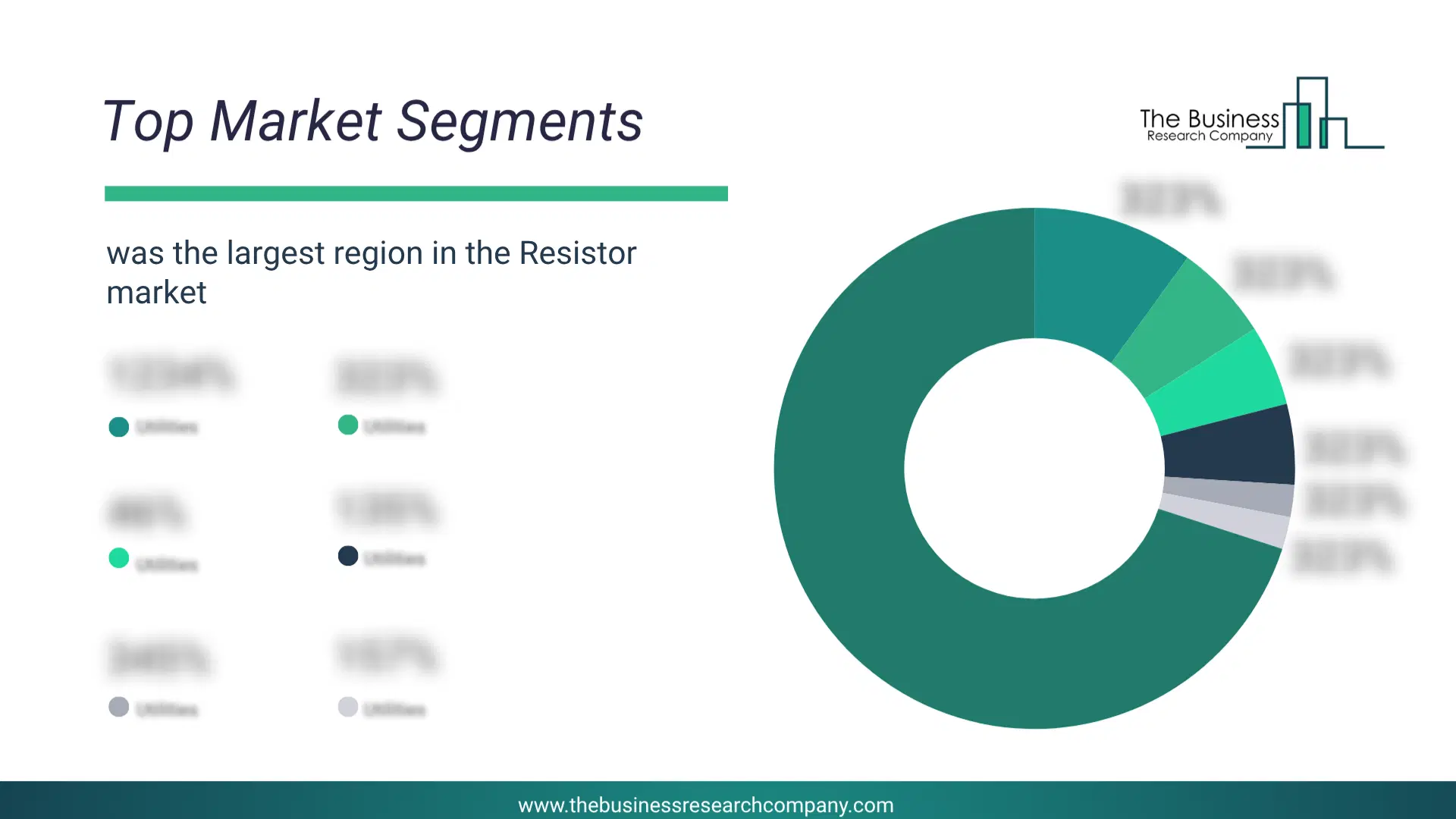
1) By Type: Linear Resistors, Fixed Resistors 2) By Material: Thin Films, Thick Films 3) By Application: Automotive, Aerospace And Defense, Communications, Consumer Electronics And Computing, Other End-user Industries Subsegments: 1) By Linear Resistors: Variable Resistors, Potentiometers 2) By Fixed Resistors: Carbon Composition Resistors, Metal Film Resistors, Wirewound Resistors, Thin Film Resistors, Thick Film Resistors The top segments in the resistor market will be: • Linear Resistors will reach $7390.5 Million by 2025. • Thin Films will reach $6442.5 Million by 2025. • Consumer Electronics And Computing will reach $4549 Million by 2025. • Thick Films will reach $4397 Million by 2025. • Non-linear Resistors will reach $3449 Million by 2025.What Is The Driver Of The Resistor Market?
The increasing demand for wearable devices is expected to propel the growth of the resistor market going forward. Wearable devices refer to electronic devices that can be worn on the body as accessories that are equipped with various sensors and often connect to smartphones or other devices to provide information or perform functions. The resistors are used in wearable devices to provide essential components that enable precise control, miniaturization, and innovation in electronic devices. For instance, in March 2025, according to YouGov, a UK-based global public opinion and data analytics company, young adults (18-34) are more likely to use wearables, with 46% of 18-24-year-olds and 47% of 25-34-year-olds owning a smartwatch, compared to just 19% of those aged 55 and over. Therefore, the increasing demand for wearable devices is driving the growth of the resistor industry.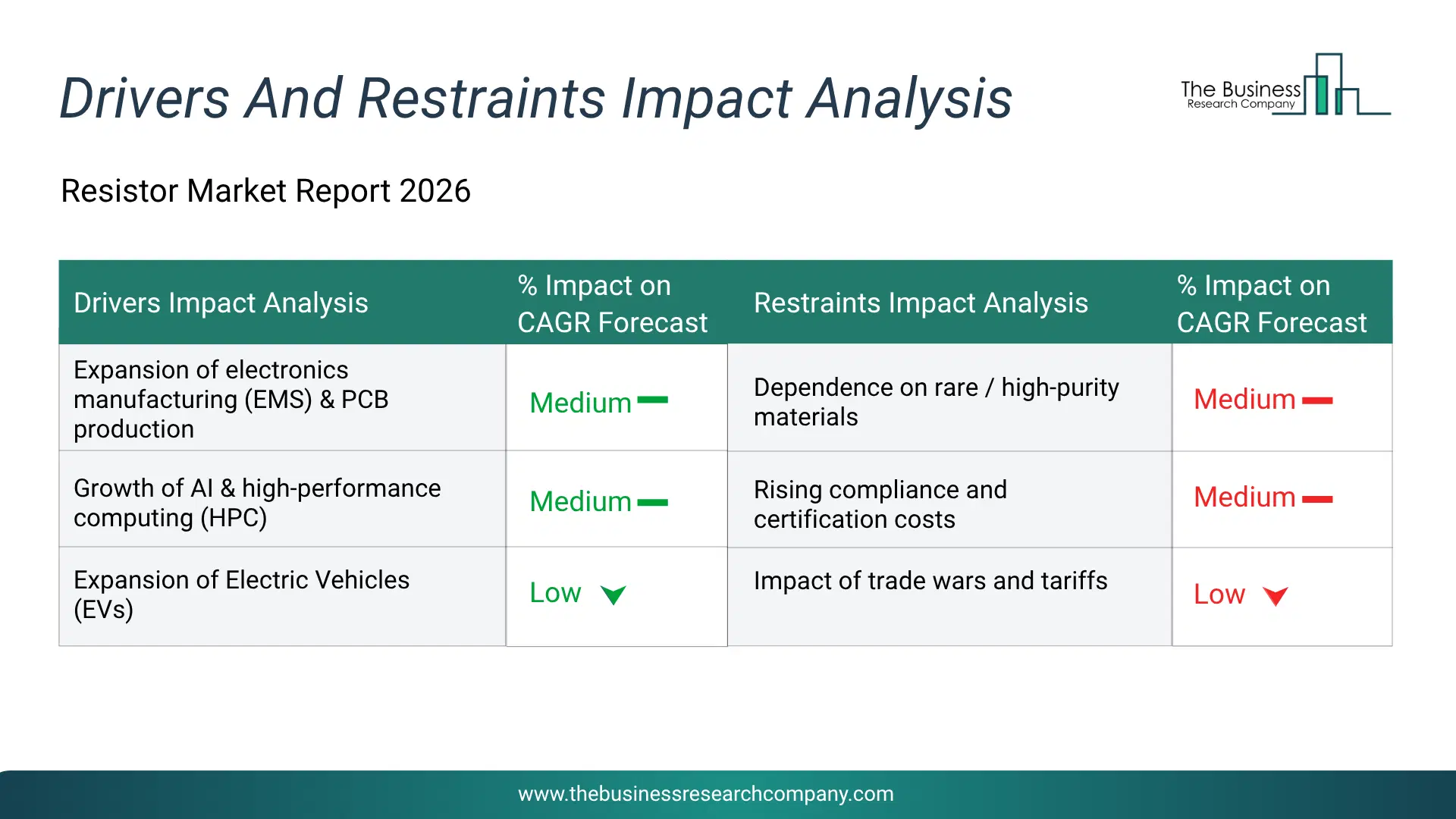
Infographic Chart Showing Key Market Drivers Analysis And Restraints For Resistor Market
The chart presents an impact analysis of key drivers and restraints, quantifying their relative influence on the market's growth rate and helping assess the balance between growth enablers and limiting factors. This chart offers a high-level perspective; the full report contains more detailed insights.
How Will The Drivers Impact Growth In The Global Resistor Market?
• Expansion of electronics manufacturing (EMS) & PCB production (Medium) – The expansion of electronics manufacturing (EMS) and printed circuit board (PCB) production is projected to significantly drive the growth of the resistor market. The expansion of contract manufacturing services and printed circuit board fabrication increases the overall volume of electronic assemblies produced globally. Each PCB integrates numerous resistors for functions such as voltage division, current limiting and signal conditioning. As EMS providers scale operations for consumer electronics, industrial equipment and automotive systems, component consumption rises proportionally. High-density PCB designs also require smaller and more precise resistor configurations. Additionally, faster production cycles and large batch manufacturing amplify demand consistency. Growing outsourcing trends further strengthen this ecosystem by increasing manufacturing throughput. This continuous scaling of electronics production directly drives higher component integration. As a result, expansion of electronics manufacturing (EMS) and printed circuit board (PCB) production is anticipated to contributing to a 1.5% annual growth in the market. • Growth of AI & high-performance computing (HPC) (Medium) – The growth of AI and high-performance computing is anticipated to boost the expansion of the resistor market. AI workloads and high-performance computing systems require advanced hardware with efficient power distribution and thermal management. Servers, GPUs and data center infrastructure depend on resistors for accurate current sensing and signal stability. Increasing processing speeds and data loads demand components with tight tolerance and low noise characteristics. These systems also operate continuously, requiring high reliability under thermal stress. The shift toward hyperscale data centers further increases hardware deployment. Compact and high-density circuit designs also require miniaturized precision components. This rapid growth in computing infrastructure significantly boosts component usage. Consequently, growth of AI and high-performance computing is projected to contributing to a 1.0% annual growth in the market. • Expansion of Electric Vehicles (EVs) (Low) – The expansion of electric vehicles (EVs) is expected to play a key role in driving the growth of the resistor market. Electric vehicles rely on complex electrical architectures that require precise current sensing and power management. Systems such as battery management, inverters, onboard chargers and motor control units depend on resistors for accurate monitoring and protection. Higher power loads in EVs require components with strong thermal stability and durability. Increasing EV production globally amplifies the volume of electronic components used per vehicle. Advanced features such as regenerative braking and fast charging further increase system complexity. Automotive standards also require components to withstand harsh environmental conditions. This transition toward electrification significantly increases component demand. Therefore, expansion of electric vehicles (EVs) is projected to supporting to a 0.8% annual growth in the market. • Rapid growth of IoT devices (Low) – The rapid growth of IoT devices is expected to significantly drive the resistor market. The proliferation of connected devices across homes, industries and cities is increasing the number of electronic nodes deployed globally. IoT devices require resistors for power regulation, sensing and signal processing within compact circuits. Continuous connectivity demands stable and energy-efficient component performance. Large-scale deployment in applications such as smart meters, wearables and industrial sensors drives volume growth. Miniaturization trends further require compact and precise resistor designs. Increasing adoption of edge computing also expands hardware requirements. This widespread expansion of connected ecosystems leads to sustained growth in component usage. Consequently, the rapid growth of IoT devices is projected to contributing to a 0.5% annual growth in the market.How Will The Restraints Impact Growth In The Global Resistor Market?
• Dependence on rare / high-purity materials (Medium) – Dependence on rare / high-purity materials is expected to restrain market growth during the forecast period. It creates operational, financial, regulatory, or commercial challenges that can increase costs, delay projects, reduce investments, or discourage purchasing decisions depending on the market. These challenges can reduce product adoption, affect business confidence, and limit the ability of companies to expand efficiently across key regions. This can reduce operational efficiency, delay expansion plans, and affect the ability of companies to achieve sustainable business growth. • Rising compliance and certification costs (Medium) – During the forecast period, rising compliance and certification costs is likely to limit market expansion. It creates operational, financial, regulatory, or commercial challenges that can increase costs, delay projects, reduce investments, or discourage purchasing decisions depending on the market. These challenges can reduce product adoption, affect business confidence, and limit the ability of companies to expand efficiently across key regions. As a result, businesses may face increased cost pressures, slower commercial adoption, and reduced revenue opportunities. • Impact of trade wars and tariffs (Low) – The market is expected to face challenges due to impact of trade wars and tariffs over the forecast period. It creates operational, financial, regulatory, or commercial challenges that can increase costs, delay projects, reduce investments, or discourage purchasing decisions depending on the market. These challenges can reduce product adoption, affect business confidence, and limit the ability of companies to expand efficiently across key regions. This may discourage new investments, delay strategic expansion initiatives, and weaken the overall competitive position of market participants.Key Players In The Global Resistor Market
Major companies operating in the resistor market are Panasonic Corporation, Honeywell International Inc., Walsin Technology Corporation, TE Connectivity, Murata Manufacturing, OKAYA Electric Industries Co. Ltd., Samsung Electro-Mechanics, Rohm Co. Ltd., Yageo Corporation, Vishay Intertechnology, Bourns Inc., AVX Corporation, CTS Corporation, Ohmite Manufacturing Company, Viking Tech Corporation, Susumu Co. Ltd., Stackpole Electronics Inc., Cyntec Electronics, Caddock Electronics Inc., Cressall Resistors, Arcol, HVR Pentagon, KOA Corporation, Shenzhen Sunlord Electronics Co. Ltd.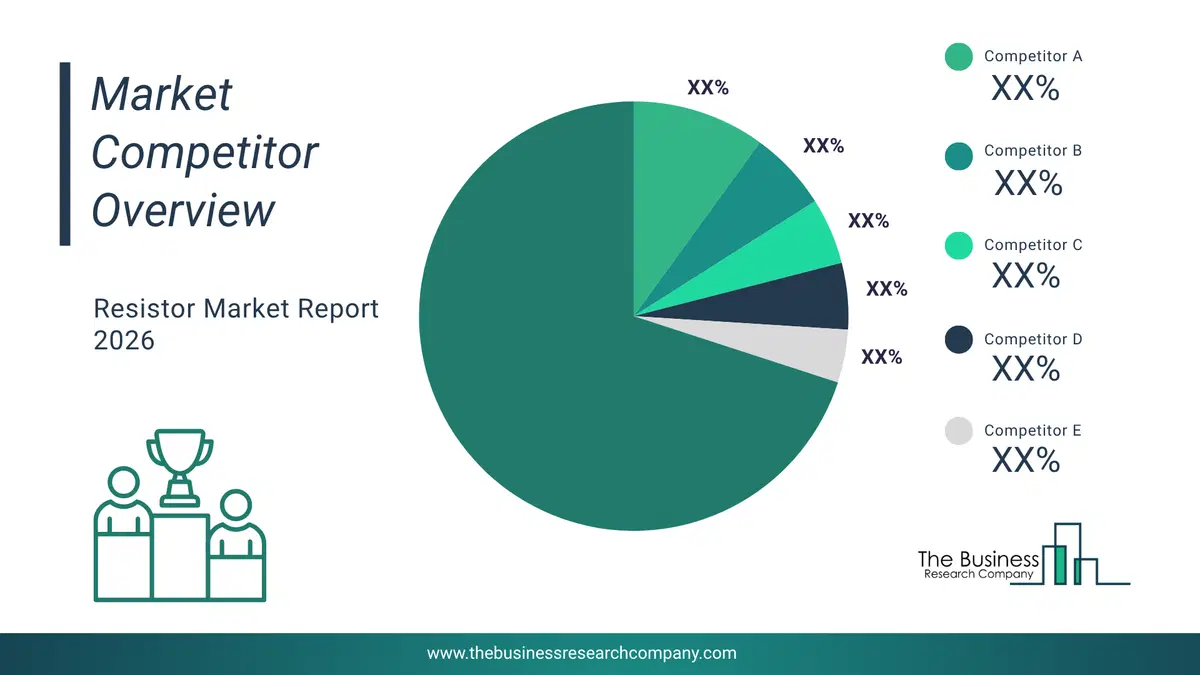
This chart is for illustrative purposes; the full report includes a detailed competitor analysis and comprehensive overview of the top 10 companies in the market.
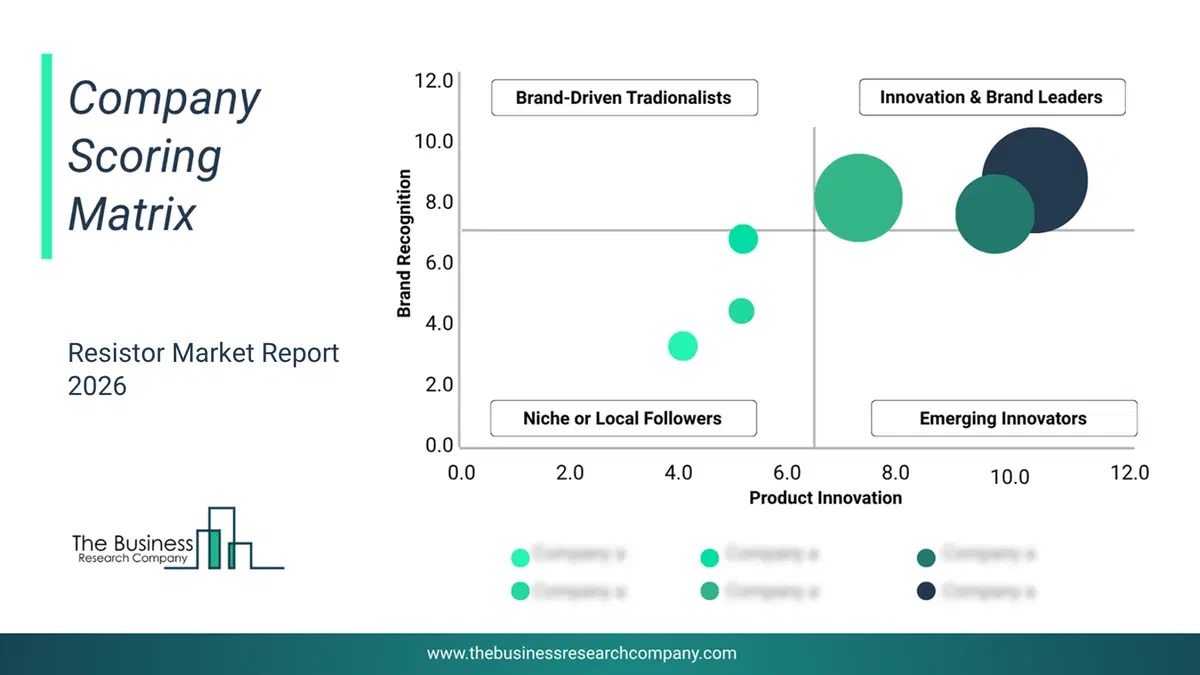
This chart maps companies by product innovation and brand strength, with bubble size indicating relative revenue, helping identify market leaders, challengers, and niche players. This is an illustrative chart; the full report provides a complete and accurate competitive analysis.
Global Resistor Market Trends and Insights
Major companies operating in the resistor market are focusing on developing innovative technology, such as thin-film resistors, to maintain high resistance stability. Thin-film technology is a modern engineering approach that involves the development of very thin layers of material, typically ranging from a nanometer to a few micrometers in thickness. For instance, in December 2024, Vishay Intertechnology, Inc., a United States-based semiconductor and electronic components company, launched the MMU, MMA, and MMB series precision thin-film MELF resistors. The newly introduced resistors offer resistance values up to 10 MΩ, tight tolerances down to ±0.1%, and a temperature coefficient of resistance as low as ±15 ppm/K, making them suitable for applications requiring high stability and reliability. These resistors are targeted at automotive, industrial, and medical electronics markets and are AEC-Q200 qualified for automotive-grade reliability.What Are Latest Mergers And Acquisitions In The Resistor Market?
In April 2023, Bourns Inc., a US-based electronics company, acquired Riedon Inc. for an undisclosed amount. As a result of the acquisition, Bourns is making significant strides in its strategy to enhance its protection portfolio. This move not only complements Bourns' existing resistors product line but also allows the company to provide a wider and more comprehensive range of resistive and current sense solutions. Additionally, it positions Bourns to effectively address the technology and advanced product demands of high-growth markets. Riedon Inc. is a US-based manufacturer of precision resistors.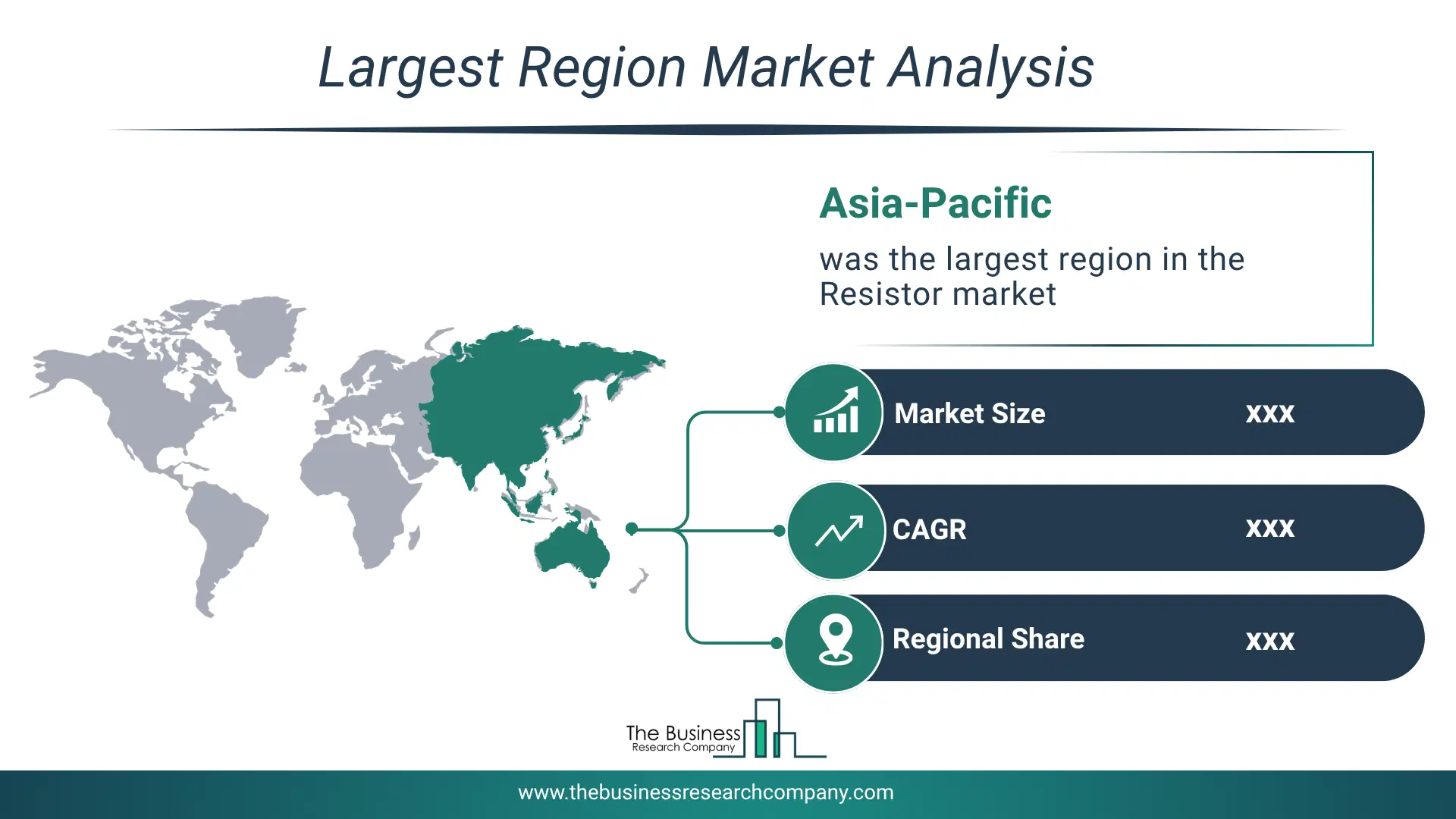
Regional Outlook
Asia-Pacific was the largest region in the resistor market in 2025. Asia-Pacific is expected to be the fastest-growing region in the forecast period. The regions covered in this market report are Asia-Pacific, South East Asia, Western Europe, Eastern Europe, North America, South America, Middle East, Africa. The countries covered in this market report are Australia, Brazil, China, France, Germany, India, Indonesia, Japan, Taiwan, Russia, South Korea, UK, USA, Canada, Italy, Spain.What Defines the Resistor Market?
The resistor market consists of sales of carbon composition resistors, variable resistors, light-dependent resistors, thermocouples, network resistors, and surface mount resistors. Values in this market are ‘factory gate’ values, that is, the value of goods sold by the manufacturers or creators of the goods, whether to other entities (including downstream manufacturers, wholesalers, distributors, and retailers) or directly to end customers. The value of goods in this market includes related services sold by the creators of the goods.How is Market Value Defined and Measured?
The market value is defined as the revenues that enterprises gain from the sale of goods and/or services within the specified market and geography through sales, grants, or donations in terms of the currency (in USD unless otherwise specified). The revenues for a specified geography are consumption values that are revenues generated by organizations in the specified geography within the market, irrespective of where they are produced. It does not include revenues from resales along the supply chain, either further along the supply chain or as part of other products.
This chart presents market attractiveness based on a quantitative evaluation of growth, competition, strategic alignment, and risk, offering a clear view of opportunity areas for decision-making. This chart is for illustrative purposes; the full report contains the complete analysis.

This chart highlights the Total Addressable Market (TAM) by estimating the maximum revenue opportunity using an assumption-driven approach, supporting strategic planning and opportunity sizing across markets. The chart is illustrative; the full report provides a more comprehensive analysis.
What Key Data and Analysis Are Included in the Resistor Market Report 2026?
The resistor market research report is one of a series of new reports from The Business Research Company that provides market statistics, including industry global market size, regional shares, competitors with the market share, detailed market segments, market trends and opportunities, and any further data you may need to thrive in the resistor industry. The market research report delivers a complete perspective of everything you need, with an in-depth analysis of the current and future state of the industry.Resistor Market Report 2026 Market Report Forecast Analysis
| Report Attribute | Details |
|---|---|
| Market Size Value In 2026 | $11.2 billion |
| Revenue Forecast In 2035 | $12.84 billion |
| Growth Rate | CAGR of 3.2% from 2026 to 2035 |
| Base Year For Estimation | 2025 |
| Actual Estimates/Historical Data | 2020-2025 |
| Forecast Period | 2026 - 2030 - 2035 |
| Market Representation | Revenue in USD Billion and CAGR from 2026 to 2035 |
| Segments Covered | Type, Material, Application |
| Regional Scope | Asia-Pacific, Western Europe, Eastern Europe, North America, South America, Middle East, Africa |
| Country Scope | The countries covered in the report are Australia, Brazil, China, France, Germany, India, ... |
| Key Companies Profiled | Panasonic Corporation, Honeywell International Inc., Walsin Technology Corporation, TE Connectivity, Murata Manufacturing, OKAYA Electric Industries Co. Ltd., Samsung Electro-Mechanics, Rohm Co. Ltd., Yageo Corporation, Vishay Intertechnology, Bourns Inc., AVX Corporation, CTS Corporation, Ohmite Manufacturing Company, Viking Tech Corporation, Susumu Co. Ltd., Stackpole Electronics Inc., Cyntec Electronics, Caddock Electronics Inc., Cressall Resistors, Arcol, HVR Pentagon, KOA Corporation, Shenzhen Sunlord Electronics Co. Ltd. |
| Customization Scope | Request for Customization |
| Pricing And Purchase Options | Explore Purchase Options |