

Solar EPC Market Report 2026
Global Outlook – By Mounting Type ( Ground, Rooftop, Floating), By Technology ( Concentrated Solar Power, Photovoltaic), By End-User ( Residential, Commercial, Industrial) – Market Size, Trends, Strategies, and Forecast to 2030
Solar EPC Market Overview
• Solar EPC market size has reached to $246.41 billion in 2025 • Expected to grow to $317.6 billion in 2030 at a compound annual growth rate (CAGR) of 5.2% • Growth Driver: Rising Renewable Energy Demand Fuels Growth In The Solar EPC Market • Market Trend: Advancements In Innovative Financing Solutions For Solar Projects • North America was the largest region in 2025.Market Gains By 2030 – Top Opportunities By Segment
Market Gain identifies the most promising market opportunities by highlighting the segments or products expected to generate the highest incremental revenue growth over the next five years.
What Is Covered Under Solar EPC Market?
The solar EPC (engineering, procurement, and construction) refers to the process of designing, planning, and installation of solar power plants or systems, including engineering, procurement, and construction services. This involves sourcing and acquiring all the necessary materials, equipment, and components required for the solar project. The main mounting types of solar EPC are ground, rooftop, and floating. Rooftop refers to the installation of solar power systems on the roofs of buildings that involves designing, installing, and maintaining solar power systems on rooftops. The various technologies include concentrated solar power and photovoltaic, which are used by several end-users, such as residential, commercial, industrial.
What Is The Solar EPC Market Size 2026 And Growth Rate?
The solar epc market size has grown strongly in recent years. It will grow from $246.41 billion in 2025 to $259.58 billion in 2026 at a compound annual growth rate (CAGR) of 5.3%. The growth in the historic period can be attributed to growth in large scale solar project development, early adoption of photovoltaic technologies, expansion of commercial and industrial solar installations, rise in government subsidies for solar infrastructure, increasing focus on reducing fossil fuel dependency.What Is The Solar EPC Market Growth Forecast?
The solar epc market size is expected to see strong growth in the next few years. It will grow to $317.6 billion in 2030 at a compound annual growth rate (CAGR) of 5.2%. The growth in the forecast period can be attributed to rising investment in utility and floating solar projects, growing demand for rooftop solar installations, advancements in tracking and mounting technologies, expansion of smart grid and solar integration solutions, increasing need for scalable and cost efficient solar epc services. Major trends in the forecast period include growing deployment of utility scale solar epc projects, rising adoption of floating solar epc installations, increasing use of single and dual axis tracking systems, expansion of rooftop solar epc in residential and commercial sectors, shift toward integrated epc models for faster project delivery.
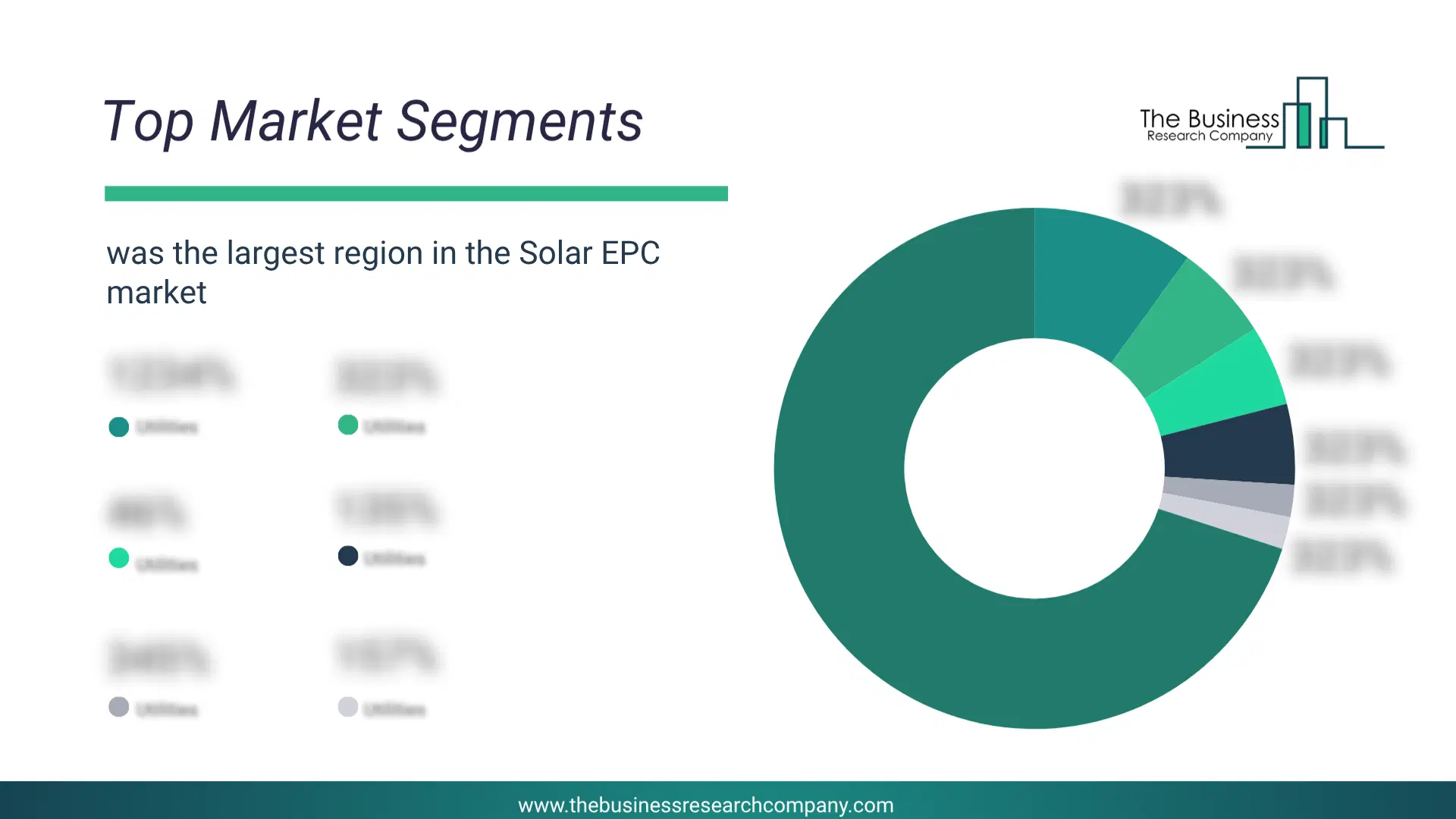
Global Solar EPC Market Segmentation
1) By Mounting Type: Ground, Rooftop, Floating 2) By Technology: Concentrated Solar Power, Photovoltaic 3) By End-User: Residential, Commercial, Industrial Subsegments: 1) By Ground: Fixed Tilt Ground Mount, Single Axis Tracking Ground Mount, Dual Axis Tracking Ground Mount 2) By Rooftop: Residential Rooftop, Commercial Rooftop, Industrial Rooftop 3) By Floating: Fixed Floating Solar Systems, Tracking Floating Solar Systems The top segments in the solar engineering, procurement, and construction (epc) market will be: • Ground will reach $217.72 Billion by 2030. • Rooftop will reach $84.16 Billion by 2030. • Floating will reach $14.94 Billion by 2030.What Is The Driver Of The Solar EPC Market?
The growing demand for renewable energy sources is expected to propel the growth of the solar EPC market going forward. Renewable energy refers to energy derived from resources that are naturally replenished on a human timescale, such as sunlight, wind, rain, tides, waves, geothermal heat, and biomass. Solar EPC helps in the implementation of solar energy projects by providing a holistic approach that covers design, procurement, and construction. This approach helps optimize costs, ensure quality, and streamline the entire process, making it a valuable asset for the development and expansion of renewable energy sources, particularly solar power. For instance, in September 2024, according to data published by the Department for Energy Security and Net Zero, a UK-based governmental department, In Q2 2024, renewable energy accounted for 51.6% of total energy generation in the UK saw an increase of 9.9% points (PP) in Q2 2024 compared to the same period in 2023. Solar PV contributed to three-quarters of these new installations. Therefore, the growing demand for renewable energy sources drives the solar EPC industry.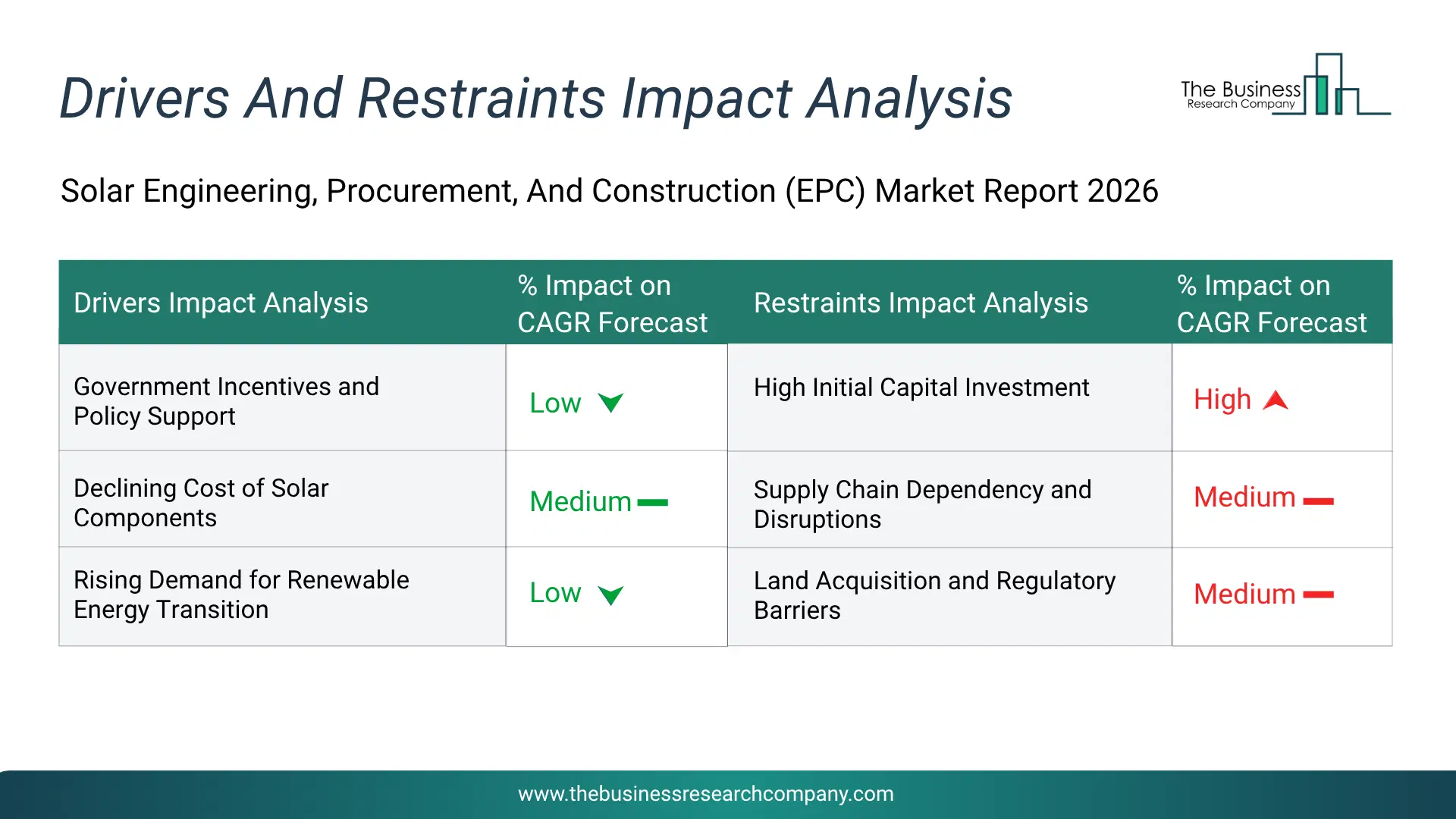
Infographic Chart Showing Key Market Drivers Analysis And Restraints For Solar Epc Market
The chart presents an impact analysis of key drivers and restraints, quantifying their relative influence on the market's growth rate and helping assess the balance between growth enablers and limiting factors. This chart offers a high-level perspective; the full report contains more detailed insights.
How Will The Drivers Impact Growth In The Global Solar Engineering, Procurement, And Construction (EPC) Market?
• Government Incentives and Policy Support (Low) – During the forecast period, the government incentives and policy support are expected to emerge as a key growth driver for the solar engineering, procurement, and construction (EPC) market by 2030. Incentives such as subsidies, tax credits, renewable energy targets, and auction mechanisms are significantly accelerating solar project deployment. These supportive frameworks reduce financial risks and enhance project viability for developers and EPC contractors. Additionally, national and international renewable targets are driving consistent demand for solar installations. Incentive programs are also encouraging private sector participation and long-term power purchase agreements, strengthening project bankability. • Declining Cost of Solar Components (Medium) – During the forecast period, the declining cost of solar components is expected to play a crucial role in driving the expansion of the solar EPC market by 2030. Continuous reductions in solar module and system component prices have significantly improved the cost competitiveness of solar energy. Lower equipment costs reduce overall capital expenditure, enhancing project returns and encouraging faster investment from utilities, corporations, and governments. Advancements in manufacturing technologies and economies of scale have been key contributors to this trend. As affordability improves, EPC companies benefit from increased project volumes across both developed and emerging markets. Additionally, declining costs are supporting the growth of distributed solar installations, further expanding the addressable market. • Rising Demand for Renewable Energy Transition (Low) – During the forecast period, the rising demand for renewable energy transition is expected to act as a major growth catalyst for the solar EPC market by 2030. The global shift toward clean energy is significantly increasing the demand for solar power installations. Governments and corporations are actively pursuing decarbonization and net-zero targets, leading to substantial investments in renewable energy projects. Solar energy remains a preferred solution due to its scalability, cost-effectiveness, and environmental advantages. Growing electricity demand, particularly in developing economies, is further accelerating solar adoption. In addition, volatility in fossil fuel prices is encouraging a transition toward more stable and sustainable energy sources. EPC providers play a critical role in executing these projects, directly benefiting from the surge in demand.How Will The Restraints Impact Growth In The Global Solar Engineering, Procurement, And Construction (EPC) Market?
• High Initial Capital Investment (Low) – During the forecast period, high initial capital investment is significantly restricting the growth of the solar EPC market. Large upfront costs associated with project development, equipment procurement, engineering design, and installation are creating financing challenges, particularly for large-scale utility projects and emerging market participants. • Supply Chain Dependency and Disruptions (Medium) – During the forecast period, supply chain dependency and disruptions are significantly restricting the growth of the solar EPC market. Reliance on global suppliers for solar modules, inverters, and key raw materials, combined with logistics delays and geopolitical uncertainties, is impacting project timelines and increasing overall execution risks. • Land Acquisition and Regulatory Barriers (Low) – During the forecast period, land acquisition and regulatory barriers are significantly restricting the growth of the solar EPC market. Challenges related to land availability, lengthy approval processes, environmental clearances, and local regulatory compliance are delaying project development and increasing pre-construction costs.Key Players In The Global Solar EPC Market
Major companies operating in the solar epc market are Bechtel Corp., Siemens Gamesa Renewable Energy S.A., Adani Group, Canadian Solar Inc., Xylem Inc., First Solar Inc., Black & Veatch Holding Company, Blattner Energy, Renewable Energy System Ltd., Juwi AG, Sterling and Wilson Pvt. Ltd., Anesco Ltd., Vikram Solar Limited, DEPCOM Power Inc., Q Cells, Core Development Group, Alas Solar System LLC, Sunel Group, Enerparc AG, Greenspark Solar, BELECTRIC Solar & Battery Holding GmbH, Strata Solar LLC, Hild Energy Pvt. Ltd., LNB Renewable, Eternia Solar, Swinerton Renewable Energy, Tata Power Solar Systems Ltd.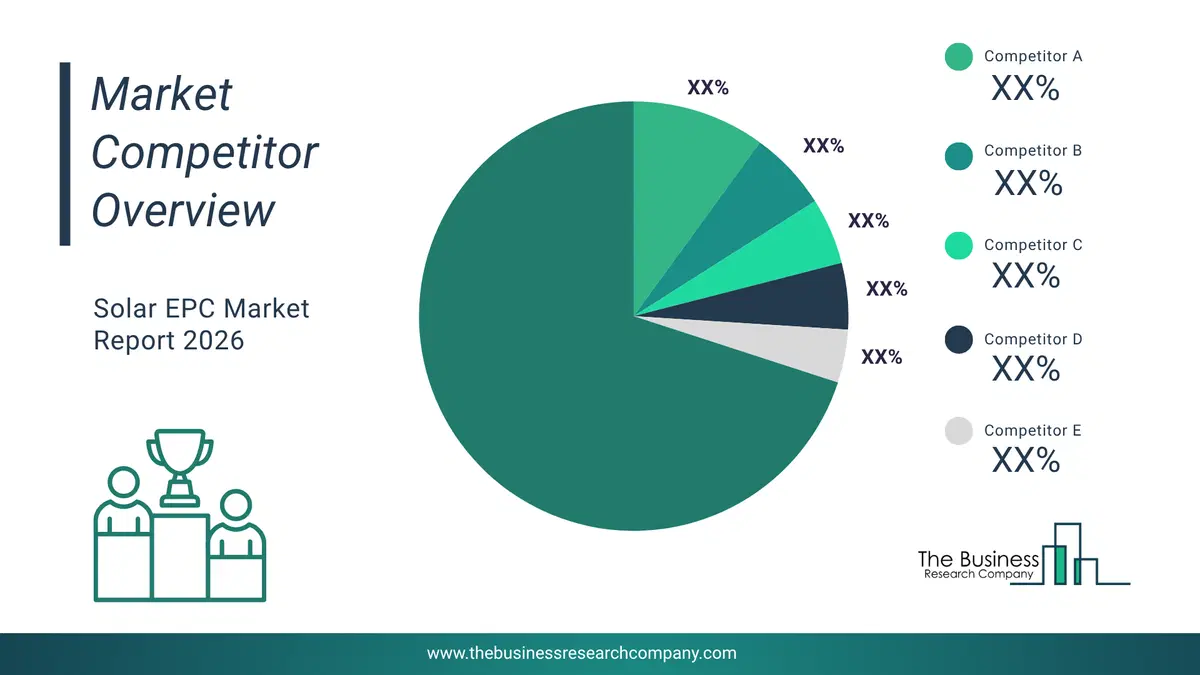
This chart is for illustrative purposes; the full report includes a detailed competitor analysis and comprehensive overview of the top 10 companies in the market.
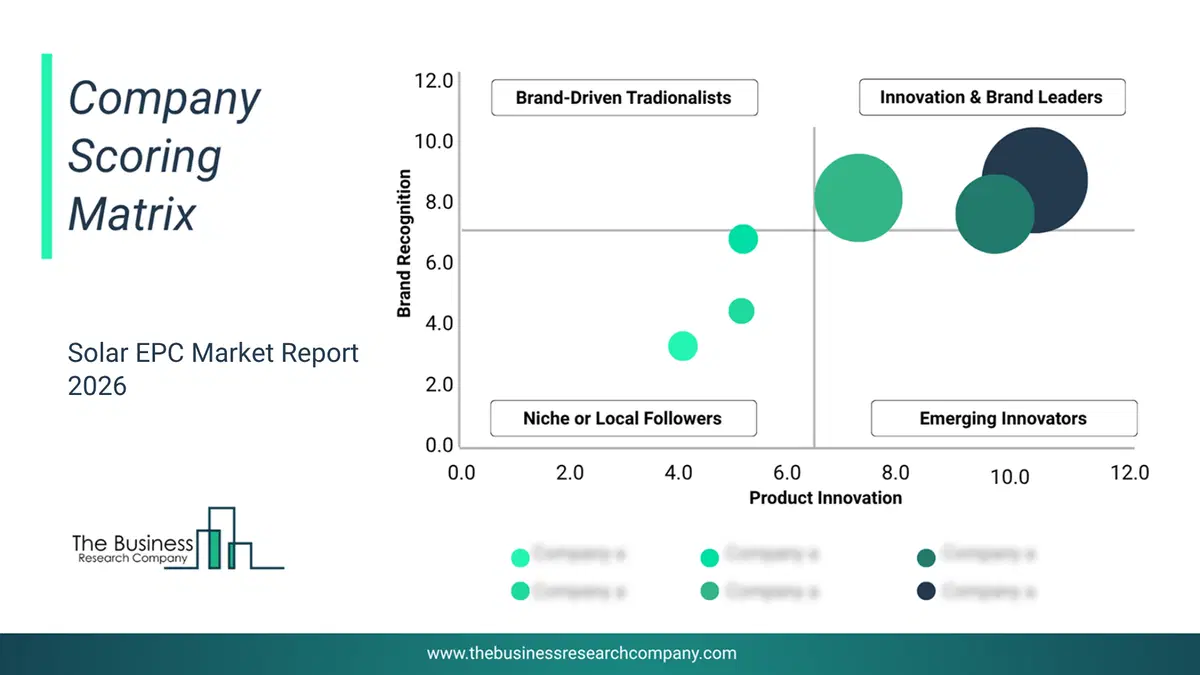
This chart maps companies by product innovation and brand strength, with bubble size indicating relative revenue, helping identify market leaders, challengers, and niche players. This is an illustrative chart; the full report provides a complete and accurate competitive analysis.
Global Solar EPC Market Trends and Insights
Major companies operating in the solar EPC market are focusing on developing innovative solutions such as end-to-end digital lending to streamline rooftop solar project financing, accelerate adoption, and enhance accessibility for residential and commercial customers. End-to-end digital lending refers to a seamless, technology-driven loan process that manages everything from application and credit assessment to disbursement and repayment through digital channels. For instance, in July 2025, Fibe, an India-based digital lending platform, launched rooftop solar financing in Bharat, providing collateral-free loans, fast digital approvals, and partnerships with over 100 solar EPC companies to expand residential solar installations across Tier 2 and Tier 3 cities. This solution helps households access sustainable energy while supporting EPC companies in scaling their installations efficiently.What Are Latest Mergers And Acquisitions In The Solar EPC Market?
In July 2024, Complete Solar, Inc., a U.S.-based solar technology, services, and installation company, acquired Core Energy, LLC, for an undisclosed amount. With this acquisition, Complete Solar aims to expand its installation footprint, strengthen its project execution capabilities, and integrate Core Energy’s operational team and expertise to deliver more efficient and large-scale solar energy projects. Core Energy is a US-based solar EPC company that offers Solar EPC services.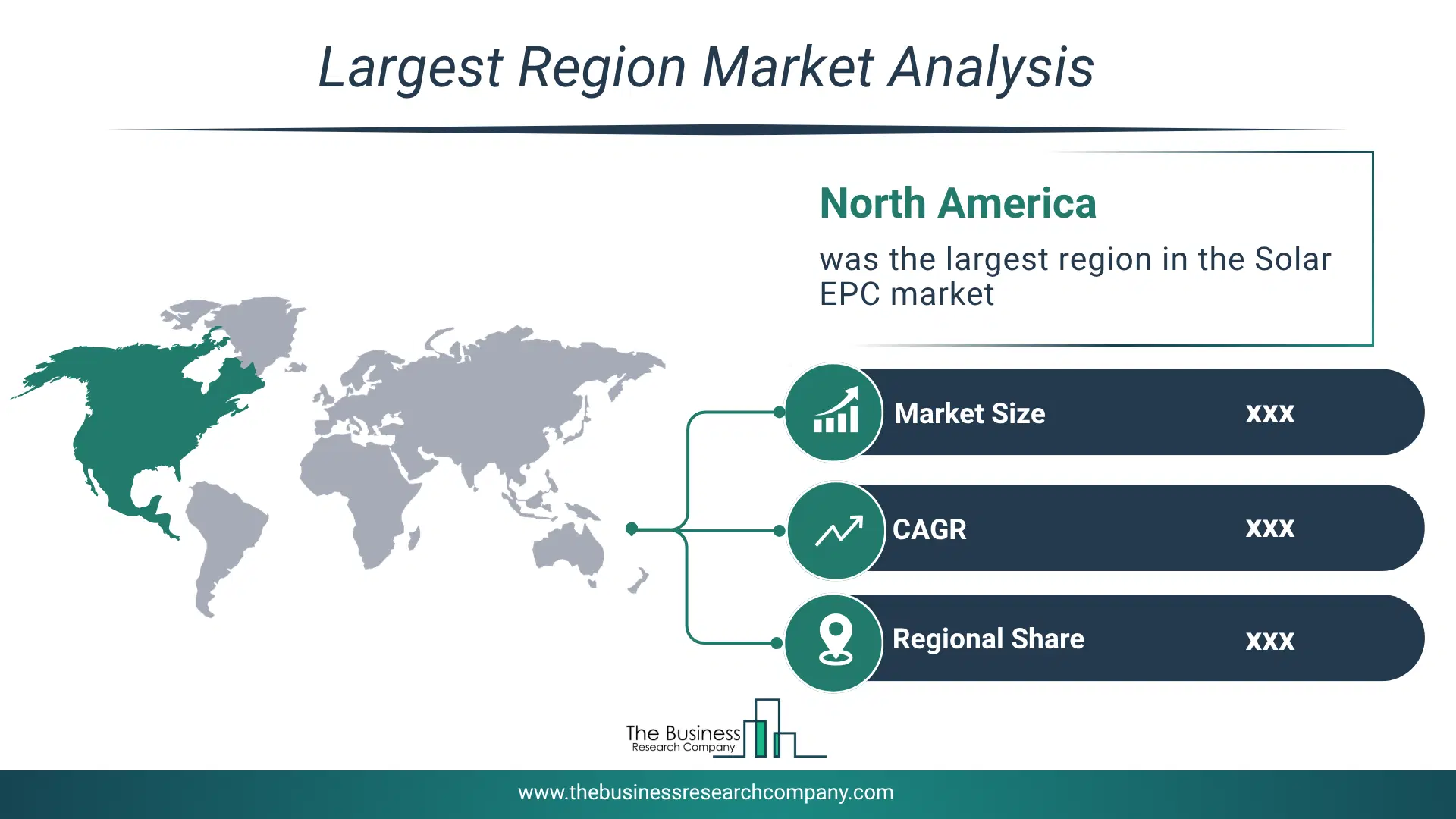
Regional Outlook
North America was the largest region in the solar EPC market in 2025. The regions covered in this market report are Asia-Pacific, South East Asia, Western Europe, Eastern Europe, North America, South America, Middle East, Africa. The countries covered in this market report are Australia, Brazil, China, France, Germany, India, Indonesia, Japan, Taiwan, Russia, South Korea, UK, USA, Canada, Italy, Spain.What Defines the Solar EPC Market?
The solar EPC market includes revenues earned by entities by providing end-to-end solar energy services, project development, operations and management, and the installation of solar panels and related equipment. The market value includes the value of related goods sold by the service provider or included within the service offering. Only goods and services traded between entities or sold to end consumers are included.How is Market Value Defined and Measured?
The market value is defined as the revenues that enterprises gain from the sale of goods and/or services within the specified market and geography through sales, grants, or donations in terms of the currency (in USD unless otherwise specified). The revenues for a specified geography are consumption values that are revenues generated by organizations in the specified geography within the market, irrespective of where they are produced. It does not include revenues from resales along the supply chain, either further along the supply chain or as part of other products.
This chart presents market attractiveness based on a quantitative evaluation of growth, competition, strategic alignment, and risk, offering a clear view of opportunity areas for decision-making. This chart is for illustrative purposes; the full report contains the complete analysis.

This chart highlights the Total Addressable Market (TAM) by estimating the maximum revenue opportunity using an assumption-driven approach, supporting strategic planning and opportunity sizing across markets. The chart is illustrative; the full report provides a more comprehensive analysis.
What Key Data and Analysis Are Included in the Solar EPC Market Report 2026?
The solar epc market research report is one of a series of new reports from The Business Research Company that provides market statistics, including industry global market size, regional shares, competitors with the market share, detailed market segments, market trends and opportunities, and any further data you may need to thrive in the solar epc industry. The market research report delivers a complete perspective of everything you need, with an in-depth analysis of the current and future state of the industry.Solar EPC Market Report Forecast Analysis Market Report Forecast Analysis
| Report Attribute | Details |
|---|---|
| Market Size Value In 2026 | $259.58 billion |
| Revenue Forecast In 2030 | $317.6 billion |
| Growth Rate | CAGR of 5.3% from 2026 to 2030 |
| Base Year For Estimation | 2025 |
| Actual Estimates/Historical Data | 2020-2025 |
| Forecast Period | 2026 - 2030 |
| Market Representation | Revenue in USD Billion and CAGR from 2026 to 2030 |
| Segments Covered | Mounting Type, Technology, End-User |
| Regional Scope | Asia-Pacific, Western Europe, Eastern Europe, North America, South America, Middle East, Africa |
| Country Scope | The countries covered in the report are Australia, Brazil, China, France, Germany, India, Indonesia, Japan, Taiwan, Russia, South Korea, UK, USA, Canada, Italy, Spain. |
| Key Companies Profiled | Bechtel Corp., Siemens Gamesa Renewable Energy S.A., Adani Group, Canadian Solar Inc., Xylem Inc., First Solar Inc., Black & Veatch Holding Company, Blattner Energy, Renewable Energy System Ltd., Juwi AG, Sterling and Wilson Pvt. Ltd., Anesco Ltd., Vikram Solar Limited, DEPCOM Power Inc., Q Cells, Core Development Group, Alas Solar System LLC, Sunel Group, Enerparc AG, Greenspark Solar, BELECTRIC Solar & Battery Holding GmbH, Strata Solar LLC, Hild Energy Pvt. Ltd., LNB Renewable, Eternia Solar, Swinerton Renewable Energy, Tata Power Solar Systems Ltd. |
| Customization Scope | Request for Customization |
| Pricing And Purchase Options | Explore Purchase Options |