

Space Insurance Market Report 2026
Global Outlook – By Type Of Insurance (Launch Insurance, In-Orbit Insurance, End-Of-Life Insurance, Satellite Insurance, Spacecraft Insurance), By Distribution Channel (Direct Sales, Brokers, Online Platforms, Reinsurance Companies, Insurance Agents), By Application (Communication Satellites, Earth Observation Satellites, Navigation Satellites, Scientific And Exploration Missions, Space Stations And Habitats), By End-User (Government Space Agencies, Commercial Satellite Operators, Launch Service Providers, Space Tourism Companies, Academic And Research Institutions) – Market Size, Trends, Strategies, and Forecast to 2035
Space Insurance Market Overview
• Space Insurance market size has reached to $4.06 billion in 2025 • Expected to grow to $6.23 billion in 2030 at a compound annual growth rate (CAGR) of 8.9% • Growth Driver: The Rising Number Of Satellite Launches Is Fueling The Growth Of The Market Due To Increasing Demand For Global High-Speed Internet And Risk Mitigation Needs • Market Trend: Innovative Satellite Liability Insurance Solutions Safeguard Operators Amid Growing Space Sector Risks • North America was the largest region in 2025.Market Gains By 2030 – Top Opportunities By Segment
Market Gain identifies the most promising market opportunities by highlighting the segments or products expected to generate the highest incremental revenue growth over the next five years.
What Is Covered Under Space Insurance Market?
Space insurance is a specialized type of insurance coverage designed to protect against financial losses related to space missions and satellite operations. It includes a variety of policies that cover different phases of a space mission and safeguard stakeholders, including satellite operators, space agencies, and investors, from significant financial losses. The main types of space insurance are launch insurance, in-orbit insurance, end-of-life insurance, satellite insurance, and spacecraft insurance. Launch insurance is a specialized policy that protects against financial losses from failures or damages during the high-risk launch phase of spacecraft and satellite missions. It is distributed through various distribution channels such as direct sales, brokers, online platforms, reinsurance companies, and insurance agents for several applications, including communication satellites, earth observation satellites, navigation satellites, scientific and exploration missions, and space stations and habitats, and is used by various end-users such as government space agencies, commercial satellite operators, launch service providers, space tourism companies, and academic and research institutions.
What Is The Space Insurance Market Size and Share 2026?
The space insurance market size has grown strongly in recent years. It will grow from $4.06 billion in 2025 to $4.43 billion in 2026 at a compound annual growth rate (CAGR) of 9.1%. The growth in the historic period can be attributed to growth in commercial satellite launches increasing demand for mission risk coverage, early development of pre-launch and launch insurance frameworks, rising complexity of orbital missions driving need for specialized reinsurance capacity, increased frequency of launch delays prompting adoption of delay insurance products, expansion of third-party liability requirements due to growing space traffic.What Is The Space Insurance Market Growth Forecast?
The space insurance market size is expected to see strong growth in the next few years. It will grow to $6.23 billion in 2030 at a compound annual growth rate (CAGR) of 8.9%. The growth in the forecast period can be attributed to rising deployment of mega-constellations increasing aggregate insurance exposure, growing demand for tailored insurance products for on-orbit servicing and refueling missions, development of advanced actuarial models incorporating space debris and collision risks, increasing participation of private insurers and reinsurers in high-value space risk portfolios, expansion of insurance coverage for lunar and deep space mission activities. Major trends in the forecast period include rising demand for comprehensive in-orbit risk coverage, growth in insurance products for mega-constellations, increased focus on debris-related liability insurance, expansion of insurance solutions for commercial human spaceflight, higher adoption of modular and customizable satellite insurance packages.
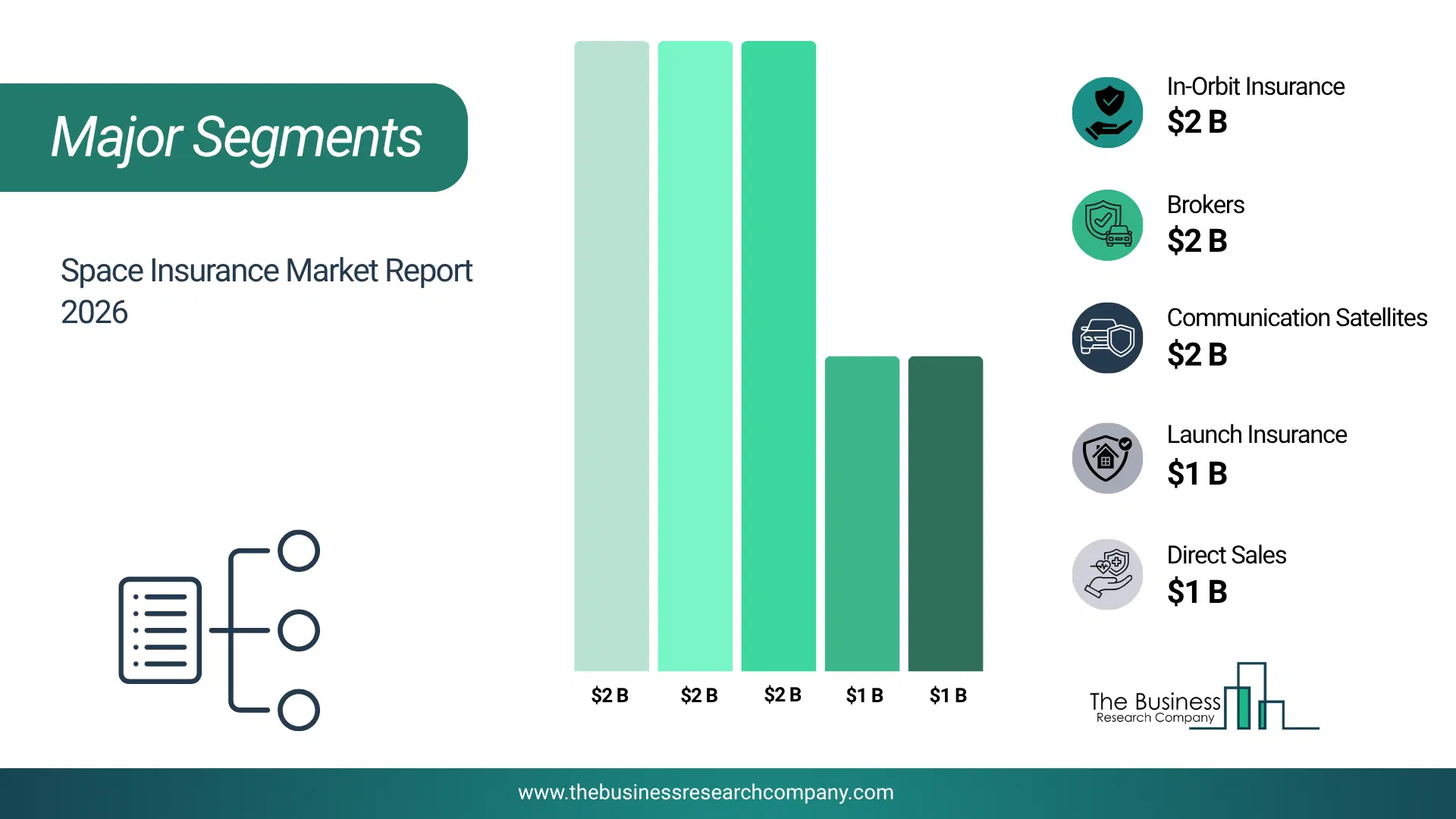
Global Space Insurance Market Segmentation
1) By Type Of Insurance: Launch Insurance, In-Orbit Insurance, End-Of-Life Insurance, Satellite Insurance, Spacecraft Insurance 2) By Distribution Channel: Direct Sales, Brokers, Online Platforms, Reinsurance Companies, Insurance Agents 3) By Application: Communication Satellites, Earth Observation Satellites, Navigation Satellites, Scientific And Exploration Missions, Space Stations And Habitats 4) By End-User: Government Space Agencies, Commercial Satellite Operators, Launch Service Providers, Space Tourism Companies, Academic And Research Institutions Subsegments: 1) By Launch Insurance: Commercial Satellite Launches, Government And Military Launches, Human Spaceflight Launches, Cargo And Resupply Missions, Rideshare Missions 2) By In-Orbit Insurance: Communication Satellites, Earth Observation Satellites, Navigation And Global Positioning System (GPS) Satellites, Scientific And Research Satellites, Defense And Surveillance Satellites 3) By End-Of-Life Insurance: De-Orbiting Services, Satellite Disposal Operations, Passive Decommissioning Coverage, Re-Entry Risk Mitigation, Collision Avoidance During End-Of-Life 4) By Satellite Insurance: Geostationary Orbit (GEO) Satellites, Medium Earth Orbit (MEO) Satellites, Low Earth Orbit (LEO) Satellites, CubeSats And SmallSats, Mega Constellations 5) By Spacecraft Insurance: Crewed Spacecraft, Uncrewed Scientific Probes, Space Station Modules, Interplanetary Spacecraft, Deep Space Missions The top segments in the space insurance market will be: • In-Orbit Insurance will reach $2100.6 Million by 2025. • Brokers will reach $2025.2 Million by 2025. • Communication Satellites will reach $1836.4 Million by 2025. • Launch Insurance will reach $1255.2 Million by 2025. • Direct Sales will reach $1105.6 Million by 2025.What Is Driver Of The Space Insurance Market?
The rising number of satellite launches is expected to propel the growth of the space insurance market going forward. A satellite launch involves deploying a satellite into Earth's orbit or space using a rocket or launch vehicle. The rising number of satellite launches is due to increasing companies' and governments' deployment of satellites to meet the rising need for worldwide high-speed internet connectivity. Space insurance safeguards satellite launches by covering losses from launch failures, operational issues, or deployment damage. It provides financial protection, helping investors manage risks in expensive space projects. For instance, in May 2025, the Satellite Industry Association, a US-based non-profit trade association, In 2024, a total of 259 launches including 224 commercially procured were conducted, driving global commercial launch revenues up to $9.3 billion, a 30% increase compared with 2023. Therefore, the rising number of satellite launches is driving the growth of the space insurance industry.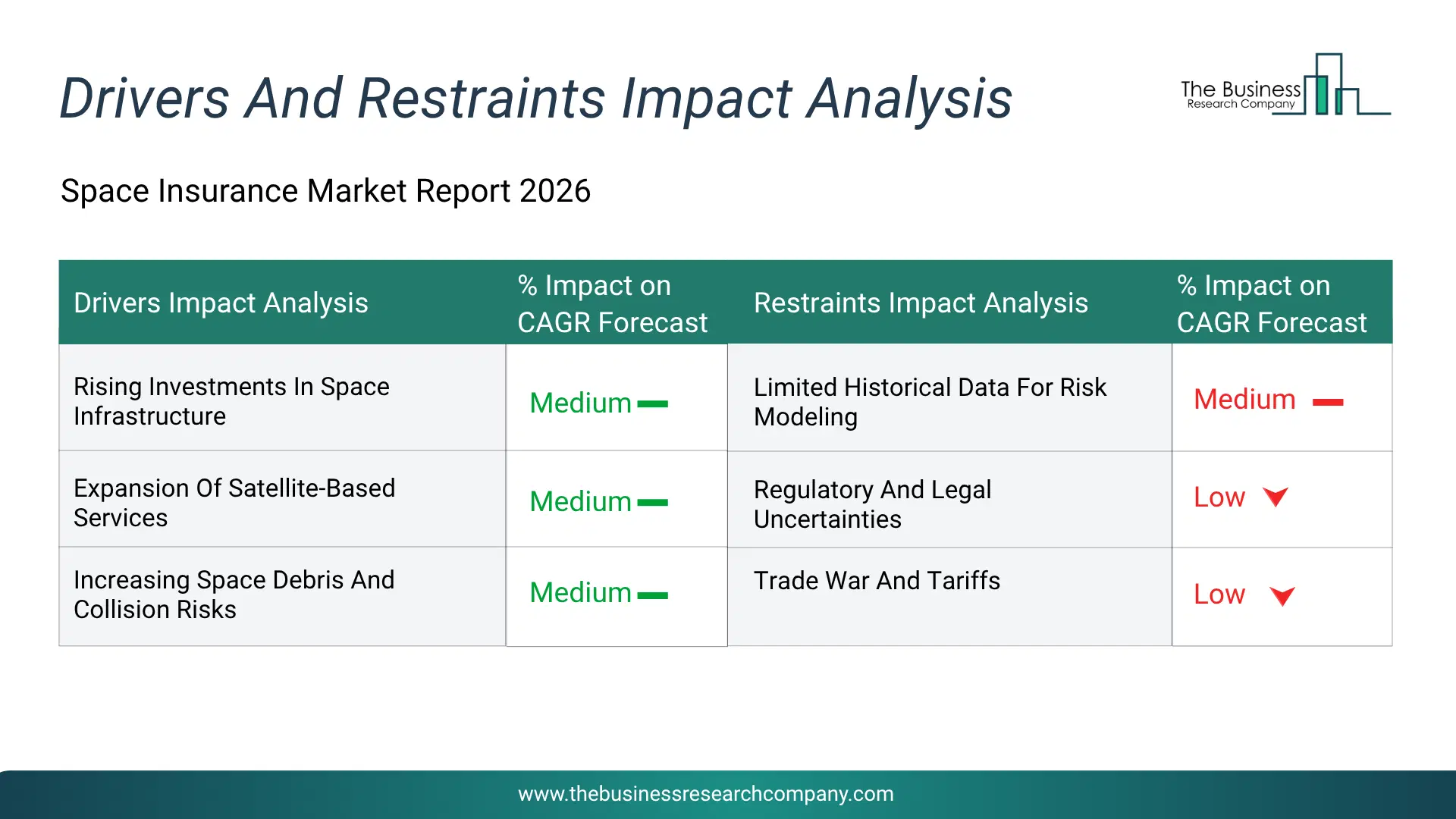
Infographic Chart Showing Key Market Drivers Analysis And Restraints For Space Insurance Market
The chart presents an impact analysis of key drivers and restraints, quantifying their relative influence on the market's growth rate and helping assess the balance between growth enablers and limiting factors. This chart offers a high-level perspective; the full report contains more detailed insights.
How Will The Drivers Impact Growth In The Global Space Insurance Market?
• Rising Investments In Space Infrastructure (Medium) – The rising investments in space infrastructure will become a key driver of growth in the space insurance market by 2030. Governments and private sector players are increasingly allocating capital toward satellite networks, launch facilities, ground stations and space exploration programs. This surge in investment will expand the number and value of space assets, thereby increasing exposure to operational and financial risks. As a result, demand for comprehensive insurance coverage is anticipated to grow. Insurers are likely to respond by enhancing capacity and developing tailored solutions to address evolving risk profiles. As a result, the rising investments in space infrastructure is anticipated to contributing to a 1.8% annual growth in the market. • Expansion Of Satellite-Based Services (Medium) – The expansion of satellite-based services will emerge as a major factor driving the expansion of the space insurance market by 2030. Increasing adoption of satellite-enabled applications such as broadband connectivity, navigation, remote sensing and IoT services is driving the launch of more satellites across various orbits. This expansion increases the value and complexity of space assets, thereby elevating exposure to technical and operational risks. As service providers seek to ensure reliability and continuity, demand for comprehensive insurance coverage is anticipated to rise. Consequently, the expansion of satellite-based services is projected to contributing to a 1.5% annual growth in the market. • Increasing Space Debris And Collision Risks (Medium) – The increasing space debris and collision risks will serve as a key growth catalyst for the space insurance market by 2030. The growing number of satellites, particularly in low Earth orbit, has intensified congestion, elevating the probability of accidental impacts and operational disruptions. These risks pose significant financial threats to satellite operators and mission stakeholders. As a result, demand for comprehensive insurance coverage is anticipated to increase to safeguard high-value assets and ensure business continuity. Therefore, this increasing space debris and collision risks is projected to supporting to a 1.0% annual growth in the market. • Growth In Earth Observation And Data Analytics Demand (Low) – The growth in earth observation and data analytics demand will become a significant driver contributing to the growth of the space insurance market by 2030. Increasing reliance on satellite-generated data across sectors such as agriculture, defense, climate monitoring and urban planning is accelerating the deployment of Earth observation satellites. This trend raises the value and volume of space-based assets, thereby increasing exposure to operational and financial risks. As organizations depend more on uninterrupted data services, the need for robust insurance coverage is likely to rise. Consequently, the growth in earth observation and data analytics demand is projected to contributing to a 0.5% annual growth in the market.How Will The Restraints Impact Growth In The Global Space Insurance Market?
• Limited Historical Data For Risk Modeling (Medium) – Limited historical data for risk modeling is expected to restrain market growth during the forecast period. It creates operational, financial, regulatory, or commercial challenges that can increase costs, delay projects, reduce investments, or discourage purchasing decisions depending on the market. These challenges can reduce product adoption, affect business confidence, and limit the ability of companies to expand efficiently across key regions. This can reduce operational efficiency, delay expansion plans, and affect the ability of companies to achieve sustainable business growth. • Regulatory And Legal Uncertainties (Medium) – During the forecast period, regulatory and legal uncertainties is likely to limit market expansion. It creates operational, financial, regulatory, or commercial challenges that can increase costs, delay projects, reduce investments, or discourage purchasing decisions depending on the market. These challenges can reduce product adoption, affect business confidence, and limit the ability of companies to expand efficiently across key regions. As a result, businesses may face increased cost pressures, slower commercial adoption, and reduced revenue opportunities. • Trade War And Tariffs (Medium) – The market is expected to face challenges due to trade war and tariffs over the forecast period. It creates operational, financial, regulatory, or commercial challenges that can increase costs, delay projects, reduce investments, or discourage purchasing decisions depending on the market. These challenges can reduce product adoption, affect business confidence, and limit the ability of companies to expand efficiently across key regions. This may discourage new investments, delay strategic expansion initiatives, and weaken the overall competitive position of market participants.Key Players In The Global Space Insurance Market
Major companies operating in the space insurance market are Munich Re, Swiss Re, Tokio Marine Holdings Inc., Sompo International Holdings Ltd., SCOR SE, Marsh LLC, Aon plc, Willis Towers Watson, AXA XL, Starr Insurance Companies, Hiscox Ltd., Lockton Companies, TATA AIG, Lloyd’s of London, Global Aerospace, Odyssey Re Holdings Corp., Atrium Underwriting Group, MAPFRE Global Risks , Assure Space LLC, ExpanseInsure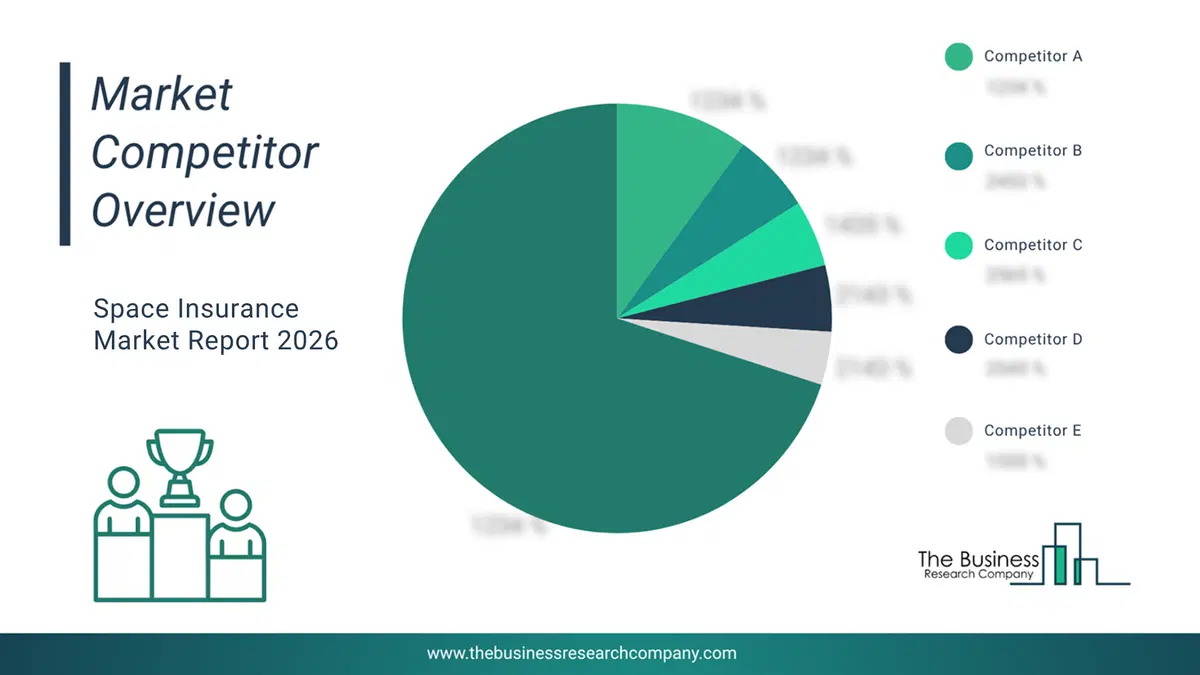
This chart is for illustrative purposes; the full report includes a detailed competitor analysis and comprehensive overview of the top 10 companies in the market.
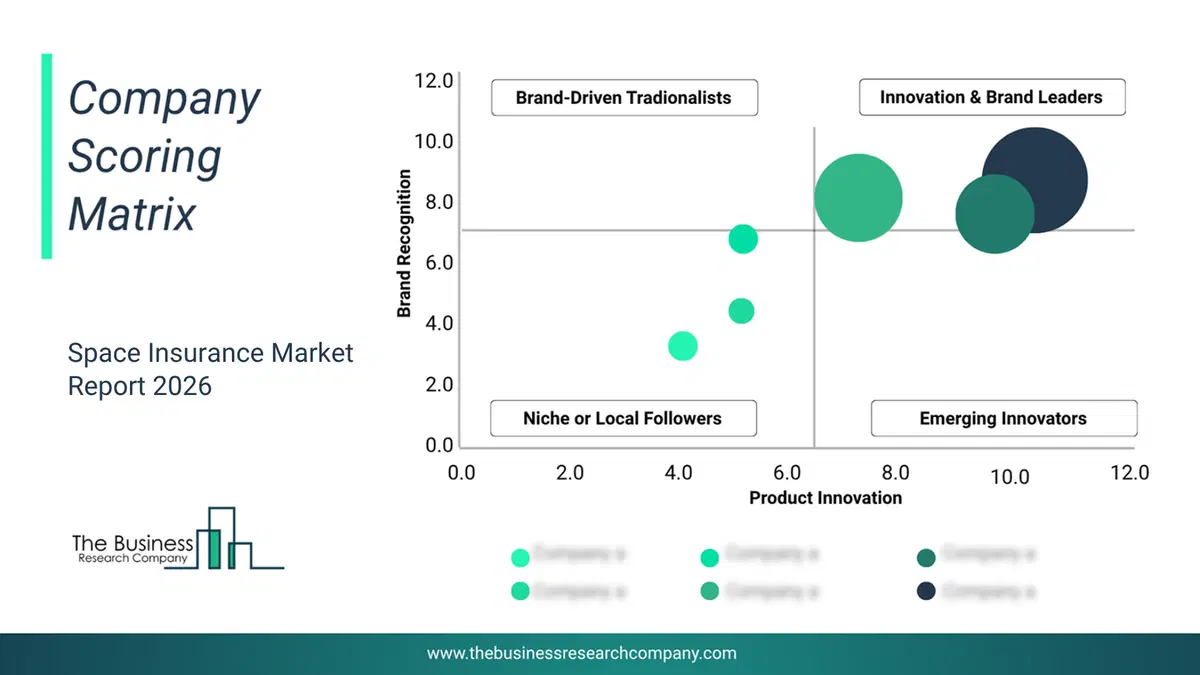
This chart maps companies by product innovation and brand strength, with bubble size indicating relative revenue, helping identify market leaders, challengers, and niche players. This is an illustrative chart; the full report provides a complete and accurate competitive analysis.
Global Space Insurance Market Trends and Insights
Major companies operating in the space insurance market are focusing on innovative solutions, such as satellite liability insurance, to protect operators from potential damages caused to third parties during space operations. Satellite liability insurance covers satellite operators against financial damages or legal claims resulting from harm to third parties during launch, in-orbit activities, or re-entry. For instance, in May 2024, Tata AIG, an India-based insurance company, launched India’s first Satellite In-Orbit Third-Party Liability Insurance. It provides critical financial protection for satellite manufacturers and operators against third-party bodily injury and property damage caused by incidents involving satellites in orbit. This policy, aligning with international standards, addresses the growing risks in India’s rapidly expanding space sector, especially amid increased satellite launches and recent solar storms. It supports the country’s ambition to boost its share in the global space market.What Are Latest Mergers And Acquisitions In The Space Insurance Market? Tokio Marine Partnered With Axelspace Holdings Inc. To Advance Space Insurance And Disaster Response With Microsatellite Technology
In April 2023, Tokio Marine Holdings, Inc., a Japan-based provider of space insurance, partnered with Axelspace Holdings Inc. to innovate space insurance and disaster response through cutting-edge satellite technology. This collaboration aims to develop specialized insurance products and digital services leveraging microsatellite data to meet the growing needs of the space market and enhance disaster response capabilities. Axelspace Holdings Inc. is a Japan-based space business sector involved in developing, manufacturing, launching, and operating microsatellites.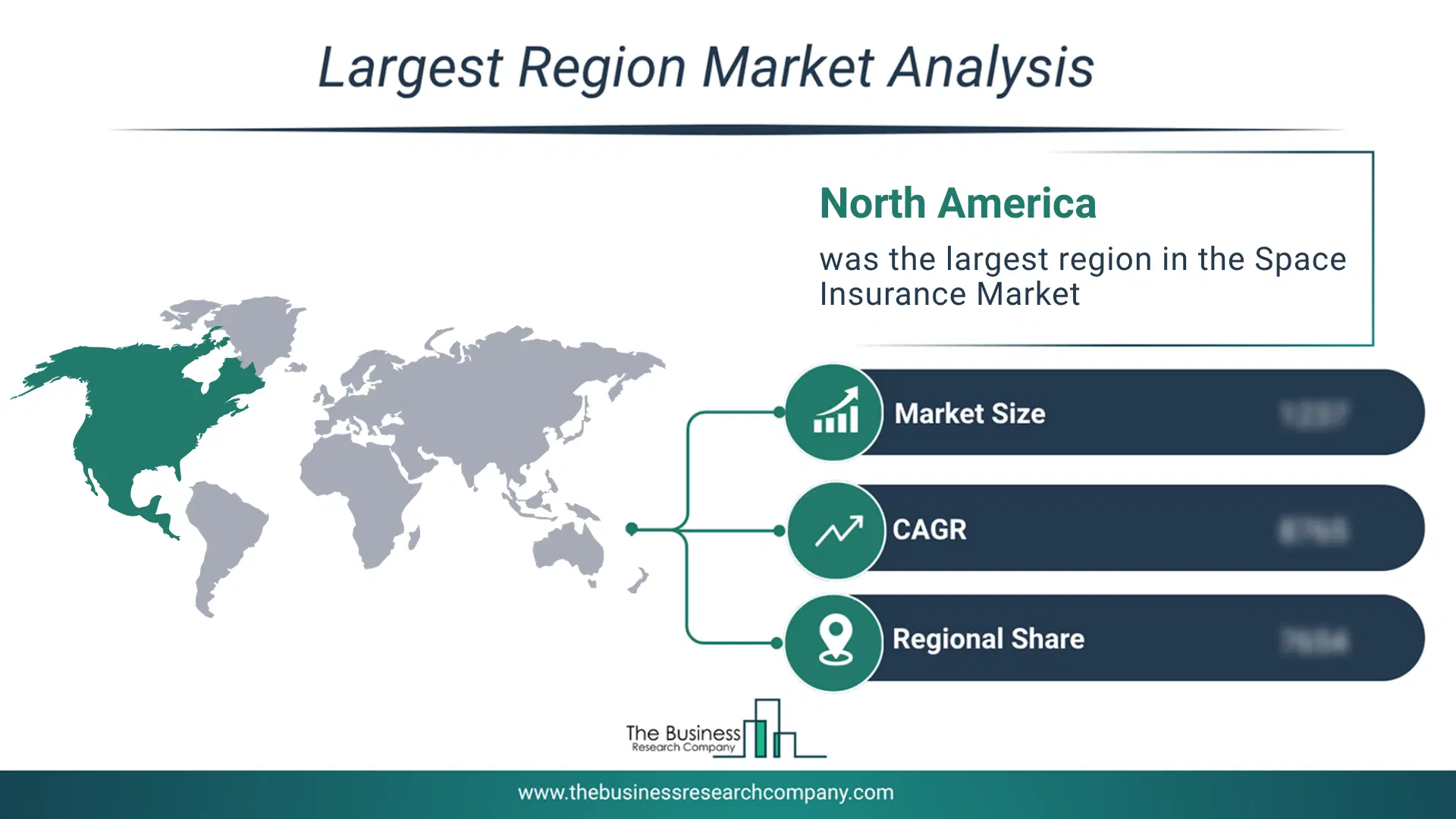
Regional Insights
North America was the largest region in the space insurance market in 2025. The regions covered in this market report are Asia-Pacific, South East Asia, Western Europe, Eastern Europe, North America, South America, Middle East, Africa. The countries covered in this market report are Australia, Brazil, China, France, Germany, India, Indonesia, Japan, Taiwan, Russia, South Korea, UK, USA, Canada, Italy, SpainWhat Defines the Space Insurance Market?
The space insurance market includes revenues earned by entities through third-party liability insurance, pre-launch insurance, reinsurance for space risks, launch delay insurance. The market value includes the value of related goods sold by the service provider or included within the service offering. Only goods and services traded between entities or sold to end consumers are included.How is Market Value Defined and Measured?
The market value is defined as the revenues that enterprises gain from the sale of goods and/or services within the specified market and geography through sales, grants, or donations in terms of the currency (in USD unless otherwise specified). The revenues for a specified geography are consumption values that are revenues generated by organizations in the specified geography within the market, irrespective of where they are produced. It does not include revenues from resales along the supply chain, either further along the supply chain or as part of other products.
This chart presents market attractiveness based on a quantitative evaluation of growth, competition, strategic alignment, and risk, offering a clear view of opportunity areas for decision-making. This chart is for illustrative purposes; the full report contains the complete analysis.

This chart highlights the Total Addressable Market (TAM) by estimating the maximum revenue opportunity using an assumption-driven approach, supporting strategic planning and opportunity sizing across markets. The chart is illustrative; the full report provides a more comprehensive analysis.
What Key Data and Analysis Are Included in the Space Insurance Market Report 2026?
The space insurance market research report is one of a series of new reports from The Business Research Company that provides market statistics, including industry global market size, regional shares, competitors with the market share, detailed market segments, market trends and opportunities, and any further data you may need to thrive in the space insurance industry. The market research report delivers a complete perspective of everything you need, with an in-depth analysis of the current and future state of the industry.Space Insurance Market Report Forecast Analysis
| Report Attribute | Details |
|---|---|
| Market Size Value In 2026 | $4.43 billion |
| Revenue Forecast In 2035 | $6.23 billion |
| Growth Rate | CAGR of 9.1% from 2026 to 2035 |
| Base Year For Estimation | 2025 |
| Actual Estimates/Historical Data | 2020-2025 |
| Forecast Period | 2026 - 2030 - 2035 |
| Market Representation | Revenue in USD Billion and CAGR from 2026 to 2035 |
| Segments Covered | Type Of Insurance, Distribution Channel, Application, End-User |
| Regional Scope | Asia-Pacific, Western Europe, Eastern Europe, North America, South America, Middle East, Africa |
| Country Scope | The countries covered in the report are Australia, Brazil, China, France, Germany, India, ... |
| Key Companies Profiled | Munich Re, Swiss Re, Tokio Marine Holdings Inc., Sompo International Holdings Ltd., SCOR SE, Marsh LLC, Aon plc, Willis Towers Watson, AXA XL, Starr Insurance Companies, Hiscox Ltd., Lockton Companies, TATA AIG, Lloyd’s of London, Global Aerospace, Odyssey Re Holdings Corp., Atrium Underwriting Group, MAPFRE Global Risks , Assure Space LLC, ExpanseInsure |
| Customization Scope | Request for Customization |
| Pricing And Purchase Options | Explore Purchase Options |