
Spatial Computing Market Report 2026
Global Outlook – By Component (Hardware, Software, Services), By Technology (Augmented Reality, Virtual Reality, Mixed Reality), By End User (Automotive, Healthcare, Gaming, Manufacturing, Retail, Education, Other End Users) – Market Size, Trends, Strategies, and Forecast to 2030
Spatial Computing Market Overview
• Spatial Computing market size has reached to $188.46 billion in 2025 • Expected to grow to $448.95 billion in 2030 at a compound annual growth rate (CAGR) of 18.3% • Growth Driver: Impact Of Remote Work Practices On Spatial Computing Market Growth • Market Trend: Revolutionizing Spatial Computing With Seamless Integration Of Physical And Digital Realms • North America was the largest region in 2025.What Is Covered Under Spatial Computing Market?
Spatial computing refers to the integration of digital information with the physical environment in real-time, allowing users to interact with digital content in a seamless and immersive manner within the context of their surroundings. These technologies leverage sensors, cameras, and other tools to understand the three-dimensional space around them, enabling more natural and intuitive interactions between humans and computers. The main types of components in spatial computing are hardware, software, and services. Hardware refers to the physical components of spatial computing devices like headsets, sensors, and processing units. It includes various technologies such as augmented reality, virtual reality, and mixed reality, and end users are automotive, healthcare, gaming, manufacturing, retail, education, and others.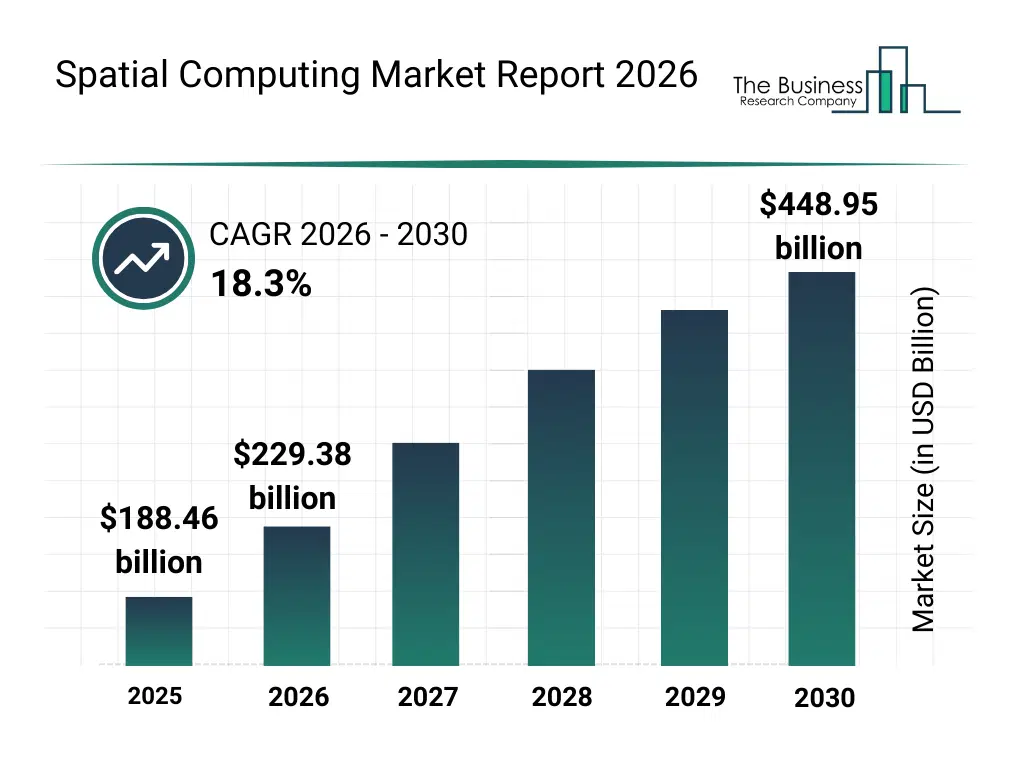
What Is The Spatial Computing Market Size and Share 2026?
The spatial computing market size has grown exponentially in recent years. It will grow from $188.46 billion in 2025 to $229.38 billion in 2026 at a compound annual growth rate (CAGR) of 21.7%. The growth in the historic period can be attributed to advancements in sensor and camera technologies, early adoption of ar and vr devices, growth of gaming and visualization platforms, expansion of industrial simulation use cases, increasing investment in immersive interfaces.What Is The Spatial Computing Market Growth Forecast?
The spatial computing market size is expected to see rapid growth in the next few years. It will grow to $448.95 billion in 2030 at a compound annual growth rate (CAGR) of 18.3%. The growth in the forecast period can be attributed to increasing deployment of spatial computing in manufacturing and healthcare, rising integration with AI-driven perception systems, expansion of metaverse-related applications, growing demand for real-time spatial analytics, increasing adoption of mixed reality enterprise solutions. Major trends in the forecast period include increasing adoption of enterprise ar and vr applications, rising use of 3D mapping and spatial analytics, growing integration of digital twins with physical environments, expansion of wearable spatial computing devices, enhanced focus on natural human-computer interaction.
Global Spatial Computing Market Segmentation
1) By Component: Hardware, Software, Services 2) By Technology: Augmented Reality, Virtual Reality, Mixed Reality 3) By End User: Automotive, Healthcare, Gaming, Manufacturing, Retail, Education, Other End Users Subsegments: 1) By Hardware: Wearables (AR/VR Headsets, Smart Glasses), Sensors (Depth Sensors, Motion Sensors), Processors (Graphics Processing Units, Application Processors), Displays (Head-Up Displays, Holographic Displays), Controllers (Haptic Feedback Controllers, Gesture Control Devices) 2) By Software: Augmented Reality (AR) Software, Virtual Reality (VR) Software, Mixed Reality (MR) Software, 3D Mapping And Modeling Software, Spatial Analytics Software, Development Platforms (Game Engines, AR Or VR SDKs) 3) By Services: Consulting Services, Integration And Deployment Services, Maintenance And Support Services, Training And Education Services, Managed ServicesWhat Is The Driver Of The Spatial Computing Market?
The increasing adoption of remote work practices is expected to propel the growth of the spatial computing market going forward. Remote work practices refer to methodologies employed by organizations to effectively conduct work outside of a traditional office environment. It arises because of technological advancements, global connectivity, flexibility, work-life balance, pandemic impact, and employee preferences. Spatial computing has been used to transform remote work practices by providing more immersive collaboration experiences, improving training and onboarding processes, creating virtual office environments, enabling remote assistance, and developing specialized productivity tools. For instance, in February 2023, according to the Office for National Statistics, a UK-based non-ministerial department, between April 27 and May 8, 2022, approximately 38% of employed adults stated that they had worked remotely. In the latest period, from January 25 to February 5, 2023, about 40% of working adults mentioned having worked from home at least once in the past seven days. Therefore, the increasing adoption of remote work practices is driving the growth of the spatial computing industry.Key Players In The Global Spatial Computing Market
Major companies operating in the spatial computing market are Apple Inc, Google plc, Samsung Corporation, Microsoft Corporation, Meta Platforms Inc, Huawei Technologies Co. Ltd, Sony Corporation, Lenovo Group Limited, Intel Corporation, Qualcomm Incorporated, NVIDIA Corporation, Vuzix Corporation, Seiko Epson Corporation, Dassault Systèmes, Autodesk Inc, Snap Inc, PTC Inc, Unity Technologies, Melexis NV, Niantic Inc, RealWear Inc, Atheer Inc, OnScale Inc, Blippar Ltd, Wikitude GmbH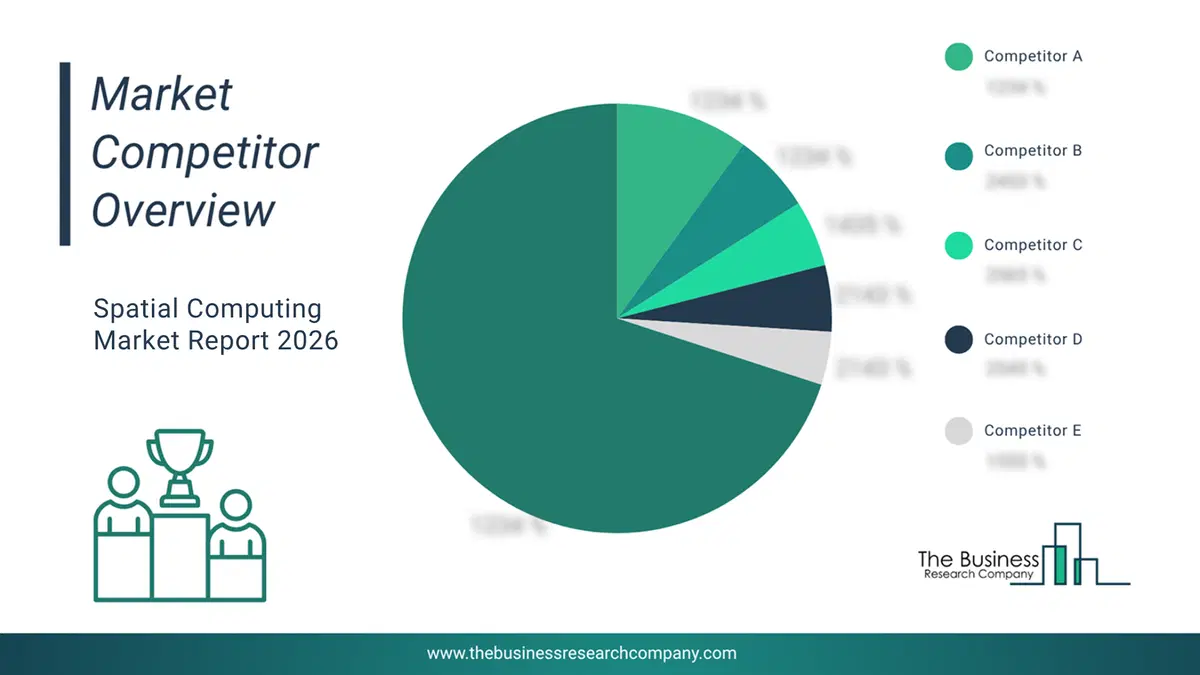
This chart is for illustrative purposes; the full report includes a detailed competitor analysis and comprehensive overview of the top 10 companies in the market.
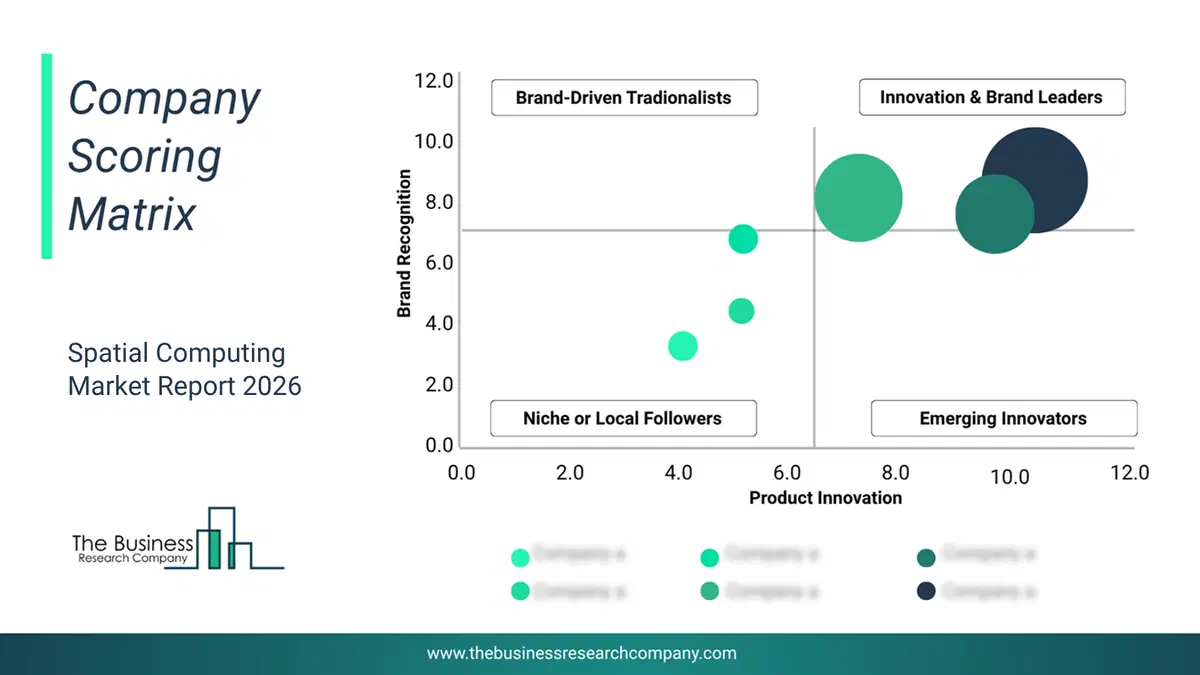
This chart maps companies by product innovation and brand strength, with bubble size indicating relative revenue, helping identify market leaders, challengers, and niche players. This is an illustrative chart; the full report provides a complete and accurate competitive analysis.
Global Spatial Computing Market Trends and Insights
Major companies operating in spatial computing are focusing on developing innovative technological products, such as the Apple Vision Pro, to expand their product portfolio and reach new customers. It is a revolutionary spatial computer that seamlessly blends digital content with the physical world, offering a unique user experience where physical inputs like motion gestures, eye tracking, and speech recognition interact seamlessly with digital content. For instance, in June 2023, Apple Inc., a US-based technology company, launched the Apple Vision Pro, a revolutionary spatial computer that seamlessly blends digital content with the physical world, allowing users to stay present and connected to others. This Vision Pro creates an infinite canvas for apps that scales beyond the boundaries of a traditional display, introduces hands and voice, and allows users to be more productive with infinite screen real estate, access to favorite apps, and new multitasking capabilities. Additionally, it features a unique design that distinguishes it from other AR/VR headsets. It includes an external battery pack connected via a cable to reduce weight and discomfort during extended use.What Are Latest Mergers And Acquisitions In The Spatial Computing Market?
In April 2024, CoStar Group, Inc., a US-based commercial real estate information services company, acquired Matterport for $1.6 billion. CoStar's acquisition of Matterport aims to leverage its 3D technology and AI capabilities to enhance property visualization and data analysis, including construction camera solutions for improved project management and digital documentation. Matterport is a US-based spatial data company that provides 3D capture technology to create immersive digital twins of physical spaces for industries like real estate, construction, and architecture.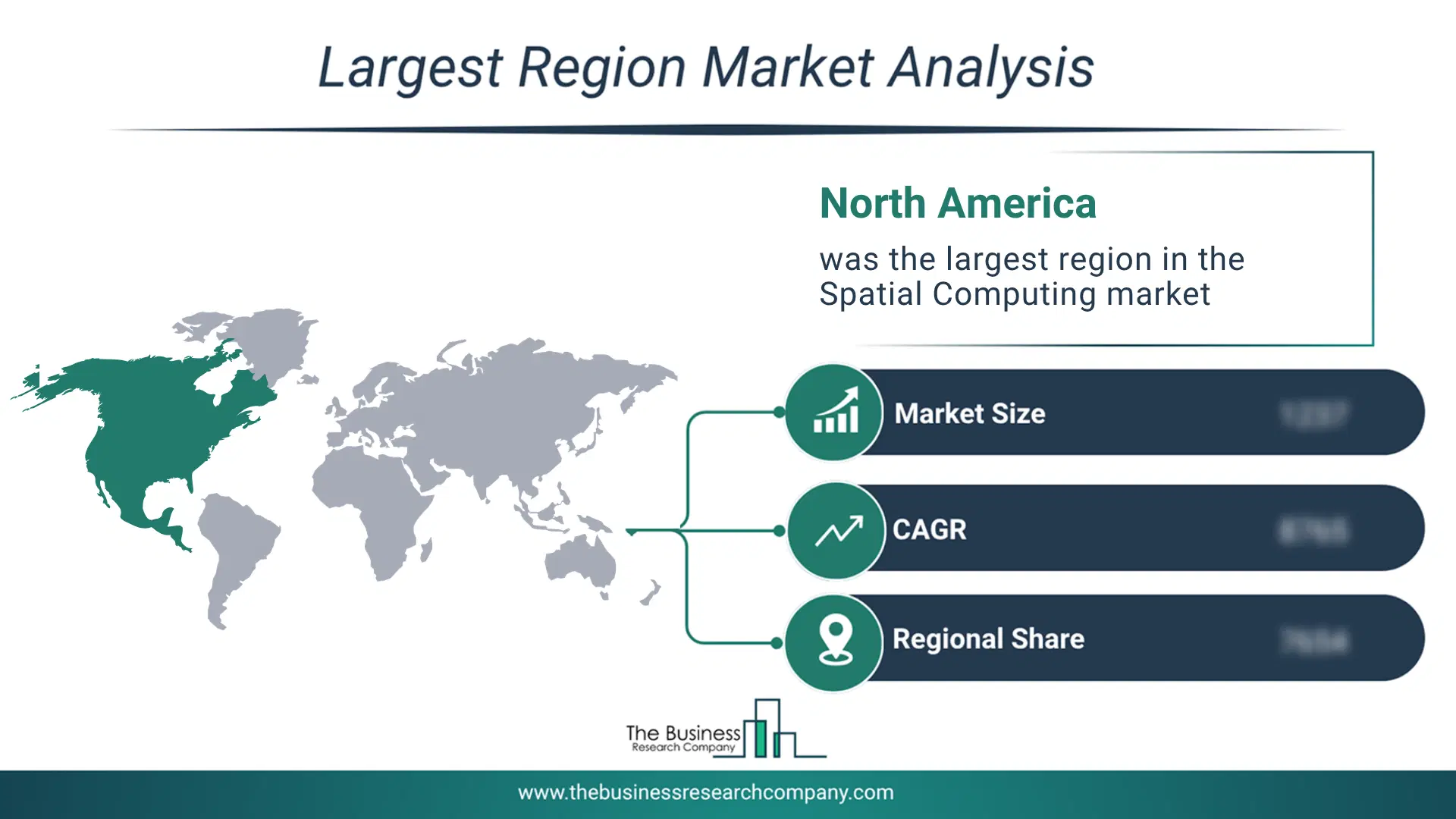
Regional Insights
North America was the largest region in the spatial computing market in 2025. The regions covered in this market report are Asia-Pacific, South East Asia, Western Europe, Eastern Europe, North America, South America, Middle East, Africa. The countries covered in this market report are Australia, Brazil, China, France, Germany, India, Indonesia, Japan, Taiwan, Russia, South Korea, UK, USA, Canada, Italy, Spain.What Defines the Spatial Computing Market?
The spatial computing market includes revenues earned by entities by providing services such as 3D mapping and visualization, spatial analytics, spatial simulation and training, spatial design and prototyping, and spatial computing consulting. The market value includes the value of related goods sold by the service provider or included within the service offering. The spatial computing market also includes sales of augmented reality (AR) glasses, virtual reality (VR) headsets, spatial mapping and visualization tools, gesture and motion tracking tools, and spatial sound spatial analytics systems. Values in this market are ‘factory gate’ values, that is, the value of goods sold by the manufacturers or creators of the goods, whether to other entities (including downstream manufacturers, wholesalers, distributors, and retailers) or directly to end customers. The value of goods in this market includes related services sold by the creators of the goods.How is Market Value Defined and Measured?
The market value is defined as the revenues that enterprises gain from the sale of goods and/or services within the specified market and geography through sales, grants, or donations in terms of the currency (in USD unless otherwise specified). The revenues for a specified geography are consumption values that are revenues generated by organizations in the specified geography within the market, irrespective of where they are produced. It does not include revenues from resales along the supply chain, either further along the supply chain or as part of other products.
This chart presents market attractiveness based on a quantitative evaluation of growth, competition, strategic alignment, and risk, offering a clear view of opportunity areas for decision-making. This chart is for illustrative purposes; the full report contains the complete analysis.

This chart highlights the Total Addressable Market (TAM) by estimating the maximum revenue opportunity using an assumption-driven approach, supporting strategic planning and opportunity sizing across markets. The chart is illustrative; the full report provides a more comprehensive analysis.
What Key Data and Analysis Are Included in the Spatial Computing Market Report 2026?
The spatial computing market research report is one of a series of new reports from The Business Research Company that provides market statistics, including industry global market size, regional shares, competitors with the market share, detailed market segments, market trends and opportunities, and any further data you may need to thrive in the spatial computing industry. The market research report delivers a complete perspective of everything you need, with an in-depth analysis of the current and future state of the industry.Spatial Computing Market Report Forecast Analysis
| Report Attribute | Details |
|---|---|
| Market Size Value In 2026 | $229.38 billion |
| Revenue Forecast In 2030 | $448.95 billion |
| Growth Rate | CAGR of 18.3% from 2026 to 2030 |
| Base Year For Estimation | 2025 |
| Actual Estimates/Historical Data | 2020-2025 |
| Forecast Period | 2026 - 2030 |
| Market Representation | Revenue in USD Billion and CAGR from 2026 to 2030 |
| Segments Covered | Component, Technology, End User |
| Regional Scope | Asia-Pacific, Western Europe, Eastern Europe, North America, South America, Middle East, Africa |
| Country Scope | The Countries Covered In This Market Report Are Australia, Brazil, China, France, Germany, India, Indonesia, Japan, Taiwan, Russia, South Korea, Uk, Usa, Canada, Italy, Spain. |
| Key Companies Profiled | Apple Inc, Google plc, Samsung Corporation, Microsoft Corporation, Meta Platforms Inc, Huawei Technologies Co. Ltd, Sony Corporation, Lenovo Group Limited, Intel Corporation, Qualcomm Incorporated, NVIDIA Corporation, Vuzix Corporation, Seiko Epson Corporation, Dassault Systèmes, Autodesk Inc, Snap Inc, PTC Inc, Unity Technologies, Melexis NV, Niantic Inc, RealWear Inc, Atheer Inc, OnScale Inc, Blippar Ltd, Wikitude GmbH |
| Customization Scope | Request for Customization |
| Pricing And Purchase Options | Explore Purchase Options |