

Undersea Warfare Systems Market Report 2026
Global Outlook – By Type (Communication And Surveillance Systems, Sensors And Computation Systems, Countermeasure Systems And Payload, Unmanned Underwater Vehicles, Weapon Systems), By Mode of Operation (Manned Operations, Autonomous Operations, Remotely Operations), By End-User (Navy, Air Force) – Market Size, Trends, Strategies, and Forecast to 2030
Undersea Warfare Systems Market Overview
• Undersea Warfare Systems market size has reached to $21.14 billion in 2025 • Expected to grow to $28.51 billion in 2030 at a compound annual growth rate (CAGR) of 6% • Growth Driver: Surging Global Military Expenditure Fuels Expansion Of The Undersea Warfare Systems Market • Market Trend: Advancements In Fast-Attack Submarines With Enhanced Stealth And Networked Capabilities • North America was the largest region in 2025 and Asia-Pacific is the fastest growing region.Market Gains By 2030 – Top Opportunities By Segment
Market Gain identifies the most promising market opportunities by highlighting the segments or products expected to generate the highest incremental revenue growth over the next five years.
What Is Covered Under Undersea Warfare Systems Market?
The undersea warfare systems are used to defend against undersea threats by enemies to strengthen the nation’s security. Undersea warfare systems are commonly used in naval operations of a particular country to provide security against opposing countries. It consists of the antisubmarine, offensive and defensive submarine, and mine warfare systems to control and maintain underwater nations’ borders by using various defensive and effective underwater weapons and systems. The main types of the undersea warfare systems include communication and surveillance systems, sensors and computation systems, countermeasure systems and payload, unmanned underwater vehicles, and weapon systems. Communication and surveillance systems refer to platforms and technologies designed to enable real-time underwater communication, monitor maritime environments, and provide situational awareness for naval operations. There are modes of operation such as manned operations, autonomous operations, and remotely operated systems, and they are used by several end-users such as the navy and air force.
What Is The Undersea Warfare Systems Market Size and Share 2026?
The undersea warfare systems market size has grown strongly in recent years. It will grow from $21.14 billion in 2025 to $22.6 billion in 2026 at a compound annual growth rate (CAGR) of 6.9%. The growth in the historic period can be attributed to increasing naval investment in antisubmarine and mine-warfare capabilities, expansion of submarine fleets to strengthen maritime defense, advancements in underwater communication systems to support coordinated operations, rising deployment of acoustic sensors and sonar technologies for threat detection, early modernization programs upgrading legacy undersea warfare platforms.What Is The Undersea Warfare Systems Market Growth Forecast?
The undersea warfare systems market size is expected to see strong growth in the next few years. It will grow to $28.51 billion in 2030 at a compound annual growth rate (CAGR) of 6.0%. The growth in the forecast period can be attributed to growing demand for autonomous and remotely operated undersea warfare systems, increasing integration of advanced sonar and sensing technologies for enhanced situational awareness, development of next-generation submarines with improved stealth and endurance, rising emphasis on securing strategic maritime zones amid geopolitical tensions, expansion of digital undersea communication networks enabling real-time coordinated defense operations. Major trends in the forecast period include integration of advanced sonar and acoustic detection systems, development of autonomous unmanned underwater vehicles (uuvs), enhancement of electronic countermeasure (ecm) capabilities, deployment of precision mine warfare systems, improvement of undersea communication and data link technologies.
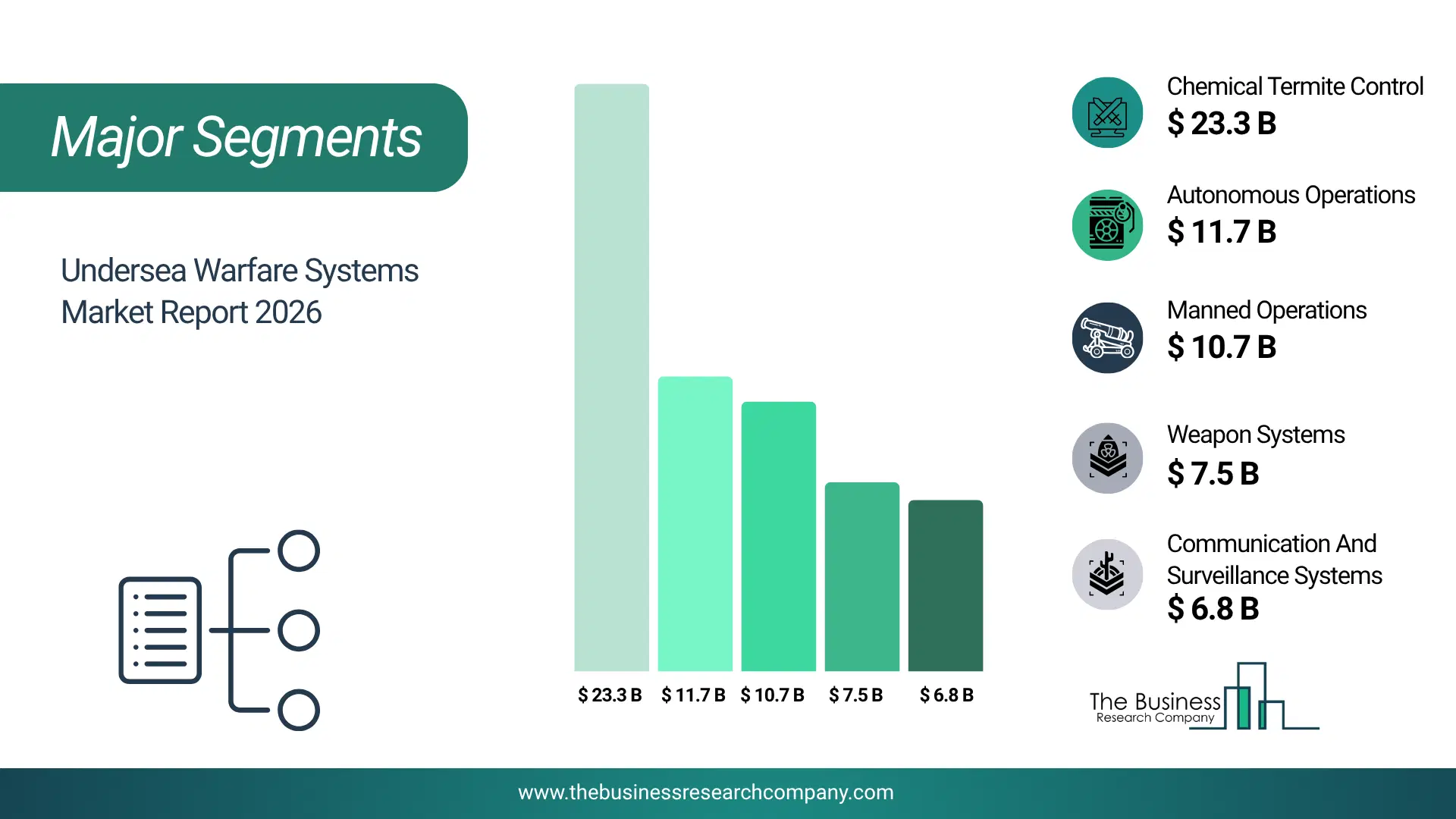
Global Undersea Warfare Systems Market Segmentation
1) By Type: Communication And Surveillance Systems, Sensors And Computation Systems, Countermeasure Systems And Payload, Unmanned Underwater Vehicles, Weapon Systems 2) By Mode of Operation: Manned Operations, Autonomous Operations, Remotely Operations 3) By End-User: Navy, Air Force Subsegments: 1) By Communication And Surveillance Systems: Acoustic Communication Systems, Data Link Systems, Surveillance Sonar Systems 2) By Sensors And Computation Systems: Sonar Sensors, Electronic Support Measures (ESM), Decision Support Systems 3) By Countermeasure Systems And Payload: Torpedoes, Decoys, Electronic Countermeasures (ECM) 4) By Unmanned Underwater Vehicles (UUVs): Autonomous Underwater Vehicles (AUVs), Remotely Operated Vehicles (ROVs) 5) By Weapon Systems: Torpedo Systems, Anti-Submarine Warfare (ASW) Systems, Mine Warfare Systems The top segments in the undersea warfare systems market will be: • Navy will reach $23374.04 Million by 2030. • Manned Operations will reach $10770.34 Million by 2030. • Autonomous Operations will reach $11708.89 Million by 2030. • Weapon Systems will reach $7498.88 Million by 2030. • Communication And Surveillance Systems will reach $6862.43 Million by 2030.What Is Driver Of The Undersea Warfare Systems Market?
Rising military expenditure is expected to propel the growth of the undersea warfare systems market going forward. Military expenditure is the financial resources allocated by a government or a nation to fund its military forces, defense infrastructure, and related activities. Higher defense budgets allow governments to purchase and upgrade underwater warfare systems, including submarines, torpedoes, sonar technology, and anti-submarine warfare equipment. For instance, in April 2024, according to the Stockholm International Peace Research Institute (SIPRI), a Sweden-based international research institute, global military spending reached $2.443 trillion in 2023, marking a 6.8% increase in real terms compared to 2022. Therefore, rising military expenditure is driving the growth of the underwater warfare systems market.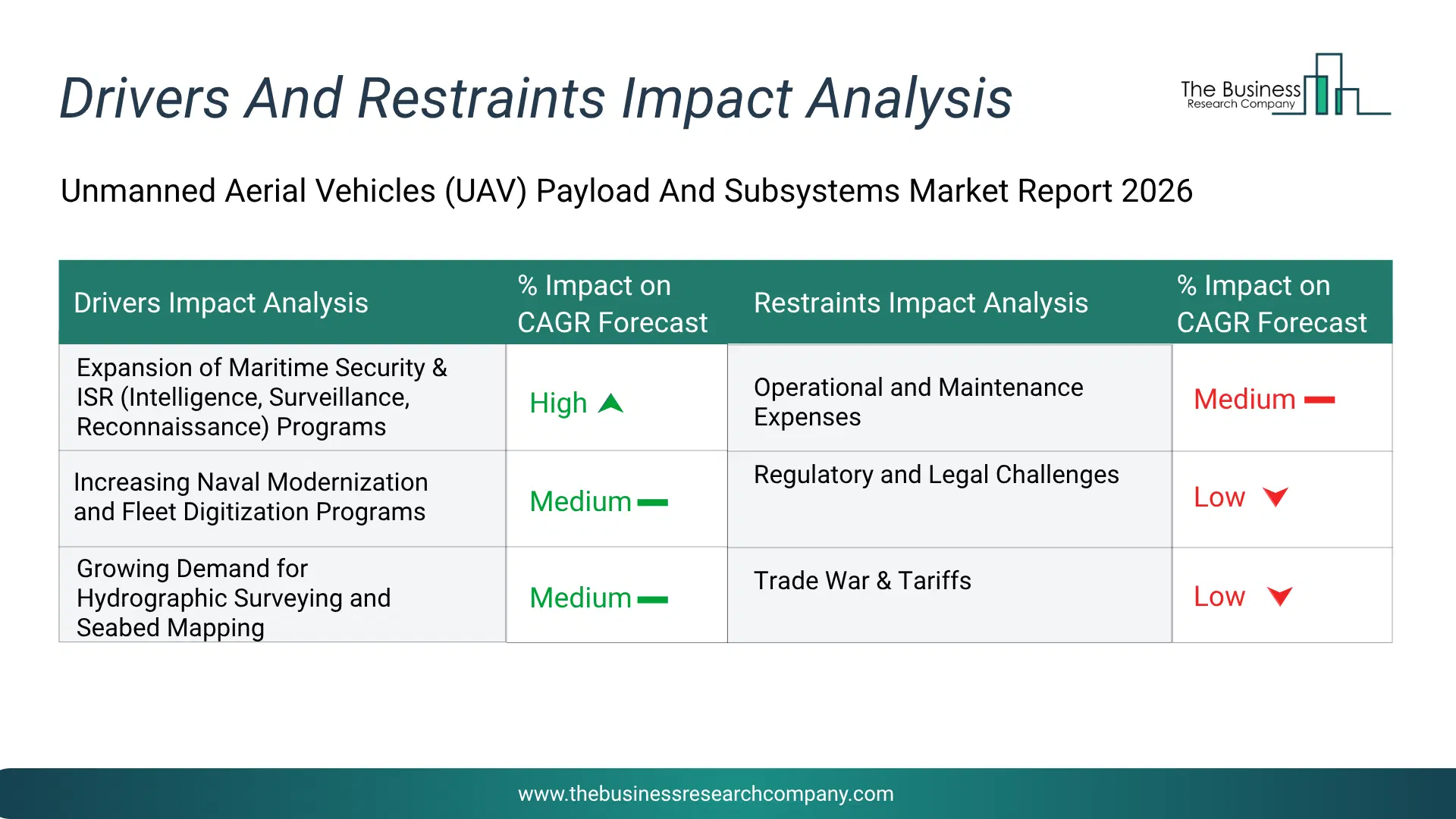
Infographic Chart Showing Key Market Drivers Analysis And Restraints For Undersea Warfare Systems Market
The chart presents an impact analysis of key drivers and restraints, quantifying their relative influence on the market's growth rate and helping assess the balance between growth enablers and limiting factors. This chart offers a high-level perspective; the full report contains more detailed insights.
How Will The Drivers Impact Growth In The Global Undersea Warfare Systems Market?
• Need for Protection of Maritime Trade Routes (Medium) – During the forecast period, the need for protection of maritime trade routes will become a key driver of growth in the undersea warfare systems market by 2030. rising global trade volumes and increased dependence on sea-based logistics have heightened the strategic importance of secure shipping lanes. threats such as submarine incursions, naval mines, piracy and geopolitical tensions have prompted governments to strengthen undersea surveillance and defense capabilities. as a result, navies are investing in advanced sonar systems, unmanned underwater vehicles and anti-submarine warfare platforms. these investments aim to ensure uninterrupted trade flows, safeguard critical maritime infrastructure and maintain national security, thereby supporting sustained market expansion. therefore, the need for protection of maritime trade routes will drive the growth of the undersea warfare systems market. as a result, need for protection of maritime trade routes is anticipated to contributing to a 1.5% annual growth in the market. • Rise in Naval Modernization Programs (Medium) – During the forecast period, the rise in naval modernization programs will emerge as a major factor driving the expansion of the undersea warfare systems market by 2030. many countries are upgrading their naval capabilities to address evolving security threats and strengthen maritime dominance. these programs emphasize the replacement of aging fleets with advanced submarines, surface combatants and integrated undersea defense technologies. increased investments in sonar systems, torpedoes, unmanned underwater vehicles and command-and-control platforms are enhancing underwater surveillance and combat effectiveness. additionally, the adoption of network-centric warfare and automation is improving operational efficiency. collectively, these modernization initiatives are accelerating procurement and deployment of advanced undersea warfare systems worldwide. therefore, the rise in naval modernization programs will drive the growth of the undersea warfare systems market. consequently, the rise in naval modernization programs is projected to contributing to a 1.3% annual growth in the market. • Expansion of Undersea Communication & Data Networks (Medium) – During the forecast period, the expansion of undersea communication and data networks will serve as a key growth catalyst for the undersea warfare systems market by 2030. subsea cables and sensor networks play a critical role in global data transmission, financial transactions and defense communications, making them strategic assets. growing concerns over cable sabotage, espionage and accidental damage have increased the need for enhanced undersea monitoring and protection. consequently, defense forces are investing in advanced surveillance systems, autonomous underwater vehicles and subsea security solutions. these technologies help detect, monitor and neutralize potential threats, driving sustained demand for sophisticated undersea warfare systems. therefore, the expansion of undersea communication & data networks will drive the growth of the undersea warfare systems market. therefore, expansion of undersea communication and data networks is projected to supporting to a 1% annual growth in the market. • Expansion of Unmanned & Autonomous Systems (Low) – During the forecast period, the expansion of unmanned and autonomous systems is expected to propel the growth of the undersea warfare systems market during forecast period. navies are increasingly adopting autonomous underwater vehicles (auvs) and unmanned underwater vehicles (uuvs) to enhance surveillance, reconnaissance and mine countermeasure operations. these systems reduce operational risks to personnel while enabling persistent and cost-effective monitoring of underwater environments. advances in artificial intelligence, sensor integration and endurance capabilities have further improved their operational effectiveness. as defense forces seek scalable and flexible solutions for complex maritime threats, investments in unmanned and autonomous undersea platforms are driving sustained market growth. therefore, rhe expansion of unmanned & autonomous systems will drive the growth of the undersea warfare systems market. the expansion of unmanned and autonomous systems growth contribution during the forecast period in 2025 is 0.5%.How Will The Restraints Impact Growth In The Global Undersea Warfare Systems Market?
• Regulatory & Export Control Restrictions (Medium) – During the forecast period, regulatory and export control restrictions is expected to hinder the growth of the undersea warfare systems market in forecast period. undersea warfare technologies are highly sensitive and subject to strict national and international regulations governing their development, transfer and deployment. export control regimes, defense procurement policies and compliance requirements can limit cross-border sales and delay contract approvals. additionally, restrictions on technology sharing often increase development costs and extend project timelines for manufacturers. these regulatory barriers may reduce market access, particularly in emerging economies and constrain collaboration between global defense firms, thereby slowing overall market expansion despite rising defense demand. therefore, regulatory & export control restrictions may hinder the growth of the undersea warfare systems market. growth affected by regulatory and export control restrictions across regions during the forecast period in 2025 is -1.6%. • Environmental and Operational Restrictions (Medium) – During the forecast period, environmental and operational restrictions is expected to hinder the growth of the undersea warfare systems market. Stringent environmental regulations aimed at protecting marine ecosystems limit the use of active sonar and underwater explosives, increasing compliance costs for defense operators. Additionally, challenging underwater conditions such as deep-sea pressure, variable temperatures and complex seabed terrain can restrict system performance and deployment flexibility. Operational constraints, including limited endurance, high maintenance requirements and specialized training needs, further add to costs and complexity. Collectively, these factors slow deployment cycles, reduce operational efficiency and restrain market growth despite rising security requirements. Therefore, the environmental and operational restrictions may hinder the growth of the undersea warfare systems market. Growth affected by u environmental and operational restrictions across regions during the forecast period in 2025 is -1.0% • Trade War & Tariffs (Medium) – During the forecast period, trade wars and tariffs are expected to restrain the growth of the undersea warfare systems market during the forecast period by increasing the costs of imported raw materials, critical components and advanced subsystems. escalating trade tensions can increase duties on imported defense components such as sensors, electronics, propulsion systems and specialized materials. these higher input costs raise overall manufacturing and procurement expenses for undersea warfare platforms. in response, governments may delay or scale back acquisition programs due to budget constraints. additionally, tariffs can disrupt global supply chains and limit access to advanced foreign technologies, reducing operational efficiency. collectively, these factors can slow production cycles, hinder international collaboration and restrain overall market growth. therefore, trade wars and tariffs may restrain the growth of the undersea warfare systems market. growth affected by trade war and tariffs across regions during the forecast period in 2025 is -0.2%.Key Players In The Global Undersea Warfare Systems Market
Major companies operating in the undersea warfare systems market are BAE Systems plc, General Dynamics Corporation, Kongsberg Gruppen AS, L3Harris Technologies Inc., Leonardo S.p.A., Lockheed Martin Corporation, Northrop Grumman Corporation, RTX Corporation, Saab AB, Thales Group, ATLAS ELEKTRONIK GmbH, S.A. de Electronica Submarina, ECA Group, Ultra Electronics Holdings plc, Abeking & Rasmussen GmbH & Co. KG, Babcock International Group PLC, Bharat Electronics Limited, DRS Technologies Inc., Elbit Systems Ltd., Fincantieri S.p.A., Hydroid Inc., Israel Aerospace Industries Ltd., Kraken Robotics Inc., L3 OceanServer, Navantia S.A., Ocean Aero Inc., QinetiQ Group plc, Rafael Advanced Defense Systems Ltd., Safran Electronics & Defense, Sonardyne International Ltd.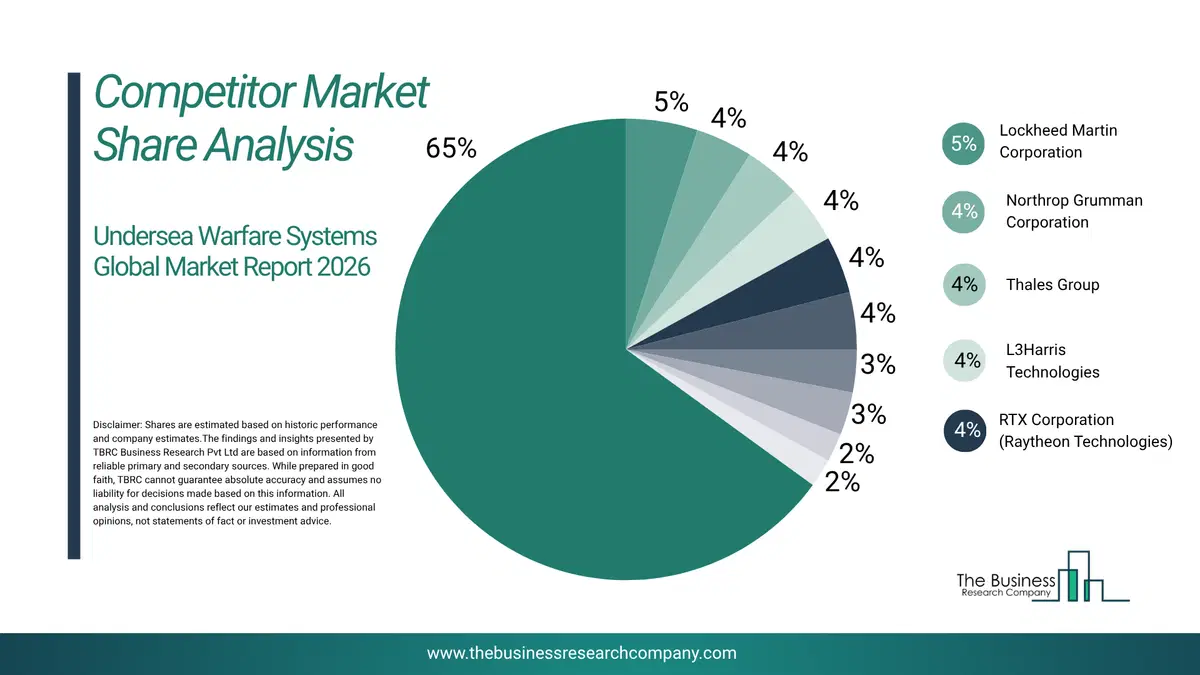
This chart is for illustrative purposes; the full report includes a detailed competitor analysis and comprehensive overview of the top 10 companies in the market.
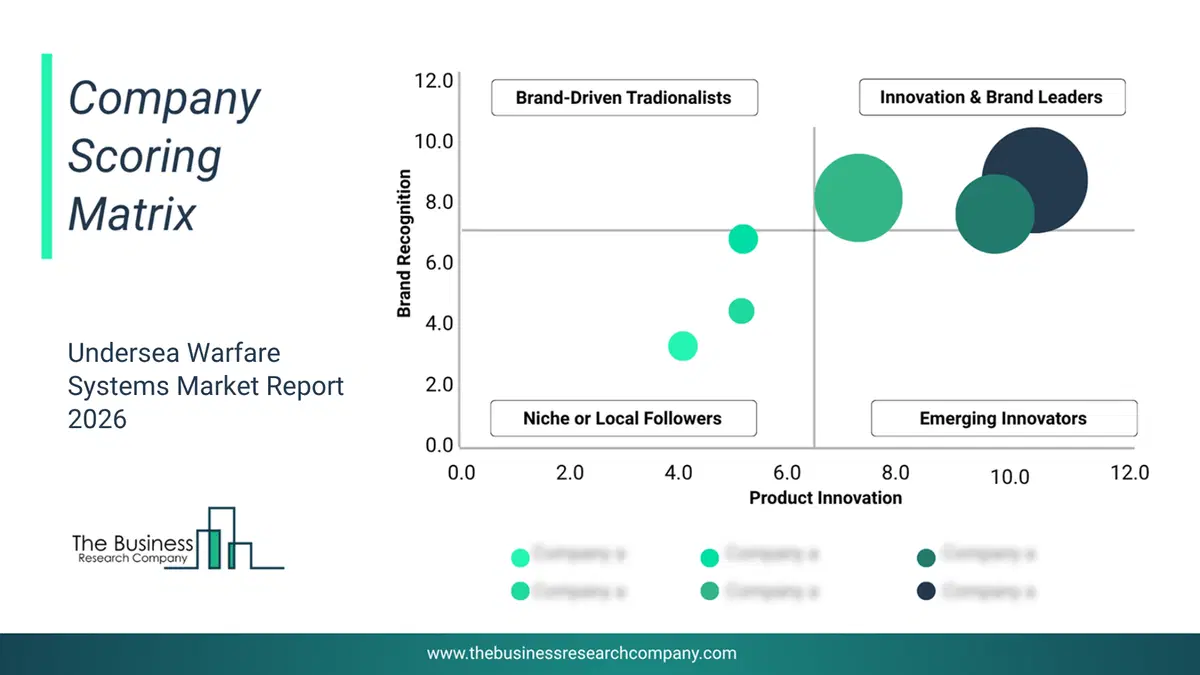
This chart maps companies by product innovation and brand strength, with bubble size indicating relative revenue, helping identify market leaders, challengers, and niche players. This is an illustrative chart; the full report provides a complete and accurate competitive analysis.
Global Undersea Warfare Systems Market Trends and Insights
Major companies operating in the undersea warfare systems market are focusing on developing innovative systems, such as fast-attack submarines to incorporate low observable acoustic coatings and enable networked undersea operations. Fast-attack submarines are vessels built for high-speed, stealth operations to locate and engage enemy ships and submarines while supporting intelligence gathering and special missions to safeguard strategic maritime assets. For instance, in August 2024, the US Navy, a US-based maritime service branch, launched USS IDAHO (SSN 799), a Virginia-class fast attack submarine. The USS Idaho features advanced stealth technologies, sophisticated surveillance systems, and special warfare enhancements, enabling it to meet the Navy's multi-mission requirements. The submarine's design emphasizes reduced acoustic signatures and improved sensor systems, enhancing its effectiveness in various operational scenarios. Additionally, the USS Idaho is equipped with enhanced payload capabilities, allowing for greater flexibility in mission execution.What Are Latest Mergers And Acquisitions In The Undersea Warfare Systems Market? Fincantieri Acquired Whitehead Alenia Sistemi Subacquei (WASS) To Boost Underwater Defense Capabilities
In January 2025, Fincantieri, an Italy-based shipbuilding group, acquired Leonardo’s Underwater Business Whitehead Alenia Sistemi Subacquei (WASS) for an undisclosed amount. The acquisition aims to strengthen Fincantieri's position in naval defense and the underwater domain by integrating advanced expertise in underwater weapons and acoustic technologies, enhancing capabilities for military and critical infrastructure security applications, and driving growth in the underwater systems market. Whitehead Alenia Sistemi Subacquei (WASS) is an Italy-based company that designs and manufactures undersea‑warfare systems.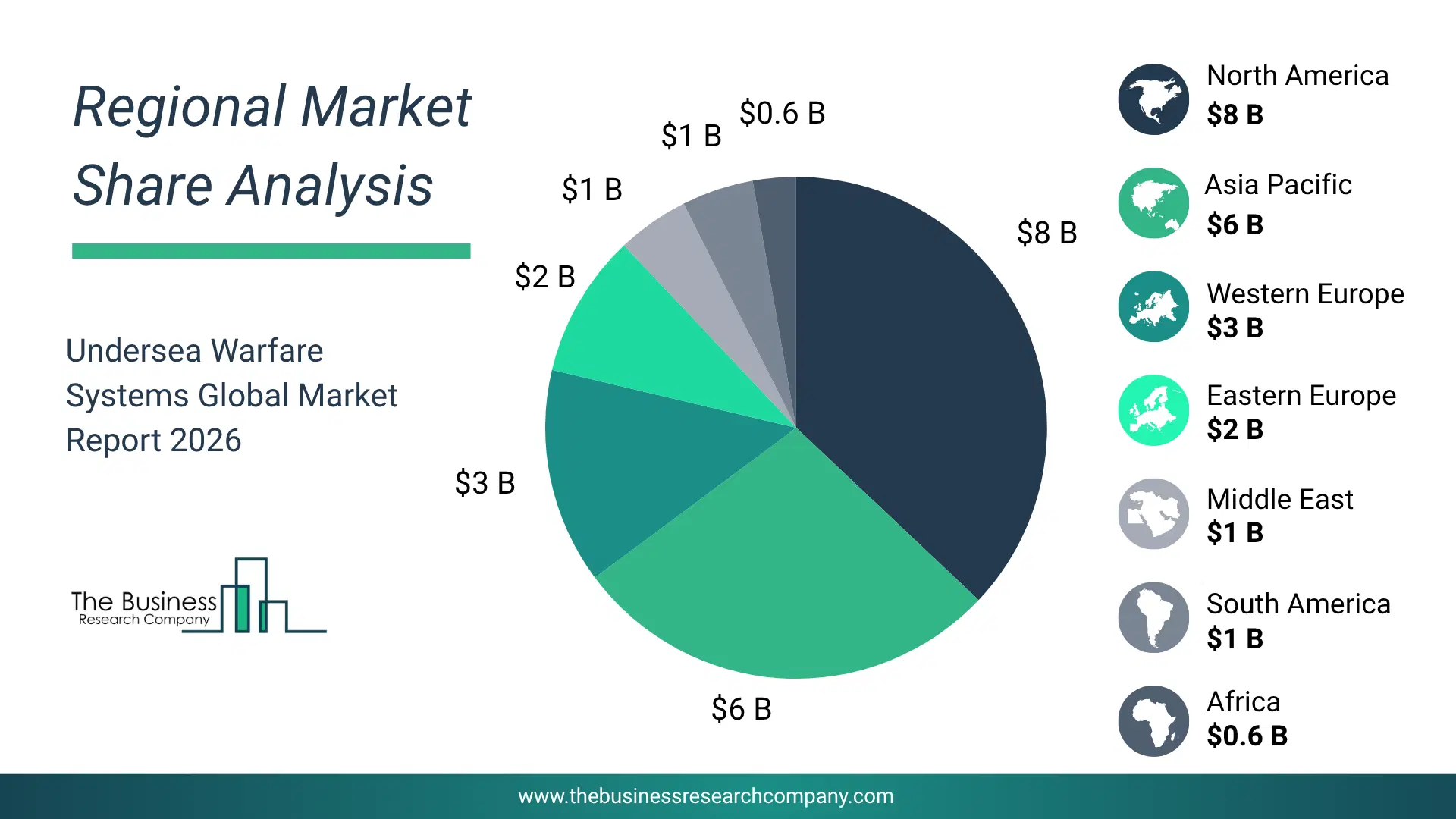
Regional Insights
North America was the largest region in the undersea warfare systems market in 2025. Asia-Pacific is expected to be the fastest-growing region in the forecast period. The regions covered in this market report are Asia-Pacific, South East Asia, Western Europe, Eastern Europe, North America, South America, Middle East, Africa. The countries covered in this market report are Australia, Brazil, China, France, Germany, India, Indonesia, Japan, Taiwan, Russia, South Korea, UK, USA, Canada, Italy, SpainWhat Defines the Undersea Warfare Systems Market?
The undersea warfare systems market consists of sales of submarines, communication systems and mine warfare systems. Values in this market are ‘factory gate’ values, that is the value of goods sold by the manufacturers or creators of the goods, whether to other entities (including downstream manufacturers, wholesalers, distributors, and retailers) or directly to end customers. The value of goods in this market includes related services sold by the creators of the goods.How is Market Value Defined and Measured?
The market value is defined as the revenues that enterprises gain from the sale of goods and/or services within the specified market and geography through sales, grants, or donations in terms of the currency (in USD unless otherwise specified). The revenues for a specified geography are consumption values that are revenues generated by organizations in the specified geography within the market, irrespective of where they are produced. It does not include revenues from resales along the supply chain, either further along the supply chain or as part of other products.
This chart presents market attractiveness based on a quantitative evaluation of growth, competition, strategic alignment, and risk, offering a clear view of opportunity areas for decision-making. This chart is for illustrative purposes; the full report contains the complete analysis.

This chart highlights the Total Addressable Market (TAM) by estimating the maximum revenue opportunity using an assumption-driven approach, supporting strategic planning and opportunity sizing across markets. The chart is illustrative; the full report provides a more comprehensive analysis.
What Key Data and Analysis Are Included in the Undersea Warfare Systems Market Report 2026?
The undersea warfare systems market research report is one of a series of new reports from The Business Research Company that provides market statistics, including industry global market size, regional shares, competitors with the market share, detailed market segments, market trends and opportunities, and any further data you may need to thrive in the undersea warfare systems industry. The market research report delivers a complete perspective of everything you need, with an in-depth analysis of the current and future state of the industry.Undersea Warfare Systems Market Report Forecast Analysis
| Report Attribute | Details |
|---|---|
| Market Size Value In 2026 | $22.6 billion |
| Revenue Forecast In 2030 | $28.51 billion |
| Growth Rate | CAGR of 6.9% from 2026 to 2030 |
| Base Year For Estimation | 2025 |
| Actual Estimates/Historical Data | 2020-2025 |
| Forecast Period | 2026 - 2030 - 2035 |
| Market Representation | Revenue in USD Billion and CAGR from 2026 to 2030 |
| Segments Covered | Type, Mode of Operation, End-User |
| Regional Scope | Asia-Pacific, Western Europe, Eastern Europe, North America, South America, Middle East, Africa |
| Country Scope | The countries covered in the report are Australia, Brazil, China, France, Germany, India, Indonesia, Japan, Taiwan, Russia, South Korea, UK, USA, Canada, Italy, Spain. |
| Key Companies Profiled | BAE Systems plc, General Dynamics Corporation, Kongsberg Gruppen AS, L3Harris Technologies Inc., Leonardo S.p.A., Lockheed Martin Corporation, Northrop Grumman Corporation, RTX Corporation, Saab AB, Thales Group, ATLAS ELEKTRONIK GmbH, S.A. de Electronica Submarina, ECA Group, Ultra Electronics Holdings plc, Abeking & Rasmussen GmbH & Co. KG, Babcock International Group PLC, Bharat Electronics Limited, DRS Technologies Inc., Elbit Systems Ltd., Fincantieri S.p.A., Hydroid Inc., Israel Aerospace Industries Ltd., Kraken Robotics Inc., L3 OceanServer, Navantia S.A., Ocean Aero Inc., QinetiQ Group plc, Rafael Advanced Defense Systems Ltd., Safran Electronics & Defense, Sonardyne International Ltd. |
| Customization Scope | Request for Customization |
| Pricing And Purchase Options | Explore Purchase Options |