

Fashion Retailing Market Report 2026
Global Outlook – By Product (Bag And Accessories, Clothing And Apparel, Footwear), By Price Range (Luxury, Mid Range, Budget), By Application (Department Stores, Variety Stores, Independents, Supermarkets, Discount Stores, Online, Other Applications), By End-User (Children, Men, Women) – Market Size, Trends, Strategies, and Forecast to 2030
Fashion Retailing Market Overview
• Fashion Retailing market size has reached to $99.31 billion in 2025 • Expected to grow to $142.03 billion in 2030 at a compound annual growth rate (CAGR) of 7.4% • Growth Driver: Impact of the Growing Working Population on the Fashion Retailing Market • Market Trend: Leveraging AI for Enhanced Customer Experience and Inventory Management in Fashion Retail • North America was the largest region in 2025.Market Gains By 2030 – Top Opportunities By Segment
Market Gain identifies the most promising market opportunities by highlighting the segments or products expected to generate the highest incremental revenue growth over the next five years.
What Is Covered Under Fashion Retailing Market?
Fashion retailing involves the buying and selling of clothing, footwear, and accessories to consumers through various distribution channels, including physical stores and online platforms. Its primary aim is to meet consumer demand for current fashion trends while providing a convenient and enjoyable shopping experience. This sector focuses on curating and marketing collections that cater to diverse styles and preferences, ultimately driving sales and brand loyalty. The main types of products in the fashion retailing market are bag and accessories, clothing and apparel, and footwear. Bag and accessories refer to items designed to carry personal belongings and complementary items that enhance or serve functional or decorative purposes in coordination with bags. The price range includes luxury, mid-range and budget. These are accessed through department stores, variety stores, independents, supermarkets, discount stores, online, and others. The several end-users include children, men, and women.
What Is The Fashion Retailing Market Size and Share 2026?
The fashion retailing market size has grown strongly in recent years. It will grow from $99.31 billion in 2025 to $106.69 billion in 2026 at a compound annual growth rate (CAGR) of 7.4%. The growth in the historic period can be attributed to rising urbanization, growing middle-class population, increasing disposable income, expansion of retail chains, influence of western fashion trends.What Is The Fashion Retailing Market Growth Forecast?
The fashion retailing market size is expected to see strong growth in the next few years. It will grow to $142.03 billion in 2030 at a compound annual growth rate (CAGR) of 7.4%. The growth in the forecast period can be attributed to growing e-commerce penetration, adoption of AI-driven retail solutions, focus on sustainable fashion, expansion into emerging markets, integration of AR/VR shopping experiences. Major trends in the forecast period include rapid shift to omnichannel retailing, personalization and customization of fashion products, rise of fast fashion and trend-driven collections, adoption of experiential retail concepts, growth of influencer and social media marketing.
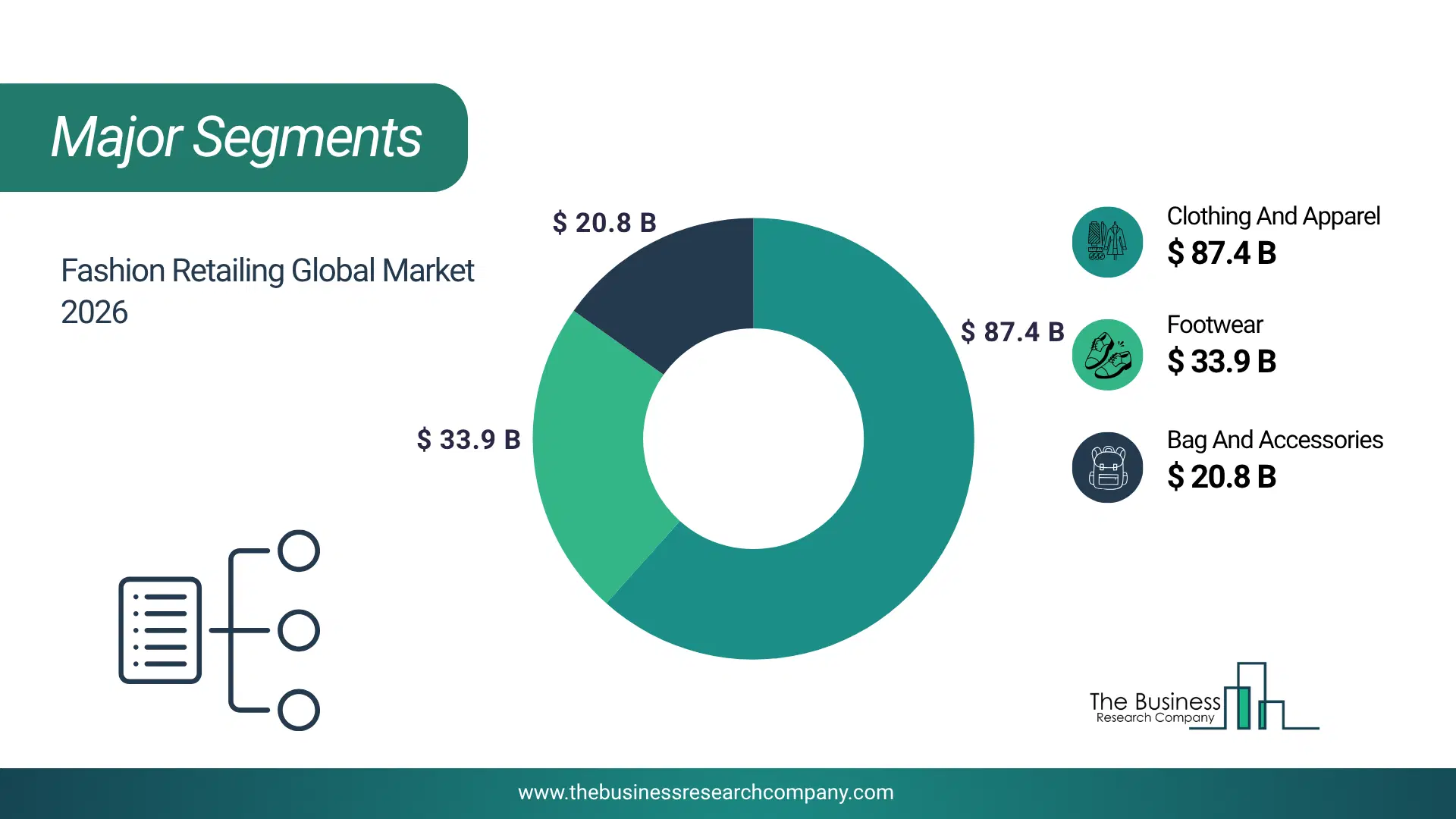
Global Fashion Retailing Market Segmentation
1) By Product: Bag And Accessories, Clothing And Apparel, Footwear 2) By Price Range: Luxury, Mid Range, Budget 3) By Application: Department Stores, Variety Stores, Independents, Supermarkets, Discount Stores, Online, Other Applications 4) By End-User: Children, Men, Women Subsegments: 1) By Bag and Accessories: Handbags, Backpacks, Wallets, Belts, Sunglasses, Jewelry, Watches, Scarves and Gloves, Hats and Caps 2) By Clothing and Apparel: Men’s Apparel, Women’s Apparel, Children’s Apparel, Casual Wear, Formal Wear, Sportswear, Outerwear, Lingerie and Sleepwear, Activewear 3) By Footwear: Men’s Footwear, Women’s Footwear, Children’s Footwear, Casual Footwear, Formal Footwear, Sports Footwear, Boots, Sandals and Flip-Flops The top segments in the fashion retailing market will be: • Clothing And Apparel will reach $87.4 billion by 2030. • Footwear will reach $33.88 billion by 2030. • Bag And Accessories will reach $20.75 billion by 2030.What Is The Driver Of The Fashion Retailing Market?
The rapid growth in the working population is expected to propel the growth of the fashion retailing market going forward. The rapid growth in the working population is attributed to demographic shifts, urbanization, economic development, increased education, a rising female workforce, and immigration. Fashion retailing helps the working population by providing convenient access to professional and stylish attire that enhances their confidence and suits workplace environments. For instance, in June 2024, the Office for National Statistics, a UK-based government agency, estimated that in March 2024, the total number of Workforce Jobs (WFJ) in the UK increased by 431,000 compared to the previous year, reaching 37.2 million. Therefore, the growing working population is driving the fashion retailing industry.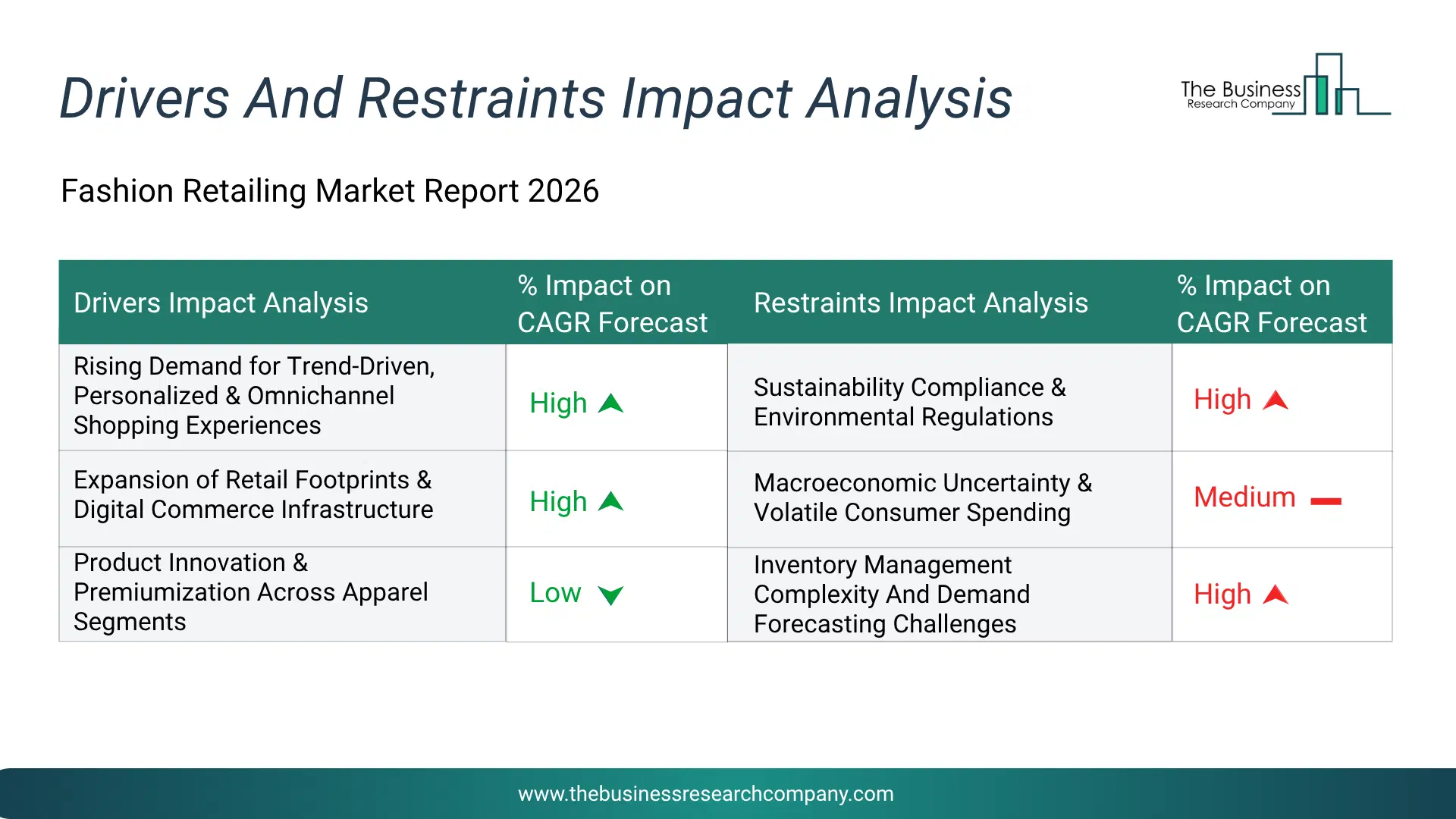
Infographic Chart Showing Key Market Drivers Analysis And Restraints For Fashion Retailing Market
The chart presents an impact analysis of key drivers and restraints, quantifying their relative influence on the market's growth rate and helping assess the balance between growth enablers and limiting factors. This chart offers a high-level perspective; the full report contains more detailed insights.
How Will The Drivers Impact Growth In The Global Fashion Retailing Market?
• Rising Demand for Trend-Driven, Personalized & Omnichannel Shopping Experiences (High) – During the forecast period, the rising demand for trend-driven, personalized, and omnichannel shopping experiences is expected to become a key growth driver for the fashion retailing market by 2030. Heightened consumer engagement with social media trends, influencer campaigns, and rapid fashion cycles is accelerating product turnover and purchasing frequency. As customers increasingly expect seamless interaction across stores, mobile platforms, and online channels, retailers are enhancing click-and-collect capabilities, ai-powered recommendations, and frictionless digital payment systems. Virtual try-on solutions and analytics-driven assortment planning are improving engagement and conversion performance. Together, these dynamics are sustaining strong demand across global apparel markets. • Expansion of Retail Footprints & Digital Commerce Infrastructure (High) – During the forecast period, the expansion of retail footprints and digital commerce infrastructure is expected to become a significant growth driver for the fashion retailing market by 2030. Brands are broadening their presence through flagship store development, deeper penetration into secondary cities, and strategic international expansion. Concurrently, investments in warehouse automation, advanced fulfilment systems, and cross -border e -commerce platforms are enhancing operational efficiency and global accessibility. Direct -to -consumer strategies are improving margin management and strengthening customer ownership. • Product Innovation & Premiumization Across Apparel Segments (Low) – During the forecast period, product innovation and premiumization across apparel segments are expected to become important growth drivers for the fashion retailing market by 2030. Rising interest in sustainable materials, performance -oriented apparel, and limited -edition collaborations is supporting higher average selling prices and clearer brand differentiation. Retailers are launching environmentally responsible collections and curated product lines to align with shifting lifestyle and value preferences. Strategic designer partnerships and exclusive releases are attracting aspirational buyers across developed and emerging economies.How Will The Restraints Impact Growth In The Global Fashion Retailing Market?
• Sustainability Compliance & Environmental Regulations (High) – During the forecast period, the increasing regulatory pressure related to carbon emissions, waste reduction, sustainable sourcing, and circular fashion models is raising operational and compliance costs for retailers. Transitioning toward eco-friendly materials and transparent supply chains requires significant capital investment and supplier restructuring. Smaller players particularly face margin pressures in adapting to esg mandates. These regulatory and cost challenges are estimated to reduce market growth potential by −1.50%. • Macroeconomic Uncertainty & Volatile Consumer Spending (Medium) – During the forecast period, the inflationary pressures, fluctuating raw material costs, currency volatility, and global economic slowdowns directly influence discretionary spending on apparel. Fashion retail is highly sensitive to shifts in consumer confidence, especially in mid-range and premium segments. Supply chain disruptions and geopolitical tensions can further affect sourcing and pricing strategies. These macroeconomic uncertainties are projected to negatively impact the market by −1.25% during the forecast period. • Inventory Management Complexity And Demand Forecasting Challenges (High) – During the forecast period, the inventory management complexity and demand forecasting challenges act as a restraint for the fashion retailing market by making it difficult for retailers to accurately align stock levels with rapidly changing consumer trends. Fashion demand is highly seasonal and influenced by fast-moving styles, leading to frequent overstocking or stockouts. Inefficient inventory control increases markdowns, wastage, and holding costs, directly impacting profitability. Additionally, inaccurate forecasting disrupts supply chain planning and reduces operational efficiency. These challenges collectively limit revenue optimization and constrain overall market growth.Key Players In The Global Fashion Retailing Market
Major companies operating in the fashion retailing market are Christian Dior SE, LVMH Moët Hennessy Louis Vuitton S.E., Nike Inc., Industria de Diseño Textil S.A., Adidas AG, H & M Hennes & Mauritz AB, Kering S.A., Uniqlo Co. Ltd., Chanel Inc., Gap Inc., John Lewis Partnership plc, Hermès International S.A., PVH Corp., The Swatch Group Ltd., Hanesbrands Inc., Ralph Lauren Corporation, Levi Strauss & Co., Prada S.p.A., ASOS plc, Burberry Group plc, Gildan Activewear Inc., Boohoo Group Plc, VF Corporation, Jockey International Inc., Golden Lady Company S.p.A.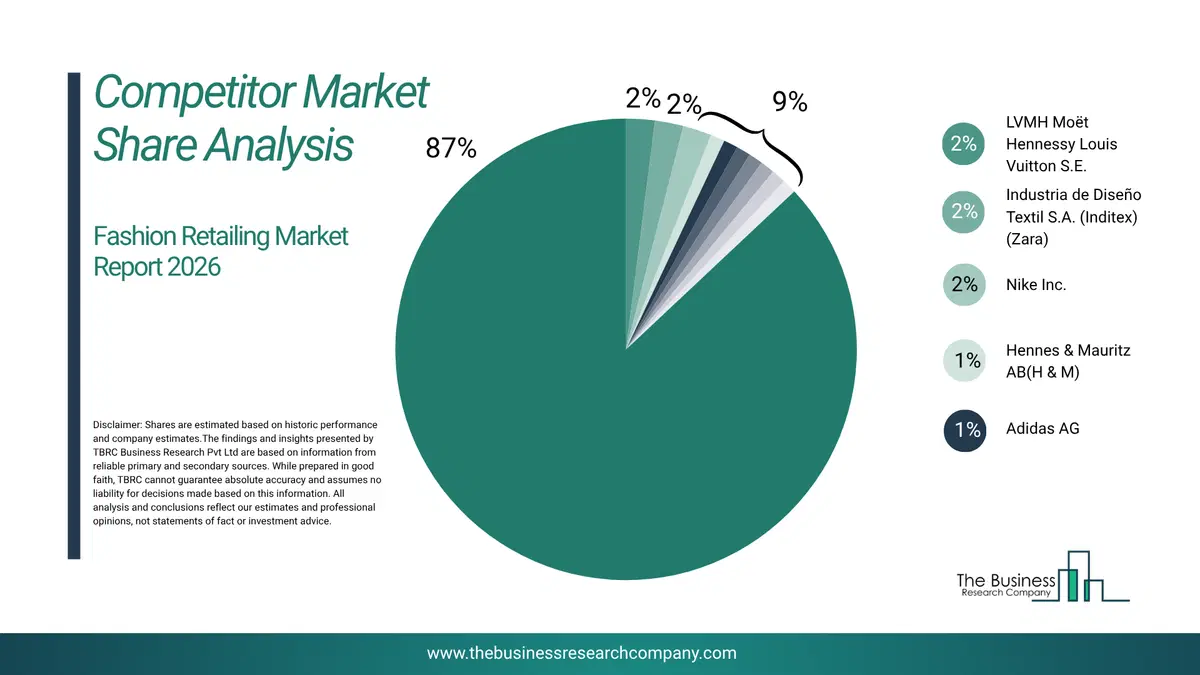
This chart is for illustrative purposes; the full report includes a detailed competitor analysis and comprehensive overview of the top 10 companies in the market.
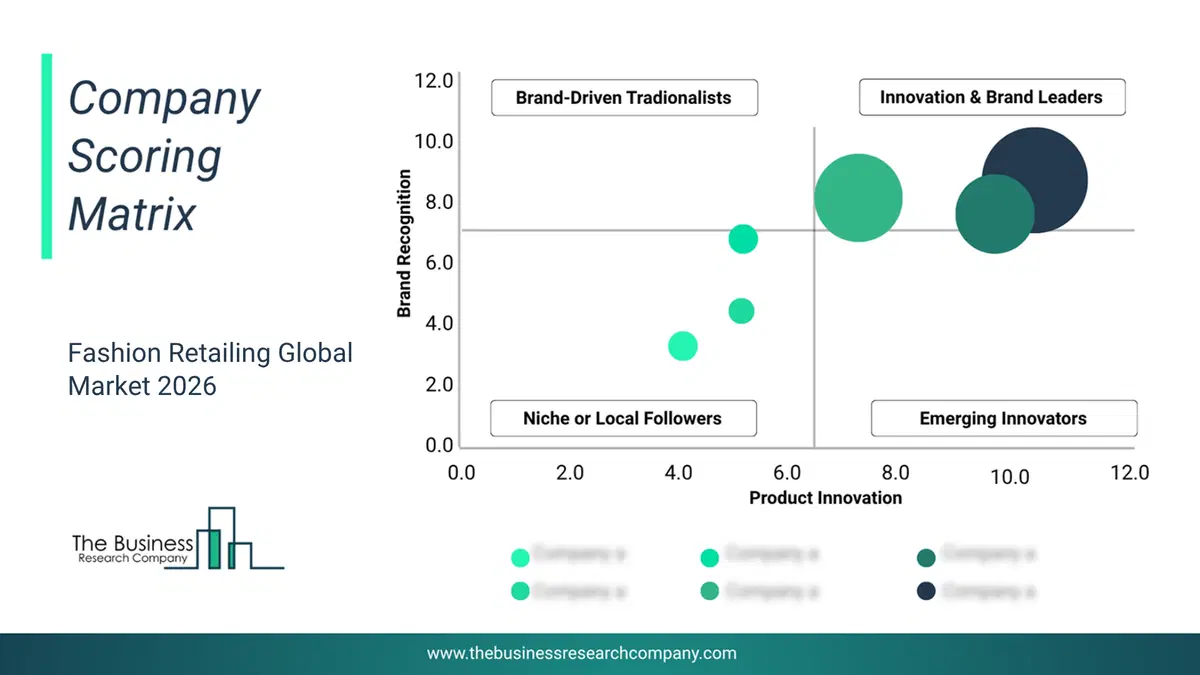
This chart maps companies by product innovation and brand strength, with bubble size indicating relative revenue, helping identify market leaders, challengers, and niche players. This is an illustrative chart; the full report provides a complete and accurate competitive analysis.
Global Fashion Retailing Market Trends and Insights
Major companies operating in the fashion retailing market are focusing on artificial intelligence (AI) to gain a competitive advantage. AI in fashion retail leverages algorithms to create personalized shopping experiences, improve inventory management, and enhance customer service. For instance, in May 2023, Zyler, a UK-based virtual fashion try-on firm, launched an AI-powered tool to set up personalized shopping experiences. The tool uses advanced AI to analyze customer preferences and body measurements, offering features such as customized outfit recommendations and virtual try-ons, which provide a realistic and engaging shopping experience. This innovation improves customer satisfaction by offering tailored fashion suggestions and helps retailers optimize their stock by understanding popular trends and sizes, thereby reducing overstock and stockouts.What Are Latest Mergers And Acquisitions In The Fashion Retailing Market?
In September 2023, Aditya Birla Fashion and Retail Ltd., an India-based company offering a diverse portfolio of brands across menswear, womenswear, and accessories, acquired a 51% stake in TCNS Clothing for $201.9 million. This strategic move aims to bolster Aditya Birla Fashion's comprehensive portfolio across diverse consumer segments and price points while strengthening its commitment to promoting ethnic wear in the Indian market. TCNS Clothing is an India-based company that produces women's apparel brands.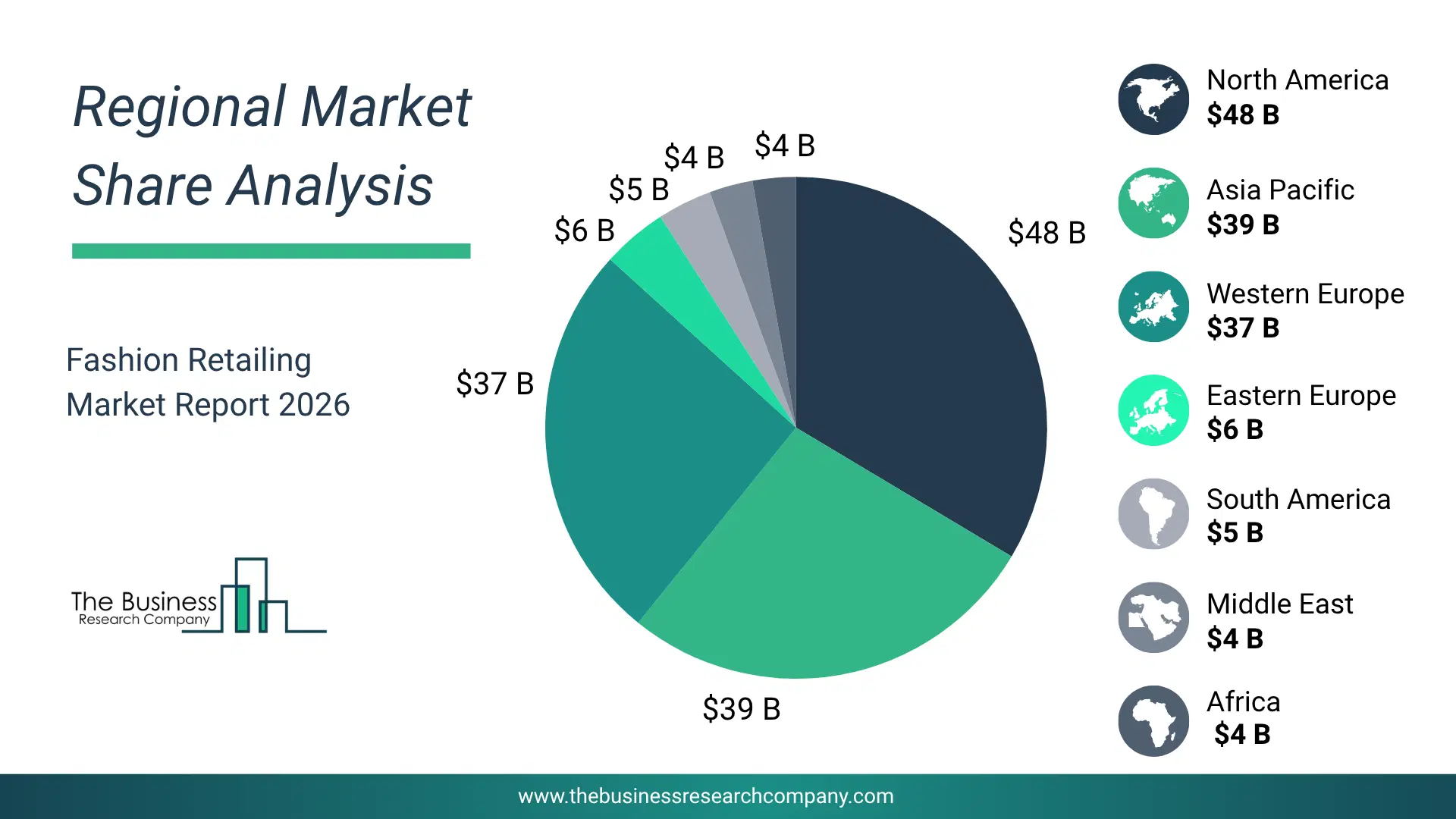
Regional Outlook
North America was the largest region in the fashion retailing market in 2025. The regions covered in this market report are Asia-Pacific, South East Asia, Western Europe, Eastern Europe, North America, South America, Middle East and Africa. The countries covered in this market report are Australia; Brazil; China; France; Germany; India; Indonesia; Japan; Taiwan; Russia; South Korea; UK; USA; Canada; Italy; Spain.What Defines the Fashion Retailing Market?
The fashion retailing market includes revenues earned by entities by providing services such as merchandising, inventory management, marketing and promotion, and customer service. The market value includes the value of related goods sold by the service provider or included within the service offering. Only goods and services traded between entities or sold to end consumers are included.How is Market Value Defined and Measured?
The market value is defined as the revenues that enterprises gain from the sale of goods and/or services within the specified market and geography through sales, grants, or donations in terms of the currency (in USD unless otherwise specified). The revenues for a specified geography are consumption values that are revenues generated by organizations in the specified geography within the market, irrespective of where they are produced. It does not include revenues from resales along the supply chain, either further along the supply chain or as part of other products.
This chart presents market attractiveness based on a quantitative evaluation of growth, competition, strategic alignment, and risk, offering a clear view of opportunity areas for decision-making. This chart is for illustrative purposes; the full report contains the complete analysis.

This chart highlights the Total Addressable Market (TAM) by estimating the maximum revenue opportunity using an assumption-driven approach, supporting strategic planning and opportunity sizing across markets. The chart is illustrative; the full report provides a more comprehensive analysis.
What Key Data and Analysis Are Included in the Fashion Retailing Market Report 2026?
The fashion retailing market research report is one of a series of new reports from The Business Research Company that provides market statistics, including industry global market size, regional shares, competitors with the market share, detailed market segments, market trends and opportunities, and any further data you may need to thrive in the fashion retailing industry. The market research report delivers a complete perspective of everything you need, with an in-depth analysis of the current and future state of the industry.Fashion Retailing Market Report Forecast Analysis
| Report Attribute | Details |
|---|---|
| Market Size Value In 2026 | $92.94 billion |
| Revenue Forecast In 2030 | $133.84 billion |
| Growth Rate | CAGR of 10.0% from 2026 to 2030 |
| Base Year For Estimation | 2025 |
| Actual Estimates/Historical Data | 2020-2025 |
| Forecast Period | 2026 - 2030 |
| Market Representation | Revenue in USD Billion and CAGR from 2026 to 2030 |
| Segments Covered | Product, Price Range, Application, End-User |
| Regional Scope | Asia-Pacific, Western Europe, Eastern Europe, North America, South America, Middle East, Africa |
| Country Scope | The countries covered in the report are Australia, Brazil, China, France, Germany, India, Indonesia, Japan, Taiwan, Russia, South Korea, UK, USA, Canada, Italy, Spain. |
| Key Companies Profiled | Christian Dior SE, LVMH Moët Hennessy Louis Vuitton S.E., Nike Inc., Industria de Diseño Textil S.A., Adidas AG, H & M Hennes & Mauritz AB, Kering S.A., Uniqlo Co. Ltd., Chanel Inc., Gap Inc., John Lewis Partnership plc, Hermès International S.A., PVH Corp., The Swatch Group Ltd., Hanesbrands Inc., Ralph Lauren Corporation, Levi Strauss & Co., Prada S.p.A., ASOS plc, Burberry Group plc, Gildan Activewear Inc., Boohoo Group Plc, VF Corporation, Jockey International Inc., Golden Lady Company S.p.A. |
| Customization Scope | Request for Customization |
| Pricing And Purchase Options | Explore Purchase Options |