
Lunar Exploration Technology Market Report 2026
Global Outlook – By Technology Type (Propulsion Systems, Landing Systems, Navigation And Guidance, Communication Systems, Power Systems, Robotics And Automation, Scientific Instruments, Other Technology Types), By Application (Manned Missions, Unmanned Missions, Lunar Rovers, Lunar Landers, Lunar Orbiters, Other Applications), By End-User (Government Space Agencies, Commercial Space Companies, Research Institutes, Other End-Users) – Market Size, Trends, Strategies, and Forecast to 2035
Lunar Exploration Technology Market Overview
• Lunar Exploration Technology market size has reached to $11.42 billion in 2025 • Expected to grow to $21.42 billion in 2030 at a compound annual growth rate (CAGR) of 13.3% • Growth Driver: Surge In Space Exploration Fueling The Growth Of The Market Due To Increasing Investment In Scientific Research • Market Trend: Advancements In Next-Generation Lunar Landers And Rovers • North America was the largest region in 2025 and Asia-Pacific is the fastest growing region.
What Is Covered Under Lunar Exploration Technology Market?
Lunar exploration technology refers to the tools, systems, and methods developed to study, navigate, and operate on the Moon, including spacecraft, landers, rovers, communication systems, and scientific instruments. Its purpose is to advance scientific understanding, support resource utilization, and enable future human and robotic missions for sustained lunar presence and space exploration. The main types of lunar exploration technology are propulsion systems, landing systems, navigation and guidance, communication systems, power systems, robotics and automation, scientific instruments, and others. Propulsion systems refer to the mechanisms and technologies used to generate thrust, enabling a spacecraft or vehicle to move and maneuver in space. These systems are used for various applications, including manned missions, unmanned missions, lunar rovers, lunar landers, lunar orbiters, and others, with the key end-users include government space agencies, commercial space companies, research institutes, and others.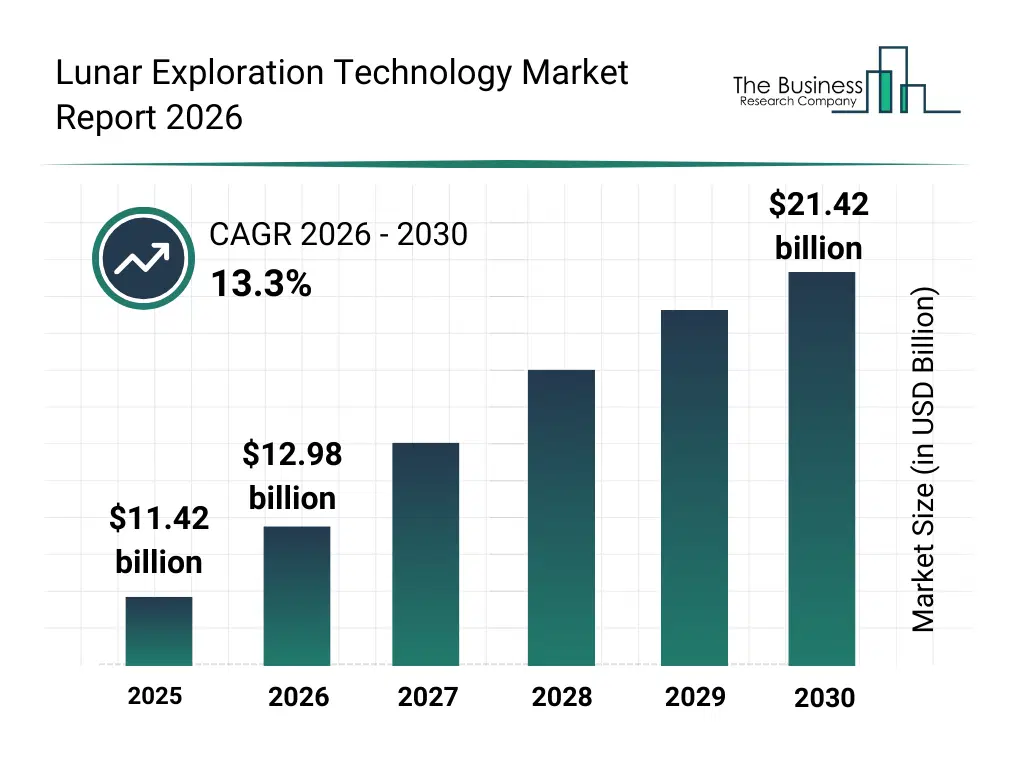
What Is The Lunar Exploration Technology Market Size and Share 2026?
The lunar exploration technology market size has grown rapidly in recent years. It will grow from $11.42 billion in 2025 to $12.98 billion in 2026 at a compound annual growth rate (CAGR) of 13.7%. The growth in the historic period can be attributed to successful robotic lunar missions, advances in lunar rover mobility, development of lunar communication relays, implementation of in-situ resource utilization experiments, government space agency investments.What Is The Lunar Exploration Technology Market Growth Forecast?
The lunar exploration technology market size is expected to see rapid growth in the next few years. It will grow to $21.42 billion in 2030 at a compound annual growth rate (CAGR) of 13.3%. The growth in the forecast period can be attributed to growth in commercial lunar exploration missions, demand for autonomous surface operations, development of advanced lunar drilling and excavation systems, adoption of radiation-resistant materials, integration of AI-driven lunar data analytics. Major trends in the forecast period include in-situ resource utilization (isru) adoption, modular lunar lander and rover designs, advanced lunar surface mobility solutions, lunar environment monitoring and hazard detection, high-precision lunar landing and navigation systems.Global Lunar Exploration Technology Market Segmentation
1) By Technology Type: Propulsion Systems, Landing Systems, Navigation And Guidance, Communication Systems, Power Systems, Robotics And Automation, Scientific Instruments, Other Technology Types 2) By Application: Manned Missions, Unmanned Missions, Lunar Rovers, Lunar Landers, Lunar Orbiters, Other Applications 3) By End-User: Government Space Agencies, Commercial Space Companies, Research Institutes, Other End-Users Subsegments: 1) By Propulsion Systems Type: Chemical Propulsion, Electric Propulsion, Hybrid Propulsion, Nuclear Propulsion 2) By Landing Systems Type: Powered Descent Systems, Precision Landing Systems, Hazard Detection And Avoidance Systems, Soft Landing Systems 3) By Navigation And Guidance Type: Inertial Navigation Systems, Celestial Navigation Systems, Terrain Relative Navigation, Autonomous Guidance Systems 4) By Communication Systems Type: Deep Space Communication Systems, Optical Communication Systems, Radio Frequency Communication Systems, Relay Satellite Systems 5) By Power Systems Type: Solar Power Systems, Nuclear Power Systems, Fuel Cell Systems, Battery Storage Systems 6) By Robotics And Automation Type: Lunar Rovers, Robotic Arms, Autonomous Navigation Robots, In Situ Resource Utilization Robots 7) By Scientific Instruments Type: Spectrometers, Seismometers, Imaging Systems, Drilling And Sampling Instruments 8) By Other Technology Types: Thermal Control Systems, Radiation Protection Systems, Habitat Support Systems, Additive Manufacturing SystemsWhat Is Driver Of The Lunar Exploration Technology Market?
The increasing interest in space exploration is expected to propel the growth of the lunar exploration technology market going forward. Space exploration is the study and discovery of outer space using rockets, satellites, and spacecraft. The rise in space exploration is driven by increasing investment in scientific research, as it allows countries and companies to discover new knowledge and develop advanced technologies. Lunar exploration technology helps space exploration by enabling detailed study of the Moon’s surface, supporting future missions, and advancing our understanding of the solar system. For instance, in July 2023, according to Pixalytics Ltd., a UK-based earth observation company, there were 11330 individual satellites orbiting the Earth at the end of June 2023, a whopping 37.94% increase since January 2022. Therefore, the increasing interest in space exploration imagery is driving the growth of the lunar exploration technology industry.Key Players In The Global Lunar Exploration Technology Market
Major companies operating in the lunar exploration technology market are Boeing Company, Lockheed Martin Corporation, Northrop Grumman Corporation, National Aeronautics and Space Administration (NASA), Space Exploration Technologies Corp. (SpaceX), Blue Origin LLC, Sierra Nevada Corporation, MDA Space Ltd., Teledyne Brown Engineering Inc., ispace Inc., Astrolab SAS, Intuitive Machines Inc., Firefly Aerospace Inc., The Exploration Company GmbH, GITAI Japan Inc., Special Aerospace Services Ltd., Astrobotic Technology Inc., Indian Space Research Organisation (ISRO), Lunar Outpost Inc., CisLunar Industries Inc.Global Lunar Exploration Technology Market Trends and Insights
Major companies operating in the lunar exploration technology market are focusing on developing technological advancements such as next-generation lunar lander and rover systems to achieve safe landing, mobility, and in-situ experiments on the Moon. Next-generation lunar lander and rover systems are advanced exploration technologies designed to perform precise landings, navigate rough lunar terrain, and carry scientific payloads for long-duration missions. For instance, in July 2023, the Indian Space Research Organisation (ISRO), an India-based government space agency, launched Chandrayaan-3. This demonstrated a successful soft landing near the lunar south pole, deployed a rover for surface exploration, enhanced India’s capability in planetary missions, and contributed vital scientific data for future lunar research. Additionally, the mission's data helps deepen understanding of the moon's geology and resources, opening avenues for further scientific discovery and potential utilization.What Are Latest Mergers And Acquisitions In The Lunar Exploration Technology Market? Voyager Space Acquires ZIN Technologies, Inc.
In March 2023, Voyager Space, a US-based provider of space station infrastructure, services, and technology solutions, acquired ZIN Technologies, Inc. for an undisclosed amount. With this acquisition, Voyager Space aimed to expand its space infrastructure and technology capabilities to further its development of Starlab, a continuously crewed commercial space station. ZIN Technologies, Inc. is a US-based advanced aerospace engineering company providing engineering, design, and integration services, including human-rated spaceflight systems, propulsion, and microgravity research equipment, with decades-long experience serving NASA, national security agencies, and leading aerospace and defense companies.Regional Insights
North America was the largest region in the lunar exploration technology market in 2025. Asia-Pacific is expected to be the fastest-growing region in the forecast period. The regions covered in this market report are Asia-Pacific, South East Asia, Western Europe, Eastern Europe, North America, South America, Middle East, Africa. The countries covered in this market report are Australia, Brazil, China, France, Germany, India, Indonesia, Japan, Taiwan, Russia, South Korea, UK, USA, Canada, Italy, SpainWhat Defines the Lunar Exploration Technology Market?
The lunar exploration technology market consists of revenues earned by entities by providing services such as lunar landing site selection, surface mobility solutions, lunar data analytics, in-situ resource utilization (ISRU) operations, and lunar environment monitoring. The market value includes the value of related goods sold by the service provider or included within the service offering. The lunar exploration technology market includes sales of robotic arms for lunar operations, thermal control systems, radiation shielding materials, and lunar drilling and excavation equipment. Values in this market are ‘factory gate’ values, that is, the value of goods sold by the manufacturers or creators of the goods, whether to other entities (including downstream manufacturers, wholesalers, distributors, and retailers) or directly to end customers. The value of goods in this market includes related services sold by the creators of the goods.How is Market Value Defined and Measured?
The market value is defined as the revenues that enterprises gain from the sale of goods and/or services within the specified market and geography through sales, grants, or donations in terms of the currency (in USD unless otherwise specified). The revenues for a specified geography are consumption values that are revenues generated by organizations in the specified geography within the market, irrespective of where they are produced. It does not include revenues from resales along the supply chain, either further along the supply chain or as part of other products.What Key Data and Analysis Are Included in the Lunar Exploration Technology Market Report 2026?
The lunar exploration technology market research report is one of a series of new reports from The Business Research Company that provides market statistics, including industry global market size, regional shares, competitors with the market share, detailed market segments, market trends and opportunities, and any further data you may need to thrive in the lunar exploration technology industry. The market research report delivers a complete perspective of everything you need, with an in-depth analysis of the current and future state of the industry.Lunar Exploration Technology Market Report Forecast Analysis
| Report Attribute | Details |
|---|---|
| Market Size Value In 2026 | $12.98 billion |
| Revenue Forecast In 2035 | $21.42 billion |
| Growth Rate | CAGR of 13.7% from 2026 to 2035 |
| Base Year For Estimation | 2025 |
| Actual Estimates/Historical Data | 2020-2025 |
| Forecast Period | 2026 - 2030 - 2035 |
| Market Representation | Revenue in USD Billion and CAGR from 2026 to 2035 |
| Segments Covered | Technology Type, Application, End-User |
| Regional Scope | Asia-Pacific, Western Europe, Eastern Europe, North America, South America, Middle East, Africa |
| Country Scope | The countries covered in the report are Australia, Brazil, China, France, Germany, India, ... |
| Key Companies Profiled | Boeing Company, Lockheed Martin Corporation, Northrop Grumman Corporation, National Aeronautics and Space Administration (NASA), Space Exploration Technologies Corp. (SpaceX), Blue Origin LLC, Sierra Nevada Corporation, MDA Space Ltd., Teledyne Brown Engineering Inc., ispace Inc., Astrolab SAS, Intuitive Machines Inc., Firefly Aerospace Inc., The Exploration Company GmbH, GITAI Japan Inc., Special Aerospace Services Ltd., Astrobotic Technology Inc., Indian Space Research Organisation (ISRO), Lunar Outpost Inc., CisLunar Industries Inc. |
| Customization Scope | Request for Customization |
| Pricing And Purchase Options | Explore Purchase Options |