

Propulsion Systems Market Report 2026
Global Outlook – By Type (Air Breathing, Non-Air Breathing), By Application (Airplanes, Missiles, Unnamed Aerial Vehicles, Spacecraft), By End-User (Commercial, Government & Military) – Market Size, Trends, Strategies, and Forecast to 2030
Propulsion Systems Market Overview
• Propulsion Systems market size has reached to $143.84 billion in 2025 • Expected to grow to $206.51 billion in 2030 at a compound annual growth rate (CAGR) of 7.4% • Growth Driver: Escalating Defense Expenditure Fuels Growth In The Propulsion Systems Market • Market Trend: Pioneering The Future With Hydrogen Propulsion Systems • North America was the largest region in 2025 and Asia-Pacific is the fastest growing region.Market Gains By 2030 – Top Opportunities By Segment
Market Gain identifies the most promising market opportunities by highlighting the segments or products expected to generate the highest incremental revenue growth over the next five years.
What Is Covered Under Propulsion Systems Market?
A propulsion system is a machine that provides a propelling or driving force to push a forward motion in the object using Newton’s third law of action and reaction. The propulsion systems are used to generate thrust to accelerate spacecraft and artificial satellites. The main types of propulsion systems are air-breathing and non-air breathing. Air-breathing uses oxygen from the atmosphere in the combustion of fuel. The propulsion system is widely used in missiles, aircraft, spacecraft, and unnamed aerial vehicles, and they are utilized by end-users ranging from commercial, government, and military.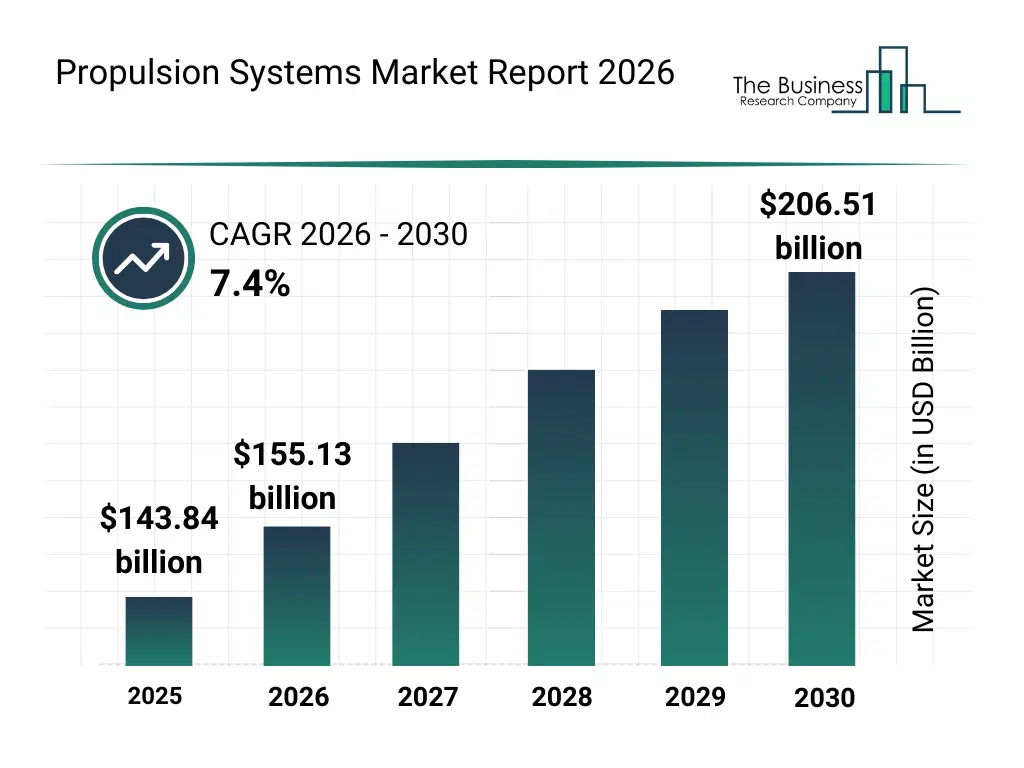
What Is The Propulsion Systems Market Size and Share 2026?
The propulsion systems market size has grown strongly in recent years. It will grow from $143.84 billion in 2025 to $155.13 billion in 2026 at a compound annual growth rate (CAGR) of 7.8%. The growth in the historic period can be attributed to expansion of space exploration programs, growth in satellite deployment activities, increased defense spending on missile systems, advancements in propulsion material science, rising investments in aerospace research.What Is The Propulsion Systems Market Growth Forecast?
The propulsion systems market size is expected to see strong growth in the next few years. It will grow to $206.51 billion in 2030 at a compound annual growth rate (CAGR) of 7.4%. The growth in the forecast period can be attributed to increasing commercialization of space missions, rising demand for small satellite launch systems, expansion of deep space exploration initiatives, growing focus on sustainable propulsion fuels, increasing adoption of electric propulsion for spacecraft. Major trends in the forecast period include increasing development of advanced rocket and spacecraft engines, rising adoption of electric and hybrid propulsion technologies, growing focus on high-thrust and fuel-efficient systems, expansion of reusable launch vehicle propulsion, enhanced integration of digital simulation and testing.
Global Propulsion Systems Market Segmentation
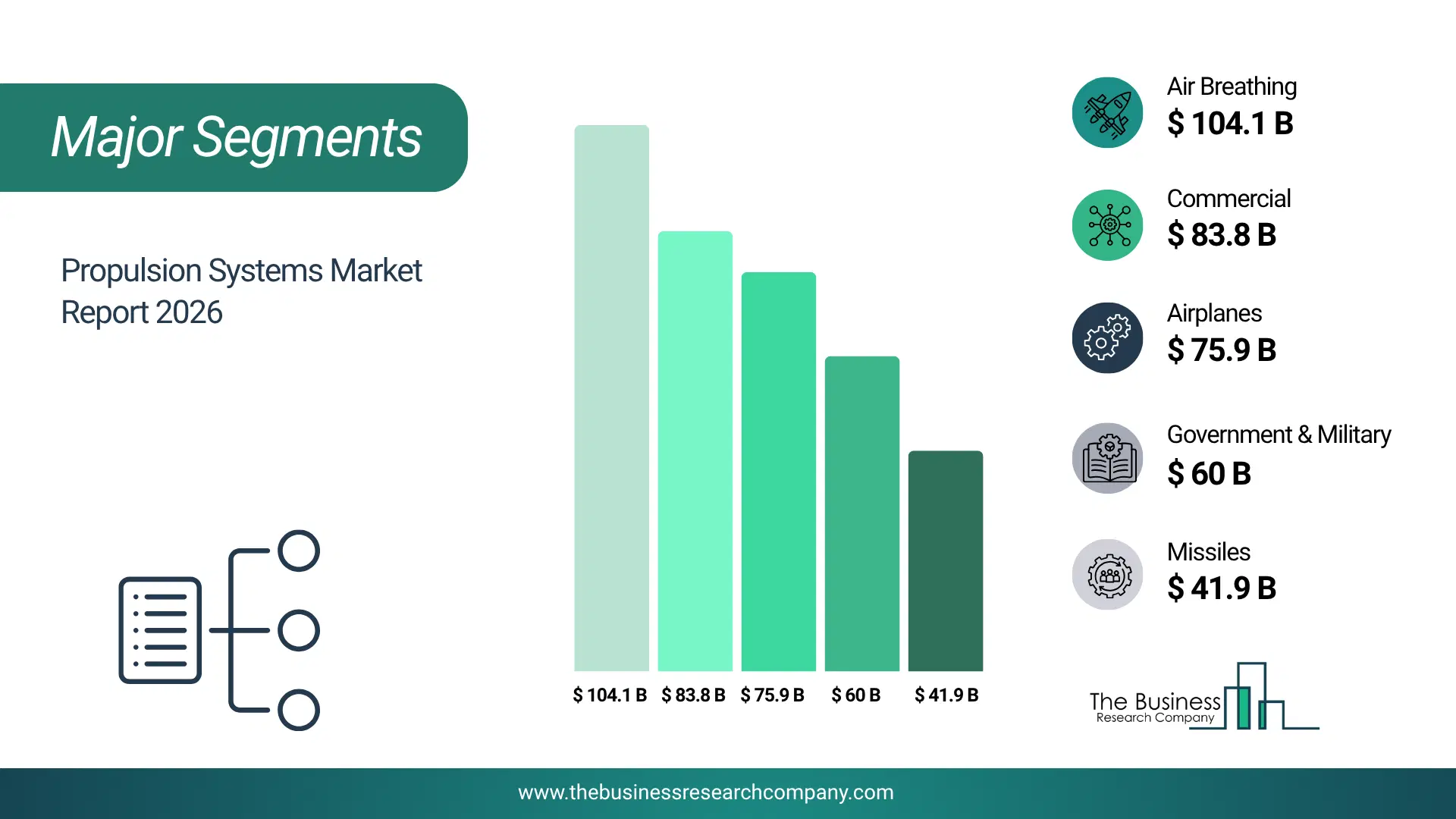
1) By Type: Air Breathing, Non-Air Breathing 2) By Application: Airplanes, Missiles, Unnamed Aerial Vehicles, Spacecraft 3) By End-User: Commercial, Government & Military Subsegments: 1) By Air Breathing: Turbojet, Turbofan, Ramjet, Scramjet 2) By Non-Air Breathing: Liquid Propellant, Solid Propellant, Hybrid Propellant, Electric Propulsion The top segments in the propulsion systems market will be: • Air Breathing will reach $104126.95 Million by 2025. • Commercial will reach $83828.77 Million by 2025. • Airplanes will reach $75935.11 Million by 2025. • Government & Military will reach $60010.48 Million by 2025. • Missiles will reach $41986.85 Million by 2025.What Is The Driver Of The Propulsion Systems Market?
Rising defense expenditure is expected to propel the growth of the propulsion systems market going forward. Defense expenditure refers to the amount that a country spends on military measures or resources. Increasing defense expenditure is expected to boost demand for propulsion systems, as they play an integral role in various products such as rockets, unmanned aerial vehicles, satellite rockets, aircraft, and others. For instance, in April 2024, according to the Stockholm International Peace Research Institute (SIPRI), a Sweden based defense think tank, global military expenditure rose to US$ 2,443 billion in 2023, a 6.8% increase compared with 2022. Therefore, rising defense expenditure is expected to boost demand for the propulsion systems industry during the forecast period.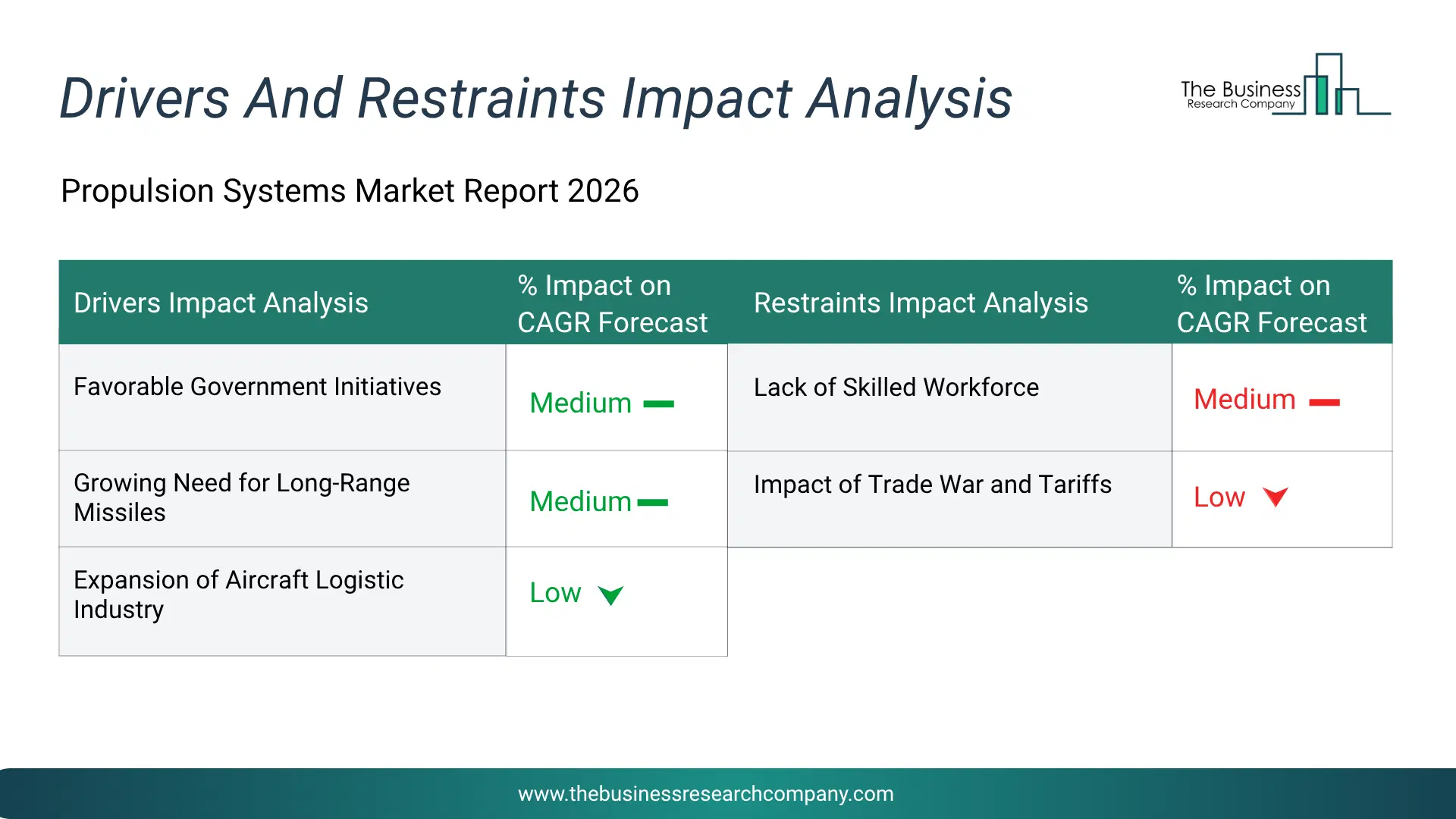
Infographic Chart Showing Key Market Drivers Analysis And Restraints For Propulsion Systems Market
The chart presents an impact analysis of key drivers and restraints, quantifying their relative influence on the market's growth rate and helping assess the balance between growth enablers and limiting factors. This chart offers a high-level perspective; the full report contains more detailed insights.
How Will The Drivers Impact Growth In The Global Propulsion Systems Market?
• Favorable Government Initiatives (Medium) – The favorable government initiatives will become a key driver of growth in the propulsion systems market by 2030. Governments globally are offering a range of financial incentives, including subsidies, tax benefits, and grants, to lower development costs and accelerate the commercialization of electric, hybrid and hydrogen propulsion technologies. These measures enhance affordability and stimulate industry-wide innovation. National policies in countries like the U.S., Germany, China, and India mandate electrification targets, driving investment in electric and hybrid systems. Increased public funding in defense and space sectors supports the development of advanced propulsion solutions, while infrastructure investments, such as EV charging and hydrogen fueling networks, enhance adoption. As a result, favorable government initiatives are anticipated to contributing to a 1.7% annual growth in the market. • Growing Need for Long-Range Missiles (Medium) – The growing need for long-range missiles will become a key driver of growth in propulsion systems market by 2030. The development of hypersonic and maneuverable missile systems is driving demand for advanced propulsion technologies like scramjets and multi-stage engines. Rising geopolitical tensions are prompting nations to upgrade missile arsenals, increasing investments in new and retrofitted propulsion systems. Additionally, growing exports of advanced missile systems to allied countries are opening new markets and strengthening global defense supply chains, collectively accelerating growth across the propulsion sector. This surge in activity is encouraging greater RAndD spending by defense contractors and fostering innovation in thermal-resistant materials. As missile capabilities evolve, propulsion technologies are becoming a critical differentiator in national defense strategies. As a result, growing need for long-range missiles is anticipated to contributing to a 1.2% annual growth in the market. • Expansion of Aircraft Logistic Industry (Low) – The expansion of aircraft logistic industry will serve as a key growth catalyst propulsion systems market by 2030. The rise in e-commerce and global trade is boosting demand for cargo aircraft, prompting advancements in propulsion systems for better performance and reliability. To improve efficiency and reduce emissions, logistics companies are modernizing fleets with next-gen engines. These upgrades focus on enhancing fuel economy, payload capacity, and long-range capabilities. Logistics carriers are modernizing fleets for greater efficiency and lower emissions, while increased aircraft utilization is boosting the need for both new engines and MRO services. Simultaneously, the rise of regional and urban air mobility logistics is creating demand for electric and hybrid propulsion solutions. Therefore, this expansion of aircraft logistic industry is projected to supporting to a 0.7% annual growth in the market. • Increasing Adoption of eVTOL Systems (Low) – The increasing adoption of evtol systems will serve as a key growth catalyst for propulsion systems market by 2030. The growing adoption of eVTOL aircraft, which depend entirely on electric propulsion through distributed motors, is significantly increasing demand for lightweight, high-efficiency electric propulsion units, advanced batteries, and power electronics. Urban air mobility (UAM) initiatives for short-distance, intra-city transport are further accelerating the need for scalable and reliable propulsion systems. As cities invest in air taxi infrastructure, the propulsion market is witnessing increased funding and innovation. Developers are focusing on lightweight composites, high-torque motors, and redundant designs to meet stringent performance and safety standards, driving rapid advancements in electric propulsion technology. Therefore, this increasing adoption of evtol systems will is projected to supporting to a 0.5% annual growth in the market.How Will The Restraints Impact Growth In The Global Propulsion Systems Market?
• High Manufacturing Cost (Medium) – High Manufacturing Cost will restrict the growth of the Propulsion Systems market during the forecast period. Advanced propulsion systems involve complex manufacturing processes and expensive materials, resulting in high production costs. High costs affect program affordability and can limit procurement quantities. Cost constraints may lead to design compromises and affect the adoption of advanced propulsion technologies. • Lack of Skilled Workforce (Low) – Lack of Skilled Workforce will restrict the growth of the Propulsion Systems market during the forecast period. Propulsion system design and manufacturing require highly skilled engineers and technicians with specialized expertise. The shortage of qualified aerospace professionals limits production capacity and innovation. Skill gaps can lead to project delays and quality issues, affecting market growth and program timelines. • Impact of Trade War and Tariffs (Low) – Impact of Trade War and Tariffs will restrict the growth of the Propulsion Systems market during the forecast period. Propulsion system production relies on global supply chains for specialized materials and components. Trade tariffs and restrictions can increase costs and affect supply chain reliability. Trade barriers may also impact defense cooperation and technology transfer, affecting market growth.Key Players In The Global Propulsion Systems Market
Major companies operating in the propulsion systems market report include General Electric Company, Raytheon Technologies Corporation, The Boeing Company, Airbus SE, Northrop Grumman Corporation, Honeywell International Inc., Mitsubishi Heavy Industries Ltd., Safran S.A., L3Harris Technologies Inc., Rolls-Royce Holdings plc, Thales Alenia Space, IHI Corporation, Space Exploration Technologies Corp, Rafael Advanced Defense Systems Ltd., Moog Inc., Aerojet Rocketdyne Holdings Inc., OHB System AG, VACCO Industries Inc., Sitael S.p.A., CFM International, MSNW LLC, Busek Co Inc., Ad Astra Rocket Company, 3W International GmbH, Accion Systems Inc., CU Aerospace LLC, Ariane Group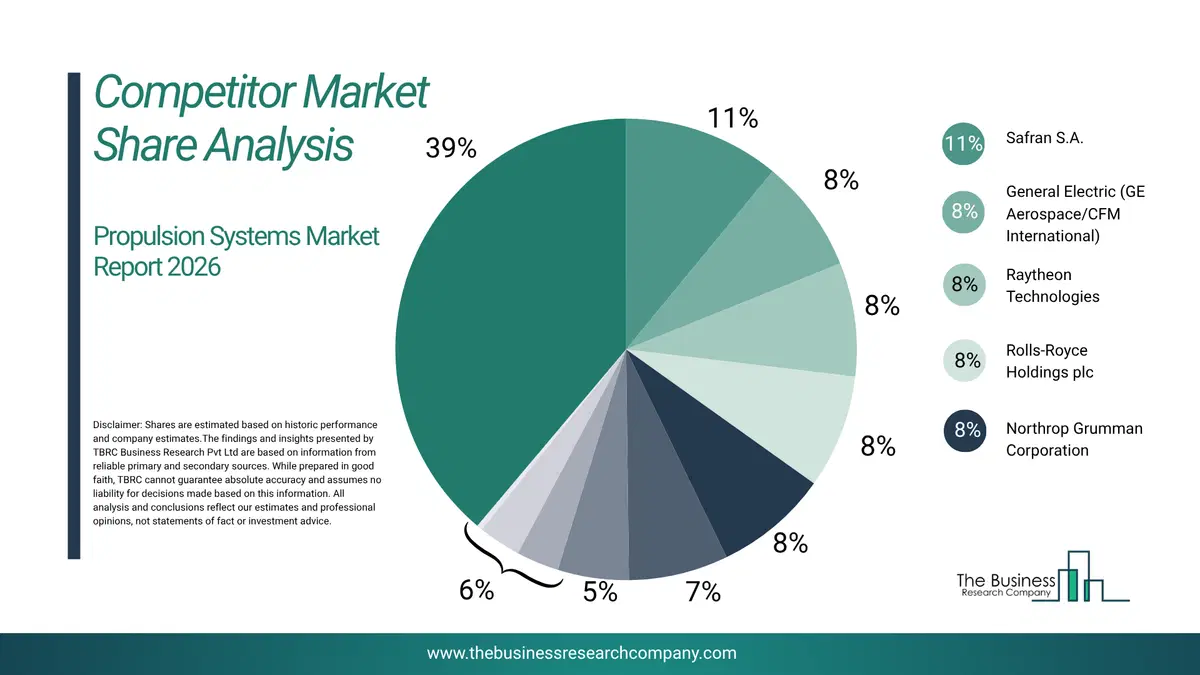
This chart is for illustrative purposes; the full report includes a detailed competitor analysis and comprehensive overview of the top 10 companies in the market.
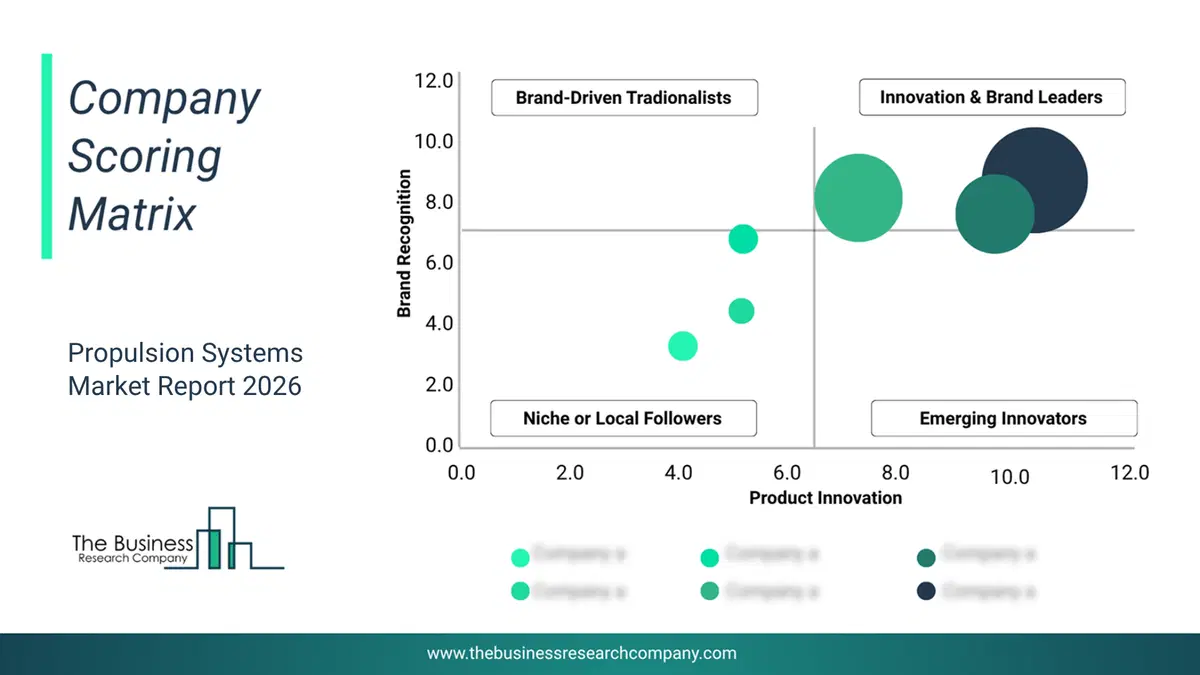
This chart maps companies by product innovation and brand strength, with bubble size indicating relative revenue, helping identify market leaders, challengers, and niche players. This is an illustrative chart; the full report provides a complete and accurate competitive analysis.
Global Propulsion Systems Market Trends and Insights
Major companies operating in the propulsion systems market are increasing their focus on introducing hydrogen propulsion systems to gain a competitive edge in the market. Hydrogen propulsion systems use hydrogen as a fuel source to generate power for driving various types of machinery and vehicles. For instance, in December 2023, Marelli Europe S.p.A., an Italy-based company, launched an advanced hydrogen propulsion system. This new system includes specific injectors with patented designs and an advanced engine control unit that is specifically designed for hydrogen engines. These engines are similar to traditional endothermic engines but use hydrogen as fuel, resulting in no CO2 emissions. The Marelli fuel system meets the strict requirements of these engines, ensuring precision, efficiency, performance, easy integration, and complexity reduction.What Are Latest Mergers And Acquisitions In The Propulsion Systems Market?
In January 2024, Yamaha Motor Co. Ltd., a Japan-based manufacturer that produces motorcycles, motorboats, and outboard motors, acquired Torqeedo for an undisclosed amount. With this acquisition, Yamaha Motor Co. Ltd. aims to enhance its portfolio of electric propulsion technologies and strengthen its position in the growing market for sustainable marine solutions. Torqeedo is a Germany-based company that specializes in manufacturing electric motors and propulsion systems for boats.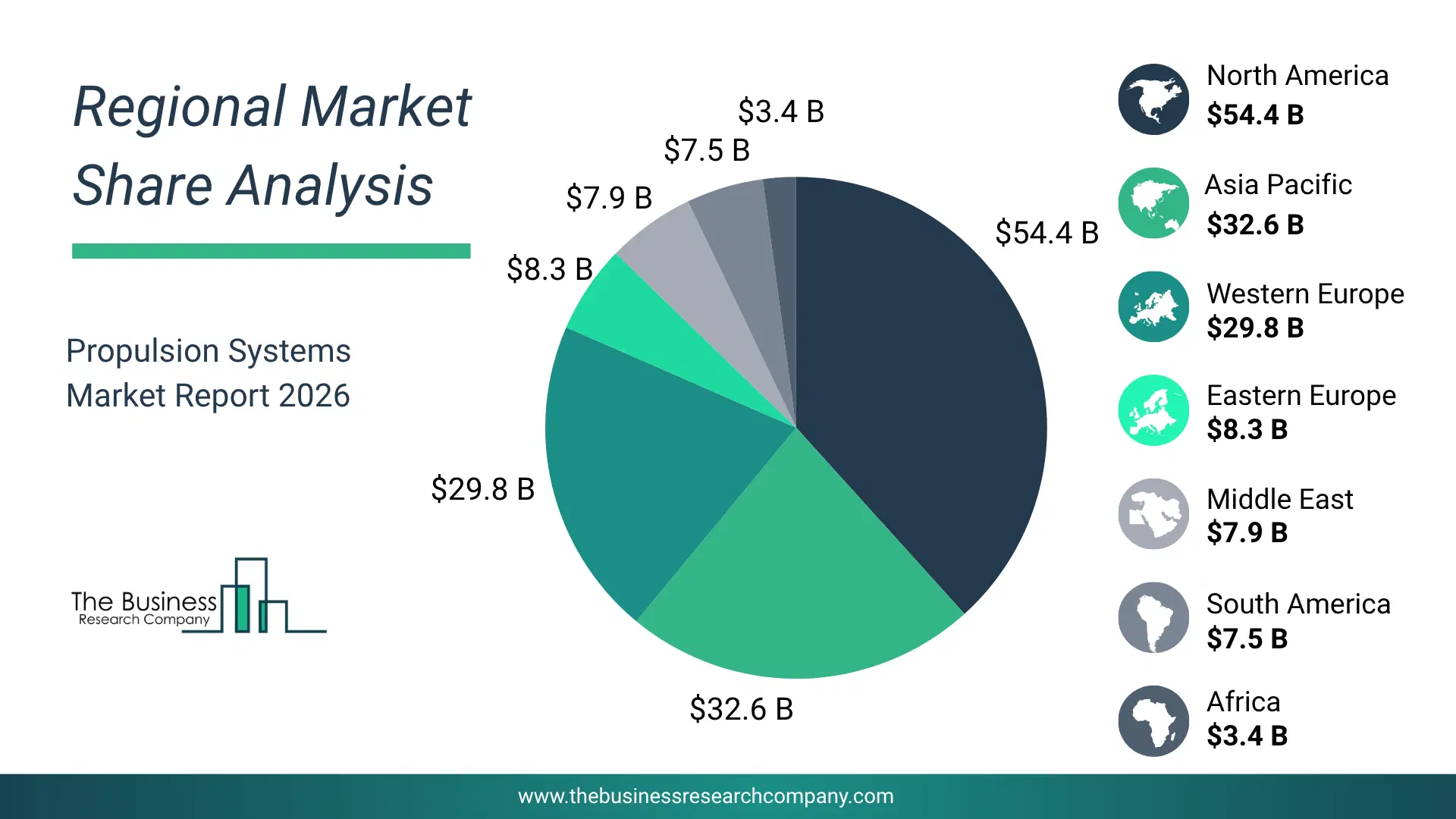
Regional Outlook
North America was the largest region in the propulsion systems market in 2025. Asia-Pacific is expected to be the fastest-growing region in the forecast period. The regions covered in this market report include Asia-Pacific, South East Asia, Western Europe, Eastern Europe, North America, South America, Middle East, Africa. The countries covered in this market report include Australia, Brazil, China, France, Germany, India, Indonesia, Japan, Taiwan, Russia, South Korea, UK, USA, Canada, Italy, SpainWhat Defines the Propulsion Systems Market?
The propulsion system market consists of sales of the propeller, the turbine (or jet) engine, the ramjet, and the rocket. Values in this market are ‘factory gate’ values, that is the value of goods sold by the manufacturers or creators of the goods, whether to other entities (including downstream manufacturers, wholesalers, distributors and retailers) or directly to end customers. The value of goods in this market includes related services sold by the creators of the goods.How is Market Value Defined and Measured?
The market value is defined as the revenues that enterprises gain from the sale of goods and/or services within the specified market and geography through sales, grants, or donations in terms of the currency (in USD unless otherwise specified). The revenues for a specified geography are consumption values that are revenues generated by organizations in the specified geography within the market, irrespective of where they are produced. It does not include revenues from resales along the supply chain, either further along the supply chain or as part of other products.
This chart presents market attractiveness based on a quantitative evaluation of growth, competition, strategic alignment, and risk, offering a clear view of opportunity areas for decision-making. This chart is for illustrative purposes; the full report contains the complete analysis.

This chart highlights the Total Addressable Market (TAM) by estimating the maximum revenue opportunity using an assumption-driven approach, supporting strategic planning and opportunity sizing across markets. The chart is illustrative; the full report provides a more comprehensive analysis.
What Key Data and Analysis Are Included in the Propulsion Systems Market Report 2026?
The propulsion systems market research report is one of a series of new reports from The Business Research Company that provides market statistics, including industry global market size, regional shares, competitors with the market share, detailed market segments, market trends and opportunities, and any further data you may need to thrive in the propulsion systems industry. The market research report delivers a complete perspective of everything you need, with an in-depth analysis of the current and future state of the industry.Propulsion Systems Market Report Forecast Analysis
| Report Attribute | Details |
|---|---|
| Market Size Value In 2026 | $155.13 billion |
| Revenue Forecast In 2030 | $206.51 billion |
| Growth Rate | CAGR of 7.8% from 2026 to 2030 |
| Base Year For Estimation | 2025 |
| Actual Estimates/Historical Data | 2020-2025 |
| Forecast Period | 2026 - 2030 |
| Market Representation | Revenue in USD Billion and CAGR from 2026 to 2030 |
| Segments Covered | Type, Application, End-User |
| Regional Scope | Asia-Pacific, Western Europe, Eastern Europe, North America, South America, Middle East, Africa |
| Country Scope | The countries covered in the report are Australia, Brazil, China, France, Germany, India, Indonesia, Japan, Taiwan, Russia, South Korea, UK, USA, Canada, Italy, Spain. |
| Key Companies Profiled | General Electric Company, Raytheon Technologies Corporation, The Boeing Company, Airbus SE, Northrop Grumman Corporation, Honeywell International Inc., Mitsubishi Heavy Industries Ltd., Safran S.A., L3Harris Technologies Inc., Rolls-Royce Holdings plc, Thales Alenia Space, IHI Corporation, Space Exploration Technologies Corp, Rafael Advanced Defense Systems Ltd., Moog Inc., Aerojet Rocketdyne Holdings Inc., OHB System AG, VACCO Industries Inc., Sitael S.p.A., CFM International, MSNW LLC, Busek Co Inc., Ad Astra Rocket Company, 3W International GmbH, Accion Systems Inc., CU Aerospace LLC, Ariane Group |
| Customization Scope | Request for Customization |
| Pricing And Purchase Options | Explore Purchase Options |