
Rocket Propulsion Market Report 2026
Global Outlook – By Propulsion Type (Solid, Liquid, Hybrid), By Orbit Type (LEO, MEO, GEO, Beyond GEO), By Launch Vehicle Type (Manned, Unmanned), By End User Type (Civil and Commercial, Military) – Market Size, Trends, Strategies, and Forecast to 2030
Rocket Propulsion Market Overview
• Rocket Propulsion market size has reached to $8.02 billion in 2025 • Expected to grow to $13.28 billion in 2030 at a compound annual growth rate (CAGR) of 10.3% • Growth Driver: Rising Commercial Satellite Demand Fuels Growth In Rocket Propulsion Market • Market Trend: Strategic Partnerships Drive Rocket Propulsion Engine Development For Market Growth • Asia-Pacific was the largest region in 2025.Market Gains By 2030 – Top Opportunities By Segment
Market Gain identifies the most promising market opportunities by highlighting the segments or products expected to generate the highest incremental revenue growth over the next five years.
What Is Covered Under Rocket Propulsion Market?
Rocket propulsion refers to the act of pushing a rocket forward with force in order to launch it into the atmosphere. The rocket propulsion is used to produce thrust, the force which moves a rocket through the air and through space. Rockets require a solid or liquid propellant, which consists of a fuel source and an oxidizer which provides the oxygen required to burn the fuel. The main types of rocket propulsion markets are solid propulsion, liquid propulsion, and hybrid propulsion. Solid propulsion refers to a type of propulsion system in which, the fuel and oxidizer are mixed together into a solid propellant and used as boosters for launch. The orbits in rocket propulsion include LEO, MEO, GEO, and beyond GEO. The different launch vehicle types utilizing in rocket propulsion systems include manned and unmanned. The various end-users of rocket propulsion systems include civil and commercial, and military.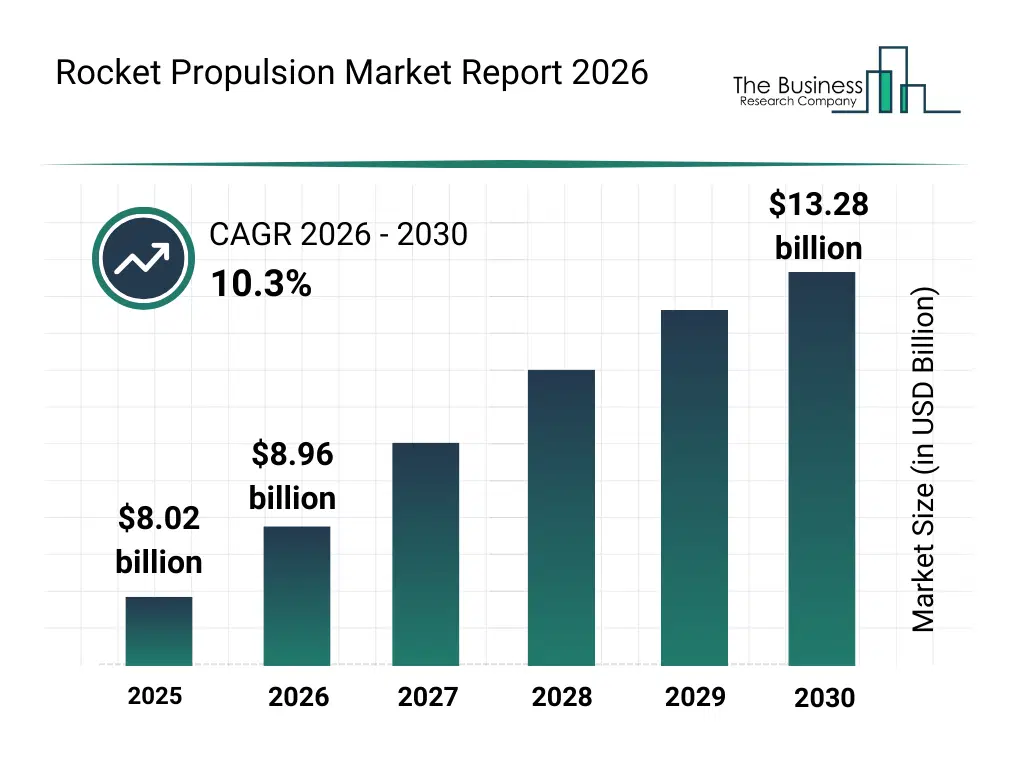
What Is The Rocket Propulsion Market Size and Share 2026?
The rocket propulsion market size has grown rapidly in recent years. It will grow from $8.02 billion in 2025 to $8.96 billion in 2026 at a compound annual growth rate (CAGR) of 11.8%. The growth in the historic period can be attributed to growing deployment of cryogenic propulsion systems for heavy-lift launch missions, advancements in solid and liquid propellant formulations improving thrust performance, expansion of commercial and government satellite launch programs, early development and testing of electric propulsion technologies for spacecraft, increasing investment in nuclear propulsion research for deep-space exploration.What Is The Rocket Propulsion Market Growth Forecast?
The rocket propulsion market size is expected to see rapid growth in the next few years. It will grow to $13.28 billion in 2030 at a compound annual growth rate (CAGR) of 10.3%. The growth in the forecast period can be attributed to rising demand for high-efficiency propulsion solutions to support long-duration space missions, increasing commercialization of low-earth-orbit operations requiring frequent launches, advancements in electric propulsion scalability for larger spacecraft platforms, development of next-generation cryogenic engines with improved fuel efficiency, expanding government and private-sector initiatives to accelerate nuclear thermal and nuclear electric propulsion maturation. Major trends in the forecast period include advanced cryogenic propulsion technologies, development of nuclear thermal propulsion, high-efficiency electric propulsion systems, multi-stage hybrid propellant optimization, thrust vectoring and propulsion control innovations.
Global Rocket Propulsion Market Segmentation
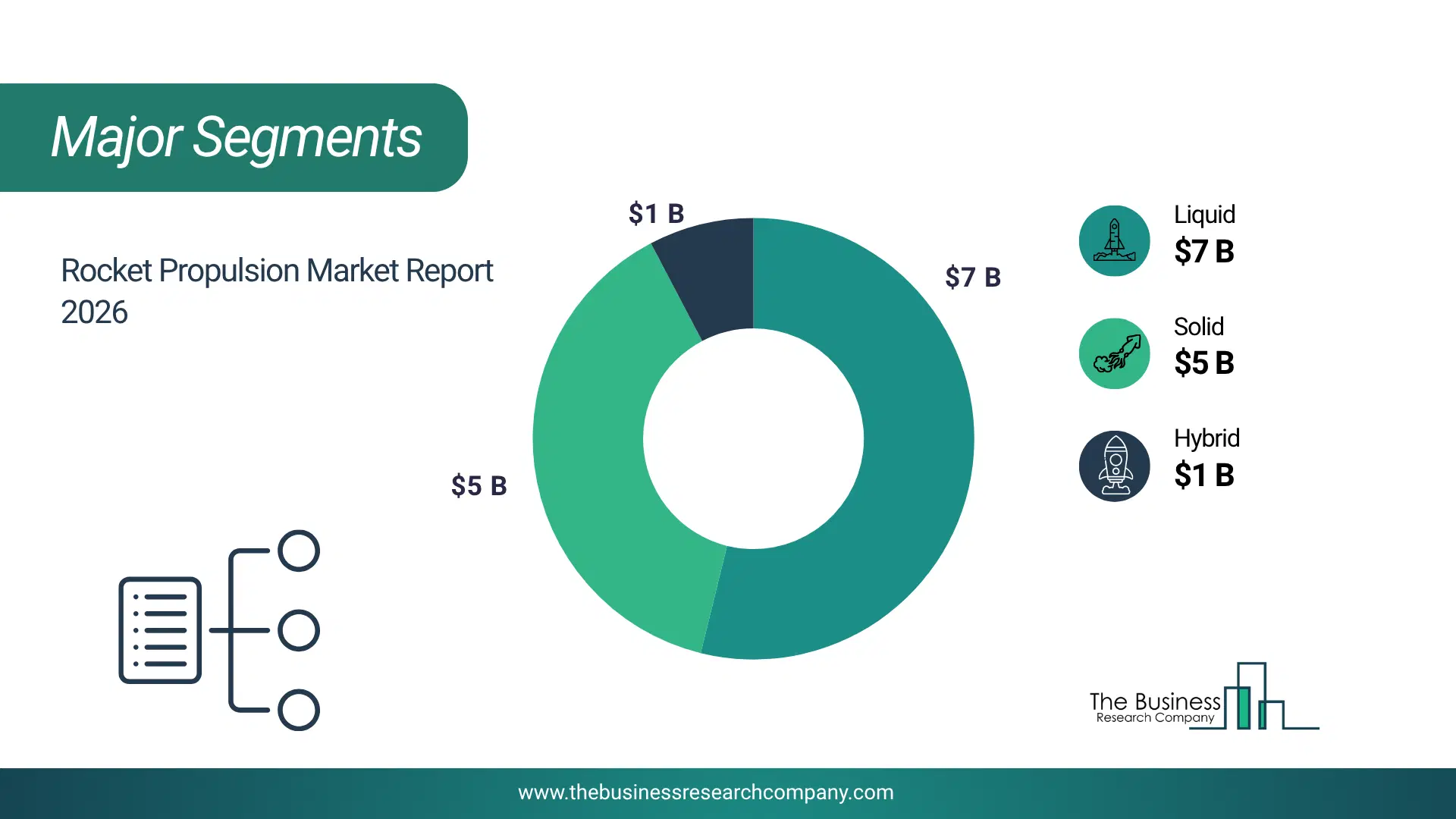
1) By Propulsion Type: Solid, Liquid, Hybrid 2) By Orbit Type: LEO, MEO, GEO, Beyond GEO 3) By Launch Vehicle Type: Manned, Unmanned 4) By End User Type: Civil and Commercial, Military Subsegments: 1) By Solid: Single-Stage Solid Propellant, Multi-Stage Solid Propellant 2) By Liquid: Bipropellant, Monopropellant 3) By Hybrid: Solid Fuel with Liquid Oxidizer, Liquid Fuel with Solid Oxidizer The top segments in the rocket propulsion market will be: • Liquid will reach $6.98 Billion by 2030. • Solid will reach $4.87 Billion by 2030. • Hybrid will reach $1.4 Billion by 2030.What Is Driver Of The Rocket Propulsion Market?
Increasing commercial satellites are expected to propel the growth of the rocket propulsion market going forward. Commercial satellites are devices that are sent into space to travel around the Earth and are used for collecting information or communicating by radio. Commercial satellites are launched into space using rocket propulsion systems, which provide the necessary thrust to lift the satellite into orbit and keep it in its desired position. For instance, in June 2024, according to the SpaceNews, a US-based non-governmental organization, in 2023 U.S. manufacturers accounted for approximately 85% of commercially procured satellites, with satellite manufacturing revenue rising by 9% to $17.2 billion, fueled by flexible software-defined payloads and advanced small satellites. A record 190 commercially procured launches took place, marking an 18% increase from 2022. These launches deployed 2,781 commercial satellites, up 20% year-over-year, largely driven by SpaceX. Therefore, increasing commercial satellites are driving the growth of the rocket propulsion industry.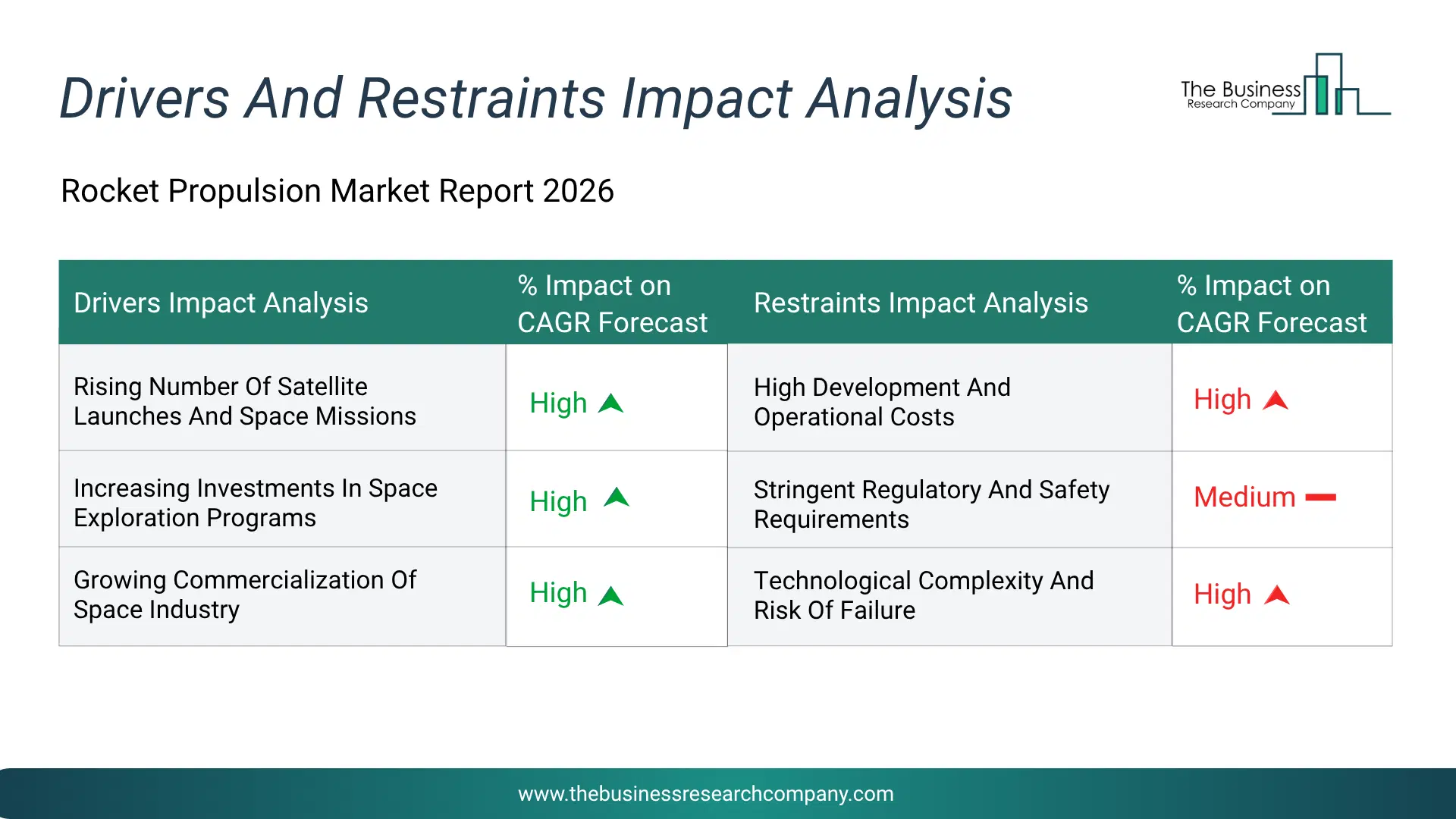
Infographic Chart Showing Key Market Drivers Analysis And Restraints For Rocket Propulsion Market
The chart presents an impact analysis of key drivers and restraints, quantifying their relative influence on the market's growth rate and helping assess the balance between growth enablers and limiting factors. This chart offers a high-level perspective; the full report contains more detailed insights.
How Will The Drivers Impact Growth In The Global Rocket Propulsion Market?
• Rising Number Of Satellite Launches And Space Missions (High) – During the forecast period, the rising number of satellite launches and space missions is expected to become a key growth driver for the rocket propulsion market by 2030. Governments, commercial operators, and research organizations are significantly increasing launch activities to deploy communication, navigation, Earth observation, and scientific satellites. The growing demand for reliable access to space is accelerating the procurement of advanced propulsion systems capable of supporting diverse mission requirements. Launch providers are expanding vehicle fleets and enhancing propulsion performance to accommodate higher launch frequencies. • Increasing Investments In Space Exploration Programs (High) – During the forecast period, the increasing investments in space exploration programs are expected to emerge as a major factor driving the expansion of the rocket propulsion market by 2030. National space agencies and international organizations are allocating substantial resources toward lunar exploration, planetary research, space station development, and next-generation exploration initiatives. These programs require highly efficient and mission-specific propulsion technologies capable of supporting long-duration and complex space operations. Growing budgets for exploration activities are encouraging innovation across propulsion architectures and engine performance capabilities. • Growing Commercialization Of Space Industry (High) – During the forecast period, the growing commercialization of the space industry is expected to act as a key growth catalyst for the rocket propulsion market by 2030. Private sector participation is expanding rapidly across satellite deployment, space tourism, cargo transportation, and in-orbit services. Commercial operators are seeking cost-effective and scalable propulsion solutions to improve launch economics and mission flexibility. The emergence of new business models and increasing venture capital investments are further stimulating demand for advanced rocket engines and propulsion technologies.How Will The Restraints Impact Growth In The Global Rocket Propulsion Market?
• High Development And Operational Costs (High) – During the forecast period, the high development and operational costs act as a major restraint for the rocket propulsion market by significantly increasing the financial burden on manufacturers and space agencies. The design, testing, and deployment of propulsion systems—especially cryogenic and nuclear—require advanced materials, precision engineering, and extensive safety validations. These factors lead to long development cycles and high capital investment, limiting participation to only well-funded organizations. Smaller companies and startups often struggle to enter the market due to these cost barriers. As a result, the overall market expansion is slowed despite growing demand for space missions. • Stringent Regulatory And Safety Requirements (High) – During the forecast period, the stringent regulatory and safety requirements restrain the rocket propulsion market by imposing strict compliance standards on manufacturing, testing, and launch operations. Governments and international bodies enforce rigorous guidelines to ensure environmental safety, national security, and mission reliability. These regulations increase the complexity and time required for approvals, delaying project timelines and raising operational costs. Additionally, failure to meet compliance standards can lead to cancellations or penalties, discouraging innovation. Consequently, companies face challenges in scaling operations and introducing new propulsion technologies efficiently. • Technological Complexity And Risk Of Failure (High) – During the forecast period, the technological complexity and risk of failure act as significant restraints by making rocket propulsion systems highly challenging to design and operate. Advanced propulsion technologies involve extreme temperatures, high pressures, and precise combustion processes, increasing the likelihood of technical failures. Even minor design flaws can lead to mission failures, causing substantial financial losses and reputational damage. This risk forces companies to invest heavily in testing and validation, extending development timelines. As a result, innovation is cautious and gradual, limiting the rapid growth of the market.Key Players In The Global Rocket Propulsion Market
Major companies operating in the rocket propulsion market are Aerojet Rocketdyne Holdings Inc., Mitsubishi Heavy Industries Ltd., Space Exploration Technologies Corp., Safran S.A., Blue Origin LLC, Northrop Grumman Innovation Systems Inc., Virgin Galactic Holdings Inc., Rocket Lab USA Inc., United Launch Alliance LLC, Boeing Space Launch System, Lockheed Martin Space Systems Company, Reaction Engines Ltd., Firefly Aerospace Inc., Sierra Nevada Corporation, ExPace Technology Co. Ltd., Relativity Space Inc., Arianespace SA, IHI Corporation, Skyrora Ltd., Masten Space Systems Inc., Gilmour Space Technologies Pty Ltd., ArianeGroup GmbH, Terran Orbital Corporation, PLD Space S.L., Dauria Aerospace, Raptor Aerospace Inc., Axiom Space Inc., CubeCab Services Private Limited, Stratolaunch Systems Corporation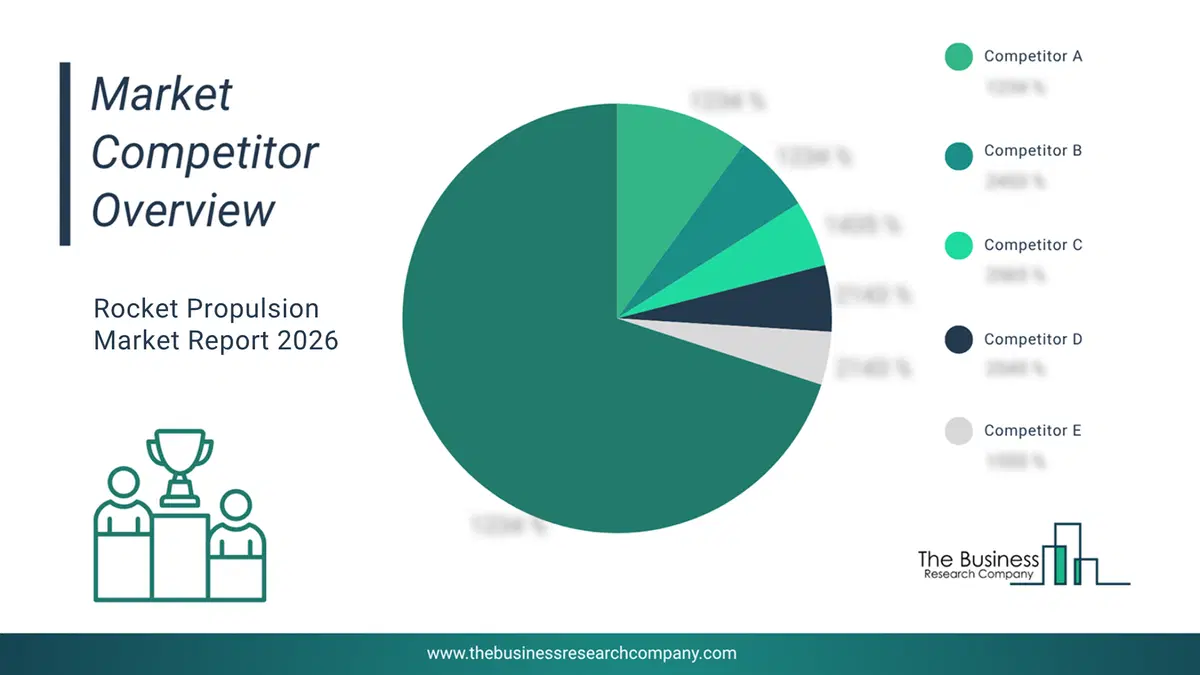
This chart is for illustrative purposes; the full report includes a detailed competitor analysis and comprehensive overview of the top 10 companies in the market.
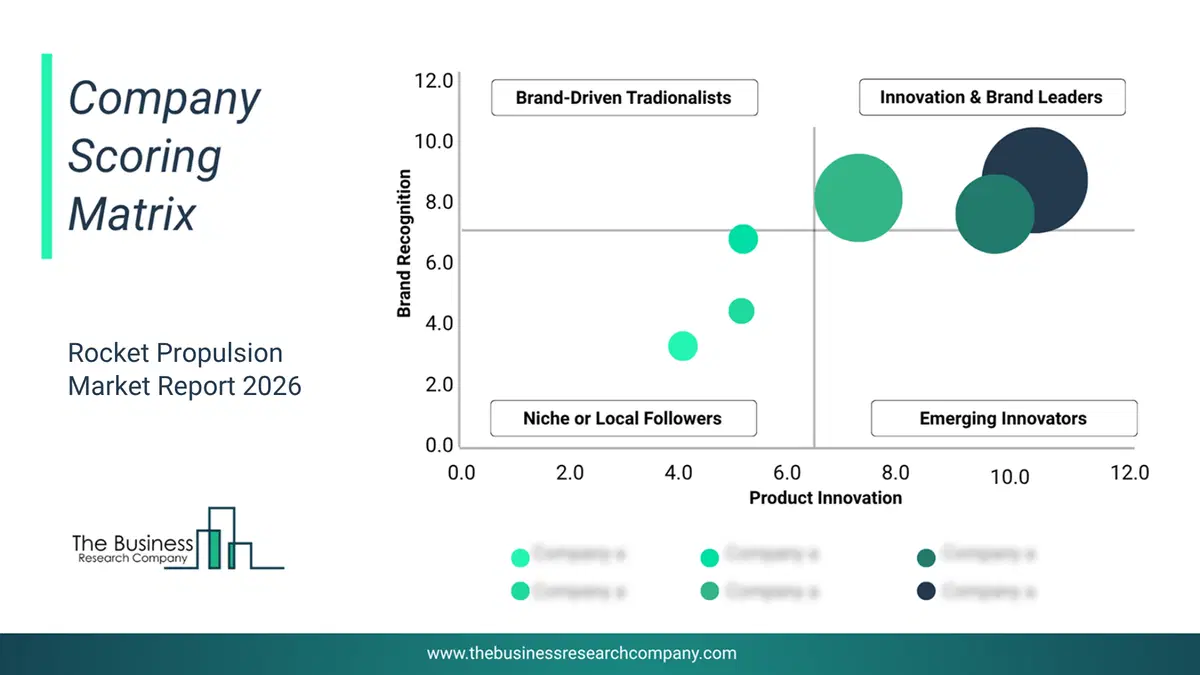
This chart maps companies by product innovation and brand strength, with bubble size indicating relative revenue, helping identify market leaders, challengers, and niche players. This is an illustrative chart; the full report provides a complete and accurate competitive analysis.
Global Rocket Propulsion Market Trends and Insights
Major companies operating in the rocket propulsion market are increasing their focus on adopting strategic partnerships for the development of rocket propulsion engines to maximize their revenues in the market. These partnerships aim to leverage the expertise and resources of different organizations to accelerate the development of rocket propulsion engines and reduce costs. For instance, in May 2023, Ursa Major, a US-based rocket propulsion company, announced a contract with the Air Force Research Laboratory (AFRL), a US-based aerospace and defense company, to advance U.S. hypersonics defense programs and space launch capabilities. As part of the agreement, Ursa Major will proceed to develop its 200,000-pound thrust Arroway engine for space launch and build and test a prototype of its new Draper engine for hypersonic travel. The Draper engine is a closed-cycle hydrogen peroxide engine with 4,000 pounds of thrust that is intended for use in hypersonic applications. For medium and heavy launch vehicles, Arroway is a reusable liquid oxygen and methane-staged combustion engine. As AFRL develops its hypersonic capabilities and eliminates America's reliance on foreign propulsion systems for launch, Ursa Major remains a crucial partner.What Are Latest Mergers And Acquisitions In The Rocket Propulsion Market? L3Harris Technologies Acquires Aerojet Rocketdyne Holdings To Strengthen Missile And Propulsion Capabilities
In July 2023, L3Harris Technologies Inc., a U.S.-based aerospace and defense company, acquired Aerojet Rocketdyne Holdings Inc. for an undisclosed amount. With this acquisition, L3Harris aimed to enhance its capabilities in missile defense systems, hypersonic technologies, and advanced propulsion, accelerate the development of next-generation aerospace solutions, and expand its portfolio of high-performance defense systems. The company also sought to leverage Aerojet Rocketdyne’s expertise in rocket propulsion to drive innovation, improve operational efficiency, and deliver more integrated and reliable solutions to global defense and aerospace clients. Aerojet Rocketdyne Holdings, Inc. is a U.S.-based aerospace company that offers rocket propulsion.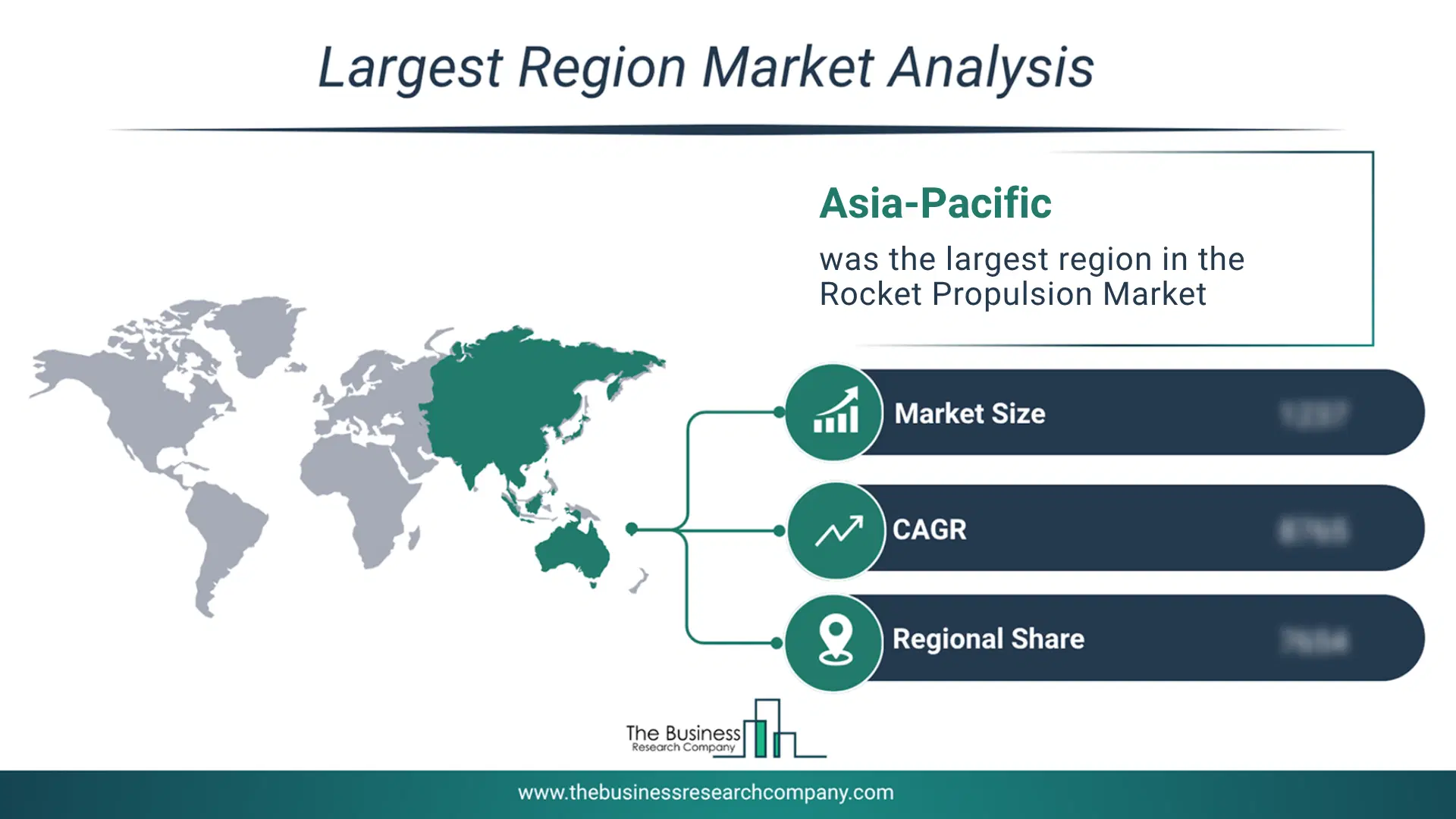
Regional Insights
Asia-Pacific was the largest region in the rocket propulsion market in 2025, and it is also expected to be the fastest-growing region in the forecast period. The regions covered in this market report are Asia-Pacific, South East Asia, Western Europe, Eastern Europe, North America, South America, Middle East, Africa. The countries covered in this market report are Australia, Brazil, China, France, Germany, India, Indonesia, Japan, Taiwan, Russia, South Korea, UK, USA, Canada, Italy, SpainWhat Defines the Rocket Propulsion Market?
The rocket propulsion market consists of sales of cryogenic propulsion, electric propulsion system and nuclear propulsion. Values in this market are ‘factory gate’ values, that is the value of goods sold by the manufacturers or creators of the goods, whether to other entities (including downstream manufacturers, wholesalers, distributors, and retailers) or directly to end customers. The value of goods in this market includes related services sold by the creators of the goods.How is Market Value Defined and Measured?
The market value is defined as the revenues that enterprises gain from the sale of goods and/or services within the specified market and geography through sales, grants, or donations in terms of the currency (in USD unless otherwise specified). The revenues for a specified geography are consumption values that are revenues generated by organizations in the specified geography within the market, irrespective of where they are produced. It does not include revenues from resales along the supply chain, either further along the supply chain or as part of other products.
This chart presents market attractiveness based on a quantitative evaluation of growth, competition, strategic alignment, and risk, offering a clear view of opportunity areas for decision-making. This chart is for illustrative purposes; the full report contains the complete analysis.

This chart highlights the Total Addressable Market (TAM) by estimating the maximum revenue opportunity using an assumption-driven approach, supporting strategic planning and opportunity sizing across markets. The chart is illustrative; the full report provides a more comprehensive analysis.
What Key Data and Analysis Are Included in the Rocket Propulsion Market Report 2026?
The rocket propulsion market research report is one of a series of new reports from The Business Research Company that provides market statistics, including industry global market size, regional shares, competitors with the market share, detailed market segments, market trends and opportunities, and any further data you may need to thrive in the rocket propulsion industry. The market research report delivers a complete perspective of everything you need, with an in-depth analysis of the current and future state of the industry.Rocket Propulsion Market Report Forecast Analysis
| Report Attribute | Details |
|---|---|
| Market Size Value In 2026 | $8.96 billion |
| Revenue Forecast In 2030 | $13.28 billion |
| Growth Rate | CAGR of 11.8% from 2026 to 2030 |
| Base Year For Estimation | 2025 |
| Actual Estimates/Historical Data | 2020-2025 |
| Forecast Period | 2026 - 2030 |
| Market Representation | Revenue in USD Billion and CAGR from 2026 to 2030 |
| Segments Covered | Propulsion Type, Orbit Type, Launch Vehicle Type, End User Type |
| Regional Scope | Asia-Pacific, Western Europe, Eastern Europe, North America, South America, Middle East, Africa |
| Country Scope | The countries covered in the report are Australia, Brazil, China, France, Germany, India, Indonesia, Japan, Taiwan, Russia, South Korea, UK, USA, Canada, Italy, Spain. |
| Key Companies Profiled | Aerojet Rocketdyne Holdings Inc., Mitsubishi Heavy Industries Ltd., Space Exploration Technologies Corp., Safran S.A., Blue Origin LLC, Northrop Grumman Innovation Systems Inc., Virgin Galactic Holdings Inc., Rocket Lab USA Inc., United Launch Alliance LLC, Boeing Space Launch System, Lockheed Martin Space Systems Company, Reaction Engines Ltd., Firefly Aerospace Inc., Sierra Nevada Corporation, ExPace Technology Co. Ltd., Relativity Space Inc., Arianespace SA, IHI Corporation, Skyrora Ltd., Masten Space Systems Inc., Gilmour Space Technologies Pty Ltd., ArianeGroup GmbH, Terran Orbital Corporation, PLD Space S.L., Dauria Aerospace, Raptor Aerospace Inc., Axiom Space Inc., CubeCab Services Private Limited, Stratolaunch Systems Corporation |
| Customization Scope | Request for Customization |
| Pricing And Purchase Options | Explore Purchase Options |