
Marine Propulsion Engines Market Report 2026
Global Outlook – By Engine Type (2-Stroke Engine, 4- Stroke Engine), By Ship Type (Cargo Or Container Ships, Tanker, Bulk Carrier, Offshore Vessel, Passenger Ship), By Power Range (1,001-5,000 HP, 5,001-10,000 HP, 10,001-20,000 HP, Above 20,000 HP), By Fuel Type (Diesel, Heavy Fuel Oil, Natural Gas), By Application (Commercial, Defense, Passenger) – Market Size, Trends, Strategies, and Forecast to 2030
Marine Propulsion Engines Market Overview
• Marine Propulsion Engines market size has reached to $26.98 billion in 2025 • Expected to grow to $33.75 billion in 2030 at a compound annual growth rate (CAGR) of 4.6% • Growth Driver: Surge In International Seaborne Trade Fuels Growth In The Marine Propulsion Engine Market • Market Trend: Advancements In Auxiliary Engines Reshaping The Marine Propulsion Engine Market • Asia-Pacific was the largest region in 2025.What Is Covered Under Marine Propulsion Engines Market?
Marine propulsion engines refer to a system that propels ships across the water while maintaining a higher level of safety for the marine environment. These enable fuel and operational flexibility, high efficiency, low emissions and operational cost advantages. The main types of marine propulsion engines are 2-stroke engines, 4- stroke engines. A two-stroke engine refers to a type of internal combustion engine that uses two piston strokes to complete a power cycle in just one crankshaft rotation. The various types of ships include cargo or container ships, tankers, bulk carriers, offshore vessels, passenger ships and other ship types. The various power ranges include 0-1,000 HP, 1,001-5,000 HP, 5,001-10,000 HP, 10,001-20,000 HP, above 20,000 HP and various fuel types include diesel, heavy fuel oil, natural gas and other fuel types. These are used in various applications such as commercial, defense and passenger.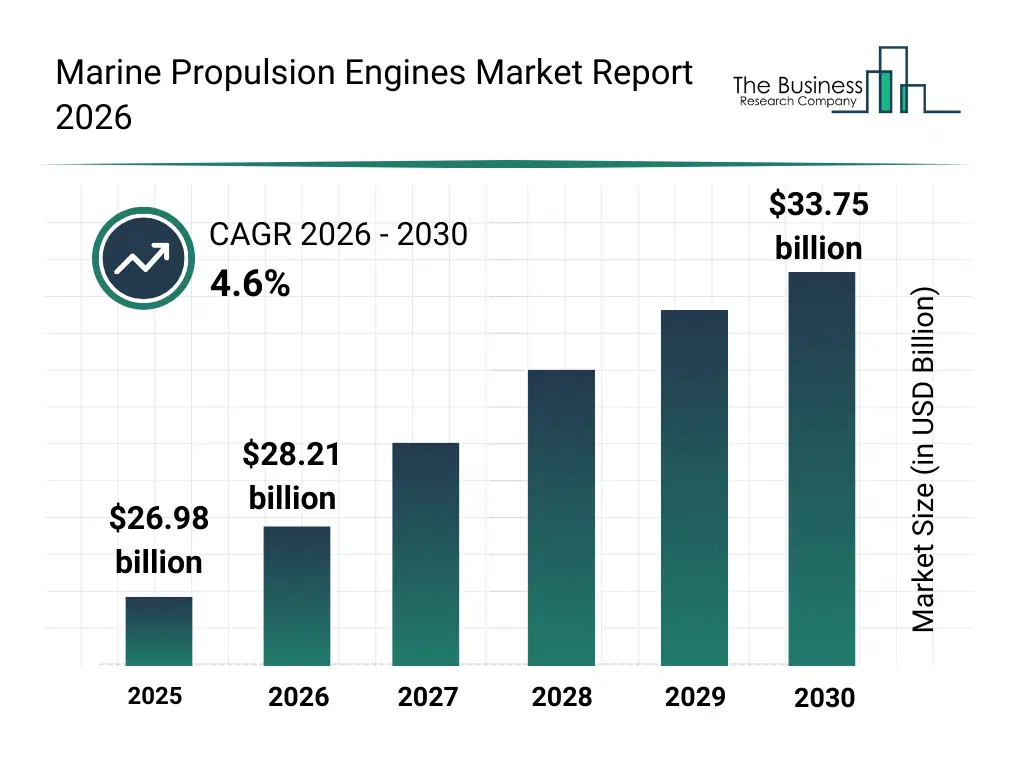
What Is The Marine Propulsion Engines Market Size and Share 2026?
The marine propulsion engines market size has grown steadily in recent years. It will grow from $26.98 billion in 2025 to $28.21 billion in 2026 at a compound annual growth rate (CAGR) of 4.5%. The growth in the historic period can be attributed to global maritime trade growth, dominance of diesel propulsion, demand for high-power engines, shipbuilding expansion, fuel cost optimization.What Is The Marine Propulsion Engines Market Growth Forecast?
The marine propulsion engines market size is expected to see steady growth in the next few years. It will grow to $33.75 billion in 2030 at a compound annual growth rate (CAGR) of 4.6%. The growth in the forecast period can be attributed to decarbonization mandates, alternative fuel adoption, digital engine control systems, efficiency-driven vessel upgrades, green shipping initiatives. Major trends in the forecast period include adoption of low-emission propulsion systems, shift toward lng and dual-fuel engines, growth of fleet modernization programs, demand for high-efficiency engines, expansion of smart engine monitoring.Tariff Impact On Marine Propulsion Engines Market
Tariffs are impacting the marine propulsion engines market by increasing the cost of imported crankshafts, turbochargers, fuel delivery systems, engine control units, and heavy cast components. Commercial and defense shipbuilders in North America and Europe are particularly affected due to reliance on imported propulsion systems, while Asia-Pacific exporters face margin pressure. These tariffs are raising vessel construction and retrofit costs. However, they are also driving localization of engine manufacturing, regional supplier ecosystems, and innovation in low-emission and fuel-flexible propulsion technologies.
Global Marine Propulsion Engines Market Segmentation
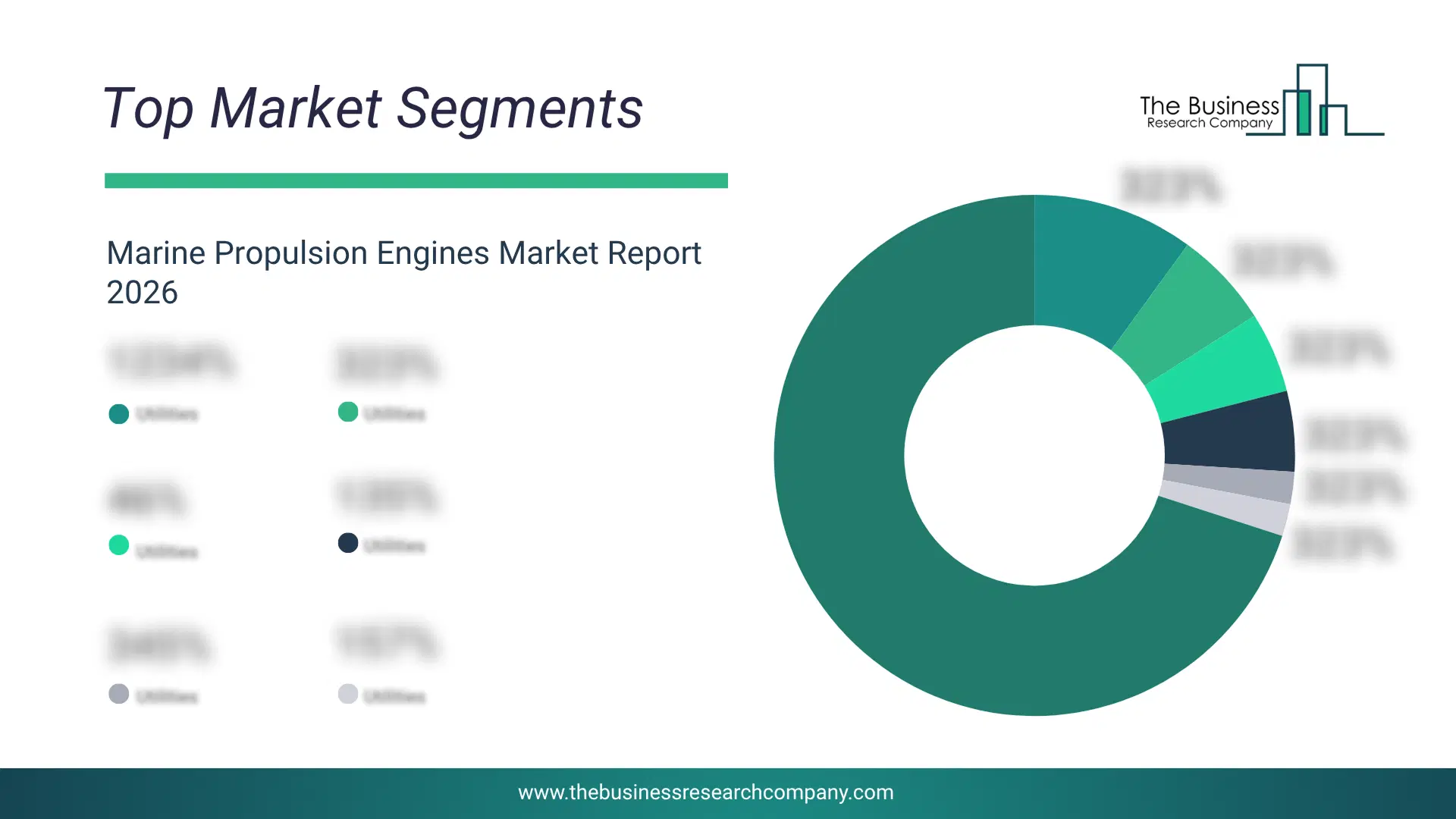
1) By Engine Type: 2-Stroke Engine, 4- Stroke Engine 2) By Ship Type: Cargo Or Container Ships, Tanker, Bulk Carrier, Offshore Vessel, Passenger Ship 3) By Power Range: 1,001-5,000 HP, 5,001-10,000 HP, 10,001-20,000 HP, Above 20,000 HP 4) By Fuel Type: Diesel, Heavy Fuel Oil, Natural Gas 5) By Application: Commercial, Defense, Passenger Subsegments: 1) By 2-Stroke Engine: Low-Speed Crosshead 2-Stroke Engines, Medium-Speed Trunk Piston 2-Stroke Engines, Diesel-Fueled 2-Stroke Engines, Dual-Fuel 2-Stroke Engines (Diesel And Gas), Liquefied Natural Gas (LNG) 2-Stroke Engines, Heavy Fuel Oil 2-Stroke Engines, Electronically Controlled 2-Stroke Engines, Mechanically Controlled 2-Stroke Engines 2) By 4-Stroke Engine: Medium-Speed 4-Stroke Engines, High-Speed 4-Stroke Engines, Diesel-Fueled 4-Stroke Engines, Gas-Fueled 4-Stroke Engines, Dual-Fuel 4-Stroke Engines (Diesel And Gas), Liquefied Natural Gas (LNG) 4-Stroke Engines, Lean-Burn 4-Stroke Engines, Spark-Ignited 4-Stroke Engines, Turbocharged 4-Stroke EnginesWhat Is The Driver Of The Marine Propulsion Engines Market?
The rise in international seaborne trade is expected to propel the growth of the marine propulsion engine market going forward. Seaborne trade refers to the kind of trade that uses ships to convey commodities across the sea. Ships are propelled across the water by means of marine propulsion systems, which also provide a higher level of safety for the marine ecosystem, are economical, and minimize emissions for the maritime industry. As a result, the rise in international seaborne trade increases the demand for the marine propulsion engine market. For instance, in October 2024, according to the United Nations Conference on Trade and Development (UNCTAD), a Switzerland-based permanent intergovernmental body of the United Nations, reported that seaborne trade growth increased from 4.2% in ton-miles in 2023 to 5.1% in 2024, representing a 21.4% increase in growth rate. Additionally, total seaborne trade rose from 5,047 nautical miles in 2023 to 5,186 nautical miles in 2024, an increase of approximately 2.8%. Therefore, the rise in international seaborne trade is driving the marine propulsion engine industry.Key Players In The Global Marine Propulsion Engines Market
Major companies operating in the marine propulsion engines market are Caterpillar lnc., Daihatsu Diesel Mfg Co. Ltd, Hyundai Heavy Industries Co. Ltd., Mitsubishi Heavy Industries Ltd., Rolls-Royce Holdings Plc, Wärtsilä Corporation, Yanmar Holdings Co. Ltd., Scania AB, MAN Energy Solutions, Cummins Inc., AB Volvo Penta, Kawasaki Heavy Industries Ltd., Fairbanks Morse Defense, Anglo Belgian Corporation, Nigata Power Systems Co. Ltd., Deutz AG, WinGD, Yamaha Motor Co. Ltd., China Shipbuilding Corporation, Mitsubishi Turbocharger and Engine Europe B.V.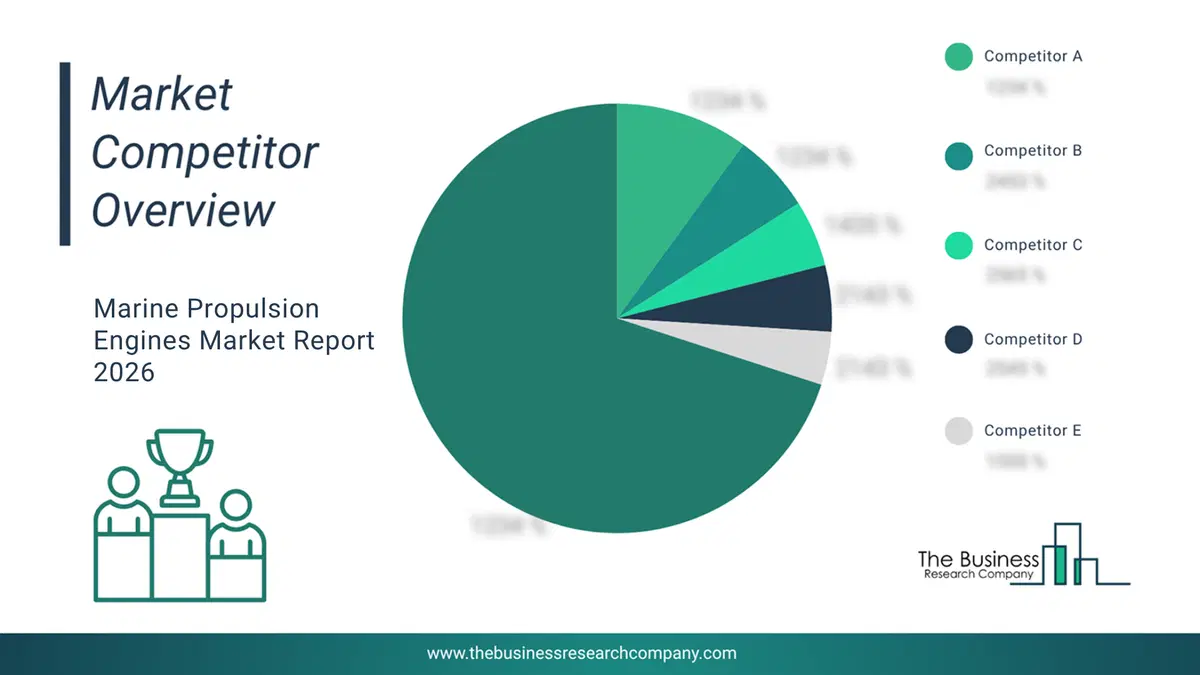
This chart is for illustrative purposes; the full report includes a detailed competitor analysis and comprehensive overview of the top 10 companies in the market.
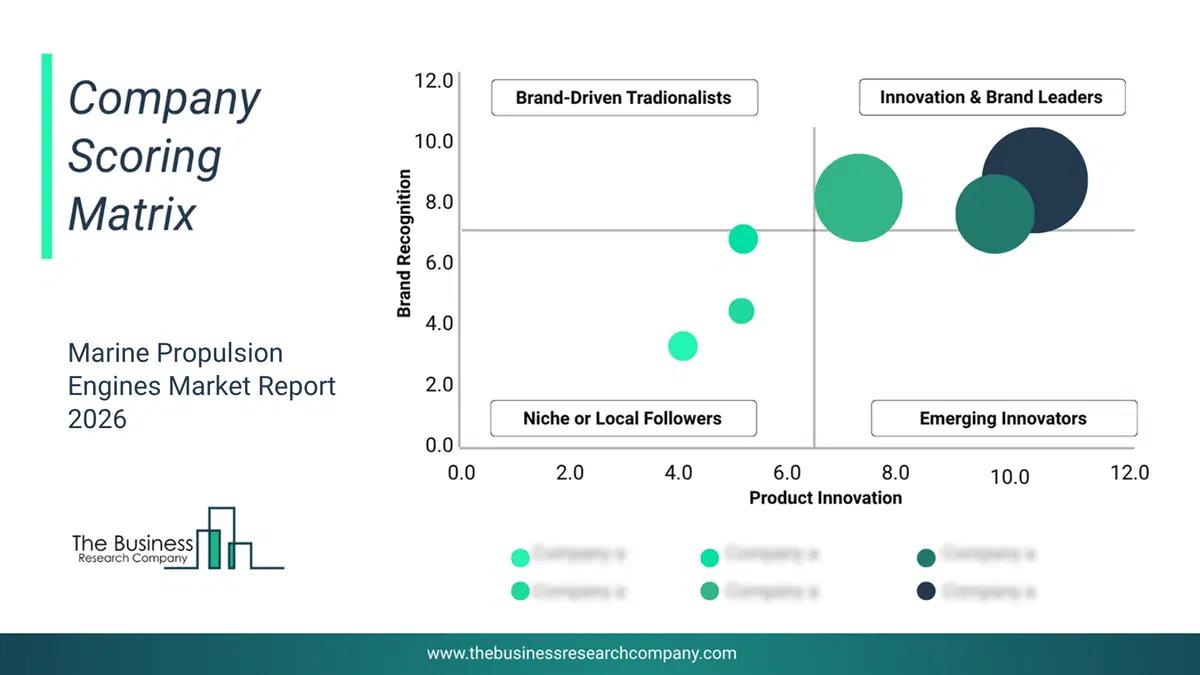
This chart maps companies by product innovation and brand strength, with bubble size indicating relative revenue, helping identify market leaders, challengers, and niche players. This is an illustrative chart; the full report provides a complete and accurate competitive analysis.
Global Marine Propulsion Engines Market Trends and Insights
Major companies operating in the marine propulsion engine market are developing new auxiliary engines to gain a competitive edge in the market. An auxiliary engine is a secondary power source in a vehicle or vessel that provides additional energy for specific functions other than the primary propulsion. For instance, in September 2023, Perkins Engines Company Limited, a UK-based marine engines company, launched the Perkins E44 and E70B auxiliary engines, designed for diverse marine applications such as inland waterways, tugs, governmental vessels, fishing boats, and ferry services. The E44, an electronic 4.4-liter, 4-cylinder engine, and the E70B boast a wide range of power ratings, providing flexible and configurable power solutions to cater to the auxiliary power needs of boat operators. Engineered for durability and high uptime, the electronic engines offer a 500-hour service interval and low maintenance features, including a self-priming fuel system and automatic valve lash adjustment. With a focus on compact design and easy installation, the engines target end-users in various sectors, offering multiple cooling options and ease of integration.What Are Latest Mergers And Acquisitions In The Marine Propulsion Engines Market?
In April 2024, Yamaha Motor, a Japan-based automobile manufacturer company acquired Torqeedo for an undisclosed amount. The acquisition aims to bolster Yamaha’s research and development efforts in electric propulsion technology, leveraging Torqeedo's extensive expertise and patent portfolio in electric motors and systems. Torqeedo is a Germany-based manufacturer of electric marine propulsion.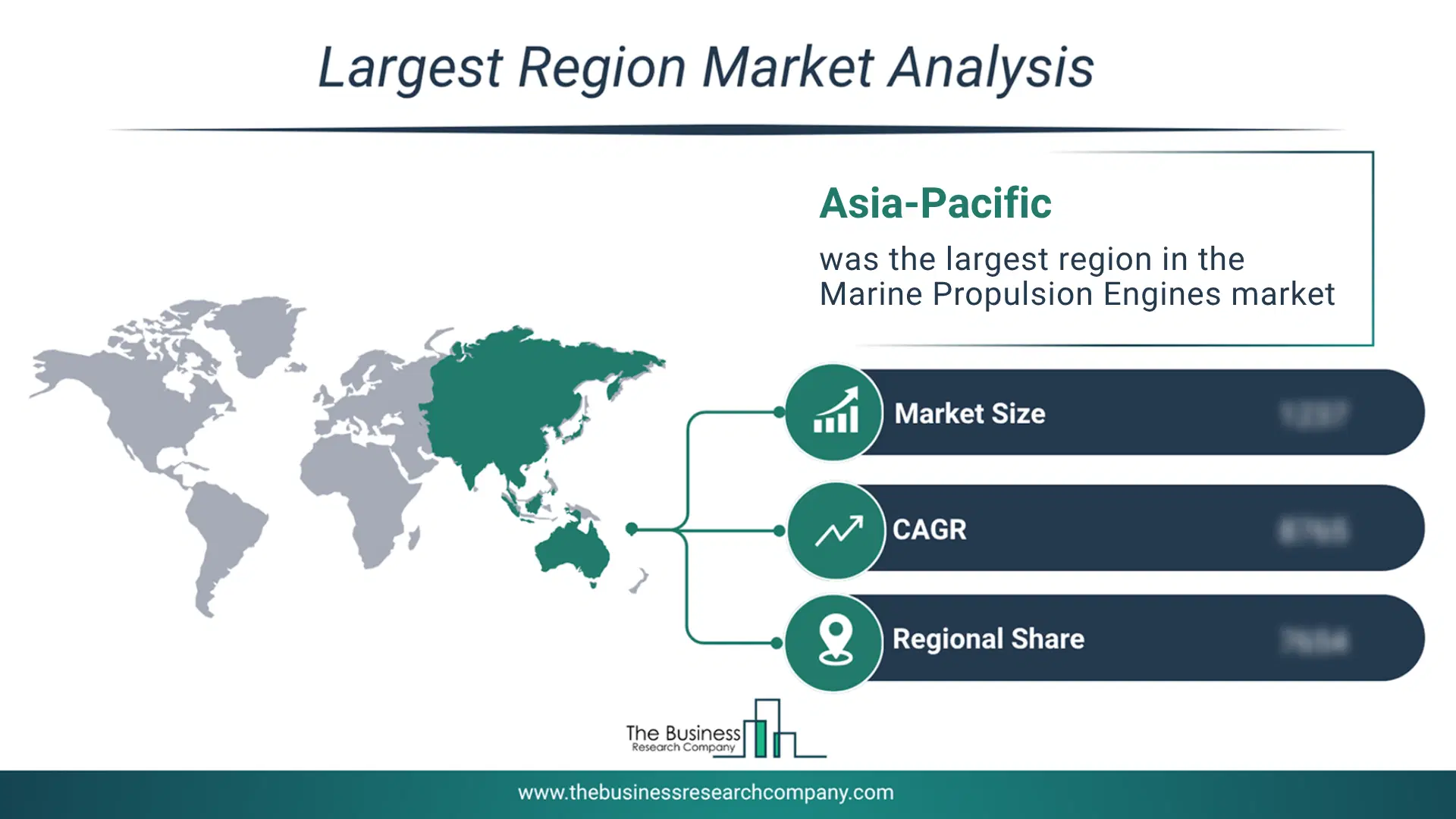
Regional Outlook
Asia-Pacific was the largest region in the marine propulsion engines market in 2025. The regions covered in this market report are Asia-Pacific, South East Asia, Western Europe, Eastern Europe, North America, South America, Middle East, Africa The countries covered in this market report are Australia, Brazil, China, France, Germany, India, Indonesia, Japan, Taiwan, Russia, South Korea, UK, USA, Canada, Italy, Spain.What Defines the Marine Propulsion Engines Market?
The marine propulsion engines market consists of sales of wind propulsion systems, nuclear propulsion systems and gas turbine propulsion systems. Values in this market are ‘factory gate’ values, that is the value of goods sold by the manufacturers or creators of the goods, whether to other entities (including downstream manufacturers, wholesalers, distributors and retailers) or directly to end customers. The value of goods in this market includes related services sold by the creators of the goods.How is Market Value Defined and Measured?
The market value is defined as the revenues that enterprises gain from the sale of goods and/or services within the specified market and geography through sales, grants, or donations in terms of the currency (in USD unless otherwise specified). The revenues for a specified geography are consumption values that are revenues generated by organizations in the specified geography within the market, irrespective of where they are produced. It does not include revenues from resales along the supply chain, either further along the supply chain or as part of other products.
This chart presents market attractiveness based on a quantitative evaluation of growth, competition, strategic alignment, and risk, offering a clear view of opportunity areas for decision-making. This chart is for illustrative purposes; the full report contains the complete analysis.

This chart highlights the Total Addressable Market (TAM) by estimating the maximum revenue opportunity using an assumption-driven approach, supporting strategic planning and opportunity sizing across markets. The chart is illustrative; the full report provides a more comprehensive analysis.
What Key Data and Analysis Are Included in the Marine Propulsion Engines Market Report 2026?
The marine propulsion engines market research report is one of a series of new reports from The Business Research Company that provides market statistics, including industry global market size, regional shares, competitors with the market share, detailed market segments, market trends and opportunities, and any further data you may need to thrive in the marine propulsion engines industry. The market research report delivers a complete perspective of everything you need, with an in-depth analysis of the current and future state of the industry.Marine Propulsion Engines Market Report Forecast Analysis
| Report Attribute | Details |
|---|---|
| Market Size Value In 2026 | $28.21 billion |
| Revenue Forecast In 2030 | $33.75 billion |
| Growth Rate | CAGR of 4.6% from 2026 to 2030 |
| Base Year For Estimation | 2025 |
| Actual Estimates/Historical Data | 2020-2025 |
| Forecast Period | 2026 - 2030 |
| Market Representation | Revenue in USD Billion and CAGR from 2026 to 2030 |
| Segments Covered | Engine Type, Ship Type, Power Range, Fuel Type, Application |
| Regional Scope | Asia-Pacific, Western Europe, Eastern Europe, North America, South America, Middle East, Africa |
| Key Companies Profiled | Caterpillar lnc., Daihatsu Diesel Mfg Co. Ltd, Hyundai Heavy Industries Co. Ltd., Mitsubishi Heavy Industries Ltd., Rolls-Royce Holdings Plc, Wärtsilä Corporation, Yanmar Holdings Co. Ltd., Scania AB, MAN Energy Solutions, Cummins Inc., AB Volvo Penta, Kawasaki Heavy Industries Ltd., Fairbanks Morse Defense, Anglo Belgian Corporation, Nigata Power Systems Co. Ltd., Deutz AG, WinGD, Yamaha Motor Co. Ltd., China Shipbuilding Corporation, Mitsubishi Turbocharger and Engine Europe B.V. |
| Customization Scope | Request for Customization |
| Pricing And Purchase Options | Explore Purchase Options |