
Space Propulsion Systems Market Report 2026
Global Outlook – By Component (Thrusters, Rocket Motors, Propellant Feed Systems, Propulsion Thermal Control, Nozzles, Power Processing Units, Other Components), By Spacecraft Type (Satellites, Rovers, Capsules, Launch Vehicles, Interplanetary Spacecraft And Probes), By Application (Space Simulation, Rocket Launch, Other Applications), By End User (Civil And Earth Observation, Government And Military, Commercial) – Market Size, Trends, Strategies, and Forecast to 2030
Space Propulsion Systems Market Overview
• Space Propulsion Systems market size has reached to $12.76 billion in 2025 • Expected to grow to $24.74 billion in 2030 at a compound annual growth rate (CAGR) of 14.1% • Growth Driver: Propelling Beyond Boundaries Space Exploration Missions Fuel Growth In The Space Propulsion Systems Market • Market Trend: Empowering Electric Propulsion Safran Electronics And Defense Forms Strategic Partnership With Terran Orbital • North America was the largest region in 2025 and Asia-Pacific is the fastest growing region.What Is Covered Under Space Propulsion Systems Market?
The space propulsion system is a system that provides thrust to spacecraft. It includes all of the components of the rocket engine, such as the tank pumps, propellants, rocket nozzle, and power head. The main components of space propulsion systems are thrusters, rocket motors, propellant feed systems, propulsion thermal control, nozzles, power processing units, and others. Thruster is a spaceship or aircraft's engine that determines its direction and altitude. The spacecraft including satellites, rovers, capsules, launch vehicles, interplanetary spacecraft, and probes used for various applications such as space simulation, rocket launch, and others. These are used for civil and earth observation, government and military, and commercial purposes.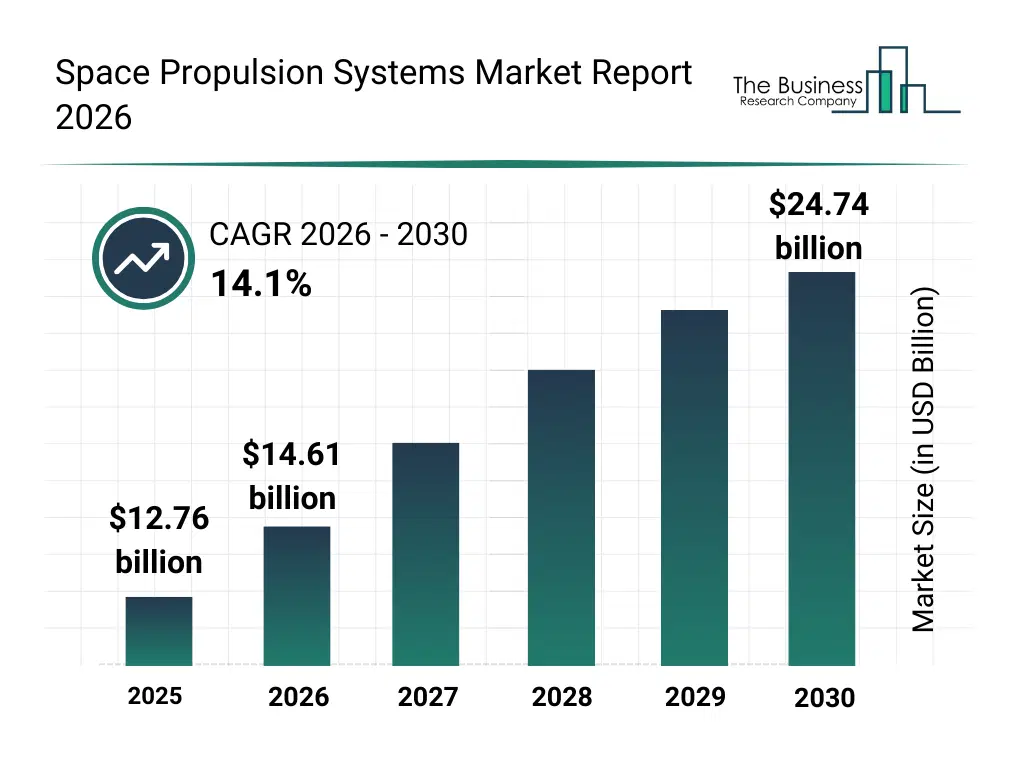
What Is The Space Propulsion Systems Market Size and Share 2026?
The space propulsion systems market size has grown rapidly in recent years. It will grow from $12.76 billion in 2025 to $14.61 billion in 2026 at a compound annual growth rate (CAGR) of 14.5%. The growth in the historic period can be attributed to increasing government investments in national space programs, rising deployment of commercial satellites for communication and broadcasting, reliance on chemical propulsion technologies for traditional launch systems, growth of defense-driven space missions requiring advanced propulsion, early development of electric propulsion for station-keeping in geostationary satellites.What Is The Space Propulsion Systems Market Growth Forecast?
The space propulsion systems market size is expected to see rapid growth in the next few years. It will grow to $24.74 billion in 2030 at a compound annual growth rate (CAGR) of 14.1%. The growth in the forecast period can be attributed to expansion of private spaceflight and mega-constellation satellite projects, increasing adoption of electric and solar electric propulsion systems for efficiency, rising demand for reusable launch vehicles requiring advanced propulsion designs, development of green propulsion technologies to reduce toxic propellants, growing focus on deep-space exploration missions driving high-performance propulsion innovations. Major trends in the forecast period include rising adoption of high-efficiency electric propulsion systems, growing development of reusable propulsion components, increasing use of advanced propellant formulations, expansion in small satellite and cubesat propulsion demand, innovation in high-temperature materials for extreme thrust operations.
Global Space Propulsion Systems Market Segmentation
1) By Component: Thrusters, Rocket Motors, Propellant Feed Systems, Propulsion Thermal Control, Nozzles, Power Processing Units, Other Components 2) By Spacecraft Type: Satellites, Rovers, Capsules, Launch Vehicles, Interplanetary Spacecraft And Probes 3) By Application: Space Simulation, Rocket Launch, Other Applications 4) By End User: Civil And Earth Observation, Government And Military, Commercial Subsegments: 1) By Thrusters: Chemical Thrusters, Electric Thrusters, Hybrid Thrusters 2) By Rocket Motors: Solid Rocket Motors, Liquid Rocket Motors, Hybrid Rocket Motors 3) By Propellant Feed Systems: Pressure-Fed Systems, Pump-fed Systems 4) By Propulsion Thermal Control: Thermal Insulation Systems, Heat Exchangers 5) By Nozzles: Bell Nozzles, Aerospike Nozzles, De Laval Nozzles 6) By Power Processing Units: Power Control Units, Power Distribution Units 7) By Other Components: Sensors, Control Valves, ConnectorsWhat Is Driver Of The Space Propulsion Systems Market?
The growing space exploration missions is expected to propel the growth of the space propulsion systems market in the coming future. Space exploration is the continuing finding and investigation of astronomical entities in outer space using constantly expanding and growing space technologies. The growing space exploration missions are expanding the space propulsion systems market as they are used to provide the required thrust for rockets and other spacecraft to reach space. For instance, in July 2024, according to a UK Space Agency, a UK-based government body responsible for the civil space program. in 2023, 175 new UK organizations were recognized for engaging in space-related activities, reflecting an 11% growth compared to 2022. Therefore, growing space exploration missions are driving the space propulsion systems industry.Key Players In The Global Space Propulsion Systems Market
Major companies operating in the space propulsion systems market are IHI Corporation, Safran S.A., Aerojet Rocketdyne Holdings Inc., Space Exploration Technologies Corp., Northrop Grumman Corporation, Moog Inc., OHB SE, Sierra Nevada Corporation, Thales Alenia Space, Accion Systems Inc., ArianeGroup, Rafael Advanced Defense Systems Ltd., Mitsubishi Heavy Industries Ltd., Lockheed Martin Corporation, NanoAvionics Corp., L3Harris Technologies Inc., Blue Origin LLC, Avio SpA, Yuzhnoye State Design Office, Honeywell International Inc., The Boeing Company, Ball Aerospace & Technologies Corp., Antrix Corporation Limited, Exotrail SA, Terran Orbital Corporation, Rocket Lab USA Inc., Firefly Aerospace Inc., Relativity Space Inc., Momentus Inc.
This chart is for illustrative purposes; the full report includes a detailed competitor analysis and comprehensive overview of the top 10 companies in the market.
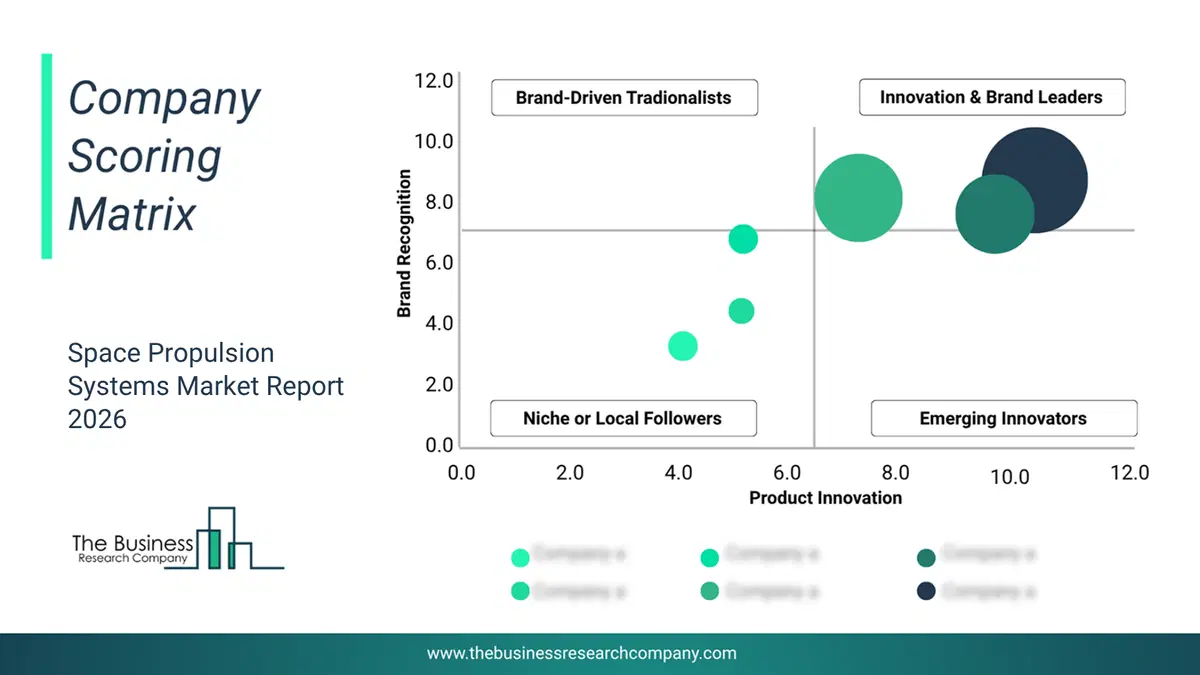
This chart maps companies by product innovation and brand strength, with bubble size indicating relative revenue, helping identify market leaders, challengers, and niche players. This is an illustrative chart; the full report provides a complete and accurate competitive analysis.
Global Space Propulsion Systems Market Trends and Insights
Major companies operating in the space propulsion systems market are adopting a strategic partnership approach aiming to manufacture electric propulsion systems in the United States of America. Strategic partnerships refer to a process in which companies leverage each other's strengths and resources to achieve mutual benefits and success. For instance, in June 2023, Safran Electronics & Defense, a France-based company focusing on electrical systems, avionics, and optronics, signed a Memorandum of Agreement with Terran Orbital, a US-based defense and aerospace company, to research and verify the requirements needed to produce a new generation of satellite electric propulsion systems. This transaction demonstrates Safran Electronics & Defense's belief in the value of Terran Orbital's industry-leading products and inventive individuals, while also adding to the strategic endeavors to create more adaptable, computerized, vertically integrated manufacturing systems. Safran Electronics & Defense and Terran Orbital will conduct a comprehensive study to evaluate the technical, industrial, and economic requirements for an innovative U.S.-based manufacturing facility for electric propulsion systems.What Are Latest Mergers And Acquisitions In The Space Propulsion Systems Market? L3Harris Enhances Defense Portfolio With Aerojet Rocketdyne Acquisition
In July 2023, L3Harris, a US-based company specializing in communication and electronic systems acquired Aerojet Rocketdyne for an undisclosed amount. Through this acquisition, L3Harris aimed to strengthen its position in the aerospace and defense sectors, focusing on integrating advanced propulsion technologies to enhance its capabilities in space and missile systems. Aerojet Rocketdyne is a US-based company known for propulsion systems and aerospace technologies that support a wide range of defense and space applications.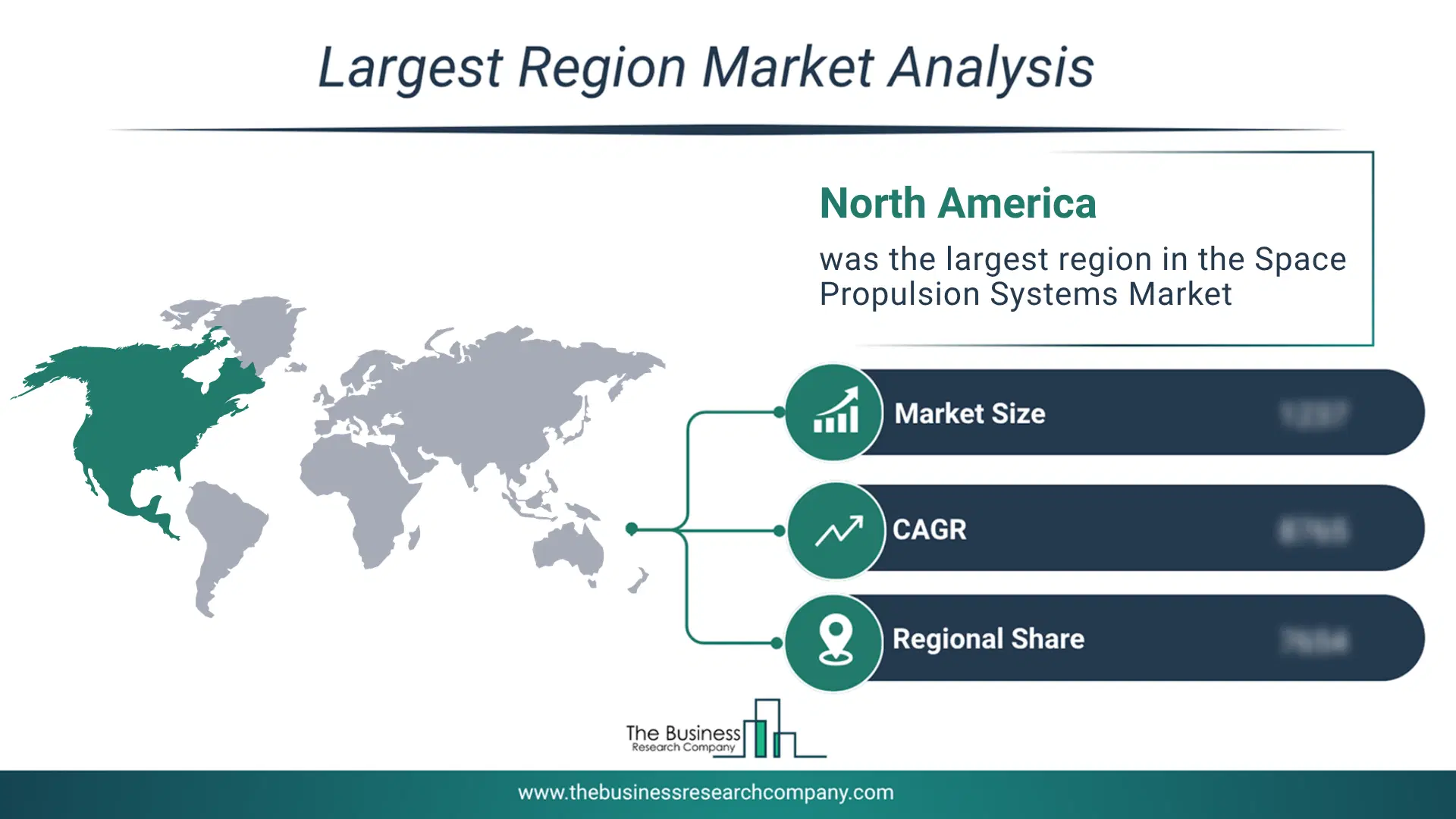
Regional Insights
North America was the largest region in the space propulsion systems market in 2025.Asia-Pacific is expected to be the fastest-growing region in the global space propulsion system market report during the forecast period. The regions covered in this market report are Asia-Pacific, South East Asia, Western Europe, Eastern Europe, North America, South America, Middle East, Africa. The countries covered in this market report are Australia, Brazil, China, France, Germany, India, Indonesia, Japan, Taiwan, Russia, South Korea, UK, USA, Canada, Italy, SpainWhat Defines the Space Propulsion Systems Market?
The space propulsion system market consists of sales of chemical and nonchemical propellants, power heads, tank pumps, and rocket nozzles. Values in this market are ‘factory gate’ values, that is the value of goods sold by the manufacturers or creators of the goods, whether to other entities (including downstream manufacturers, wholesalers, distributors and retailers) or directly to end customers. The value of goods in this market includes related services sold by the creators of the goods.How is Market Value Defined and Measured?
The market value is defined as the revenues that enterprises gain from the sale of goods and/or services within the specified market and geography through sales, grants, or donations in terms of the currency (in USD unless otherwise specified). The revenues for a specified geography are consumption values that are revenues generated by organizations in the specified geography within the market, irrespective of where they are produced. It does not include revenues from resales along the supply chain, either further along the supply chain or as part of other products.
This chart presents market attractiveness based on a quantitative evaluation of growth, competition, strategic alignment, and risk, offering a clear view of opportunity areas for decision-making. This chart is for illustrative purposes; the full report contains the complete analysis.

This chart highlights the Total Addressable Market (TAM) by estimating the maximum revenue opportunity using an assumption-driven approach, supporting strategic planning and opportunity sizing across markets. The chart is illustrative; the full report provides a more comprehensive analysis.
What Key Data and Analysis Are Included in the Space Propulsion Systems Market Report 2026?
The space propulsion systems market research report is one of a series of new reports from The Business Research Company that provides market statistics, including industry global market size, regional shares, competitors with the market share, detailed market segments, market trends and opportunities, and any further data you may need to thrive in the space propulsion systems industry. The market research report delivers a complete perspective of everything you need, with an in-depth analysis of the current and future state of the industry.Space Propulsion Systems Market Report Forecast Analysis
| Report Attribute | Details |
|---|---|
| Market Size Value In 2026 | $14.61 billion |
| Revenue Forecast In 2030 | $24.74 billion |
| Growth Rate | CAGR of 14.1% from 2026 to 2030 |
| Base Year For Estimation | 2025 |
| Actual Estimates/Historical Data | 2020-2025 |
| Forecast Period | 2026 - 2030 |
| Market Representation | Revenue in USD Billion and CAGR from 2026 to 2030 |
| Segments Covered | Component, Spacecraft Type, Application, End User |
| Regional Scope | Asia-Pacific, Western Europe, Eastern Europe, North America, South America, Middle East, Africa |
| Country Scope | The countries covered in the space propulsion systems market report are Australia, Brazil, China, France, Germany, India, Indonesia, Japan, Taiwan, Russia, South Korea, UK, USA, Canada, Italy, Spain |
| Key Companies Profiled | IHI Corporation, Safran S.A., Aerojet Rocketdyne Holdings Inc., Space Exploration Technologies Corp., Northrop Grumman Corporation, Moog Inc., OHB SE, Sierra Nevada Corporation, Thales Alenia Space, Accion Systems Inc., ArianeGroup, Rafael Advanced Defense Systems Ltd., Mitsubishi Heavy Industries Ltd., Lockheed Martin Corporation, NanoAvionics Corp., L3Harris Technologies Inc., Blue Origin LLC, Avio SpA, Yuzhnoye State Design Office, Honeywell International Inc., The Boeing Company, Ball Aerospace & Technologies Corp., Antrix Corporation Limited, Exotrail SA, Terran Orbital Corporation, Rocket Lab USA Inc., Firefly Aerospace Inc., Relativity Space Inc., Momentus Inc. |
| Customization Scope | Request for Customization |
| Pricing And Purchase Options | Explore Purchase Options |