
Space Propulsion Market Report 2026
Global Outlook – By Type (Chemical Propulsion, Non-chemical Propulsion), By Platform (Satellites, Capsules\Cargos, Interplanetary Spacecraft And Probes, Rovers/Spacecraft Landers, Launch Vehicles), By System Component (Chemical Propulsion Thrusters, Electric Propulsion Thrusters, Propellant Feed Systems, Rocket Motors, Nozzles, Propulsion Thermal Control, Power Processing Units), By Orbit (Low Earth Orbit (LEO), Medium Earth Orbit (MEO), Geostationary Earth Orbit (GEO), Beyond Geosynchronous Orbit), By End User (Commercial, Government And Defense) – Market Size, Trends, Strategies, and Forecast to 2030
Space Propulsion Market Overview
• Space Propulsion market size has reached to $14.35 billion in 2025 • Expected to grow to $30.48 billion in 2030 at a compound annual growth rate (CAGR) of 16% • Growth Driver: Government Investments Fuels Growth In The Space Propulsion Market • Market Trend: Strategic Partnerships Revolutionize Space Propulsion Technology • North America was the largest region and fastest growing region.What Is Covered Under Space Propulsion Market?
Space propulsion is a technique used to accelerate spacecraft and artificial satellites. Spacecrafts are mainly propelled by the use of a rocket engine. These systems work by ejecting mass (usually in the form of gas or plasma) at high speeds to create a reactive force that propels the spacecraft in the opposite direction, following Newton's Third Law of Motion. The main types of space propulsion are chemical propulsion and non-chemical propulsion. Chemical propulsion refers to propulsion in which the thrust is provided by the product of a chemical reaction, normally burning (or oxidizing) a fuel. By platform, types of space propulsion include satellites, capsules\cargos, interplanetary spacecraft and probes, rovers/spacecraft landers, and launch vehicles. Major end users of space propulsion are commercial and government and defense entities. The system components used in space propulsion are chemical propulsion thrusters, electric propulsion thrusters, propellant feed systems, rocket motors, nozzles, propulsion thermal control and power processing units. The orbits of space propulsion are low earth orbit (LEO), medium earth orbit (MEO), geostationary earth orbit (GEO), and beyond geosynchronous orbit.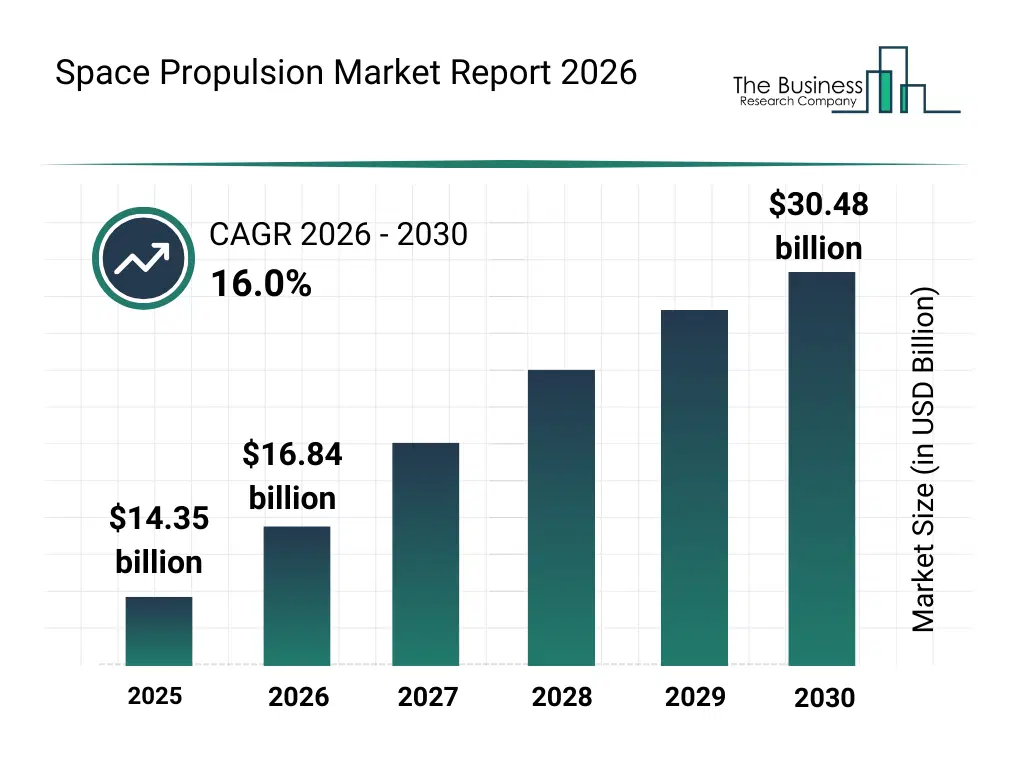
What Is The Space Propulsion Market Size and Share 2026?
The space propulsion market size has grown rapidly in recent years. It will grow from $14.35 billion in 2025 to $16.84 billion in 2026 at a compound annual growth rate (CAGR) of 17.3%. The growth in the historic period can be attributed to growing deployment of electric propulsion systems for satellite station-keeping and orbit-raising, advancements in plasma and ion thruster technologies improving mission efficiency, expansion of global satellite constellations requiring reliable in-orbit propulsion, increased government and commercial investment in propulsion research for deep-space missions, early experimentation with propellant-less concepts to reduce spacecraft mass and complexity.What Is The Space Propulsion Market Growth Forecast?
The space propulsion market size is expected to see rapid growth in the next few years. It will grow to $30.48 billion in 2030 at a compound annual growth rate (CAGR) of 16.0%. The growth in the forecast period can be attributed to rising demand for high-efficiency propulsion to support long-duration and interplanetary missions, scaling of electric propulsion for larger spacecraft platforms and higher power levels, increasing commercialization of leo operations driving need for frequent orbital adjustments, advancements in next-generation propellant-less propulsion concepts, expanding public-private partnerships to accelerate development of sustainable space-propulsion infrastructures. Major trends in the forecast period include development of high-efficiency electric propulsion systems, adoption of nuclear and solar propulsion for deep space missions, miniaturized propulsion units for small satellites and cubesats, integration of propulsion systems with advanced thermal and power management, propellant-less technologies for extended mission durations.
Global Space Propulsion Market Segmentation
1) By Type: Chemical Propulsion, Non-chemical Propulsion 2) By Platform: Satellites, Capsules\Cargos, Interplanetary Spacecraft And Probes, Rovers/Spacecraft Landers, Launch Vehicles 3) By System Component: Chemical Propulsion Thrusters, Electric Propulsion Thrusters, Propellant Feed Systems, Rocket Motors, Nozzles, Propulsion Thermal Control, Power Processing Units 4) By Orbit: Low Earth Orbit (LEO), Medium Earth Orbit (MEO), Geostationary Earth Orbit (GEO), Beyond Geosynchronous Orbit 5) By End User: Commercial, Government And Defense Subsegments: 1) By Chemical Propulsion: Solid Propulsion, Liquid Propulsion, Hybrid Propulsion 2) By Non-Chemical Propulsion: Electric Propulsion, Solar Propulsion, Nuclear Propulsion, Electromagnetic PropulsionWhat Is Driver Of The Space Propulsion Market?
The increased government investments in space technology is expected to propel the growth of the space propulsion market going forward. Government investments in space technology refer to financial allocations made by national governments toward the development, research, and deployment of space-related programs, infrastructure, and capabilities. The rise in these investments is primarily driven by intensifying geopolitical competition and national security concerns, as countries seek to establish strategic autonomy and strengthen their sovereign capabilities in space to counter emerging threats and maintain technological superiority. Government investments in space technology support space propulsion by funding the research, development, and manufacturing of advanced rocket engines, ion thrusters, and next-generation propulsion systems required for launching satellites, conducting interplanetary missions, maintaining space defense capabilities, and enabling both crewed and uncrewed spacecraft to achieve orbit and beyond. For instance, in April 2024, according to a report published by the government of the United Kingdom, a UK-based information website, During the 2022-23 financial year, 79% of funding was channeled through ESA programs, while 20% was directed towards national initiatives, such as the National Space Innovation Programme (running until 2027/28). As a result of agency funding, projected revenues are expected to increase to £1.2 billion, with private investment reaching £733 million. So, increasing investments in space technology will drive the space propulsion industry going forward.Key Players In The Global Space Propulsion Market
Major companies operating in the space propulsion market are OHB SE, Accion Systems Inc., The Boeing Company, Northrop Grumman Corporation, Maxar Technologies Inc., Thales Alenia Space, Airbus SE, VACCO Industries Inc., Moog Inc., Cobham Mission Systems Wimborne Limited., Safran S.A., NPO Splav, BAE Systems plc, Hanwha Group, Avibras Indústria Aeroespacial S.A., Blue Origin LLC, The Aerospace Corporation, Aerojet Rocketdyne Holdings Inc., Astrobotic Technology Inc., ArianeGroup, IHI Corporation, Mitsubishi Heavy Industries Ltd., Honeybee Robotics Ltd., Bluestaq LLC, Aurora Flight Sciences Corporation., Planet Labs Inc., Sierra Nevada Corporation, Avio SpA, Beta Technologies Inc.
This chart is for illustrative purposes; the full report includes a detailed competitor analysis and comprehensive overview of the top 10 companies in the market.
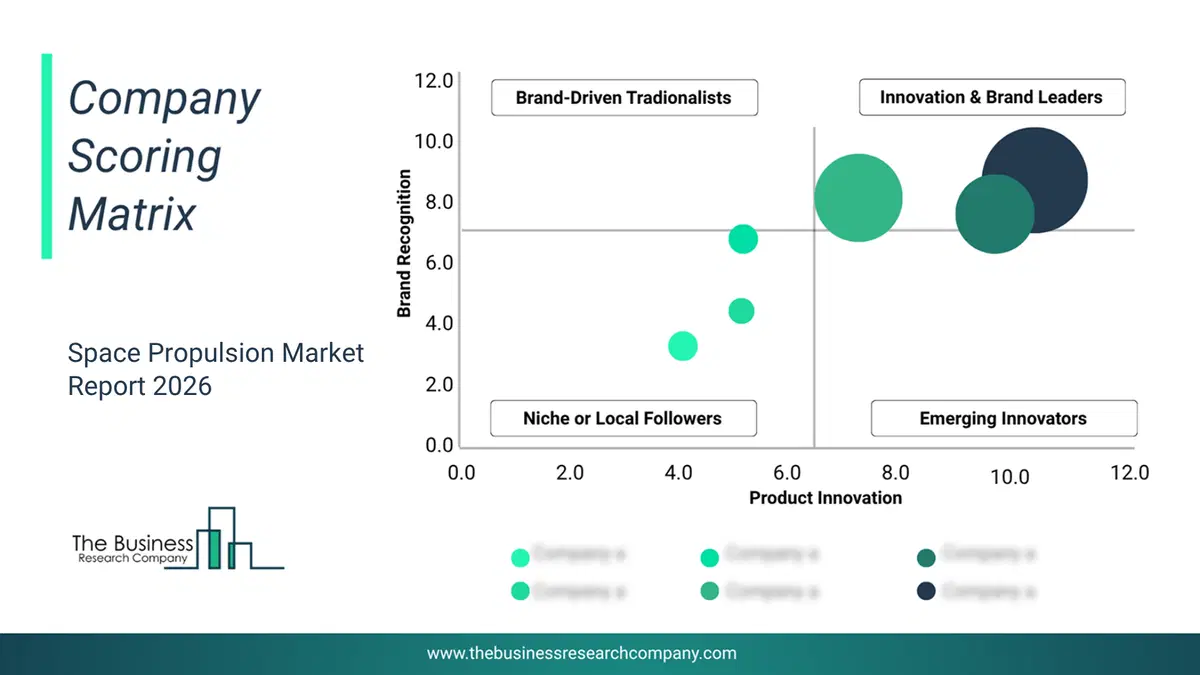
This chart maps companies by product innovation and brand strength, with bubble size indicating relative revenue, helping identify market leaders, challengers, and niche players. This is an illustrative chart; the full report provides a complete and accurate competitive analysis.
Global Space Propulsion Market Trends and Insights
Major companies operating in the space propulsion industry are adopting a strategic partnerships approach to advance technology and reduce development costs. Strategic partnerships refer to a process in which companies leverage each other's strengths and resources to achieve mutual benefits and success. For instance, in August 2023, Pulsar Fusion, a UK-based manufacturer of nuclear fusion rocket engines, partnered with the University of Michigan, a US-based public institution. With this partnership, they will develop a relationship with the plasma dynamics and electric propulsion lab at the University of Michigan, alongside Hall thruster companies such as pulsar fusion (UK) and starlight engines (us), and the University of Southampton. The partnership will be funded from the first phase of the UK Space Agency’s £20 million international bilateral fund.What Are Latest Mergers And Acquisitions In The Space Propulsion Market? Voyager Space Holdings, Inc. Acquires ZIN Technologies, Inc. to Strengthen Engineering Capabilities for Starlab Commercial Space Station Development
In March 2023, Voyager Space Holdings, Inc., a US-based leading space company dedicated to bettering humanity's future through bold exploration and cutting-edge technologies, acquired ZIN Technologies, Inc. for an undisclosed amount. With this acquisition, Voyager Space Holdings, Inc. aims to enhance its engineering capabilities and accelerate the development of the Starlab commercial space station, creating a robust platform for scientific research and innovation in low Earth orbit. ZIN Technologies, Inc., a US-based aerospace and defense company, supports space propulsion efforts indirectly through its work in aerospace system integration and research collaborations for spacecraft development.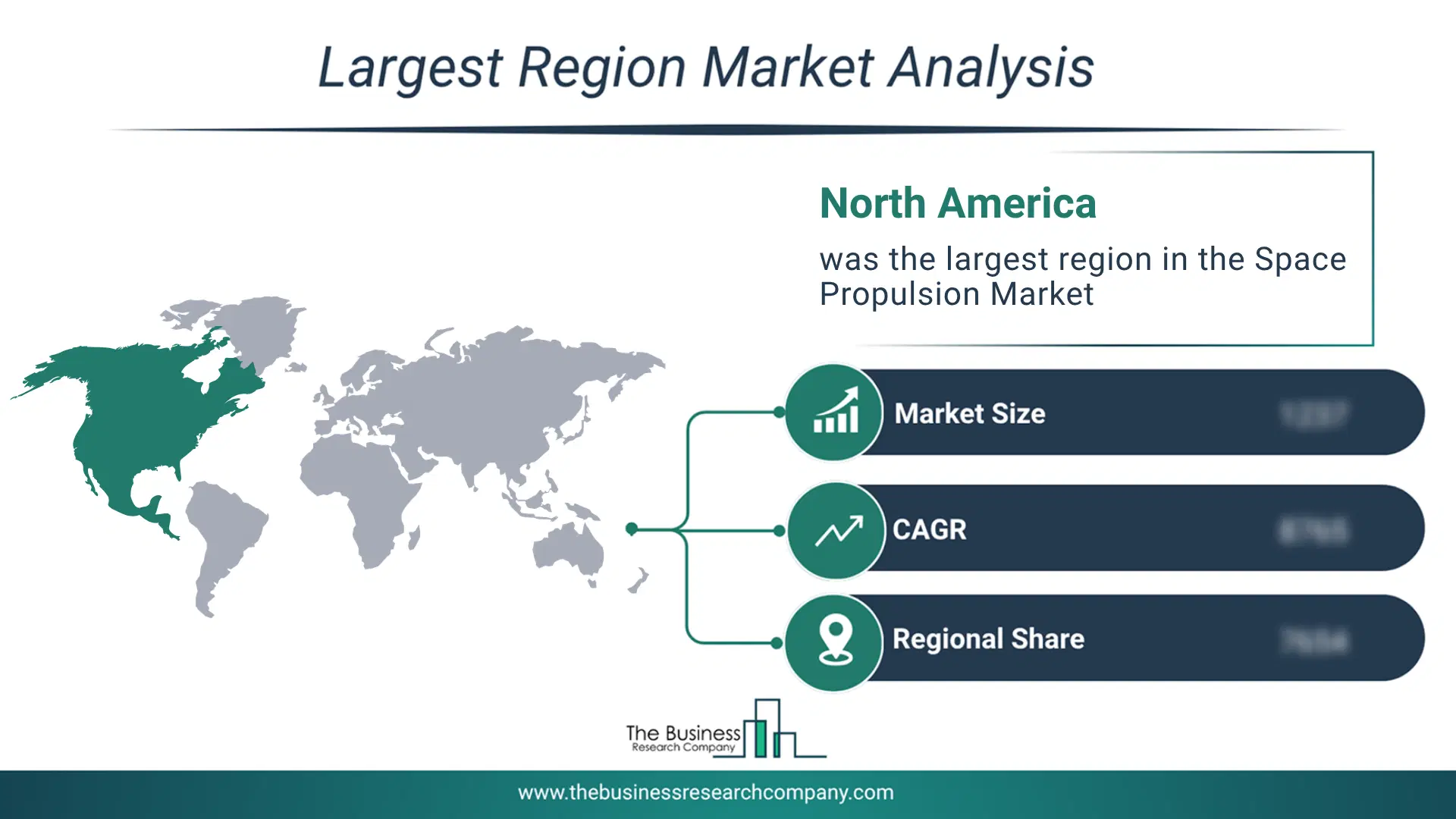
Regional Insights
North America was the largest region in the space propulsion market in 2025. North America is expected to be the fastest-growing region in the space propulsion market share during the forecast period. The regions covered in this market report are Asia-Pacific, South East Asia, Western Europe, Eastern Europe, North America, South America, Middle East, Africa. The countries covered in this market report are Australia, Brazil, China, France, Germany, India, Indonesia, Japan, Taiwan, Russia, South Korea, UK, USA, Canada, Italy, SpainWhat Defines the Space Propulsion Market?
The space propulsion market consists of sales of electric, and propellant-less space propulsions. Values in this market are ‘factory gate’ values, that is the value of goods sold by the manufacturers or creators of the goods, whether to other entities (including downstream manufacturers, wholesalers, distributors, and retailers) or directly to end customers. The value of goods in this market includes related services sold by the creators of the goods.How is Market Value Defined and Measured?
The market value is defined as the revenues that enterprises gain from the sale of goods and/or services within the specified market and geography through sales, grants, or donations in terms of the currency (in USD unless otherwise specified). The revenues for a specified geography are consumption values that are revenues generated by organizations in the specified geography within the market, irrespective of where they are produced. It does not include revenues from resales along the supply chain, either further along the supply chain or as part of other products.
This chart presents market attractiveness based on a quantitative evaluation of growth, competition, strategic alignment, and risk, offering a clear view of opportunity areas for decision-making. This chart is for illustrative purposes; the full report contains the complete analysis.

This chart highlights the Total Addressable Market (TAM) by estimating the maximum revenue opportunity using an assumption-driven approach, supporting strategic planning and opportunity sizing across markets. The chart is illustrative; the full report provides a more comprehensive analysis.
What Key Data and Analysis Are Included in the Space Propulsion Market Report 2026?
The space propulsion market research report is one of a series of new reports from The Business Research Company that provides market statistics, including industry global market size, regional shares, competitors with the market share, detailed market segments, market trends and opportunities, and any further data you may need to thrive in the space propulsion industry. The market research report delivers a complete perspective of everything you need, with an in-depth analysis of the current and future state of the industry.Space Propulsion Market Report Forecast Analysis
| Report Attribute | Details |
|---|---|
| Market Size Value In 2026 | $16.84 billion |
| Revenue Forecast In 2030 | $30.48 billion |
| Growth Rate | CAGR of 16% from 2026 to 2030 |
| Base Year For Estimation | 2025 |
| Actual Estimates/Historical Data | 2020-2025 |
| Forecast Period | 2026 - 2030 |
| Market Representation | Revenue in USD Billion and CAGR from 2026 to 2030 |
| Segments Covered | Type, Platform, System Component, Orbit, End User |
| Regional Scope | Asia-Pacific, Western Europe, Eastern Europe, North America, South America, Middle East, Africa |
| Country Scope | The countries covered in the space propulsion market report are Australia, Brazil, China, France, Germany, India, Indonesia, Japan, Taiwan, Russia, South Korea, UK, USA, Canada, Italy, Spain |
| Key Companies Profiled | OHB SE, Accion Systems Inc., The Boeing Company, Northrop Grumman Corporation, Maxar Technologies Inc., Thales Alenia Space, Airbus SE, VACCO Industries Inc., Moog Inc., Cobham Mission Systems Wimborne Limited., Safran S.A., NPO Splav, BAE Systems plc, Hanwha Group, Avibras Indústria Aeroespacial S.A., Blue Origin LLC, The Aerospace Corporation, Aerojet Rocketdyne Holdings Inc., Astrobotic Technology Inc., ArianeGroup, IHI Corporation, Mitsubishi Heavy Industries Ltd., Honeybee Robotics Ltd., Bluestaq LLC, Aurora Flight Sciences Corporation., Planet Labs Inc., Sierra Nevada Corporation, Avio SpA, Beta Technologies Inc. |
| Customization Scope | Request for Customization |
| Pricing And Purchase Options | Explore Purchase Options |