Biotechnology is advancing rapidly as digital tools, automation, artificial intelligence, and new biological engineering methods transform research, manufacturing, and commercial production. Technologies such as single-use bioprocessing, synthetic biology, bioinformatics, biosimulation, and digital biomanufacturing are helping life sciences companies improve development speed, manufacturing flexibility, process control, and scientific decision-making.
At the same time, biotechnology is expanding beyond traditional pharmaceutical applications into industrial production, sustainable materials, genomics, and advanced biological design. Global Market Model analyzed key biotechnology markets to understand their current market sizes in 2025 and expected growth through 2035.
Market Size and Growth Comparison
The comparison highlights how biotechnology markets differ in terms of current scale, adoption, and future growth potential.
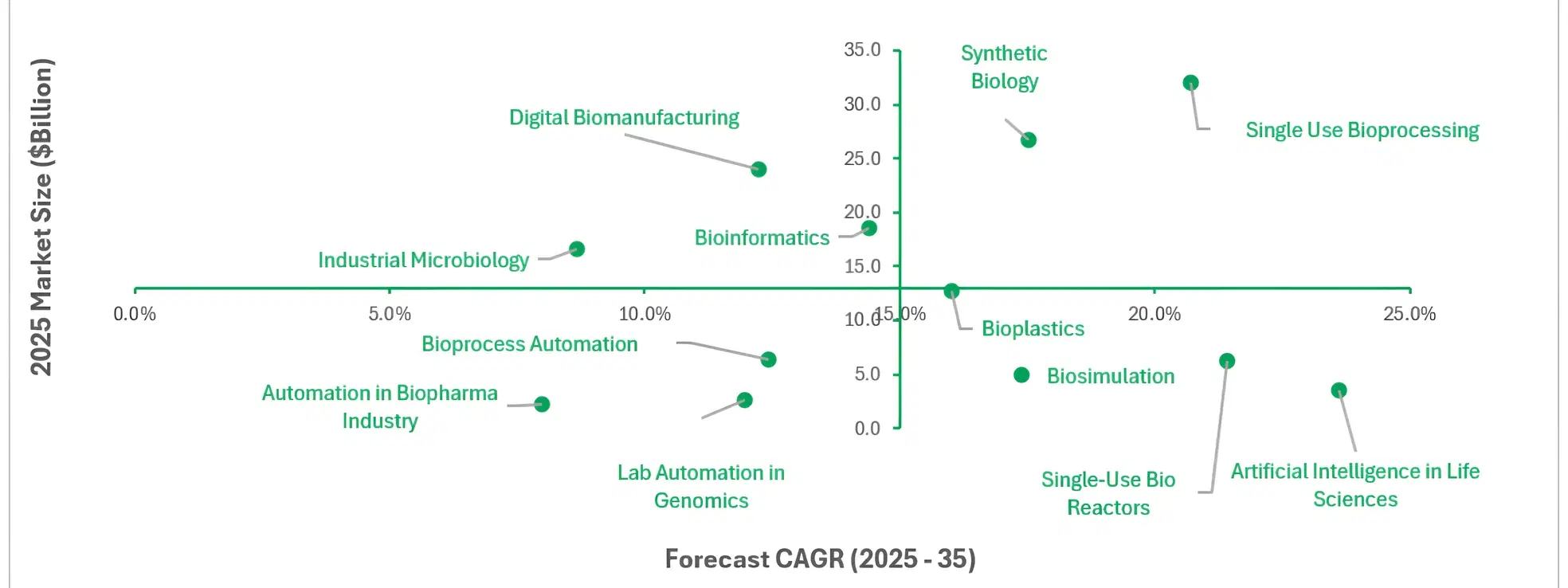
- Single-use bioprocessing, synthetic biology, and digital biomanufacturing represent some of the largest markets in the group. Their scale reflects the growing use of flexible manufacturing systems, engineered biological processes, and digitally connected production environments across biotechnology and biopharmaceutical operations.
- Artificial intelligence in life sciences, single-use bioreactors, single-use bioprocessing, and biosimulation are among the faster-growing markets. Their expansion is being supported by demand for faster research, more flexible production, improved modelling, and greater automation across drug development and manufacturing.
- Bioinformatics, bioplastics, and industrial microbiology represent established and expanding biotechnology markets. These segments support biological data analysis, sustainable material production, fermentation, enzyme applications, and industrial-scale use of microorganisms.
- Bioprocess automation, lab automation in genomics, and automation in the biopharma industry are comparatively smaller enabling markets. However, they play an important role in improving accuracy, throughput, reproducibility, and operational efficiency across laboratories and production facilities.
Explore our comprehensive market reports in the Biotechnology industry
Segment Insights

Single-Use Bioprocessing - Enabling Flexible Biopharmaceutical Manufacturing
Single-use bioprocessing represents the largest market analyzed, valued at $32.1 billion and growing at a CAGR of 20.7%. It includes disposable bags, tubing, filters, connectors, mixing systems, and other components used in biopharmaceutical manufacturing.
These systems reduce the need for cleaning and sterilization between production cycles, helping manufacturers shorten turnaround times and lower the risk of cross-contamination. Their flexibility is particularly valuable for biologics, vaccines, cell and gene therapies, and smaller-batch production, where manufacturers may need to switch rapidly between products.

Synthetic Biology - Engineering Biology for New Applications
Synthetic biology is valued at $26.7 billion and is projected to grow at a CAGR of 17.5%. The market focuses on designing and modifying biological systems to create new materials, chemicals, medicines, fuels, and agricultural products.
By combining biology with engineering, data science, and automation, synthetic biology enables companies to develop organisms and biological pathways for specific commercial purposes. Growth is being driven by demand for bio-based manufacturing, advanced therapeutics, sustainable chemicals, and more efficient biological production systems.

Digital Biomanufacturing - Connecting Data, Automation, and Production
Digital biomanufacturing represents a market of $24.0 billion and is growing at a CAGR of 12.2%. It integrates sensors, process analytics, automation, digital platforms, and advanced modelling across biopharmaceutical production.
Manufacturers use digital systems to monitor critical process parameters, identify deviations, improve product consistency, and optimize production in real time. The shift toward connected facilities and data-driven manufacturing is helping companies improve quality control, reduce waste, and make production more predictable.

Bioinformatics - Converting Biological Data into Actionable Insights
Bioinformatics is valued at $18.5 billion and is expected to grow at a CAGR of 14.4%. It combines biology, computer science, and statistics to store, organize, analyze, and interpret complex biological data.
The market is becoming increasingly important as genomic sequencing, proteomics, and other life sciences research activities generate large volumes of data. Bioinformatics supports drug discovery, disease research, biomarker identification, precision medicine, and agricultural biotechnology by helping researchers extract meaningful patterns from biological information.

Industrial Microbiology - Applying Microorganisms to Commercial Production
Industrial microbiology represents a market of $16.56 billion and is growing at a CAGR of 8.7%. It uses microorganisms such as bacteria, yeast, and fungi to produce enzymes, chemicals, food ingredients, antibiotics, biofuels, and other commercial products.
The segment benefits from the ability of microbial processes to operate under controlled conditions and convert renewable feedstocks into valuable outputs. While it is relatively mature, demand continues to be supported by sustainable production, fermentation technologies, and the replacement of some conventional chemical processes with biological alternatives.

Bioplastics - Advancing Sustainable Material Alternatives
Bioplastics are valued at $12.68 billion and are projected to grow at a CAGR of 16.0%. These materials are produced wholly or partly from renewable biological sources and may also offer biodegradable or compostable properties, depending on the product.
Growth is being driven by efforts to reduce dependence on fossil-based plastics, address plastic waste, and meet corporate sustainability targets. Applications are expanding across packaging, consumer goods, agriculture, automotive components, and other industries seeking lower-impact material alternatives.

Bioprocess Automation - Improving Control and Production Consistency
Bioprocess automation represents a $6.4 billion market and is growing at a CAGR of 12.4%. It includes automated control systems, sensors, software, and process management tools used across upstream and downstream biomanufacturing.
Automation helps manufacturers maintain consistent operating conditions, reduce manual intervention, and improve the reproducibility of biological processes. It is becoming more important as biopharmaceutical production grows in complexity and companies seek tighter control over quality, yield, and regulatory compliance.

Single-Use Bioreactors - Supporting Scalable and Rapid Production
Single-use bioreactors are valued at $6.2 billion and are expected to grow at a CAGR of 21.4%. These disposable systems provide controlled environments for growing cells or microorganisms during the production of biologics, vaccines, and other biotechnology products.
Compared with traditional stainless-steel systems, single-use bioreactors can reduce installation time, cleaning requirements, and capital intensity. Their modular nature also supports faster facility expansion and greater flexibility for small and medium production volumes.

Biosimulation - Modelling Biological and Drug Responses
Biosimulation represents a market of $5.0 billion and is growing at a CAGR of 17.4%. It uses mathematical models and computer-based simulations to study biological systems, disease progression, drug behaviour, and treatment outcomes.
Pharmaceutical and biotechnology companies use biosimulation to support dose selection, trial design, safety assessment, and development decisions. By testing scenarios virtually before conducting more expensive laboratory or clinical work, companies can reduce development risk and improve the efficiency of research programs.

Artificial Intelligence in Life Sciences - Accelerating Research and Development
Artificial intelligence in life sciences is valued at $3.6 billion and is projected to grow at a CAGR of 23.6%, making it the fastest-growing market among the segments analyzed.
AI is being applied to drug discovery, molecule design, clinical trial optimization, imaging, genomic analysis, and biological data interpretation. These technologies can identify patterns across large datasets, prioritize promising research targets, and automate complex analytical tasks. Growing data availability and pressure to shorten development timelines are accelerating adoption.

Lab Automation in Genomics - Increasing Throughput and Reproducibility
Lab automation in genomics represents a market of $2.7 billion and is growing at a CAGR of 12.0%. It includes robotic systems, liquid handlers, automated sample preparation equipment, and software used in sequencing and molecular biology laboratories.
Automation helps laboratories process larger numbers of samples with greater consistency and lower risk of manual error. As genomic testing and research volumes increase, automated workflows are becoming essential for improving turnaround time, traceability, and laboratory productivity.

Automation in the Biopharma Industry - Streamlining Laboratory and Manufacturing Workflows
Automation in the biopharma industry is valued at $2.2 billion and is projected to grow at a CAGR of 8.0%. The market includes automated systems used across research laboratories, quality control, production, packaging, and data management.
These technologies help reduce repetitive manual work, improve compliance, and standardize processes across biopharmaceutical operations. Although growth is more moderate than in AI or single-use technologies, automation remains important for companies seeking greater operational efficiency and more reliable production outcomes.
Biotechnology is increasingly being shaped by the convergence of biological science, automation, digital platforms, and advanced data analysis. Large markets such as single-use bioprocessing, synthetic biology, and digital biomanufacturing provide the foundation for flexible and scalable production, while faster-growing technologies such as artificial intelligence, single-use bioreactors, and biosimulation are changing how products are discovered, developed, and manufactured.
Biotechnology companies can use the Global Market Model to compare demand across bioprocessing, synthetic biology, bioinformatics, laboratory automation, and sustainable materials markets when planning product development or geographic expansion. Biopharmaceutical manufacturers can examine country-level market sizes and forecasts to assess where investment in digital manufacturing, automation, and single-use systems is gaining momentum. Technology providers and investors can also access historical data, long-term forecasts, and downloadable datasets to identify emerging biotechnology opportunities, benchmark market growth, and support commercial and strategic decisions through 2035.
Unlock Industry Insights with The Global Market Model
World's most comprehensive database of integrated market information
Our database provides forecasts for over 30,000+ markets, updated semi-annually to reflect the latest economic, geopolitical, and sector-specific developments. The most recent forecast, updated in July 2026, builds upon the previous insights from January 2026, ensuring unparalleled accuracy and relevance.
Leverage The Global Market Model to stay ahead, ensuring informed decisions in a rapidly evolving market.