
Competitor Intelligence In A New Geography: The Players Your Global View Cannot See
Published date: 17 August, 2026
Companies entering a new market almost always know who their global competitors are. They almost as often do not know who their competitors in that market actually are. These are different questions, and confusing them is one of the most reliable predictors of a disappointing entry.
The competitor who defeats a new entrant is rarely the multinational rival tracked in quarterly strategy reviews. It is the local player with three decades of distributor relationships, an installed base that creates switching costs, pricing built for local purchasing power, and a regulatory relationship the entrant is only beginning to establish. That competitor does not appear in global market share tables. They appear in the sales forecast, as the gap between projection and result.


Why Competitive Analysis Fails in New Markets
The Visibility Bias
Competitive research defaults to what is easy to find: listed companies, English-language filings, international press coverage, and analyst reports. In most geographies this systematically over-represents international players and under-represents domestic ones — including private firms that publish nothing, family-owned businesses with disproportionate category share, and regional operators whose strength is concentrated exactly where you intend to launch.
Position Mistaken for Strategy
Knowing a competitor's revenue tells you where they have been. It does not tell you where they are going. What determines the outcome of your entry is the strategy they will adopt in response to it — whether they will defend on price, accelerate a product launch, lock up distribution, or concede the segment. Understanding player-adopted strategies is a different research problem from measuring market share, and it requires primary work.
The Static Snapshot
A competitive landscape assessed once, at the point of business case approval, begins decaying immediately. Over the twelve to eighteen months between decision and launch, competitors are acquired, product lines are refreshed, patents are granted, distribution agreements are signed, and pricing moves. Entering a market on a competitive picture built a year earlier means entering on a picture that is materially wrong.
The Substitution Blind Spot
In unfamiliar markets, the relevant competitive set is frequently broader than the direct product category. Customers may currently solve the problem with a different technology, an informal service, a manual process, or by not solving it at all. A competitor analysis restricted to companies selling the same product misses the alternative that actually holds the budget.


What Rigorous Competitor Intelligence Covers
The Business Research Company's competitor evaluation is designed to benchmark your position against the market as it genuinely operates. The scope extends well beyond profiling.
- Competitor profiling — structured assessment of the players who matter in your specific segment and geography, including private and regional firms.
- SWOT and PESTLE analysis — competitive strengths and vulnerabilities set against the political, economic, social, technological, legal and environmental conditions of the target market.
- Competitor monitoring — ongoing tracking of strategic developments rather than a single-point assessment.
- Mystery shopping and observational research — direct, first-hand evidence of how competitors actually sell, price, and service customers, as distinct from how they describe themselves.
- Product pipeline analysis — visibility of what is coming, which frequently matters more to an entry decision than what is currently on the market.
- Patents and copyright information — intellectual property positions that may constrain your product design, marketing claims, or freedom to operate.
- Brand share calculation and competitor revenues — quantified position in the specific market you are entering, not extrapolated from global figures.
- Social media presence — how competitors engage the market and where customer sentiment actually sits.
The distinguishing features of this list are mystery shopping and observational research. Both generate primary evidence about competitor behaviour that no database contains — what a customer is actually quoted, how quickly a competitor responds to an enquiry, what is promised in the sales conversation, and where the service experience is weak. In a new geography, where published information is thinnest, this kind of direct observation frequently produces the single most actionable finding in the entire study.

The Questions Competitor Research Should Answer Before You Enter
- Who genuinely holds share in our specific segment and region — not the national or global picture, but the addressable slice we intend to serve.
- What price does the market believe this category is worth, and what does that imply for our margin structure and positioning.
- Which distribution relationships are already locked up, and what remains genuinely available to a new entrant.
- How have incumbents responded to previous new entrants — the most reliable available predictor of how they will respond to us.
- What is in the competitive pipeline that could change the basis of competition within our first two years.
- Where are incumbents structurally weak — in service, in segment coverage, in geography, in product fit — and is that weakness durable enough to build an entry thesis on.

Why Competitor Intelligence Must Be Continuous
Competitive intelligence commissioned once is a depreciating asset. This is why our competitor work is structured around ongoing tracking rather than a single deliverable, with strategic developments monitored and reported through the year.
The practical value of that cadence is that it converts competitive intelligence from a document into a decision input. When a competitor is acquired, launches into your segment, or changes distribution strategy, the question is not whether it appeared in last year's report but whether you learn about it in time to respond. Our reports are also assessed against the macro environment — tariffs, trade policy, geopolitical conflict, inflation and interest rates — because competitive dynamics in most sectors are now driven substantially by conditions outside the sector itself.
We have delivered competitive work across a wide range of contexts, including a container house manufacturers competitor study, a survey of linear accelerator radiotherapy device competitors, and a competitive threat analysis for a global tire company.
The Competitor Tracking Package
- ✓Competitor interviews: 5–7 conducted directly with market players
- ✓Distributors and intermediaries: 3–5 interviewed for channel-side perspective
- ✓Strategic analysis of competitor positioning and adopted strategies
- ✓Market share quantified for your specific segment and geography
- ✓Quarterly updates tracking strategic developments across a full year
The inclusion of distributor and intermediary interviews alongside competitor interviews is deliberate. Intermediaries observe the competitive landscape from a vantage point no competitor will volunteer: they know which products actually move, which suppliers support their channel well, where service failures recur, and what customers ask for and cannot get. In a market you are entering for the first time, that perspective is often the most candid intelligence available.

Establishing the Competitive Baseline Before You Arrive
One of the most useful and least practised disciplines in market entry is capturing a dated competitive baseline before launch. Once you are in a market, every subsequent observation is contaminated by your own presence: competitors adjust pricing, accelerate launches and reinforce distribution partly in response to you. Without a pre-entry snapshot, it becomes impossible to distinguish the market's normal behaviour from its reaction to your arrival.
A baseline should capture prevailing price points by segment and channel, competitor product configurations and specifications, service standards and response times, distribution coverage and exclusivity arrangements, marketing positioning and claims, and the publicly visible elements of each competitor's pipeline. Recorded before entry and revisited quarterly, this converts competitive intelligence from anecdote into measurable movement — and lets you answer, with evidence, whether a price decline reflects a competitor defending against you or a market-wide trend you would have faced regardless.
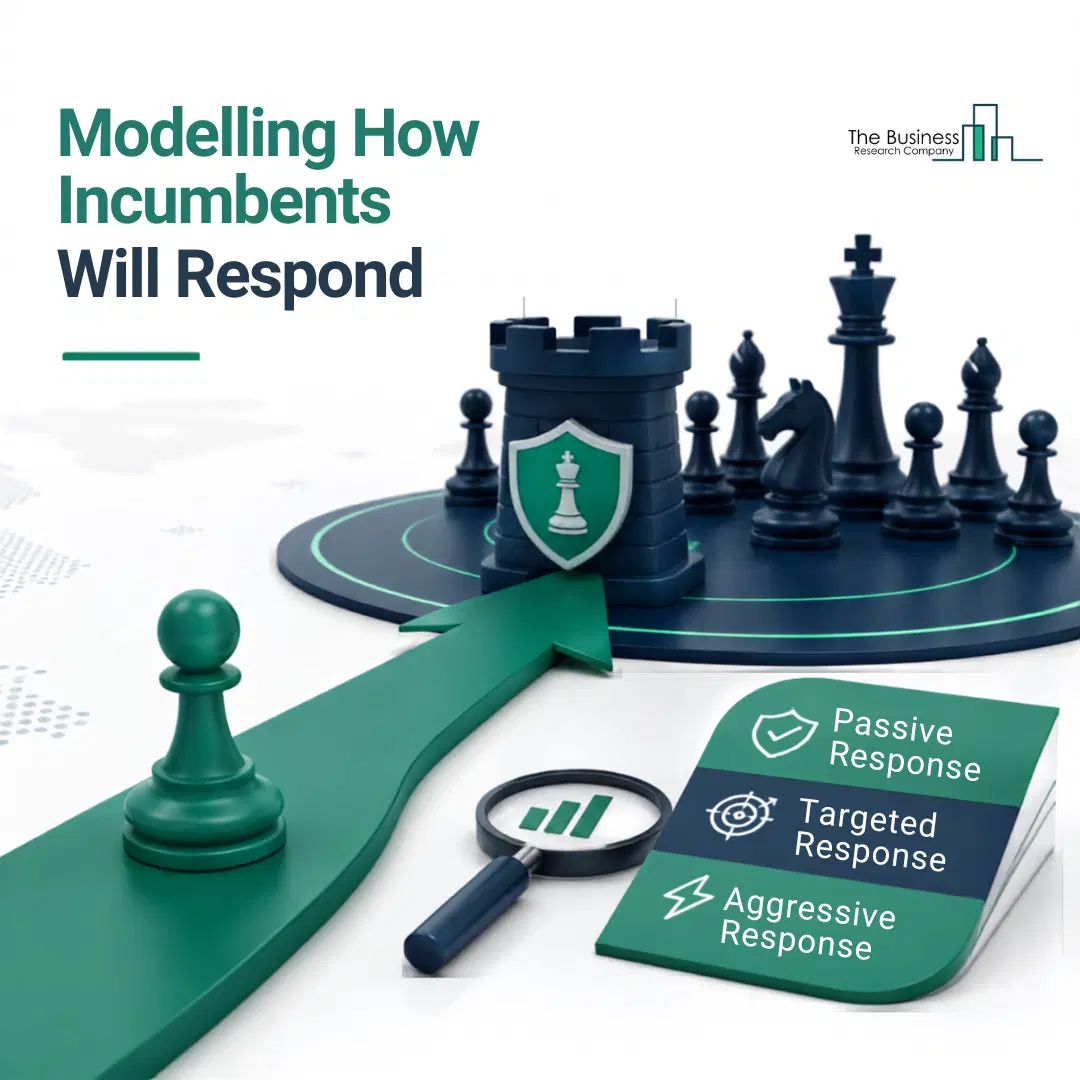

Modelling How Incumbents Will Respond
New entrants routinely plan against the competitive landscape as it stands, rather than as it will be once they are in it. This is a significant omission, because the incumbent response frequently determines the outcome. The relevant question is not only where competitors are weak today, but what they will do when a credible entrant attacks that weakness.
Response modelling is best grounded in evidence rather than speculation. The most reliable predictor of how an incumbent will respond to you is how they responded to the last entrant. Did they cut price, and how far and for how long? Did they accelerate a product launch? Did they lock in distributors with exclusivity or improved terms? Did they escalate to regulators or trade bodies? Did they concede the segment and defend elsewhere? Each of these leaves a traceable record that competitor research can recover.
Three response scenarios are usually worth building. Under a passive response, incumbents treat your entry as immaterial and your base case holds. Under a targeted response, one or two players defend the specific segment you have attacked, typically on price or distribution access. Under an aggressive response, incumbents move to deny you channel access and sustain price pressure long enough to exhaust your local funding. The strategic value of modelling all three is that it exposes whether your entry thesis survives a competitor who takes you seriously — and whether your capital plan can absorb an eighteen-month price war.

Method Matters: Rigour and Boundaries in Competitive Research
Competitive intelligence is only as good as the method behind it, and in a new geography the temptation to accept convenient information is strong. Several practices distinguish reliable work.
- Triangulation. Any material finding should be corroborated across at least two independent sources — for instance, a price point confirmed by both a distributor interview and direct observation, rather than a single claim.
- Primary over secondary. In markets where published data is thin, direct evidence from interviews, observation and mystery shopping is frequently more accurate than aggregated databases built on the same thin sources.
- Channel-side perspective. Distributors and intermediaries observe competitors from a vantage point competitors will not volunteer, and are often more candid than the competitors themselves.
- Explicit confidence grading. Findings should carry an indication of how firmly they are evidenced, so that decisions resting on weak evidence are visible as such.
- Ethical and legal boundaries. Legitimate competitive research relies on public information, observable behaviour, and voluntary disclosure from properly identified interviews. Work that depends on misrepresentation or the improper acquisition of confidential information creates legal and reputational exposure that outweighs any intelligence gained — a particularly acute risk in an unfamiliar jurisdiction.

What to Track Once You Have Entered
Pre-entry competitive research answers whether and how to enter. Post-entry tracking answers whether the thesis is holding. The two require different cadences and different metrics.
The indicators worth monitoring continuously are those that would change a decision: movement in competitor pricing within your specific segment, new entrants or exits, acquisition and consolidation activity, product launches that address the gap you targeted, changes in distribution arrangements or exclusivity, regulatory actions affecting competitors, and shifts in customer sentiment. Quarterly review of these against the pre-entry baseline turns competitive intelligence into an operating instrument rather than a document that ages on a shared drive.

From Competitive Awareness to Competitive Position
The purpose of competitor intelligence in a market entry context is not to catalogue rivals. It is to identify the specific, defensible position your business can occupy in a market where every obvious position is already held by someone with a longer history there.
That position may be a segment incumbents underserve, a service standard they have allowed to slip, a geography their distribution does not reach, or a product configuration their pipeline does not address. It cannot be identified from a summary of who the competitors are. It emerges from understanding how they operate, where they are constrained, and what they are likely to do when you arrive.