
Compliance Market Research: The Constraint That Decides Your Market Entry Timeline
Published date: 17 August, 2026
Regulation is the one variable in market entry that cannot be out-executed. A company can outspend a competitor, out-hire it, or out-market it. It cannot out-sell a product registration it does not hold, and it cannot accelerate an approval pathway by wanting the market more. Yet regulatory analysis is routinely the last piece of research commissioned and the first to be compressed when timelines tighten.
Compliance market research is the discipline of establishing, before commitment, what the regulatory environment in a target geography will require of you — in obligations, in cost, and above all in time. It determines not just whether you can enter, but when, in what legal form, and at what margin.

The Cost of Compliance Is Material and Rising
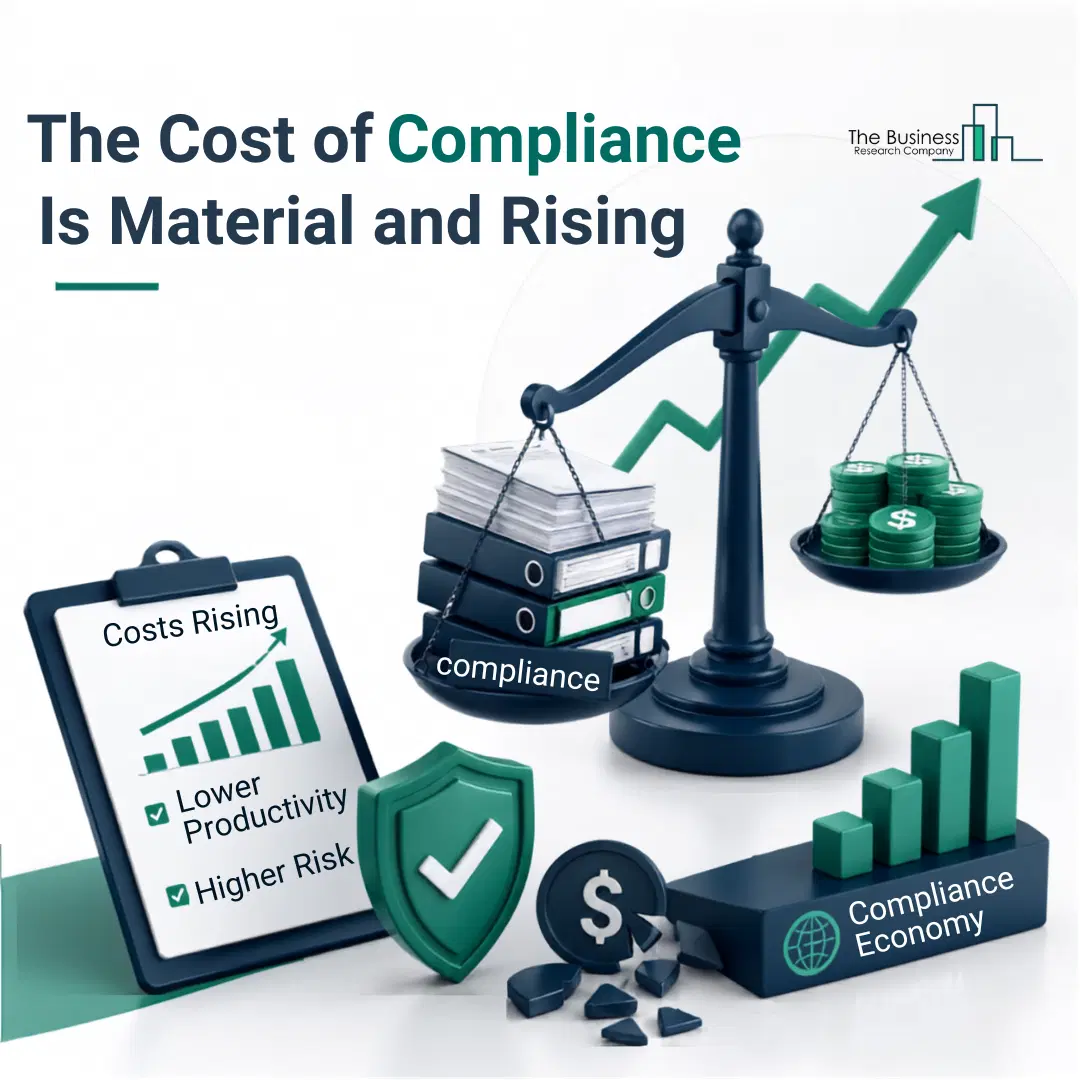
The scale of the compliance economy is now substantial in its own right. The Business Research Company's research values the global regulatory compliance market at $34.62 billion by 2030, growing at 8.3% CAGR, spanning consulting services, audit and assessment, training and certification, and risk and compliance management services. That market exists because the underlying obligation has become heavy enough to outsource.
Independent measurement bears this out. OECD analysis published in January 2026 estimates the share of the wage bill devoted to regulatory compliance tasks in the United States rose from 4.0% in 2012 to 4.2% in 2024, remained stable at around 4.5% in Australia, and increased in Europe from 3.7% in 2011 to 3.9% in 2023. Crucially, the same analysis links rising regulatory costs to weaker labour productivity and reduced business dynamism — the US increase since 2012 is associated with a decline in labour productivity of roughly 0.5%.
Earlier NBER research (Working Paper 30691) estimated the average US firm spends between 1.3% and 3.3% of its total wage bill on regulation-related tasks, with wide dispersion — some firms spend almost nothing, others more than 10%. Notably, the burden is not linear with size: analysis from the Kenan Institute indicates compliance costs rise with headcount up to roughly 500 employees before economies of scale begin to help, and that a firm in the top quartile of regulatory exposure shows approximately 1.35% lower profitability than a comparable firm in the bottom quartile.
The failure case is more expensive still. Analysis of breach costs indicates incidents involving a non-compliance factor cost materially more than those without — recent estimates put the differential at around $174,000 more per incident, on an overall average of approximately $4.61 million in 2025. And this is before considering the costs that do not appear in any breach ledger: withdrawn products, suspended licences, blocked shipments, and the reputational consequence of a regulator's public finding.

Why Compliance Research Belongs at the Front of the Process, Not the End
The sequencing error is the expensive part. Entry mode — wholly owned subsidiary, joint venture, distributor agreement, licensing, franchise, or acquisition — is very often decided in the first internal strategy meeting, before the regulatory position is understood. This is precisely backwards, because regulation frequently dictates which of those structures is available, advantageous, or prohibited.
Foreign ownership caps may make a joint venture mandatory rather than optional. Local content requirements may make importing uneconomic. Data residency rules may require in-country infrastructure that changes the capital profile entirely. Licensing regimes may mean a local partner already holds the permission you would otherwise spend two years obtaining. Each of these findings changes the entry model — and each is far cheaper to discover before an entity has been incorporated and a structure put in place.
Time Is the Currency That Matters Most
Executives instinctively price regulation in money. The more consequential currency is time. A product classification that triggers a longer approval pathway does not merely add cost; it moves your revenue start date, extends the period of pure cash outflow, delays the point at which local hires become productive, and hands competitors a window. A twelve-month registration timeline discovered after launch planning is complete is a twelve-month hole in a business case that was built without it.


What Compliance Market Research Covers
A thorough regulatory study for market entry is broader than a legal opinion. It combines regulatory intelligence with market context, because the practical question is rarely 'what does the rule say' but 'what does the rule mean for a company like ours entering now'.
- Product and service classification — how your offering is categorised in the target jurisdiction, since classification typically determines every downstream requirement.
- Registration, licensing and approval pathways — the sequence of permissions required, realistic timelines drawn from observed cases rather than published targets, and the documentation burden at each stage.
- Standards, labelling and certification — conformity requirements, local testing obligations, language and marking rules, and whether existing certifications are recognised or must be repeated.
- Ownership, entity and investment restrictions — foreign ownership limits, sector-specific restrictions, and investment screening regimes that shape the available entry structures.
- Trade, tariff and customs position — duty treatment, rules of origin, import licensing, and exposure to trade policy shifts over the planning horizon rather than at today's schedules.
- Data, privacy and cybersecurity obligations — residency, transfer, consent and breach-notification requirements, which increasingly determine system architecture as much as legal filings.
- Employment, tax and administrative requirements — the practical obligations of hiring and operating locally, which often surface later than expected and stall otherwise sound launches.
- Enforcement reality — how actively obligations are enforced, against whom, and with what consequence, which is frequently more informative than the statute itself.

How The Business Research Company Builds Regulatory Intelligence Into Market Entry
Compliance analysis is embedded in how The Business Research Company approaches market research rather than bolted on. Our reports assess the impact of regulatory change, government policies, trade policies and tariffs, geopolitical conflict, inflation and interest rates on the markets we cover, across 60+ geographies, and our Global Market Model connects those conditions to 16,000+ markets so that a regulatory shift can be traced to its commercial consequence rather than described in isolation.
For market entry specifically, regulatory findings are integrated with the rest of the entry picture. There is limited value in knowing that a licence takes nine months if you do not also know whether a prospective distributor already holds it, whether competitors obtained it through a particular route, and whether the demand you validated will still be there when it is granted. Our customized research practice runs regulatory, competitive, channel and customer workstreams as one engagement precisely because the decisions they inform are inseparable.
This is also why regulatory compliance is written into our Supplier & Distributor Package rather than sold separately. Selecting a partner and satisfying local requirements are two views of the same problem: in many jurisdictions the partner's own licences, registrations and compliance history directly determine whether your product can lawfully reach the market at all — and under numerous anti-bribery and sanctions regimes, their conduct can create liability for you.
- ✓Meticulous long listing of suppliers and distributors matched to your criteria
- ✓Supplier selection support and strategic shortlisting
- ✓Seamless distribution network design
- ✓Regulatory compliance assessment integrated into partner evaluation
- ✓HR and administrative support for standing up local operations

Regulatory Intensity Varies Enormously by Sector
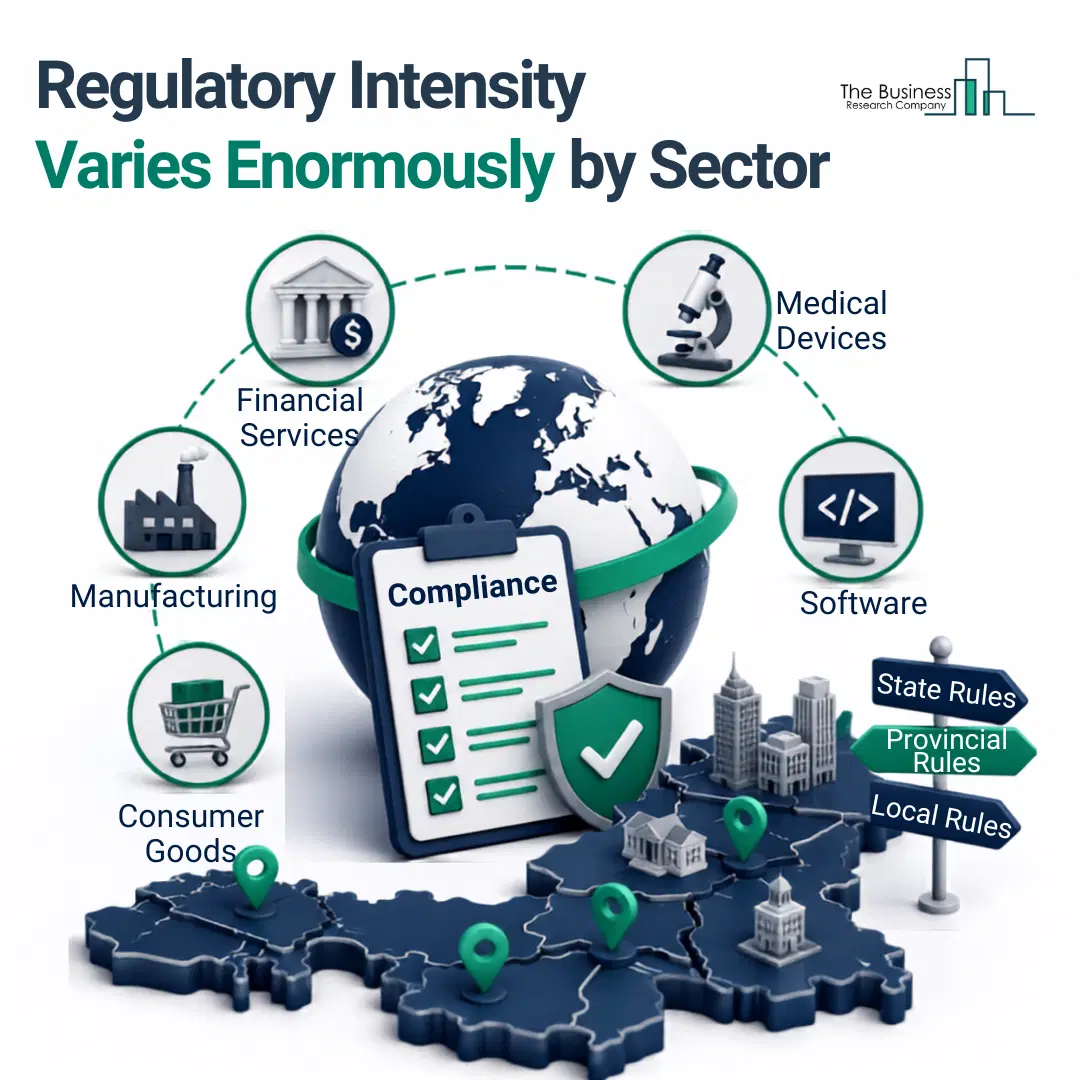
The compliance burden a company faces on entry is not a property of the country alone; it is the interaction of country and sector. NBER analysis illustrates the spread starkly: labour costs as a share of total regulatory compliance costs range from around 93.9% in the securities industry to 68.4% in manufacturing, reflecting fundamentally different compliance structures — one dominated by skilled personnel interpreting rules, the other carrying substantial capital and testing costs alongside labour.
For market entry planning, this means benchmark figures should be treated as orientation rather than estimate. A medical device entering a new jurisdiction faces classification, clinical evidence requirements, quality system audits, registration and post-market surveillance obligations that may extend the pre-revenue period by years. A financial services product faces licensing, capital adequacy, conduct rules and reporting obligations that may make certain entry structures impossible. A software product faces data residency, privacy, and increasingly AI-specific governance requirements that shape architecture. A consumer packaged good faces labelling, ingredient, packaging and marketing-claim rules that vary at sub-national level.
Each of these produces a different critical path, and the critical path is what determines the launch date. Generic country-level compliance research that does not resolve to your specific product classification will systematically understate the timeline, because the burden lives in the category detail rather than the national average.
Sub-National Complexity Is Routinely Missed
Companies frequently research a country and discover, after committing, that the operative rules are set at state, provincial or emirate level. Tax treatment, licensing, labour law, permitted marketing claims and even product standards can vary within a single national market. An entry plan built on national-level analysis in a federal jurisdiction may be accurate about the country and wrong about every location in which you actually intend to operate.

Entry Compliance Versus Ongoing Compliance
There are two distinct compliance costs in a new geography, and business cases habitually capture only the first. Entry compliance is the one-time burden of establishing lawful presence: entity formation, registrations, licences, certifications and initial approvals. Ongoing compliance is the recurring obligation of remaining lawful: renewals, periodic reporting, audits, inspections, record-keeping, and continual adaptation as rules change.
Ongoing compliance is where the burden compounds. Recent industry survey data indicates a majority of organisations now conduct four or more audits annually, with a substantial minority of enterprises exceeding six. Each audit consumes management attention as well as budget. And regulatory change itself has become a permanent operating condition rather than an occasional event — a market entry plan that assumes the rules encountered at entry will persist is planning for stability that recent years have not delivered.
The practical recommendation is to model compliance as a recurring line item in the local operating budget from year one, sized against the sector and jurisdiction, rather than treating it as a project cost that concludes at launch. Companies that budget only for entry compliance discover the ongoing burden in their second year, when it presents as unexplained margin erosion.

Compliance as Competitive Advantage, Not Overhead
The framing that serves companies best treats regulatory capability as a strategic asset. Recent surveys of senior leadership find a substantial majority — around 77% of global C-suite respondents — now consider compliance to contribute meaningfully to company objectives rather than merely constraining them. The logic is sound. Regulatory barriers that are expensive to clear are, by definition, barriers to your competitors as well. A company that has mapped the pathway accurately, budgeted for it honestly, and cleared it early holds a position that late entrants must spend the same time to reach.
The reverse is equally true. A company that treats compliance as a formality to be handled after launch planning discovers its constraints in the worst possible sequence: after capital is committed, after commitments have been made to partners and customers, and after the board has been given a date.
There is a further advantage that accrues to companies which invest early. Regulators, standards bodies and industry associations are themselves sources of market intelligence, and a company that engages them properly during the research phase — rather than presenting itself for the first time at the point of application — builds relationships that pay dividends throughout its presence in the market. Early engagement surfaces informal guidance on how rules are actually interpreted and enforced, which frequently differs from the text. It reveals forthcoming changes before they are published. And it establishes the applicant as a serious operator rather than an opportunistic entrant, which affects how subsequent submissions are received. In markets where regulatory discretion is meaningful, that standing is a genuine commercial asset, and it cannot be acquired retrospectively once a problem has already arisen.