
Custom Research vs. Off-The-Shelf Reports: Choosing Market Intelligence in the AI Era
Published date: 3rd July, 2026
AI has made information cheap and instant. Ask a chatbot for a market size and you will get an answer in seconds. That convenience has sharpened, not softened, a long-standing question for decision-makers: when is an off-the-shelf report enough, and when do you need custom research? In the AI era, the smartest organizations have learned to use both — deliberately.
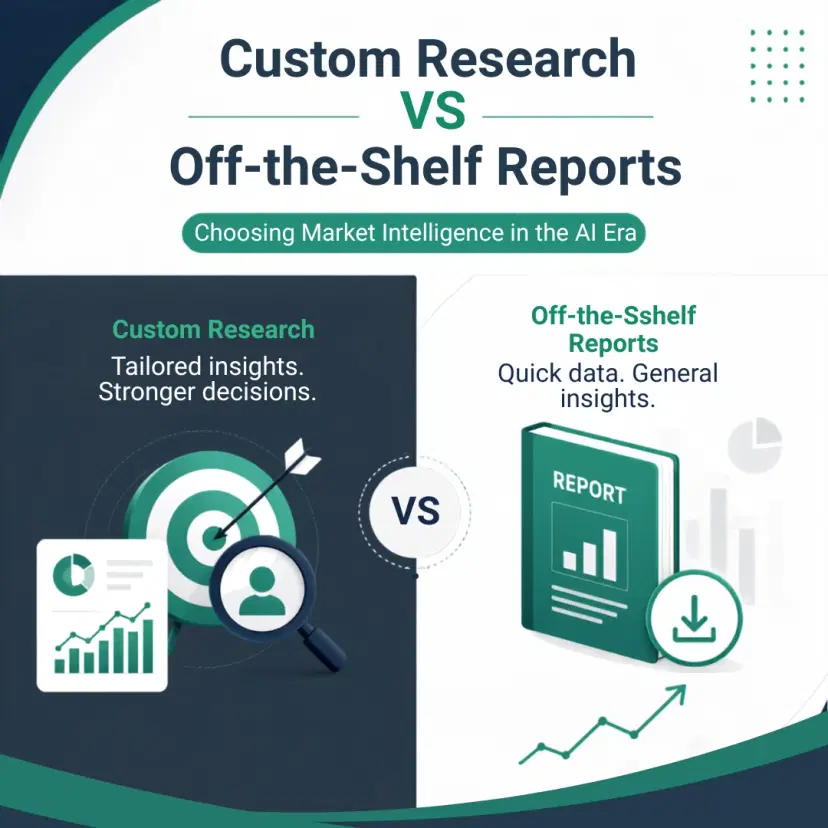

The Market Context
Demand for research is growing even as AI commoditizes basic lookups. The Business Research Company values the marketing research and analysis services market at $84.46 billion in 2025, rising to $105.31 billion by 2030 at a 4.7% CAGR — growth that TBRC attributes in part to the rising integration of AI in analytics and a growing focus on ROI-driven decisions.
The appetite for validated intelligence is rising precisely because unvalidated information is now everywhere.

What Off-The-Shelf Reports Do Well
Syndicated, ready-made reports are the efficient choice for breadth, speed, and benchmarking. TBRC publishes over 17,500 reports across 27 industries and 60+ geographies, backed by 1,500,000 datasets. A global market report delivers market sizing, segmentation, regional breakdowns, competitive landscape, total addressable market (TAM), and trends — often within days. When you need to quickly understand a market's size, growth trajectory, and key players, off-the-shelf is the right tool.
For example, a syndicated TBRC report can tell you the AI in healthcare market is projected to grow from $24.1 billion in 2025 to $91.85 billion by 2030 at a 30.2% CAGR, or that the global AI market will reach $919.62 billion by 2030 at a 30.4% CAGR. That is high-quality context, ready immediately.


What Custom Research Does That Nothing Else Can
Off-the-shelf answers a market's questions. Custom research answers your questions. When the decision is high-stakes and specific — should we enter this country, acquire this competitor, launch this product, reprice this line — you need analysis built around your exact situation.
TBRC's customized research is designed for exactly this: finding customers, evaluating competitors, identifying market opportunities, devising market-entry strategy, planning finances, and conducting distributor and partner research. Our solutions team runs senior executive interviews, consumer research, surveys, and bespoke market sizing and forecasts. This is multi-factor research — macroeconomic scenarios, regulation, competitive dynamics, and primary insight woven into a single, decision-specific deliverable.


Why AI Raises the Value of Both — and of Validation
AI accelerates research on both tracks. TBRC's AI-empowered research services automate data collection, web crawling, and analytics, while continuous research keeps intelligence live through data-rich dashboards. But AI also raises the stakes on trust. Because generative tools can produce confident, incorrect answers, the differentiator is provenance: every figure in a TBRC deliverable is sourced, referenced, and run through a multi-layer quality-control process.
McKinsey's finding that only 39% of organizations attribute any EBIT impact to AI — despite 88% using it — shows that tools without rigor do not create value. The research partner that pairs AI speed with human validation is the one that turns information into advantage.

How to Choose: A Simple Framework
- Use off-the-shelf when you need breadth, speed, benchmarking, or to scope a market before committing resources.
- Use custom research when the decision is specific, high-stakes, and unique to your business.
- Use continuous research when the market is moving fast and you need living intelligence rather than a snapshot.
- Combine all three for major strategic moves — syndicated context, custom depth, and continuous monitoring.
Find your fit: Not sure which research model fits your decision? Book a 30-minute consultation with our experts and explore our custom research packages built around your strategic goals.