
Customer And Demand Validation: Proving Buyers Exist Before You Bet On Them
Published date: 17 August, 2026
The most dangerous number in any market entry business case is the addressable market. It is dangerous precisely because it is easy to produce, difficult to challenge, and almost always wrong in the same direction. A population multiplied by a penetration assumption yields a figure large enough to justify the investment — and small enough in its evidentiary basis that nobody in the approval meeting can meaningfully interrogate it.
Demand validation is the discipline of replacing that number with evidence. Not how many people could theoretically buy, but how many will, at what price, through which channel, displacing what they use today. It is the difference between a market that exists on a slide and a market that exists.
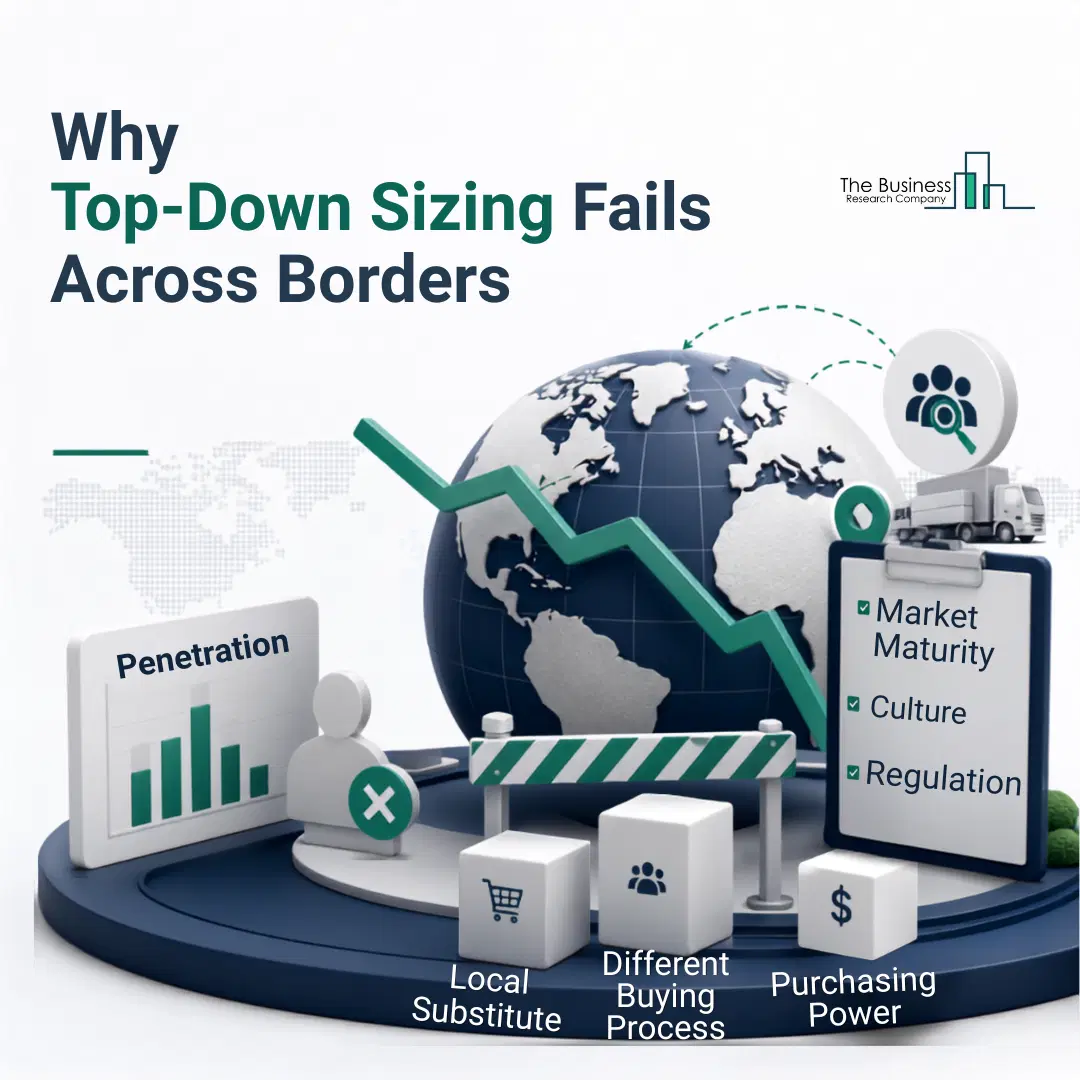

Why Top-Down Sizing Fails Across Borders
Penetration Assumptions Do Not Travel
The most common method for sizing a new geography is to take penetration in a familiar market and apply it to the target's population or GDP. This assumes the two markets convert similarly, which is exactly what has not been established. Purchasing power, category maturity, distribution infrastructure, cultural preference, regulatory permission and competitive intensity all differ — and each of them independently affects conversion.
The Substitute You Did Not Count
In an unfamiliar market, customers are rarely doing nothing. They are solving the problem with something — a local product, an informal service, a manual workaround, or a lower-specification alternative that is entirely adequate for their needs. Sizing exercises that count everyone with the underlying need, rather than everyone whose current solution is genuinely inadequate, systematically overstate the opportunity.
Stated Interest Versus Actual Purchase
Survey respondents are consistently more enthusiastic about a proposition than buyers are. Well-designed research addresses this by testing at realistic price points, against named alternatives, with questions about current spend and switching cost rather than abstract appeal. Poorly designed research produces encouraging percentages that evaporate on contact with a purchase order.
The Buying Process Is Different Here
In B2B contexts particularly, who decides, who influences, who approves budget, and how long the cycle runs varies substantially by geography. A go-to-market model calibrated to a home market with a three-month cycle and a single decision maker will underperform badly in a market with a nine-month cycle and a committee — not because demand is absent, but because the acquisition model does not fit how buying actually happens.


What Demand Validation Research Should Establish
- Who the buyer actually is — segment, profile, and the distinction between the user, the decision maker and the budget holder.
- What they use today and what it costs them, since your competition is the status quo before it is any named company.
- What would make them switch, and what switching costs — financial, operational, contractual or habitual — stand in the way.
- What price the market finds credible, tested against named alternatives rather than in isolation.
- How they buy — channel preference, decision process, cycle length, and the evidence they require before committing.
- Where they can be reached — the practical question of which channels, events, intermediaries and communications actually connect with this audience in this geography.
The output that matters is not a percentage of respondents expressing interest. It is a defensible bottom-up demand estimate, reconciled against the top-down figure, with the variance explained. When those two numbers diverge sharply — and they usually do — the divergence itself is the finding, because it exposes exactly which assumption the business case is resting on.

How The Business Research Company Approaches Customer Research
Our customer research practice is built around two connected objectives: acquiring customers and developing them. In a market entry context both matter, because the cost of acquiring the first cohort of customers in an unfamiliar geography is high enough that retaining and expanding them is what makes the unit economics work.
Customer Acquisition
On the acquisition side, we identify and segment the potential audience to support accurate targeting and brand positioning. The work includes needs analysis to establish what customers actually require rather than what they are assumed to require; prospect database building and prospect profiling; consumer surveys conducted through CATI, email and face-to-face channels, with customer data gathering and structured follow-ups; and qualified lead generation, pre-sales calls and appointment setup.
That final element deserves emphasis, because it changes what the research produces. Most customer research concludes with a report. Ours can conclude with meetings. For a company entering a new geography, the difference between an analysis of who the buyers are and a calendar of appointments with them is the difference between a study and a pipeline.
Customer Development
On the development side, we help optimise the process of deepening existing relationships through closer monitoring, social listening, customer satisfaction surveys and longitudinal customer studies. Longitudinal work is particularly valuable in a new market: measuring the same customers over time reveals whether early enthusiasm converts into repeat purchase, where satisfaction erodes, and whether the positioning that won the first cohort will win the next.
We have delivered demand-side studies across varied categories, including a high-priced microwell plates market study, a study of the rental market potential of compressors, and a wake-up lights market study — each requiring primary evidence about who buys, why, and at what price.
The Customer Research Package
- ✓Customer acquisition focus with segmentation and needs analysis
- ✓Consumer surveys via CATI, email and face-to-face channels
- ✓Qualified lead generation built from validated prospect profiling
- ✓Pre-sales calls and appointment setup with target buyers
- ✓Satisfaction surveys supporting retention and customer development
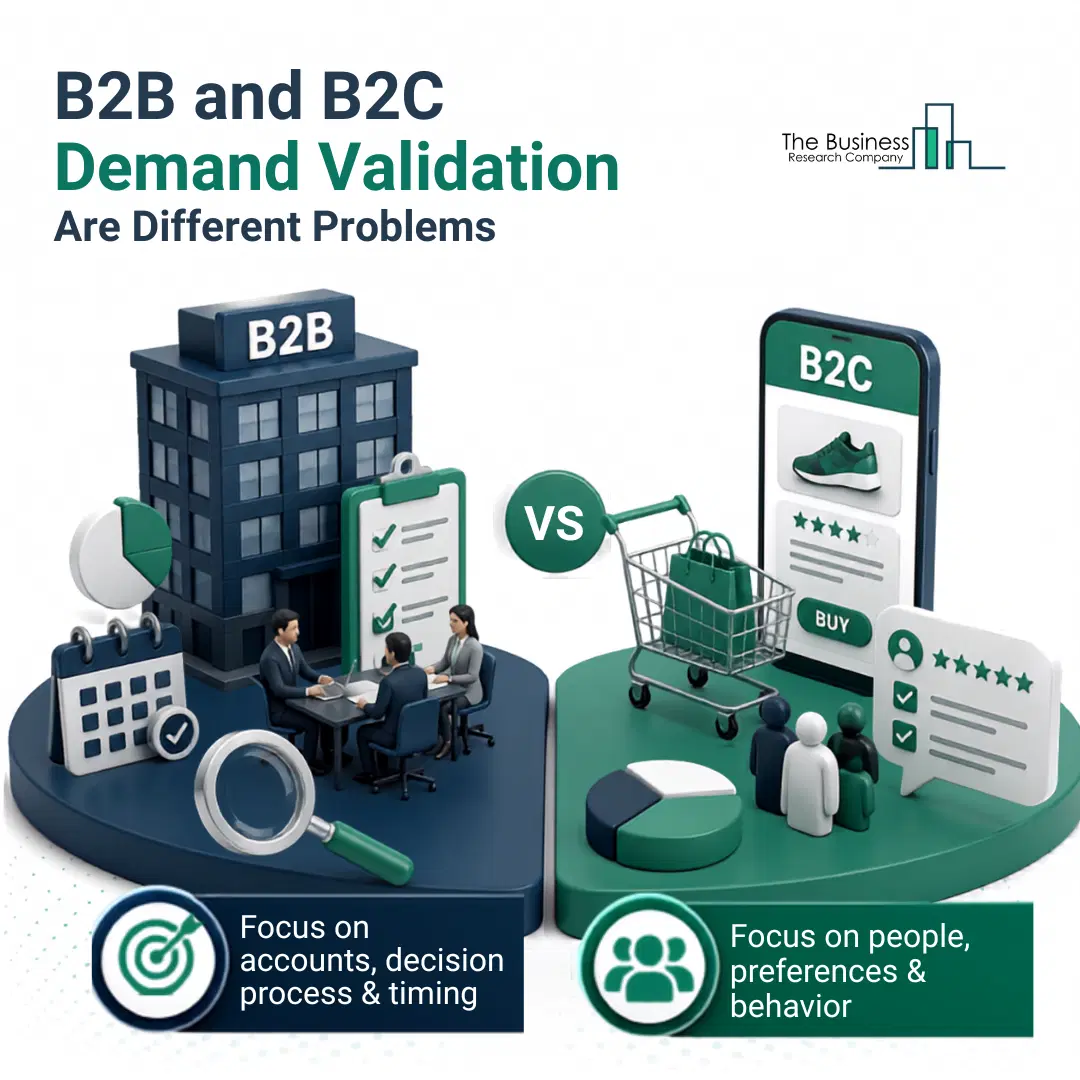

B2B and B2C Demand Validation Are Different Problems
The two require genuinely different methods, and applying the wrong one produces confident but misleading results.
Validating B2B Demand
In business markets, the population of potential buyers is often small enough to enumerate, which changes the research design entirely. Rather than sampling a large population for statistical representativeness, the objective is depth across a well-chosen set of accounts: understanding the buying committee, the approval thresholds, the procurement process, the incumbent supplier relationships and their contractual duration, and the budget cycle that determines when a purchase is even possible.
Contract timing is frequently the finding that most affects the plan. A market where the target accounts are two years into five-year agreements with an incumbent is not a market without demand; it is a market where demand is not addressable on your intended timeline. That distinction rarely survives a top-down sizing exercise, and it fundamentally changes both the revenue ramp and the case for entering now versus later.
Validating B2C Demand
In consumer markets, sample design and representativeness carry the weight. Research must reach the actual target demographic in the actual geography, in the appropriate language, through channels that do not systematically bias who responds — an online panel in a market with uneven internet penetration will over-represent urban, higher-income respondents and produce an encouraging result that does not describe the market. This is why survey channel selection matters: CATI, email and face-to-face each reach different populations, and the right instrument depends on who you need to hear from.
Consumer validation also has to contend with the gap between stated and revealed preference more acutely than B2B. Techniques that force trade-offs — presenting realistic prices alongside named alternatives, requiring respondents to allocate a fixed budget, or testing against the specific product they currently buy — produce far more reliable signals than direct questions about purchase intent.

Research Quality Determines Decision Quality
A demand study is only as trustworthy as its design, and several failure modes recur often enough to be worth naming explicitly.
- Sample that does not match the target. Research conducted among a convenient population rather than the actual buyer produces precise answers to the wrong question.
- Leading instrument design. Questions that describe a proposition enthusiastically before asking about interest reliably generate enthusiasm.
- Absent alternatives. Testing a proposition in isolation, without the competing options a real buyer would weigh, systematically overstates appeal.
- Unrealistic pricing. Interest measured without a credible price attached measures curiosity, not demand.
- Translation without localisation. A questionnaire translated literally, without adapting concepts and terminology to local usage, can change what is actually being asked.
- Ignoring non-response. Who declined to participate is frequently as informative as who agreed, particularly in B2B contexts where the least engaged accounts may be the most loyal to an incumbent.
This is why methodology transparency matters when commissioning research. A credible provider will specify sample composition and size, the instrument, the channels used, the fieldwork period, and the known limitations of the design — and will present findings with an indication of confidence rather than uniform certainty.

Establishing a Price the Market Will Accept
Pricing is where demand validation delivers some of its clearest commercial value, because pricing errors in a new market are both common and expensive in either direction. Price too high and you confirm the perception that you do not understand local conditions. Price too low and you anchor the market beneath your sustainable margin, having also surrendered the premium positioning that may have been your differentiator.
Useful pricing research establishes what buyers currently pay for the alternative they use today, what they consider the category to be worth, at what point price becomes a barrier and at what point it begins to signal inadequate quality, and how price sensitivity varies across the segments you might target. Combined with competitive intelligence on prevailing price points and margin structures through the channel, this produces a defensible position rather than a figure converted from the home market at the prevailing exchange rate — which remains, remarkably, how a great many entry prices are set.

Demand Validation Does Not Stand Alone
Customer research produces its most useful answers when it runs alongside the other market entry workstreams rather than in isolation, because the questions are interdependent.
- Demand and channel. Where customers prefer to buy determines which distributors matter — and whether the partner you were considering actually reaches them.
- Demand and competition. What customers use today is competitive intelligence. Their reasons for staying with it are your competitors' real strengths, stated by the people who chose them.
- Demand and compliance. What you may claim, how you may market, and in some sectors who you may sell to are regulatory questions that shape the proposition being tested.
- Demand and pricing. Credible price emerges from what buyers currently pay and what alternatives cost — which is customer research and competitive research answering the same question from two directions.
This is why our customized research practice runs these workstreams as a single engagement, and why the Platinum Market Entry Support Package consolidates competitor and distributor interviews, partner long-listing and shortlisting, customer development and continuous tracking into one first-year programme. Sequencing them as separate projects produces four documents that each answer a question the others have already changed.
Platinum Market Entry Support Package
- ✓Exclusive analysis report from interviews with key competitors and distributors
- ✓Direct company-to-competitor comparisons
- ✓Meticulous long-listing and strategic shortlisting of partners
- ✓Nuanced customer development across acquisition and retention
- ✓Ongoing tracking and market updates through the critical first year

The Question Worth Answering Before You Commit
Every market entry business case contains an implicit claim: that a specific number of identifiable buyers will pay a specific price for a specific proposition through a specific channel, within a specific period. Demand validation makes that claim explicit and tests each component of it while the cost of being wrong is still measured in research fees rather than in inventory, headcount and a written-off entity.
Companies that validate demand before entry do not merely reduce risk. They enter with a segmented target list, a tested price point, a channel strategy grounded in buyer preference, and in many cases a set of qualified conversations already underway. That is a materially different starting position from a launch built on a penetration assumption — and it is the difference that shows up in the first year's revenue.