Healthcare is evolving rapidly as digital technologies transform how patients are diagnosed, treated, and monitored. From AI-driven diagnostics and remote monitoring to digital therapeutics and connected devices, digital health innovations are modernizing traditional healthcare systems and enabling more personalized, efficient, and accessible care delivery.
Global Market Model analyzed key digital health segments to understand current market sizes in 2025 and growth expectations through 2035.
Market Size and Growth Comparison
The comparison highlights how digital health segments vary in terms of current adoption and future growth potential:
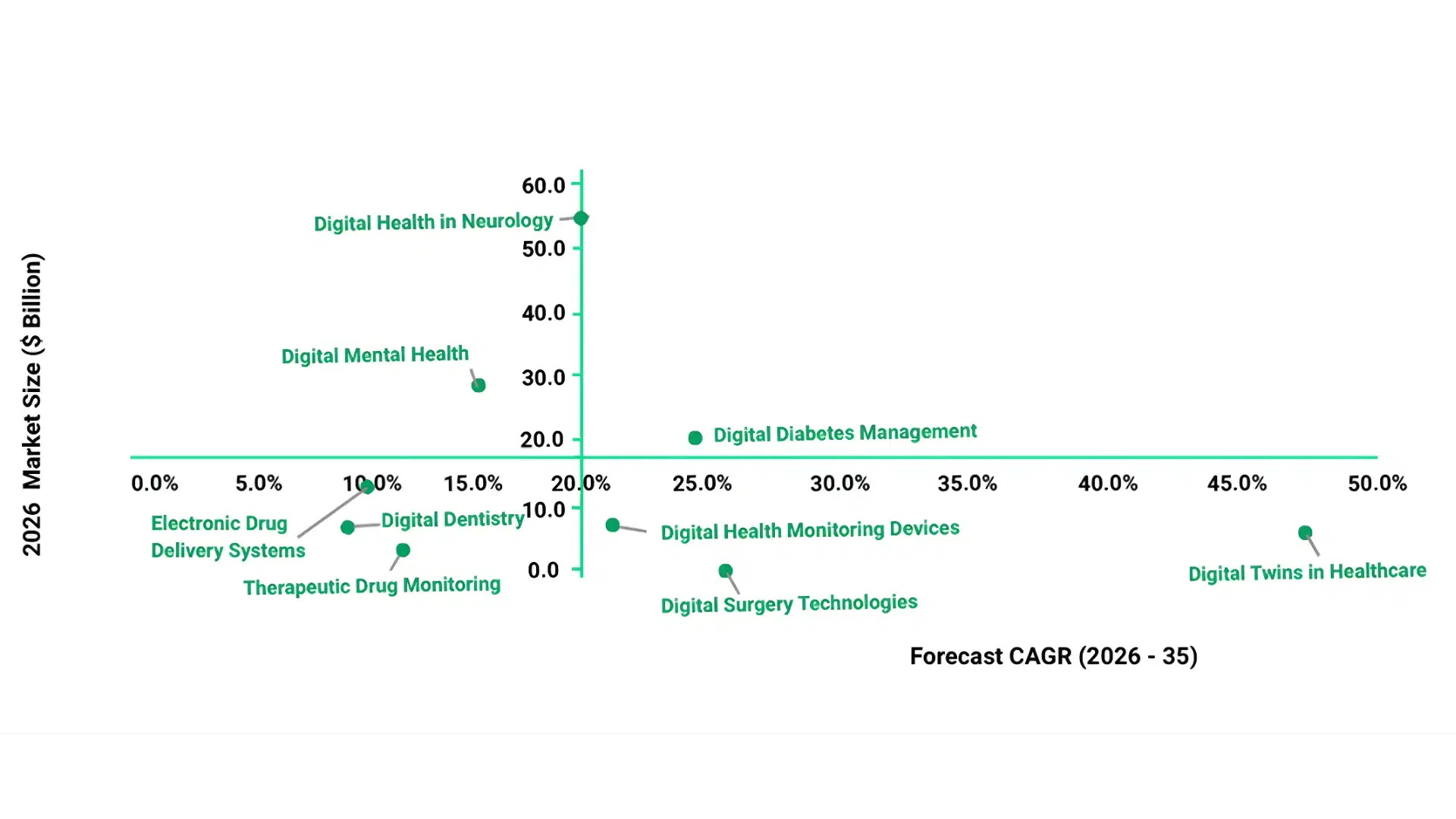
- Digital Health in Neurology and Digital Mental Health have the highest market sizes with steady growth rates, driven by the increasing global burden of neurological and psychological disorders and long-term treatment needs
- Digital Diabetes Management combines strong market size with high growth, supported by rising diabetes prevalence and continuous innovation in monitoring and treatment technologies
- Digital Twins in Healthcare, Digital Surgery Technologies, and Digital Health Monitoring Devices represent high-growth innovation segments, benefiting from advancements in AI, IoT, and real-time data analytics.
- Therapeutic Drug Monitoring, Electronic Drug Delivery Systems, and Digital Dentistry are relatively mature enabling segments, growing steadily as part of broader healthcare digitization.
Explore our comprehensive market reports in the digital therapeutics industry
Segment Insights

Digital Twins in Healthcare - Redefining Personalized Medicine
Digital twins in healthcare are emerging as one of the fastest-growing segments, with a CAGR of 47.3% and a market size of $3.0 billion. These technologies create virtual replicas of patients, organs, or biological systems using real-time data.
This allows clinicians to simulate treatment scenarios, predict disease progression, and optimize interventions before actual implementation. Growth is driven by increasing integration of AI, big data, and precision medicine approaches. While still in early adoption, digital twins have the potential to fundamentally change clinical decision-making and personalized care delivery.

Digital Surgery Technologies - Enhancing Precision and Outcomes
Digital surgery technologies integrate robotics, advanced imaging, and AI to improve surgical accuracy and efficiency. With a market size of $1.5 billion and a growth rate of 26.0%, this segment is expanding as healthcare providers prioritize better clinical outcomes.
These technologies enable minimally invasive procedures, reduce human error, and shorten recovery times. Increasing investments in robotic surgery platforms and smart operating rooms are further accelerating adoption, particularly in developed healthcare systems.

Digital Health Monitoring Devices - Enabling Continuous and Remote Care
Digital health monitoring devices, with a market size of $7.7 billion and a CAGR of 21.1%, are playing a critical role in transforming healthcare delivery.
These devices include wearable sensors, remote monitoring tools, and connected health systems that continuously track patient vitals such as heart rate, glucose levels, and oxygen saturation. Growth is driven by the shift toward preventive care, aging populations, and increasing demand for home-based healthcare. This segment is central to reducing hospital burden and enabling real-time clinical interventions.

Digital Diabetes Management - Addressing a Growing Global Burden
Digital diabetes management is a major growth driver within digital health, valued at $19.2 billion and expanding at a CAGR of 24.5%.
This segment includes continuous glucose monitoring (CGM) systems, insulin pumps, and mobile applications that help patients manage their condition more effectively. The rising global incidence of diabetes, combined with the need for continuous monitoring and lifestyle management, is fueling adoption. Integration with digital platforms and data analytics is also improving treatment outcomes and patient adherence.

Digital Health in Neurology - The Largest Digital Health Segment
Digital health in neurology represents the largest segment, valued at $54.8 billion and growing at 19.9% CAGR.
This growth is driven by the increasing prevalence of neurological disorders such as Alzheimer's disease, Parkinson's disease, epilepsy, and stroke. Digital solutions such as AI-based diagnostic tools, neuro-monitoring devices, and cognitive assessment platforms are improving early detection and long-term management. The complexity and chronic nature of neurological conditions make this a high-value, long-term growth market.

Digital Mental Health - Expanding Access to Care
Digital mental health is rapidly gaining importance, with a market size of $27.6 billion and a CAGR of 16.2%.
This segment includes teletherapy platforms, mental health apps, digital counseling services, and AI-based support tools. Growth is driven by increasing awareness, reduced stigma, and greater accessibility of care through digital platforms. The ability to provide scalable, on-demand mental health support is making this segment a critical component of modern healthcare systems.

Therapeutic Drug Monitoring - Optimizing Treatment Effectiveness
Digital mental health is rapidly gaining importance, with a market size of $27.6 billion and a CAGR of 16.2%.
This segment includes teletherapy platforms, mental health apps, digital counseling services, and AI-based support tools. Growth is driven by increasing awareness, reduced stigma, and greater accessibility of care through digital platforms. The ability to provide scalable, on-demand mental health support is making this segment a critical component of modern healthcare systems.

Electronic Drug Delivery Systems - Improving Patient Compliance
Electronic drug delivery systems, with a market size of $11.9 billion and a CAGR of 10.4%, include smart injectors, infusion pumps, and connected inhalers.
These systems improve dosing accuracy, reduce medication errors, and enhance patient compliance and adherence through automation and connectivity. Growth is driven by the increasing prevalence of chronic diseases and the need for efficient, user-friendly drug administration methods, particularly in home-care settings.

Digital Dentistry - Advancing Precision in Dental Care
Digital dentistry is valued at $6.8 billion and growing at 9.6% CAGR, representing a steady but important segment within digital health.
Technologies such as CAD/CAM systems, digital imaging, intraoral scanners, and 3D printing are improving the accuracy and efficiency of dental procedures. Adoption is increasing as clinics seek to enhance patient experience, reduce procedure time, and improve clinical outcomes.
The digital health market is evolving from fragmented innovations into an integrated and scalable healthcare ecosystem. While large segments such as neurology and mental health continue to dominate in size, high-growth areas like digital twins, digital surgery, and digital health monitoring devices are shaping the future of advanced and connected care. As digital technologies continue to mature and integrate into healthcare systems, the industry is moving toward a more predictive, personalized, and preventive care model, ultimately improving outcomes while reducing costs and increasing accessibility.
Unlock Industry Insights with The Global Market Model
World's most comprehensive database of integrated market information
Our database provides forecasts for over 30,000+ markets, updated semi-annually to reflect the latest economic, geopolitical, and sector-specific developments. The most recent forecast, updated in January 2026, builds upon the previous insights from July 2025, ensuring unparalleled accuracy and relevance.
Leverage The Global Market Model to stay ahead, ensuring informed decisions in a rapidly evolving market.