Environmental, Social, and Governance investing has evolved from a niche investment approach into an important part of global capital allocation. As governments strengthen climate policies, corporations pursue net-zero commitments, and investors place greater emphasis on sustainability, environmental markets are attracting significant investment across renewable energy, waste management, environmental services, and climate-focused technologies.
These markets support environmental protection while also creating long-term economic opportunities by enabling a cleaner, more resilient, and resource-efficient global economy. Global Market Model analyzed key environmental markets to understand their current market sizes in 2025 and expected growth through 2035.
Market Size and Growth Comparison
The comparison highlights how environmental markets differ in terms of current scale and future growth potential.
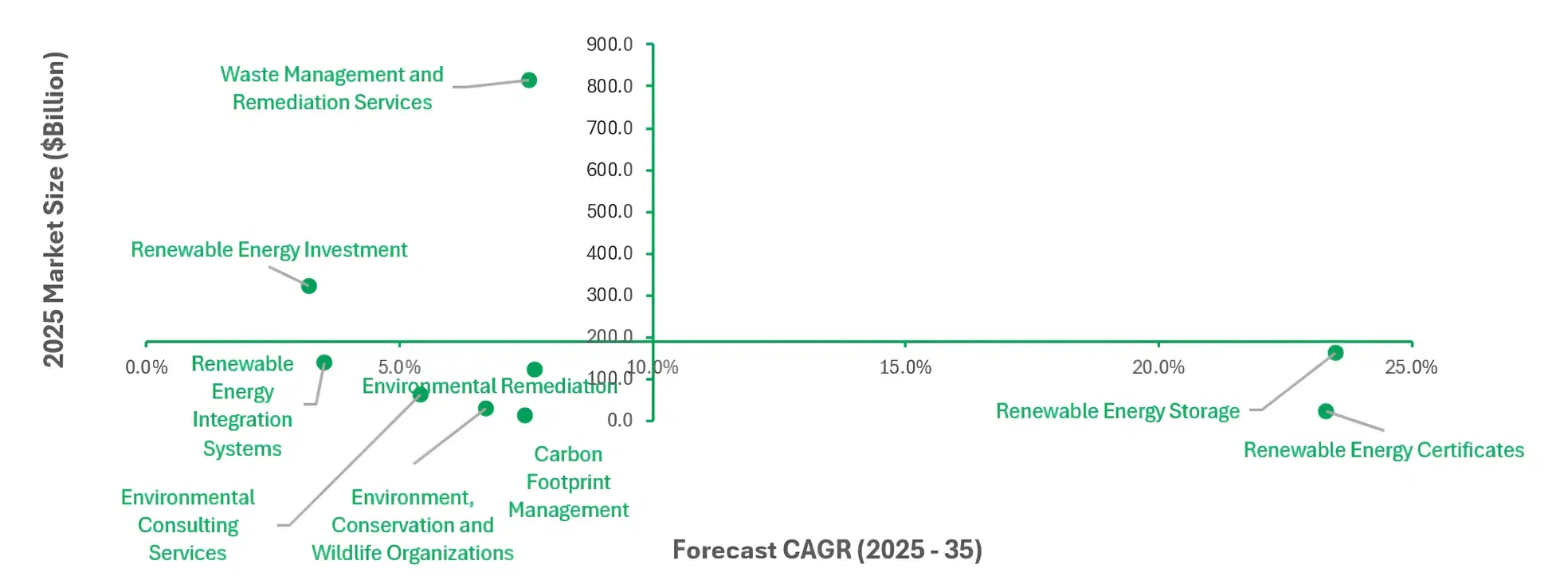
- Waste management and remediation services and renewable energy investment are the largest markets in the group. Their scale reflects the significant capital required for waste infrastructure, environmental cleanup, renewable power generation, and long-term sustainability initiatives.
- Renewable energy storage and renewable energy certificates are the fastest-growing markets. Their expansion reflects the increasing need to manage intermittent renewable power, improve grid flexibility, and help companies demonstrate progress toward renewable energy and decarbonization targets.
- Environmental remediation, environmental consulting services, carbon footprint management, and environment, conservation and wildlife organizations are smaller but important enabling markets. They support pollution control, emissions measurement, regulatory compliance, ecosystem restoration, biodiversity protection, and sustainability planning.
- Renewable energy integration systems represent a large and established market with relatively slower growth. The segment remains essential for connecting renewable energy sources to existing electricity networks and supporting the modernization of power infrastructure.
Explore our comprehensive market reports in the ESG industry
Segment Insights

Waste Management and Remediation Services - Building the Foundation of a Circular Economy
Waste management and remediation services represent the largest market, valued at $814.5 billion and growing at a CAGR of 7.6%. The market includes waste collection, recycling, treatment, disposal, hazardous waste management, and environmental cleanup activities.
The sector plays a central role in reducing pollution, recovering valuable materials, and improving resource efficiency. Increasing urbanization, stricter environmental regulations, and the growing adoption of circular economy practices are encouraging investment in recycling facilities, treatment technologies, and sustainable waste infrastructure.

Renewable Energy Investment - Accelerating the Global Energy Transition
Renewable energy investment is valued at $323.2 billion and is projected to grow at a CAGR of 3.2%. It includes capital invested in solar, wind, hydroelectric, geothermal, bioenergy, and other renewable power projects.
Although growth is relatively moderate because of the market's already substantial scale, renewable energy investment remains central to ESG strategies. Government incentives, corporate clean-energy commitments, and national decarbonization targets continue to support investment in new generation capacity and related infrastructure.

Renewable Energy Storage - Enabling Reliable Clean Energy
Renewable energy investment is valued at $323.2 billion and is projected to grow at a CAGR of 3.2%. It includes capital invested in solar, wind, hydroelectric, geothermal, bioenergy, and other renewable power projects.
Although growth is relatively moderate because of the market's already substantial scale, renewable energy investment remains central to ESG strategies. Government incentives, corporate clean-energy commitments, and national decarbonization targets continue to support investment in new generation capacity and related infrastructure.

Renewable Energy Integration Systems - Connecting Clean Power to the Grid
Renewable energy integration systems represent a market of $138.8 billion and are growing at a CAGR of 3.5%. These systems include technologies and infrastructure used to connect, manage, and balance renewable energy within existing electricity networks.
As renewable generation increases, power systems require advanced grid controls, transmission upgrades, forecasting tools, and power management technologies. The market remains strategically important even though growth is slower than in energy storage, reflecting the long development cycles associated with grid infrastructure.

Environmental Remediation - Restoring Contaminated Environments
Environmental remediation is valued at $123.0 billion and is projected to grow at a CAGR of 7.7%. The market focuses on cleaning contaminated soil, groundwater, industrial sites, and polluted ecosystems.
Demand is supported by stricter environmental standards, redevelopment of contaminated land, and the need to address pollution caused by historical industrial activity. Technologies such as soil treatment, groundwater purification, and bioremediation are helping restore land for commercial, residential, and ecological use.

Environmental Consulting Services - Supporting Sustainable Business Decisions
Environmental consulting services are valued at $61.2 billion and are growing at a CAGR of 5.4%. These services include environmental impact assessments, regulatory compliance support, sustainability strategy, environmental audits, risk assessments, and ESG reporting.
As environmental regulations become more complex, companies increasingly rely on specialist consultants to manage compliance and evaluate environmental risks. Demand is also supported by corporate sustainability targets and the need for reliable environmental data in investment and operational decisions.

Environment, Conservation and Wildlife Organizations - Protecting Natural Capital
Environment, conservation and wildlife organizations represent a market of $30.3 billion and are growing at a CAGR of 6.7%. These organizations focus on biodiversity conservation, habitat restoration, wildlife protection, ecosystem management, and environmental education.
Their role is becoming more important as biodiversity loss and ecosystem degradation gain greater attention within ESG frameworks. Funding from governments, corporations, international institutions, and philanthropic organizations supports conservation programs and the protection of natural resources.

Renewable Energy Certificates - Supporting Renewable Electricity Commitments
Renewable energy certificates are valued at $22.5 billion and are projected to grow at a CAGR of 23.3%. These certificates represent the environmental attributes associated with renewable electricity generation.
Companies use them to demonstrate that part or all of their electricity consumption is matched with renewable power. Growth is being driven by corporate clean-energy targets, net-zero commitments, voluntary sustainability programs, and increasing demand for transparent renewable energy reporting.

Carbon Footprint Management - Measuring and Reducing Emissions
Carbon footprint management is valued at $11.1 billion and is expected to grow at a CAGR of 7.5%. The market includes software platforms, monitoring systems, consulting services, and reporting tools that help organizations calculate and reduce greenhouse gas emissions.
Companies are increasingly required to measure emissions across their operations and supply chains. Climate disclosure requirements, investor scrutiny, and corporate decarbonization strategies are driving demand for tools that support emissions tracking, target setting, reporting, and reduction planning.
As ESG investing continues to influence global capital allocation, understanding the environmental markets supporting this transition has become increasingly important for investors, corporations, financial institutions, and policymakers. Large markets such as waste management and renewable energy investment provide scale, while rapidly growing areas such as renewable energy storage and renewable energy certificates are creating new opportunities across the clean-energy ecosystem.
Businesses evaluating ESG opportunities can use the Global Market Model (GMM) to identify high-growth environmental markets, compare market sizes and forecasts across countries, assess investment potential, benchmark regional opportunities, and understand how different sustainability markets are evolving over time. Whether evaluating renewable energy investments, environmental services, carbon management solutions, or conservation-related markets, Global Market Model provides access to consistent market data, long-term forecasts, country-level insights, and downloadable datasets through a single platform, helping organizations make informed investment, expansion, and strategic planning decisions.
Unlock Industry Insights with The Global Market Model
World's most comprehensive database of integrated market information
Our database provides forecasts for over 30,000+ markets, updated semi-annually to reflect the latest economic, geopolitical, and sector-specific developments. The most recent forecast, updated in July 2026, builds upon the previous insights from January 2026, ensuring unparalleled accuracy and relevance.
Leverage The Global Market Model to stay ahead, ensuring informed decisions in a rapidly evolving market.