Robotics is rapidly transitioning from a niche industrial tool to a core driver of automation across industries. Advances in artificial intelligence, machine vision, and sensor technologies are enabling robots to take on more complex, adaptive roles beyond repetitive tasks. Today, robotics is expanding across manufacturing, healthcare, logistics, agriculture, and consumer applications, reshaping how businesses operate and how services are delivered.
Global Market Model analyzed key robotics segments to understand current market sizes in 2025 and growth expectations through 2035.
Market Size and Growth Comparison
The comparison highlights how robotics segments vary in terms of current adoption and future growth potential :
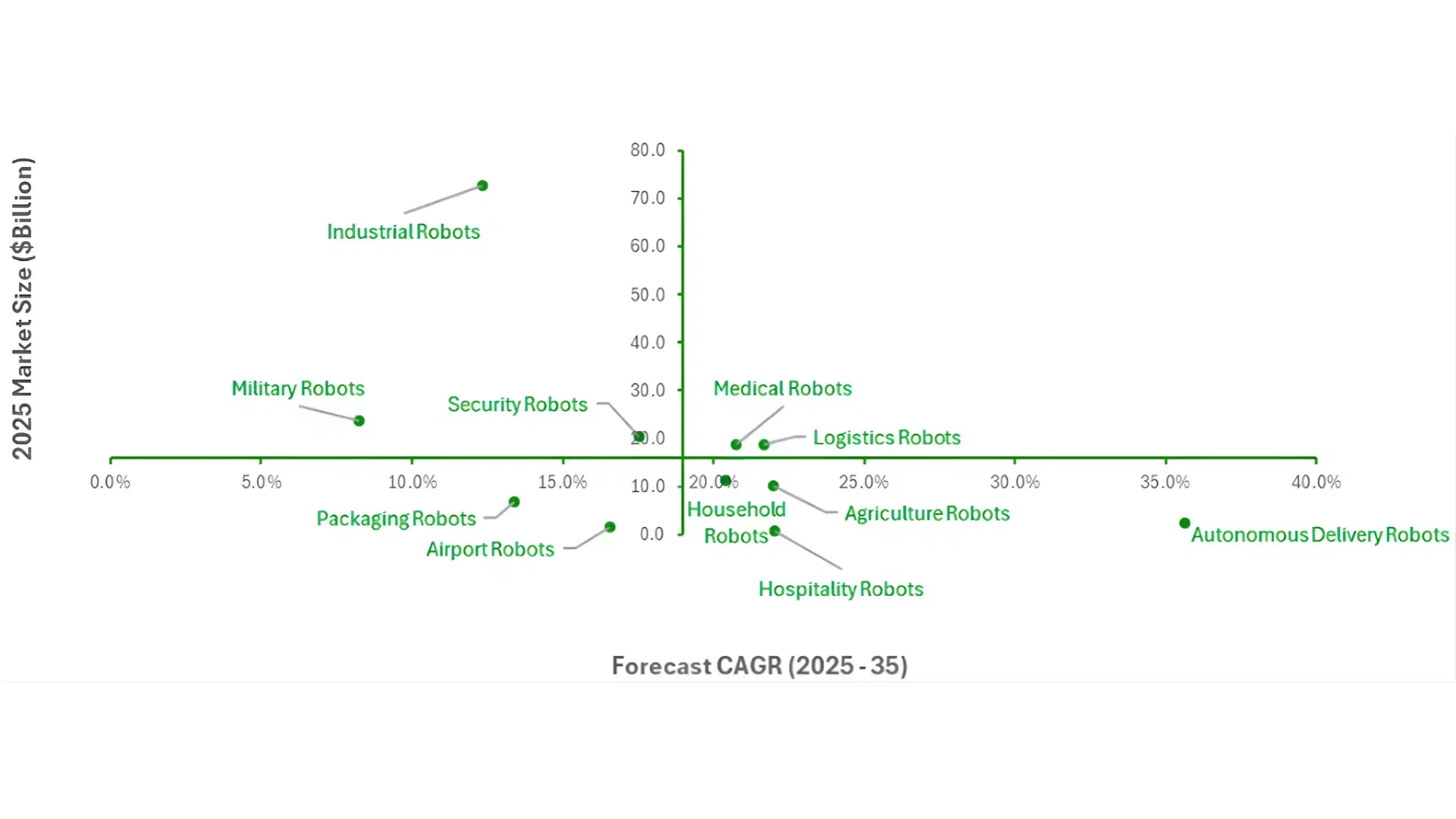
- Industrial, military, and security robots have the highest market sizes with relatively moderate growth, reflecting their maturity and widespread adoption across manufacturing, defense, and surveillance applications.
- Medical and logistics robots combine strong market size with high growth, driven by increasing automation in healthcare and supply chain operations. These segments are emerging as core expansion areas within robotics.
- Autonomous delivery, agriculture, hospitality and household robots represent high-growth segments, supported by new use cases, technological advancements, and growing demand for automation in both commercial and consumer environments.
- Airport, and packaging robots are relatively stable supporting segments, growing steadily as part of broader automation ecosystems across infrastructure and industrial processes.
Explore our comprehensive market reports in the Robotics industry
Segment Insights

Industrial Robots - The Backbone of Manufacturing Automation
Industrial robots represent the largest segment in the robotics market, valued at $72.8 billion and growing at 12.3%. These robots are widely used in automotive, electronics, and heavy industries for tasks such as assembly, welding, painting, and material handling.
Their ability to deliver high precision, consistency, and 24/7 operation makes them essential for large-scale manufacturing. Growth is supported by the transition toward Industry 4.0 and smart factories, where robots are integrated with IoT and AI systems. However, adoption is already high, leading to steady rather than exponential growth.

Military Robots - Driving Automation in Defense Operations
Military robots, valued at $23.8 billion with a growth rate of 8.3%, are primarily used in surveillance, reconnaissance, bomb disposal, and unmanned combat operations. These systems enhance operational efficiency while reducing risks to human personnel.

Medical Robots - Transforming Precision Healthcare
Medical robots, with a market size of $18.8 billion and a CAGR of 20.8%, are revolutionizing healthcare delivery. These robots are used in minimally invasive surgeries, rehabilitation, diagnostics, and patient care.
They enable higher surgical precision, reduced recovery times, and improved patient outcomes. Growth is driven by increasing healthcare investments, aging populations, and the rising need for advanced treatment solutions. Integration with AI is further enhancing their diagnostic and decision-making capabilities.

Autonomous Delivery Robots - Redefining Last-Mile Logistics
Autonomous delivery robots are the fastest-growing segment, valued at $2.5 billion and expanding at 35.6%. These robots are increasingly deployed for last-mile delivery in urban areas, campuses, and controlled environments.
They help reduce delivery costs, improve efficiency, and address labor shortages in logistics. As e-commerce continues to grow and urban logistics becomes more complex, adoption of these robots is expected to accelerate significantly.

Agriculture Robots - Enabling Precision Farming
Agriculture robots, valued at $10.2 billion and growing at 22.0%, are transforming farming through automation of labor-intensive tasks such as planting, harvesting, spraying, and monitoring crops.
These robots use sensors, GPS, and AI to enable precision farming, improving yield while optimizing the use of water, fertilizers, and pesticides. Growth is driven by rising food demand, labor shortages, and the need for sustainable farming practices.

Logistics Robots - Powering Warehouse Automation
Logistics robots account for $18.8 billion and are growing at 21.7%, driven by the rapid expansion of e-commerce and global supply chains. These robots are widely used in warehouses for picking, sorting, transporting, and inventory management.
They help companies improve operational efficiency, reduce errors, and speed up order fulfillment. Increasing adoption of automated warehouses and smart logistics systems is a key driver of this segment's growth.

Packaging Robots - Enhancing Speed and Efficiency
Packaging robots, valued at $6.8 billion and growing at 13.4%, play a critical role in automating packaging operations in manufacturing and logistics.
They enable high-speed, consistent, and cost-efficient packaging, particularly in industries such as food and beverages, pharmaceuticals, and consumer goods. Growth is supported by rising demand for automation in high-volume production environments.

Hospitality Robots - Enhancing Service Experience
Hospitality robots, valued at $0.7 billion and growing at 22.0%, are increasingly used in hotels, restaurants, and service environments. These robots assist with tasks such as food delivery, cleaning, and customer interaction.
They help improve service efficiency, reduce labor dependency, and enhance customer experience. Adoption is particularly growing in high-traffic and tech-forward environments.

Airport Robots - Supporting Smart Infrastructure
Airport robots, with a market size of $1.7 billion and growth of 16.6%, are deployed for passenger assistance, cleaning, and security operations.
These robots contribute to improving operational efficiency and enhancing the passenger experience in busy transportation hubs. Their adoption is aligned with the broader trend toward smart airports and automated infrastructure.

Security Robots - Enabling Continuous Surveillance
Security robots account for $20.5 billion and are growing at 17.5%, driven by increasing demand for automated surveillance and monitoring.
They are used in commercial buildings, public spaces, and industrial facilities for patrolling and threat detection. Their ability to provide continuous, real-time monitoring makes them a valuable addition to modern security systems.

Household Robots - Driving Smart Home Adoption
Household robots, valued at $11.3 billion and growing at 20.4%, are becoming a key part of smart home ecosystems. These include robotic vacuum cleaners, lawn mowers, and home assistants.
Growth is driven by rising consumer demand for convenience, automation, and connected living. As smart home adoption increases globally, this segment is expected to expand further.
The robotics landscape reveals a mix of mature giants and emerging disruptors. While manufacturing, healthcare, and smart cities dominate in scale, sectors like telecom services are racing ahead in growth. Meanwhile, agriculture and traditional utilities remain essential but slower adopters. As edge computing, AI, and 5G expand, robotics will continue reshaping how industries operate, connecting people, devices, and infrastructure in smarter, more efficient ways.
Unlock Industry Insights with The Global Market Model
World's most comprehensive database of integrated market information
Our database provides forecasts for over 30,000+ markets, updated semi-annually to reflect the latest economic, geopolitical, and sector-specific developments. The most recent forecast, updated in January 2026, builds upon the previous insights from July 2025, ensuring unparalleled accuracy and relevance.
Leverage The Global Market Model to stay ahead, ensuring informed decisions in a rapidly evolving market.