
Human + AI: The Future of Strategic Decision-Making
Published date: 3rd July, 2026
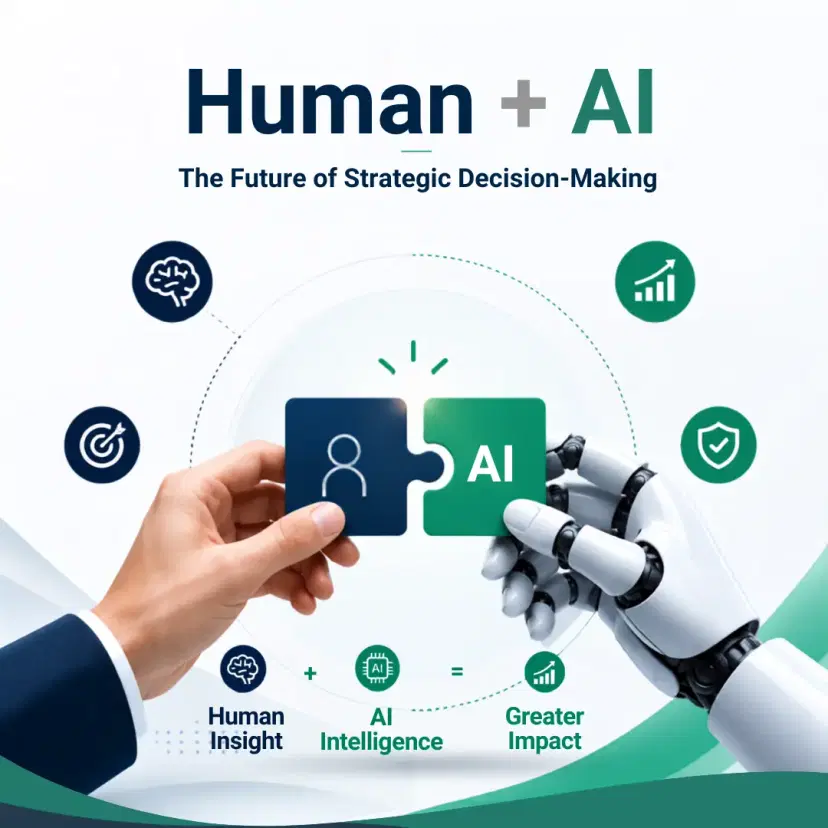
The loudest debate in business technology frames it as a contest: will AI replace human judgment? The data points to a more useful answer. The future of strategic decision-making is not human or AI — it is human and AI, with each compensating for the other's weaknesses.
The Case for the Partnership
AI's strengths are speed, scale, and pattern recognition across enormous datasets. Human strengths are context, accountability, ethics, and judgment under ambiguity. The evidence shows the combination wins. McKinsey's State of AI survey found that the organizations capturing the most value — the roughly 6% of 'AI high performers' (those attributing more than 5% of EBIT impact to AI) — are 2.8 times more likely to have fundamentally redesigned workflows (55% vs. 20% of others) and far more likely to maintain defined human-in-the-loop validation (65% vs. 23%). High performers do not remove humans; they redesign where humans add the most value.

The Market Is Voting With Its Budgets
The infrastructure for augmented decision-making is scaling fast. The Business Research Company sizes the global artificial intelligence market at $245.34 billion in 2025, heading to $919.62 billion by 2030 at a 30.4% CAGR, and the AI software market at $995.45 billion by 2030 at a 26.7% CAGR. TBRC values the predictive analytics market — the engine of decision support — at $65.28 billion by 2030, growing at 25.9% from $20.64 billion in 2025. PwC's AI Agent Survey reinforces the direction: 88% of executives plan to increase AI-related budgets over the next 12 months, and 73% agree that how they use AI agents will give them a competitive advantage. Yet the same survey shows trust drops for high-stakes tasks — a reminder that the human stays in the loop precisely where stakes are highest.

Designing the Human + AI Workflow
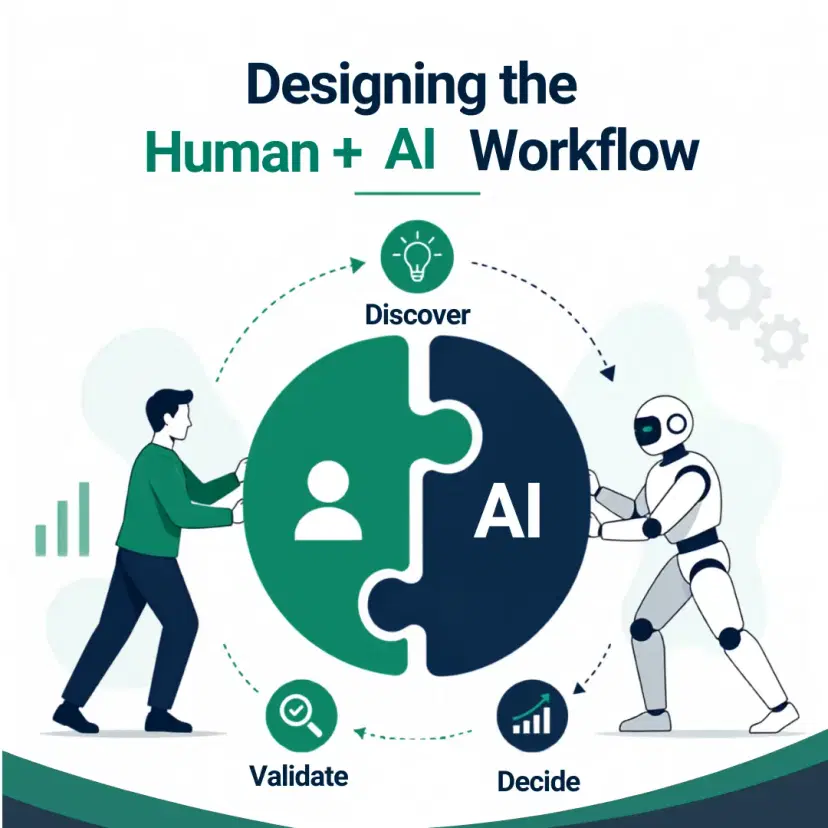
What does a well-designed partnership look like in practice? Three principles stand out: AI accelerates discovery; humans set the question. A strategic question — should we enter this market, acquire this competitor, reprice this product — is framed by humans who understand the business context. AI surfaces patterns; humans validate them. Outputs are checked against sourced evidence and multi-factor scenarios before they inform a decision. AI monitors continuously; humans decide at the inflection points. Continuous research keeps intelligence current; humans act when thresholds are crossed. This is the model TBRC is built on. Our analysts combine AI-empowered research tooling with multi-factor analysis — weighing macroeconomic scenarios, regulatory shifts, and competitive dynamics — and every deliverable passes a multi-layer quality-control process before it reaches a client.


The Trust Dividend
Trust is the currency of this partnership, and it is fragile. PwC's 2025 Customer Experience Survey found that 58% of consumers say they're only somewhat, or not at all, comfortable using AI tools to engage with brands, and that 86% of consumers consider human interaction essential to their brand experience. Organizations that pair AI efficiency with human judgment do not just make better decisions — they preserve stakeholder trust.

The Bottom Line
The firms that win the next decade will not be those that automate the most. They will be those that most intelligently divide labor between machine and human — and that anchor both in rigorous, sourced market intelligence.