
How Market Intelligence Bridges the Gap Between Data and Strategy
Published date: 3rd July, 2026
Companies have never had more data — or struggled more to turn it into decisions. The volume of information now generated is vast, yet the path from raw signal to confident strategy remains where most organizations stall. Market intelligence is the bridge.
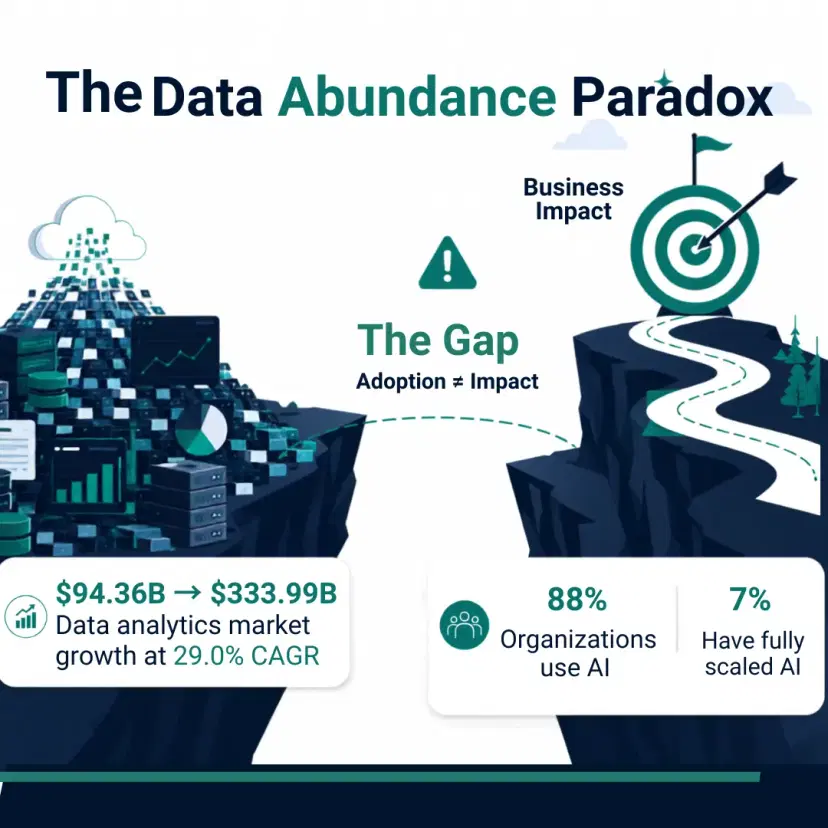

The Data Abundance Paradox
The market for analytics is exploding, which tells you how much raw material companies are accumulating. The Business Research Company values the data analytics market at $94.36 billion in 2025, rising to $333.99 billion by 2030 at a 29.0% CAGR. The predictive analytics market alone is growing from $20.64 billion in 2025 to $65.28 billion by 2030 at a 25.9% CAGR, and TBRC puts the business intelligence market on track to reach $49.61 billion by 2030 at an 11.6% CAGR. But spending on tools is not the same as capturing value. McKinsey found that while 88% of organizations use AI, only 7% have fully scaled it, and just 39% attribute any EBIT impact to AI at all. The gap between adoption and impact is the data-to-strategy gap in another form.

Why the Gap Exists
Three failures keep data from becoming strategy. First, fragmentation: signals live in silos, with no shared view of the ecosystem. Second, missing context: a number without a benchmark, a forecast, or a competitive frame is trivia, not intelligence. Third, no validation: in an age of AI-generated content, leaders increasingly cannot tell which 'insights' are trustworthy.

What Market Intelligence Actually Does
Market intelligence closes the gap by doing the connective work that tools alone cannot. At TBRC, every market is sized against the broader economy, mapped to related and parent markets, and stress-tested against macro factors — interest rates, inflation, geopolitics, trade wars, tariffs, and supply chain impacts. Our flagship Global Market Model integrates 1,500,000 datasets across 16,000+ markets, 27 industries, and 60 geographies, so a single data point sits inside a fully connected ecosystem view. This is the difference between knowing that the AI in BFSI market will grow from $101.2 billion in 2025 to $517.77 billion by 2030 at a 38.5% CAGR (per TBRC) and knowing what that means for your product roadmap, your competitors, and your market entry timing.

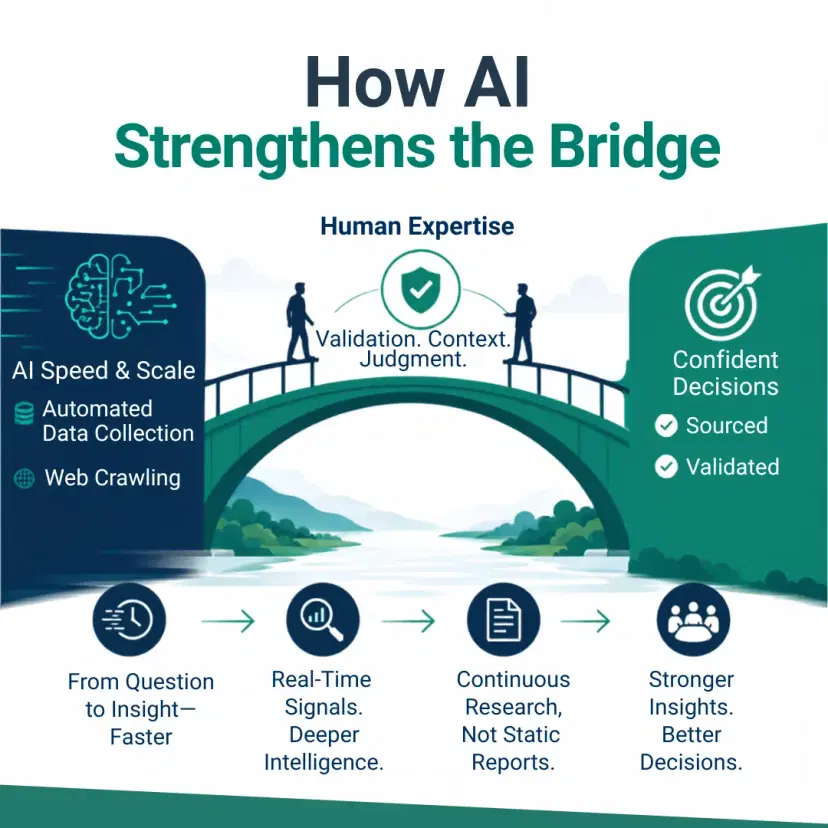

How AI Strengthens the Bridge
AI does not replace the bridge; it widens it. TBRC's AI-empowered research services automate data collection, web crawling, and analytics, compressing the time from question to insight. PwC notes that AI-driven strategic planning continuously gathers and analyzes real-time market signals, third-party datasets, and proprietary information. The result is continuous research — living intelligence rather than a static PDF. The catch is governance. Because AI can generate plausible-but-wrong outputs, the value of human-validated, sourced, multi-factor research rises, not falls. Every figure in a TBRC report is sourced, referenced, and run through a multi-layer quality-control process. That is what converts an AI-accelerated answer into a board-ready decision.

From Insight to Advantage
The World Economic Forum, citing Accenture, reports that digitally fluent organizations are three times more likely to have achieved high revenue growth over the prior three years. The bridge between data and strategy is not a nice-to-have; it is the growth engine.