
The Pre-Market Entry Study: Why Your Expansion Is Decided Before You Launch
Published date: 17 August, 2026
Every failed market entry looks like an execution failure from the outside. The product did not sell. The distributor underperformed. The regulator held up the licence. The local incumbent undercut the price. In practice, almost none of these are execution failures. They are research failures that surfaced eighteen months late, at the point where they had already become expensive.
A pre-market entry study is the work you do before capital is committed, before an entity is registered, before a distributor agreement is signed, and before a single unit is shipped. It is the difference between entering a market because the opportunity is real and entering because the opportunity looked real from head office.

The Uncomfortable Arithmetic of International Expansion
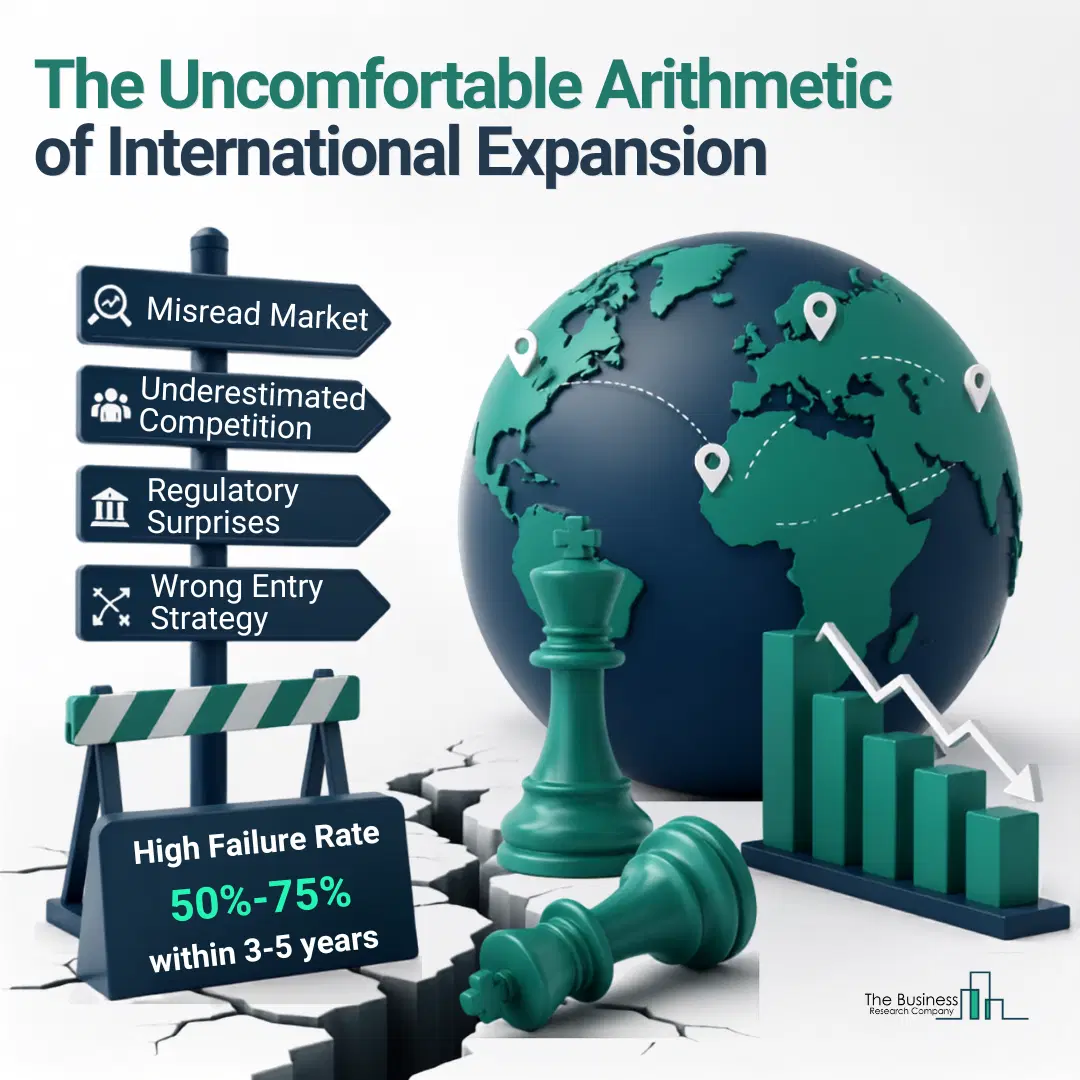
There is no single authoritative figure for how often market entry fails, and any consultancy quoting one with false precision should be treated with caution. What the available evidence consistently shows is that the failure rate is high and the causes are repetitive. Industry estimates commonly place the share of international entries that fall materially short of their targets somewhere between 50% and 75% within the first three to five years, with a meaningful proportion retreating inside the first twelve months. The range is wide because definitions of failure differ; the direction of travel does not.
The corporate case studies are less ambiguous. Target entered Canada in 2011 by acquiring 124 former Zellers locations and converting them at speed, projecting profitability by 2013. The Canadian business closed within roughly two years, on an investment widely reported at over $4 billion. Walmart bought into Germany in 1997, operated around 85 stores, and exited within a decade. Its Japanese venture, built on the 2003 acquisition of Seiyu, was sustained until 2020 and reportedly cost around $1.6 billion. These are not companies that lacked capital, brand equity, or operational competence. They lacked a sufficiently granular picture of the market they were entering.
The pattern across post-mortems is remarkably consistent. Demand was sized from macroeconomic proxies rather than validated with local buyers. Local incumbents were catalogued but not understood. Entry mode was selected in an early strategy meeting, before the regulatory position was fully mapped. And the domestic go-to-market playbook was carried across a border on the assumption that what worked at home would translate.

What a Pre-Market Entry Study Actually Answers
A serious feasibility study is not a country report with a market size on the cover. It is a structured attempt to answer the specific questions that determine whether, when, and how you should enter. Five question sets do most of the work.
1. Is There Validated Demand — Not Just Addressable Population?
Top-down sizing takes a population, applies a penetration assumption, and produces a number that is almost always flattering. Bottom-up validation starts from actual buyers: who they are, what they currently use, what they pay, what would make them switch, and what switching costs they face. The gap between the two figures is where most over-investment originates. A credible study reconciles both approaches and explains the variance rather than quietly choosing the larger number.
2. Who Really Controls the Market?
Global competitor lists systematically under-weight local players, who often hold the relationships, the shelf space, the regulatory goodwill, and the price expectation that a new entrant must displace. Understanding the competitive landscape means understanding the strategies players have actually adopted, not just their reported revenues.
3. What Does the Regulatory Path Cost in Time and Money?
Registration timelines, licensing requirements, product classification, labelling, local content rules, data residency, employment law, and tax treatment all carry a cost measured in months as well as currency. Entry mode decisions made before this analysis is complete are among the most expensive sequencing errors in expansion, because reversing them means unwinding a legal structure.
4. Can You Reach the Customer?
In most geographies you do not sell directly at first; you sell through someone. Whether the right route to market is a distributor, a joint venture, an agent, a franchise, or a wholly owned subsidiary depends on margin structure, control requirements, regulatory constraints, and the quality of partners actually available — which is an empirical question, not a strategic preference.
5. What Would Have to Be True for This to Work?
The most useful output of a feasibility study is not a recommendation but a set of explicit, testable assumptions with the evidence behind each one graded. That allows leadership to see precisely which beliefs the business case rests on, and to monitor those beliefs after launch.


Why Off-The-Shelf Country Reports Are Not Enough
Syndicated reports are genuinely valuable for scoping. The Business Research Company publishes over 17,500 reports across 27 industries and 60+ geographies, underpinned by 1,500,000 datasets, and our Global Market Model connects a market to the wider economy across 16,000+ markets. That gives a management team fast, defensible context: how large is this market, how fast is it growing, who are the named players, and how does it sit relative to adjacent and parent markets.
What a syndicated report cannot do is answer a question that is specific to your business. It cannot tell you whether the three distributors shortlisted for your product category already carry a competing line, whether your product classification triggers a twelve-month registration pathway in that jurisdiction, or whether the buyers you intend to target consider your price point credible. Those answers require primary work: interviews, surveys, site visits, and direct conversations with the people who will decide whether your entry succeeds.
This is precisely the boundary between our syndicated Reports Store and our Customized Research practice. The first tells you what the market is. The second tells you what you should do about it.

How The Business Research Company Structures a Market Entry Engagement
Our market entry work is designed to support a company through the critical first year of a new geography, not merely to hand over a document at the outset. In practice, the engagement combines competitor and distributor interviews, direct company-to-competitor comparison, meticulous long-listing and shortlisting of prospective partners, optimisation of customer acquisition and retention processes, and continuous tracking as conditions change.
That last element matters more than it sounds. A market entry thesis written in January can be materially wrong by September if a tariff line changes, a competitor is acquired, or a regulator issues new guidance. Our reports are stress-tested against macro factors including interest rates, inflation, geopolitical conflict, trade wars, tariffs and supply chain disruption — because a market entry plan that ignores those variables is a plan built for a static world that no longer exists.
We have run this work across sectors and geographies, including a market entry strategy for a niche healthcare company, a study on automated testing software penetration into the Indian market, and a market entry study for a software solution provider. The pattern across them is consistent: the value is not in the volume of data, but in the specificity of the answer.
The Platinum Market Entry Support Package
For companies that want end-to-end coverage of the first year, we consolidate the full scope into a single engagement.
- ✓Exclusive analysis report drawn from interviews with key competitors and distributors
- ✓Direct company-to-competitor comparisons across the competitive landscape
- ✓Meticulous long-listing and strategic shortlisting of partners with expert recommendations
- ✓Nuanced customer development covering both acquisition and retention
- ✓Ongoing tracking and market updates throughout the first year of go-to-market
The package is built around a simple premise: the first year in a new geography generates more decisions than any subsequent year, and each of those decisions is cheaper to get right than to correct.

When to Commission the Study — and Who Should Own It
The most common timing error is commissioning feasibility work after the decision has effectively been made. By the time a target market has been named in a board paper, a champion has emerged internally, and a launch date has been floated, research is structurally compromised: it is no longer being asked whether to enter, but to justify entering. Findings that contradict the emerging consensus get discounted as pessimism.
The productive window opens earlier, when two or three geographies are still genuinely in contention. At that point the research question becomes comparative rather than confirmatory — which of these markets offers the best risk-adjusted return, on what timeline, and under which entry structure. Comparative studies are also more rigorous by construction, because every assumption must be applied consistently across markets rather than tuned to support a preferred answer.
Ownership matters as much as timing. Feasibility work commissioned by the executive who will run the new market carries an inherent conflict. Where possible, the study should report to whoever controls the capital, with the prospective country lead as a contributor rather than the client. This is not a comment on integrity; it is simply a recognition that incentives shape which findings feel important.

Staged Entry: Buying Information Before Buying Commitment
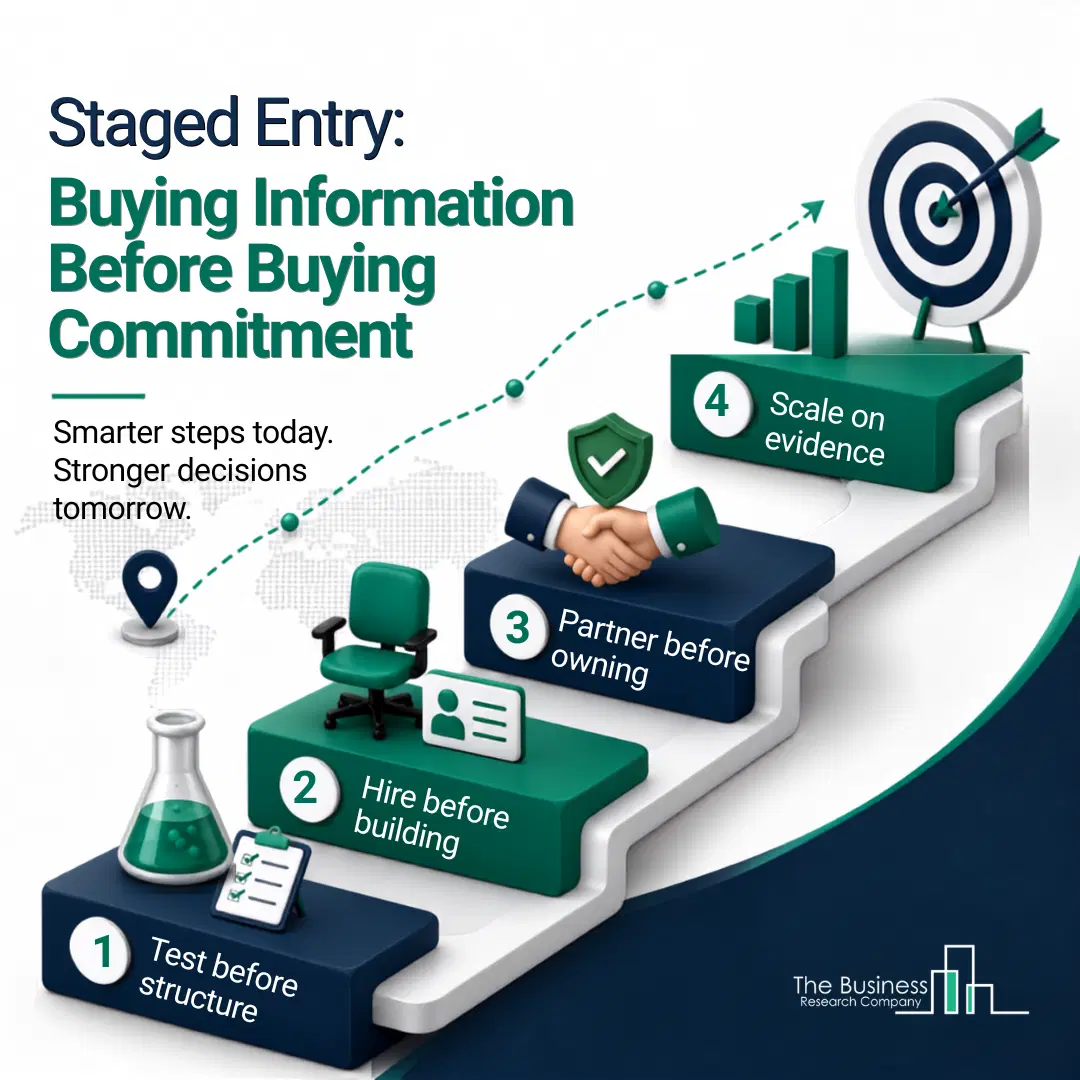
A pre-market entry study does not always conclude with enter or do not enter. Frequently the most valuable recommendation is a staged approach that converts an irreversible commitment into a sequence of reversible ones, each of which generates information that de-risks the next.
- Test before structure. Run a limited commercial pilot — a small distributor arrangement, a single-region launch, or direct export to a handful of accounts — before incorporating an entity or committing to a long-term lease.
- Hire before building. A single well-chosen local hire generates market intelligence no external study fully replicates, at a fraction of the cost of a country office.
- Partner before owning. A distributor relationship that can be exited is a cheaper way to learn a market than a subsidiary that cannot.
- Scale on evidence. Expand only against pre-agreed triggers — validated conversion rates, confirmed regulatory clearance, demonstrated partner performance — rather than against the calendar.
The strategic value of staging is that it prices optionality correctly. Committing fully at the outset buys speed at the cost of flexibility. In a market you have never operated in, where the error bars on every assumption are widest, flexibility is usually worth more than the speed you sacrifice.

What a Credible Feasibility Deliverable Contains
Executives evaluating research proposals should look for specific components. A study worth commissioning delivers a bottom-up demand estimate reconciled against top-down sizing, with the variance explained rather than averaged away. It delivers a competitive map that includes private and regional players, not only those with published financials. It delivers a regulatory pathway with realistic timelines drawn from observed cases, not from published targets. It delivers an assessed partner landscape identifying who is genuinely available. It delivers an entry mode recommendation that follows from those findings rather than preceding them. And it delivers an explicit assumption register, grading the evidence behind each belief the business case depends on.
That last item is the one most often missing and most valuable after launch. When performance diverges from plan — and it will — an assumption register lets the team identify precisely which belief proved wrong, rather than debating the entire strategy from first principles under pressure.

The Cost of Skipping the Study
The objection to pre-entry research is almost always speed. A feasibility study takes weeks; the board wants to move this quarter. It is worth being precise about what that trade actually buys. Entering without validated demand risks committing to a market that cannot support the revenue model. Entering without a regulatory map risks a legal structure that has to be unwound. Entering without partner diligence risks handing your brand to a distributor whose incentives are aligned with a competitor.
Set against a first-year expansion budget — entity formation, inventory, local hires, marketing, and management attention — the cost of the research that de-risks it is typically a rounding error. The companies that expand well are rarely the ones that move fastest. They are the ones that move on the best information.