
1, 4 Butanediol Market Report 2026
Global Outlook – By Type (Synthetic, Bio-Based), By Application (Tetrahydrofuran (THF), Polybutylene Terephthalate (PBT), Gamma Butyrolactone (GBL), Polyurethane (PU), Other Applications), By End-Use (Chemical, Automotive, Electronic, Footwear, Other End-Uses) – Market Size, Trends, Strategies, and Forecast to 2030
1, 4 Butanediol Market Overview
• 1, 4 Butanediol market size has reached to $10.22 billion in 2025 • Expected to grow to $14.76 billion in 2030 at a compound annual growth rate (CAGR) of 7.5% • Growth Driver: 1,4-Butanediol Market Thrives On Automotive Industry Surge • Market Trend: Sustainable Bio-Based Innovations Enhance Environmental Performance In 1,4-Butanediol (BDO) Production • Asia-Pacific was the largest region in 2025.What Is Covered Under 1, 4 Butanediol Market?
1,4-Butanediol is a colorless and water-soluble, thick fluid with a high point of boiling (230°C) at room temperature used as a source of gamma-hydroxybutyrate (GHB), a recreational drug with euphoric and sedative effects. It is also utilized in the synthesis of various organic compounds, especially the solvent oxolane (also known as tetrahydrofuran, or THF). It functions as a protic solvent, prodrug, and neurotoxin The main 1, 4 butanediol types are synthetic and bio based. Synthetic refers to substances that are created by man as opposed to being obtained from nature. The various applications are tetrahydrofuran (THF), polybutylene terephthalate (PBT), gamma butyrolactone (GBL), polyurethane (PU), and others, used in chemical, sports, automotive, electronic, footwear, and others.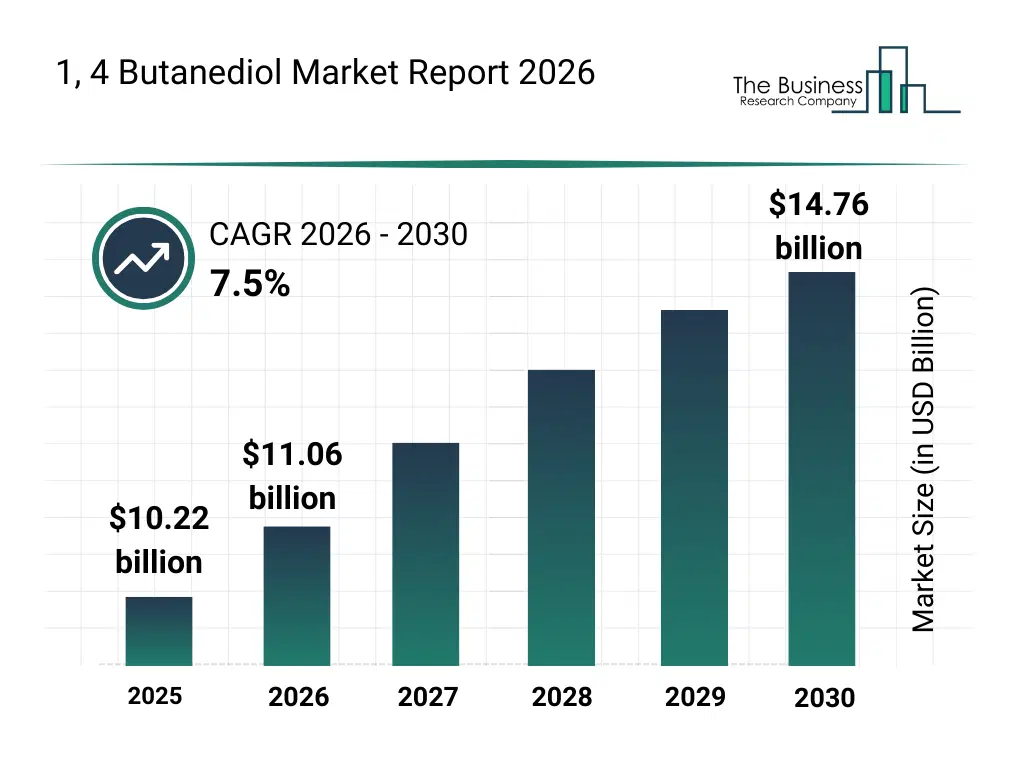
What Is The 1, 4 Butanediol Market Size and Share 2026?
The 1, 4 butanediol market size has grown strongly in recent years. It will grow from $10.22 billion in 2025 to $11.06 billion in 2026 at a compound annual growth rate (CAGR) of 8.3%. The growth in the historic period can be attributed to expansion of chemical manufacturing capacity, growth of polymer and resin industries, increasing use of synthetic solvents, availability of petrochemical feedstocks, rising industrial chemical demand.What Is The 1, 4 Butanediol Market Growth Forecast?
The 1, 4 butanediol market size is expected to see strong growth in the next few years. It will grow to $14.76 billion in 2030 at a compound annual growth rate (CAGR) of 7.5%. The growth in the forecast period can be attributed to increasing investments in bio-refinery technologies, rising demand for lightweight automotive materials, expansion of sustainable polymer production, growing adoption of eco-friendly solvents, increasing focus on circular chemical processes. Major trends in the forecast period include increasing adoption of bio-based butanediol production, rising demand for thf and pbt applications, growing use in high-performance polymers, expansion of sustainable chemical synthesis, enhanced focus on process efficiency.
Global 1, 4 Butanediol Market Segmentation
1) By Type: Synthetic, Bio-Based 2) By Application: Tetrahydrofuran (THF), Polybutylene Terephthalate (PBT), Gamma Butyrolactone (GBL), Polyurethane (PU), Other Applications 3) By End-Use: Chemical, Automotive, Electronic, Footwear, Other End-Uses Subsegments: 1) By Synthetic: Reppe Process (Acetylene–Formaldehyde Route), Maleic Anhydride Hydrogenation Route, Butadiene-Based Process 2) By Bio-Based: Fermentation-Based 1,4-Butanediol, Sugar-Derived Or Biomass-Based 1,4-ButanediolWhat Is The Driver Of The 1, 4 Butanediol Market?
The increasing automotive sector is expected to propel the growth of the 1,4-butanediol market in the coming future. The automotive sector encompasses businesses involved in the creation, distribution, sale, and upkeep of automobiles. In automotive sector, the manufacture of vehicle’s bumpers, fenders, spoilers, and automobile front and rear end fascia require urethane elastomers made from 1,4-butanediol. Thus, the increasing demand from the automotive sector boosts the expansion of the 1,4-butanediol market. For instance, in August 2024, according to the European Automobile Manufacturers' Association, a Belgium-based organization, seven months into 2024, new car registrations rose by 3.9%, exceeding 6.5 million units. The largest markets in the bloc demonstrated positive yet modest growth, with Spain (+5.6%), Italy (+5.2%), Germany (+4.3%), and France (+2.2%) all reporting increases. Therefore, the increasing automotive sector is driving the 1,4-butanediol market.Key Players In The Global 1, 4 Butanediol Market
Major companies operating in the 1, 4 butanediol market are BASF SE, Mitsubishi Chemical Corporation, SK Global Chemical Co. Ltd., Dairen Chemical Corporation, LyondellBasell Industries N.V., Dow Inc., Genomatica Inc., Xinjiang Tianye Co. Ltd., Koch Industries, PTT Global Chemical Public Company Limited, Saudi International Petrochemical Company, Chongqing Jianfeng Chemical Co. Ltd., Nan Ya Plastics Corporation, Sinopec Yizheng Chemical Fibre Company Limited, Shanxi Sanwei Group Co. Ltd., INVISTA S.à r.l., Nanjing Bluestar Co. Ltd., Oxea GmbH, TCC Group, Formosa Plastics Corporation, Huntsman Corporation, Myriant Corporation
This chart is for illustrative purposes; the full report includes a detailed competitor analysis and comprehensive overview of the top 10 companies in the market.
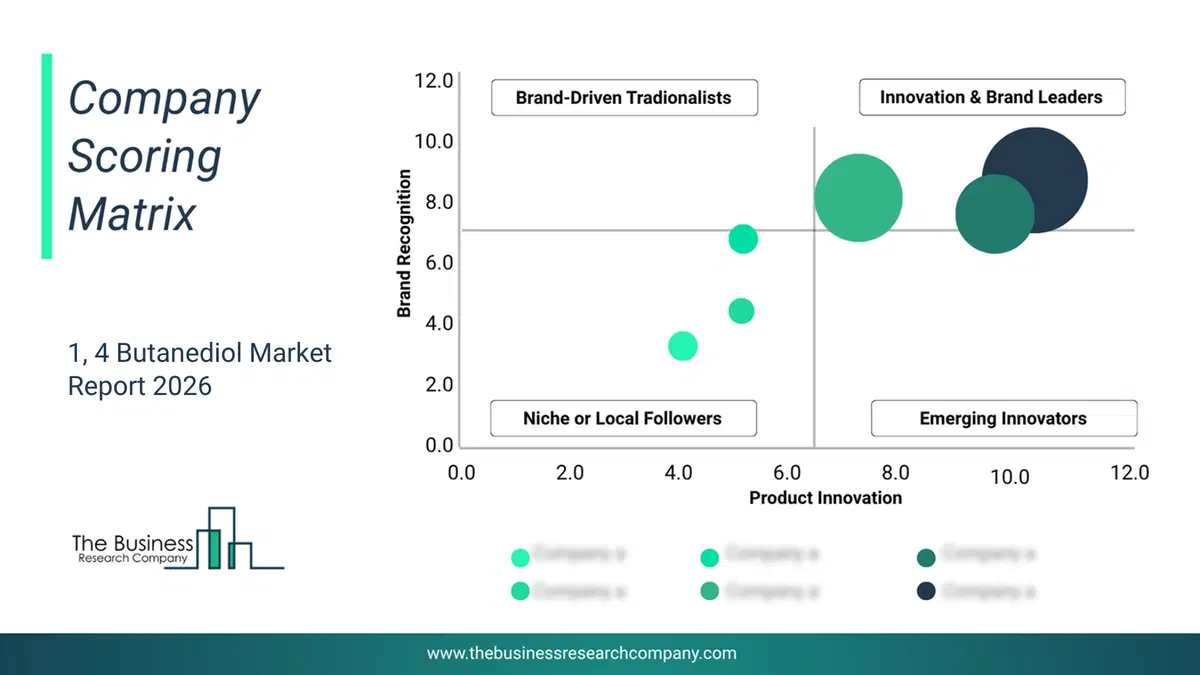
This chart maps companies by product innovation and brand strength, with bubble size indicating relative revenue, helping identify market leaders, challengers, and niche players. This is an illustrative chart; the full report provides a complete and accurate competitive analysis.
Global 1, 4 Butanediol Market Trends and Insights
Major companies operating in the 1,4-butanediol market are focusing on developing sustainable solutions, such as bio-based feedstock, to reduce carbon emissions and improve environmental performance without compromising product quality. Bio-based feedstock is produced from plant-derived sugars through fermentation and delivers the same performance characteristics as conventional fossil-based BDO while significantly lowering greenhouse gas emissions. For instance, in September 2023, BASF, a Germany-based chemical company, secured long-term access to QIRA bio-based 1,4-butanediol from Qore LLC, a joint venture between Cargill and HELM AG. The first commercial batches of QIRA are expected in Q1 2025 and will enable BASF to expand its range of BDO derivatives, including polytetrahydrofuran (PolyTHF) and tetrahydrofuran (THF), with substantially reduced product carbon footprints while maintaining identical physical and technical properties compared to fossil-based alternatives. QIRA supports wide-ranging applications across textiles, automotive, electronics, and pharmaceuticals. Key features include corn-based fermentation, compatibility with existing production processes, carbon footprint reduction of up to 86%, and the ability to support large-scale production of PolyTHF and THF derivatives. Through this initiative, BASF aims to further strengthen its sustainable solutions portfolio and deliver renewable-based chemical options to its global customer base.What Are Latest Mergers And Acquisitions In The 1, 4 Butanediol Market?
In March 2023, Maire Tecnimont S.p.A., an Italy-based technology and engineering group, acquired Conser for an undisclosed amount. This strategic transaction allows Maire Tecnimont to enter the bio-based technologies and products market. After the deal closes, NextChem Holding will own 83.5% of Conser's shares, with the option to acquire the remaining 16.5% within the next three years, as per the terms of the agreement. Conser is an Italy-based provider of technologies for the production of butanediol (BDO).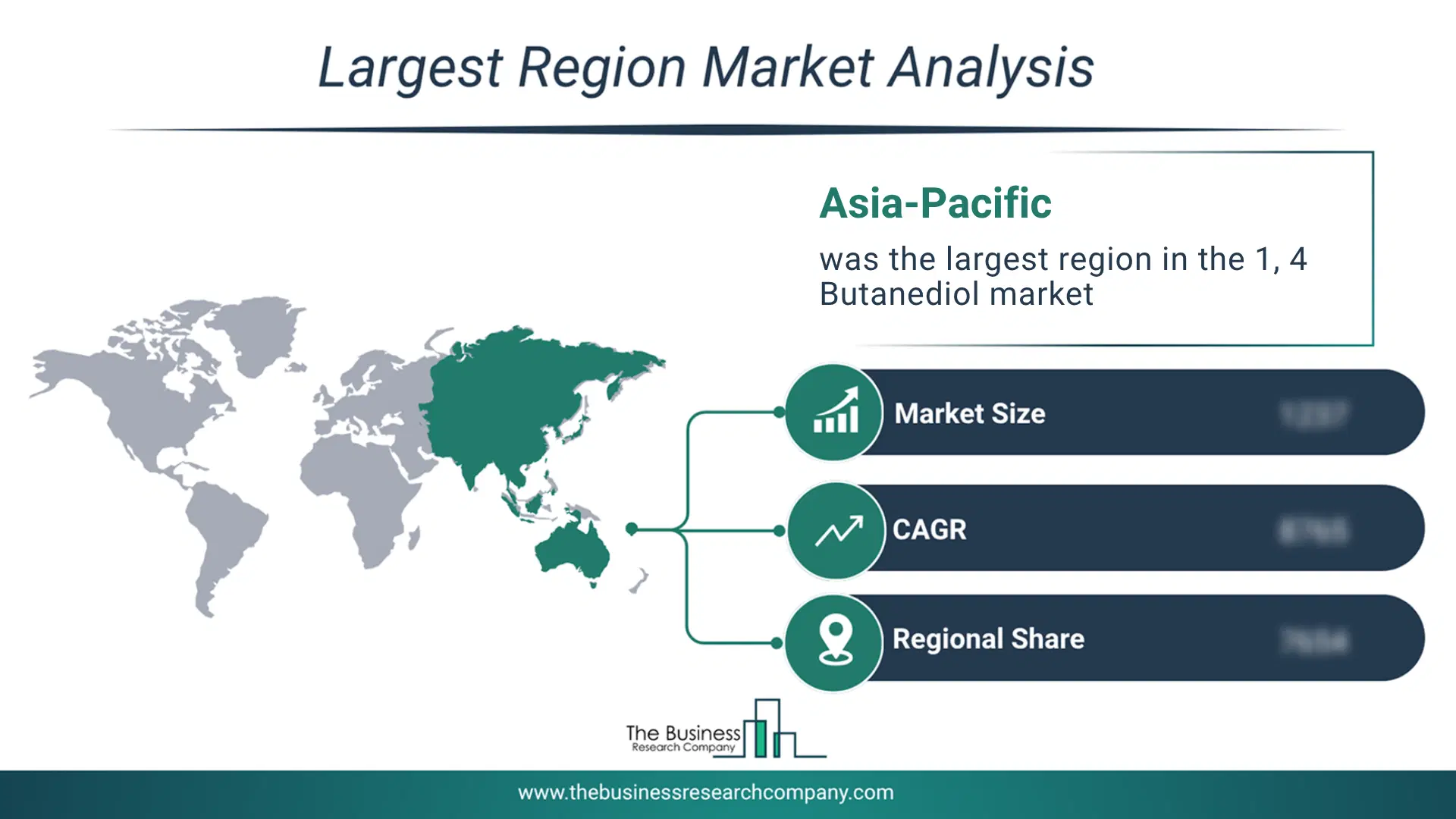
Regional Insights
Asia-Pacific was the largest region in the 1,4 butanediol market in 2025. The regions covered in this market report are Asia-Pacific, South East Asia, Western Europe, Eastern Europe, North America, South America, Middle East, Africa The countries covered in this market report are Australia, Brazil, China, France, Germany, India, Indonesia, Japan, Taiwan, Russia, South Korea, UK, USA, Canada, Italy, SpainWhat Defines the 1, 4 Butanediol Market?
The 1,4-butanediol market consists of sales of synthetic 1,4-butanediol and biobased 1,4-butanediol. Values in this market are ‘factory gate’ values, that is the value of goods sold by the manufacturers or creators of the goods, whether to other entities (including downstream manufacturers, wholesalers, distributors and retailers) or directly to end customers. The value of goods in this market includes related services sold by the creators of the goods.How is Market Value Defined and Measured?
The market value is defined as the revenues that enterprises gain from the sale of goods and/or services within the specified market and geography through sales, grants, or donations in terms of the currency (in USD unless otherwise specified). The revenues for a specified geography are consumption values that are revenues generated by organizations in the specified geography within the market, irrespective of where they are produced. It does not include revenues from resales along the supply chain, either further along the supply chain or as part of other products.
This chart presents market attractiveness based on a quantitative evaluation of growth, competition, strategic alignment, and risk, offering a clear view of opportunity areas for decision-making. This chart is for illustrative purposes; the full report contains the complete analysis.

This chart highlights the Total Addressable Market (TAM) by estimating the maximum revenue opportunity using an assumption-driven approach, supporting strategic planning and opportunity sizing across markets. The chart is illustrative; the full report provides a more comprehensive analysis.
What Key Data and Analysis Are Included in the 1, 4 Butanediol Market Report 2026?
The 1, 4 butanediol market research report is one of a series of new reports from The Business Research Company that provides market statistics, including industry global market size, regional shares, competitors with the market share, detailed market segments, market trends and opportunities, and any further data you may need to thrive in the 1, 4 butanediol industry. The market research report delivers a complete perspective of everything you need, with an in-depth analysis of the current and future state of the industry.1 4 Butanediol Market Report Forecast Analysis
| Report Attribute | Details |
|---|---|
| Market Size Value In 2026 | $11.06 billion |
| Revenue Forecast In 2030 | $14.76 billion |
| Growth Rate | CAGR of 8.3% from 2026 to 2030 |
| Base Year For Estimation | 2025 |
| Actual Estimates/Historical Data | 2020-2025 |
| Forecast Period | 2026 - 2030 |
| Market Representation | Revenue in USD Billion and CAGR from 2026 to 2030 |
| Segments Covered | Type, Application, End-Use |
| Regional Scope | Asia-Pacific, Western Europe, Eastern Europe, North America, South America, Middle East, Africa |
| Country Scope | The countries covered in this market report are Australia, Brazil, China, France, Germany, India, Indonesia, Japan, Taiwan, Russia, South Korea, UK, USA, Canada, Italy, Spain |
| Key Companies Profiled | BASF SE, Mitsubishi Chemical Corporation, SK Global Chemical Co. Ltd., Dairen Chemical Corporation, LyondellBasell Industries N.V., Dow Inc., Genomatica Inc., Xinjiang Tianye Co. Ltd., Koch Industries, PTT Global Chemical Public Company Limited, Saudi International Petrochemical Company, Chongqing Jianfeng Chemical Co. Ltd., Nan Ya Plastics Corporation, Sinopec Yizheng Chemical Fibre Company Limited, Shanxi Sanwei Group Co. Ltd., INVISTA S.à r.l., Nanjing Bluestar Co. Ltd., Oxea GmbH, TCC Group, Formosa Plastics Corporation, Huntsman Corporation, Myriant Corporation |
| Customization Scope | Request for Customization |
| Pricing And Purchase Options | Explore Purchase Options |