
1-Decanol Market Report 2026
Global Outlook – By Type (Synthetic, Natural), By Grade (Industrial Grade, Cosmetic Grade, Pharmaceutical Grade, Food Grade), By Application (Plasticizers, Lubricants, Detergents And Cleaners, Cosmetics And Personal Care, Pharmaceuticals, Flavors And Fragrances, Other Applications) – Market Size, Trends, Strategies, and Forecast to 2030
1-Decanol Market Overview
• 1-Decanol market size has reached to $0.29 billion in 2025 • Expected to grow to $0.45 billion in 2030 at a compound annual growth rate (CAGR) of 9.7% • Growth Driver: Covid-19 Pandemic Boosts Demand For 1-Decanol In Personal Care And Household Cleaning Products Market • Asia-Pacific was the largest region in 2025 and Asia-Pacific is the fastest growing region.What Is Covered Under 1-Decanol Market?
1-Decanol, also known as decyl alcohol (C₁₀H₂₂O), is a fatty alcohol with a ten-carbon chain and a hydroxyl group (-OH) at one end. It is a colorless, oily liquid mildly soluble in water but highly soluble in organic solvents such as ethanol and ether. It has a variety of industrial and commercial applications due to its chemical properties, including its lubricating, emollient, and solvent characteristics. The main types of 1-Decanol are synthetic and natural. The synthetic 1-Decanol is produced from Ziegler processing in which fatty alcohols from ethylene are produced using an organo aluminium compound. Natural 1-Decanol is produced from plant sources such as citrus oils, apples, coriander, babaco fruit, and others. 1-Decanol is used in the manufacturing of plasticizers, lubricants, detergents and cleaners, cosmetics and personal care products, pharmaceuticals, flavors and fragrances, and others.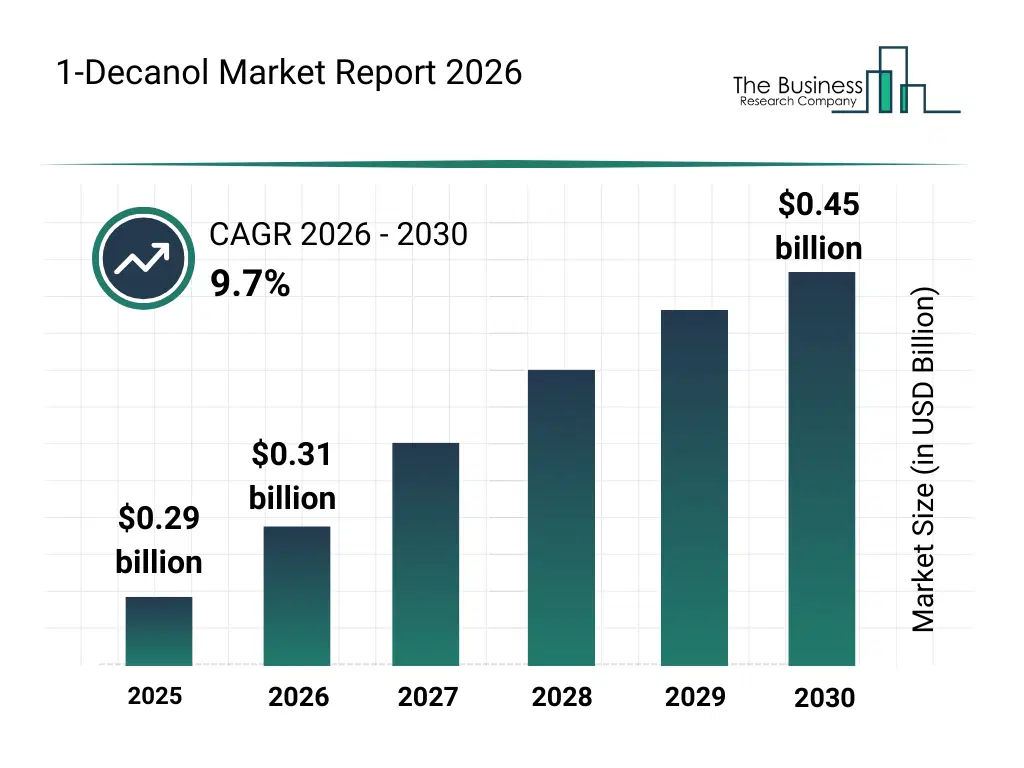
What Is The 1-Decanol Market Size and Share 2026?
The 1-decanol market size has grown strongly in recent years. It will grow from $0.29 billion in 2025 to $0.31 billion in 2026 at a compound annual growth rate (CAGR) of 9.9%. The growth in the historic period can be attributed to expansion of detergent and surfactant manufacturing, growth of cosmetics and personal care formulations, increasing industrial lubricant usage, availability of petrochemical feedstocks, rising adoption in fragrance blending.What Is The 1-Decanol Market Growth Forecast?
The 1-decanol market size is expected to see strong growth in the next few years. It will grow to $0.45 billion in 2030 at a compound annual growth rate (CAGR) of 9.7%. The growth in the forecast period can be attributed to growing shift toward plant-based chemical inputs, increasing demand from pharmaceutical excipients, expansion of specialty solvent applications, rising focus on sustainable alcohol production, increasing regulatory emphasis on chemical purity. Major trends in the forecast period include growing adoption of bio-based fatty alcohols, rising use in specialty chemical formulations, increasing demand from personal care applications, expansion of high-purity industrial grades, enhanced focus on process efficiency.
Global 1-Decanol Market Segmentation
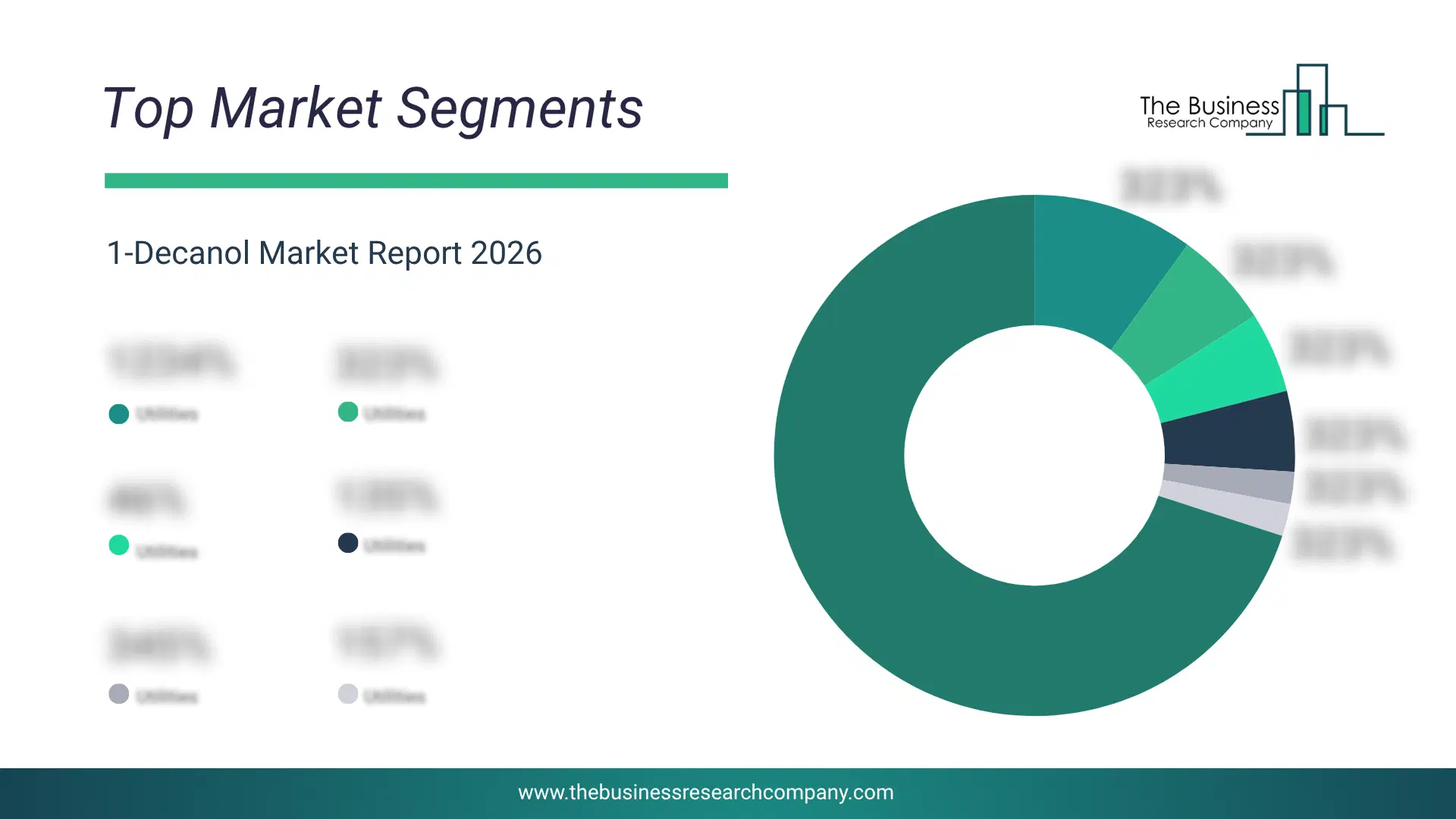
1) By Type: Synthetic, Natural 2) By Grade: Industrial Grade, Cosmetic Grade, Pharmaceutical Grade, Food Grade 2) By Application: Plasticizers, Lubricants, Detergents And Cleaners, Cosmetics And Personal Care, Pharmaceuticals, Flavors And Fragrances, Other Applications Subsegments: 1) By Synthetic: Petrochemical-Based 1-Decanol, Laboratory-Synthesized 1-Decanol 2) By Natural: Plant-Plant-Oil-Derived 1-Decanol, Bio-Based Fermentation-Derived 1-DecanolWhat Are The Drivers Of The 1-Decanol Market?
The increasing demand for personal care and household cleaning products expected to propel the growth of the 1-Decanol market going forward. Personal care and household cleaning products refer to items used for maintaining personal hygiene, grooming, and cleanliness of living spaces, including products like soaps, shampoos, toothpaste, detergents, and surface cleaners. Increasing demand for personal care and household cleaning products is primarily driven by growing consumer awareness of hygiene and health, prompting people to adopt products that ensure cleanliness, prevent illness, and maintain overall well-being. 1-Decanol enhances personal care and household cleaning products by acting as a versatile solvent and surfactant, improving texture, fragrance dispersion, and cleaning efficiency. For instance, in September 2024, according to the Bureau of Labor Statistics, a US-based government agency, spending on personal care products and services increased by 9.7% from 2022 to 2023, while their share of total annual expenditures remained steady at 1.2% in both years. Therefore, the increase in usage of personal care products including soap and sanitizers increased the demand for 1-decanol, thereby driving the growth of the 1-decanol industry. Growing pharmaceutical sales are expected to propel the growth of the 1-Decanol market going forward. Pharmaceutical refers to a drug or medicine that is used to diagnose, treat, prevent disease, or restore health. Pharmaceutical sales are rising because the growing prevalence of chronic diseases is increasing the demand for long-term treatments, driving steady and continuous medication use. Decanol supports pharmaceutical sales by serving as a key ingredient in drug formulations, enhancing product stability and effectiveness, which boosts demand for related medications. For instance, in April 2025 according to the accroding to the Eurosta a Luxembourg-based government agency in April 2024, according to Eurostat, a Luxembourg-based official statistical agency of the European Union, imports of medicinal and pharmaceutical products into the EU increased by 6.1% in 2023, totaling 137.4 billion USD (€119 billion) compared to the previous year. During the same period, EU exports reached 319.2 billion USD (€277 billion), resulting in a trade surplus of 182.0 billion USD (€158 billion). Therefore, the growing pharmaceutical sales are driving the 1-Decanol industry. The growing investment in research and development is expected to propel the growth of the 1-Decanol market going forward. Investment in research and development refers to the allocation of financial, human, and technological resources by a company or organization to create, improve, or innovate products, services, or processes. Growing investment in research and development (R&D) is primarily driven by the rising demand for innovation, enabling companies to develop new products, improve technologies, and stay competitive in rapidly evolving markets. Increasing investment in research and development helps improve how 1-Decanol is made by allowing the creation of better production methods, purer products, and new uses in different industries. For instance, in November 2023, according to the report published by the European Federation of Pharmaceutical Industries and Associations, a Belgium-based trade association, pharmaceutical industry research and development expenditure rose to 50,000 million in 2023, up from 47,010 million in 2022. Therefore, the growing investment in research and development is driving the 1-decanol industry.Key Players In The Global 1-Decanol Market
Major companies operating in the 1-decanol market are Sasol, Emery Oleochemicals, IOI Oleochemical (IOI Group), Wilmar International, KLK OLEO (Kuala Lumpur Kepong), Musim Mas Group, Godrej Industries, VVF LLC, Croda International, BASF SE, Kao Corporation, Oleon NV, Cargill Incorporated, PTT Global Chemical, Oxiteno, Berg+Schmidt, Sinarmas Cepsa, Ecogreen Oleochemicals, Stepan Company, Nouryon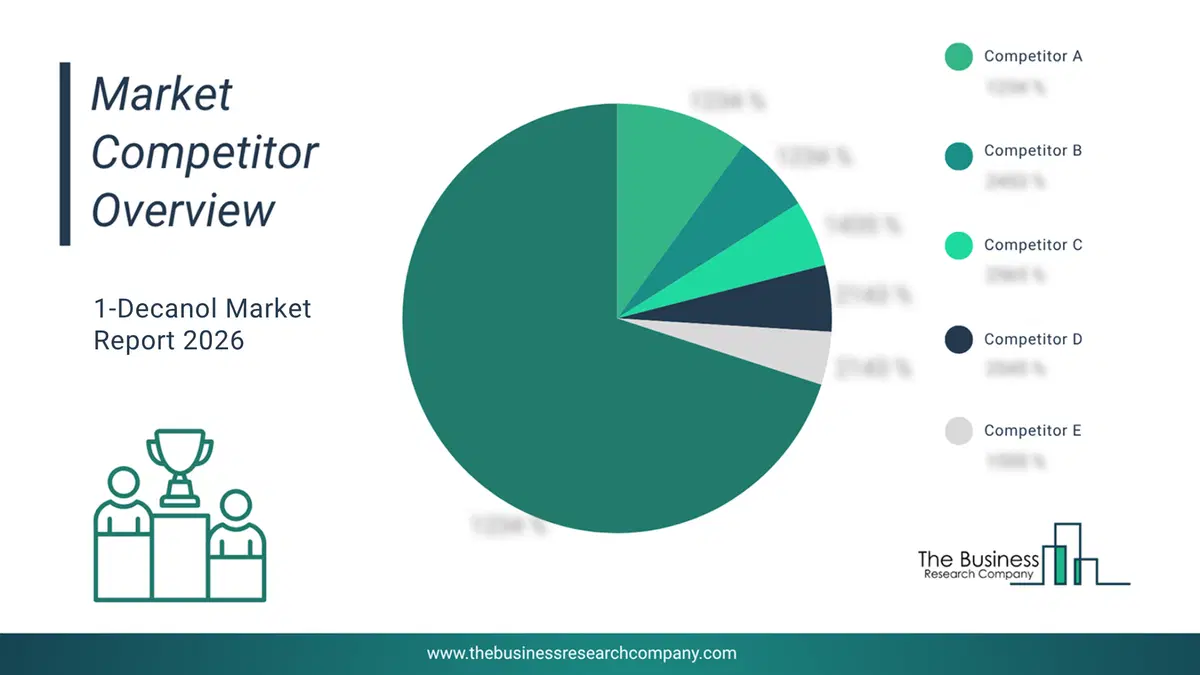
This chart is for illustrative purposes; the full report includes a detailed competitor analysis and comprehensive overview of the top 10 companies in the market.
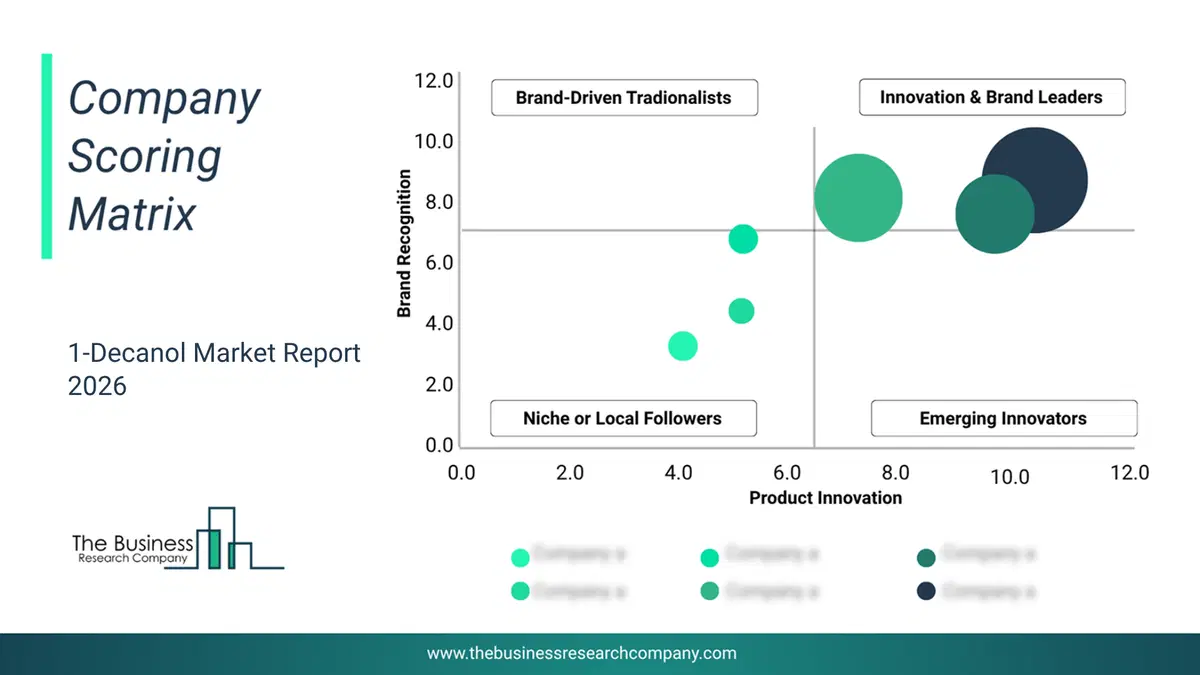
This chart maps companies by product innovation and brand strength, with bubble size indicating relative revenue, helping identify market leaders, challengers, and niche players. This is an illustrative chart; the full report provides a complete and accurate competitive analysis.
Regional Insights
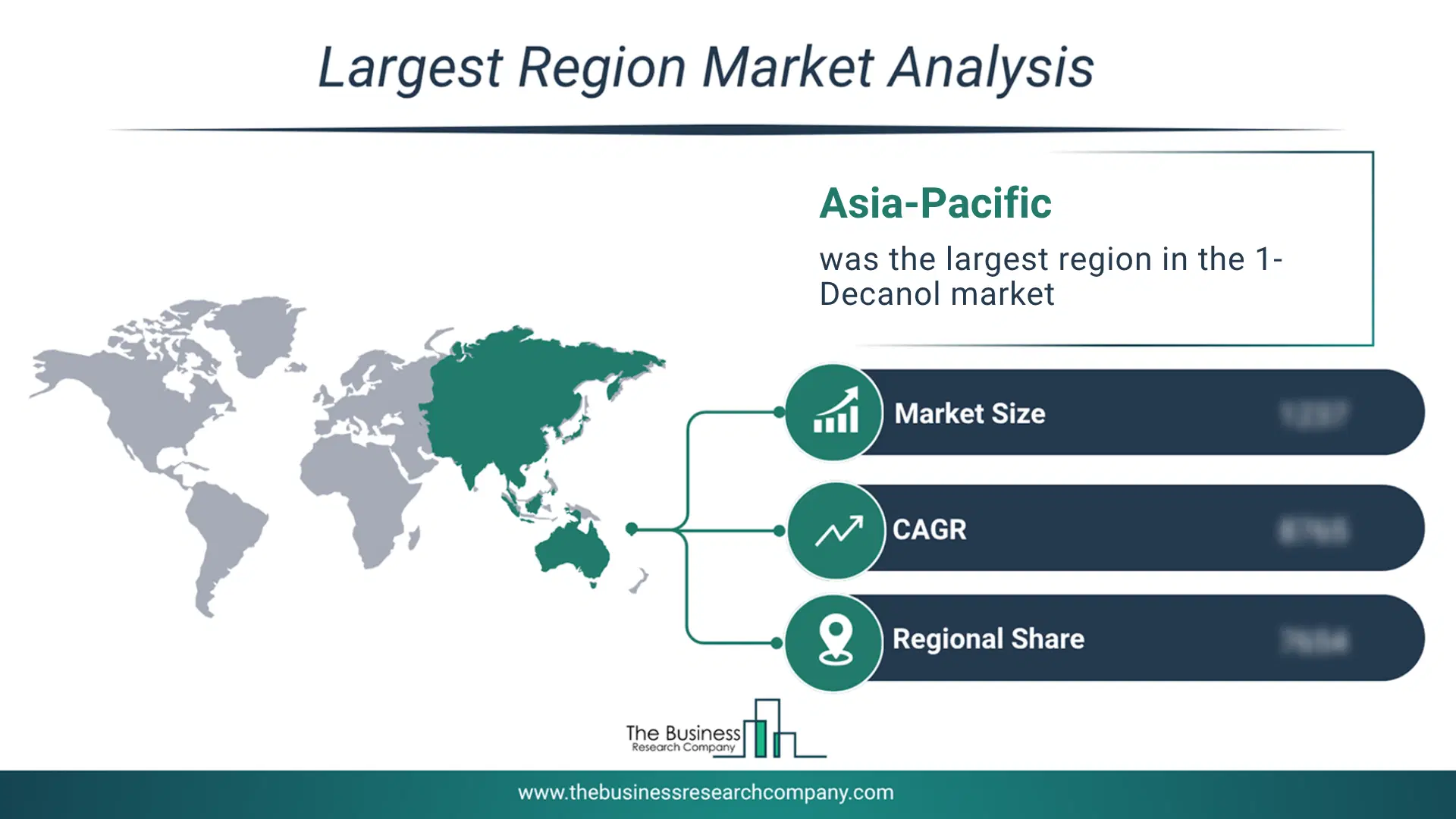
Asia-Pacific was the largest region in the 1-Decanol market in 2025. Asia-Pacific is expected to be the fastest-growing region in the global 1-Decanol market. The regions covered in this market report are Asia-Pacific, South East Asia, Western Europe, Eastern Europe, North America, South America, Middle East, Africa The countries covered in this market report are Australia, Brazil, China, France, Germany, India, Indonesia, Japan, Taiwan, Russia, South Korea, UK, USA, Canada, Italy, SpainWhat Defines the 1-Decanol Market?
The 1-Decanol market consists of sales of 1-Decanol sources including citrus oils and wines. Values in this market are ‘factory gate’ values, that is the value of goods sold by the manufacturers or creators of the goods, whether to other entities (including downstream manufacturers, wholesalers, distributors, and retailers) or directly to end customers. The value of goods in this market includes related services sold by the creators of the goods.How is Market Value Defined and Measured?
The market value is defined as the revenues that enterprises gain from the sale of goods and/or services within the specified market and geography through sales, grants, or donations in terms of the currency (in USD unless otherwise specified). The revenues for a specified geography are consumption values that are revenues generated by organizations in the specified geography within the market, irrespective of where they are produced. It does not include revenues from resales along the supply chain, either further along the supply chain or as part of other products.
This chart presents market attractiveness based on a quantitative evaluation of growth, competition, strategic alignment, and risk, offering a clear view of opportunity areas for decision-making. This chart is for illustrative purposes; the full report contains the complete analysis.

This chart highlights the Total Addressable Market (TAM) by estimating the maximum revenue opportunity using an assumption-driven approach, supporting strategic planning and opportunity sizing across markets. The chart is illustrative; the full report provides a more comprehensive analysis.
What Key Data and Analysis Are Included in the 1-Decanol Market Report 2026?
The 1-decanol market research report is one of a series of new reports from The Business Research Company that provides market statistics, including industry global market size, regional shares, competitors with the market share, detailed market segments, market trends and opportunities, and any further data you may need to thrive in the 1-decanol industry. The market research report delivers a complete perspective of everything you need, with an in-depth analysis of the current and future state of the industry.1-Decanol Market Report Forecast Analysis
| Report Attribute | Details |
|---|---|
| Market Size Value In 2026 | $0.31 billion |
| Revenue Forecast In 2030 | $0.45 billion |
| Growth Rate | CAGR of 9.9% from 2026 to 2030 |
| Base Year For Estimation | 2025 |
| Actual Estimates/Historical Data | 2020-2025 |
| Forecast Period | 2026 - 2030 |
| Market Representation | Revenue in USD Billion and CAGR from 2026 to 2030 |
| Segments Covered | Type, Grade, Application |
| Regional Scope | Asia-Pacific, Western Europe, Eastern Europe, North America, South America, Middle East, Africa |
| Country Scope | The countries covered in this market report are Australia, Brazil, China, France, Germany, India, Indonesia, Japan, Taiwan, Russia, South Korea, UK, USA, Canada, Italy, Spain |
| Key Companies Profiled | Sasol, Emery Oleochemicals, IOI Oleochemical (IOI Group), Wilmar International, KLK OLEO (Kuala Lumpur Kepong), Musim Mas Group, Godrej Industries, VVF LLC, Croda International, BASF SE, Kao Corporation, Oleon NV, Cargill Incorporated, PTT Global Chemical, Oxiteno, Berg+Schmidt, Sinarmas Cepsa, Ecogreen Oleochemicals, Stepan Company, Nouryon |
| Customization Scope | Request for Customization |
| Pricing And Purchase Options | Explore Purchase Options |