
2D Cell Culture Market Report 2026
Global Outlook – By Type (Skin Cell, Lung Cell, Brain Cell, Kidney Cell, Liver Cell, Breast Cell, Other Types), By Technology (2D Cell Culture Platforms, Microfluidics Technology, Automated Cell Culture Systems, Incubation and Analysis Systems, Culture Monitoring and Control Systems), By Application (Pharmaceutical, Stem Cell Research, Bioproduction, Food Application, Bioenergy, Environment Testing and Toxicology, Agriculture), By End-User (Pharmaceutical Companies, Biotechnology Companies, Contract Research Organizations, Academic Research Institutes) – Market Size, Trends, Strategies, and Forecast to 2030
2D Cell Culture Market Overview
• 2D Cell Culture market size has reached to $5.3 billion in 2025 • Expected to grow to $8.44 billion in 2030 at a compound annual growth rate (CAGR) of 9.7% • Growth Driver: Surge In Demand For Personalized Medicine Driving The Growth Of Market Due To Targeted Therapies And Better Treatment Outcomes • Market Trend: Advancing Cell Cultures With Biomimetic Hydrogel Innovations • North America was the largest region in 2025 and Asia-Pacific is the fastest growing region.What Is Covered Under 2D Cell Culture Market?
2D cell culture refers to a laboratory technique that grows cells on flat, rigid surfaces like glass or plastic, enabling the formation of a monolayer. It provides a controlled environment for studying cell behavior, biological processes, and drug responses. The method remains widely adopted due to its simplicity, cost-effectiveness, and reproducibility, making it a standard approach in research and drug development. The main types of the 2D cell cultures include skin cells, lung cells, brain cells, kidney cells, liver cells, breast cells, and others. Skin cell refers to in vitro cultured cells used for research, drug testing, and disease modeling in dermatology and related fields. It uses various technologies such as 2D cell culture platforms, microfluidics technology, automated cell culture systems, incubation and analysis systems, and culture monitoring and control systems. The application areas include pharmaceuticals, stem cell research, bioproduction, food application, bioenergy, environment testing and toxicology, and agriculture, and key end-users include pharmaceutical companies, biotechnology companies, contract research organizations, and academic research institutes.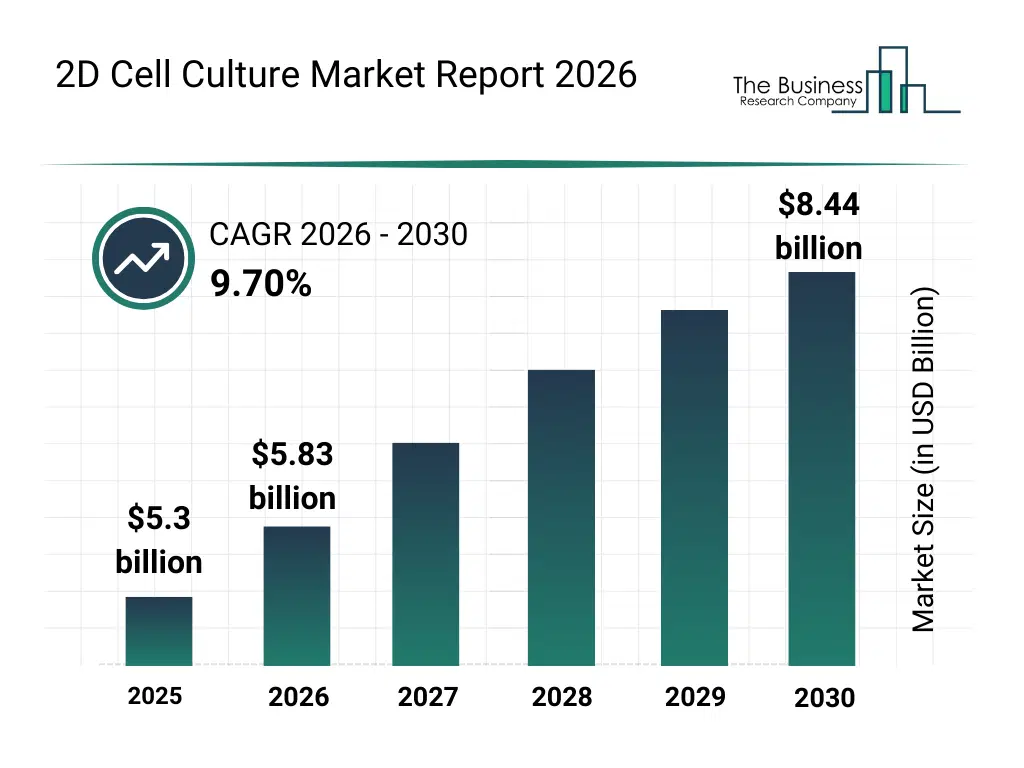
What Is The 2D Cell Culture Market Size and Share 2026?
The 2d cell culture market size has grown strongly in recent years. It will grow from $5.3 billion in 2025 to $5.83 billion in 2026 at a compound annual growth rate (CAGR) of 10.0%. The growth in the historic period can be attributed to widespread adoption of monolayer culture techniques, extensive use in early-stage drug discovery, availability of cost-effective plasticware, academic research dependence on 2d models, standardized laboratory protocols.What Is The 2D Cell Culture Market Growth Forecast?
The 2d cell culture market size is expected to see strong growth in the next few years. It will grow to $8.44 billion in 2030 at a compound annual growth rate (CAGR) of 9.7%. The growth in the forecast period can be attributed to growing integration with automated imaging systems, rising demand from biopharmaceutical pipelines, expansion of toxicology and safety testing, increased use in regenerative medicine studies, continued relevance alongside 3d culture models. Major trends in the forecast period include increasing use of standardized cell culture consumables, rising adoption of automated 2d culture platforms, growing demand for high-reproducibility assays, expansion of high-throughput screening applications, enhanced focus on cost-efficient cell-based research.
Global 2D Cell Culture Market Segmentation
1) By Type: Skin Cell, Lung Cell, Brain Cell, Kidney Cell, Liver Cell, Breast Cell, Other Types 2) By Technology: 2D Cell Culture Platforms, Microfluidics Technology, Automated Cell Culture Systems, Incubation and Analysis Systems, Culture Monitoring and Control Systems 3) By Application: Pharmaceutical, Stem Cell Research, Bioproduction, Food Application, Bioenergy, Environment Testing and Toxicology, Agriculture 4) By End-User: Pharmaceutical Companies, Biotechnology Companies, Contract Research Organizations, Academic Research Institutes Subsegments: 1) By Skin Cell: Epidermal Cell, Dermal Cell, Melanocyte, Keratinocyte 2) By Lung Cell: Alveolar Cell, Bronchial Cell, Pneumocyte 3) By Brain Cell: Neuron, Astrocyte, Microglia, Oligodendrocyte 4) By Kidney Cell: Glomerular Cell, Tubular Cell, Podocyte 5) By Liver Cell: Hepatocyte, Kupffer Cell, Stellate Cell 6) By Breast Cell: Luminal Cell, Myoepithelial Cell, Basal Cell 7) By Other Types: Endothelial Cell, Fibroblast, Stem Cell, Immune CellWhat Is The Driver Of The 2D Cell Culture Market?
The increasing demand for personalized medicine is expected to propel the growth of the 2D cell culture market going forward. Personalized medicine refers to a medical approach that tailors treatment and prevention strategies to an individual's unique genetic makeup, lifestyle, and environment, rather than using a one-size-fits-all method. The rise in demand for personalized medicine is driven by better treatment outcomes, as it provides targeted therapies that are more effective and have fewer side effects. This helps patients recover faster and improves their quality of life. The demand for personalized medicine drives the need for 2D cell culture as it allows researchers to grow and analyze patient-specific cells, enabling the study of individualized drug responses and the development of tailored treatment strategies. For instance, in February 2024, Personalized Medicine Coalition, a US-based non-profit organization, in 2023, the FDA approved 16 new personalized treatments for patients with rare diseases, a significant increase from the six approved in 2022. Therefore, the rising demand for personalized medicine is driving the growth of the 2D cell culture industry.Key Players In The Global 2D Cell Culture Market
Major companies operating in the 2d cell culture market are Tecan Group Ltd., Roche Holding AG, Thermo Fisher Scientific Inc., Takara Bio Inc., Danaher Corporation, Merck KGaA, GE Healthcare, Corning Incorporated, Becton Dickinson and Company (BD), Lonza Group AG, Agilent Technologies Inc., Sartorius AG, PerkinElmer Inc., Bio-Rad Laboratories Inc., Eppendorf AG, Bio-Techne Corporation, STEMCELL Technologies Inc., Greiner Bio-One International AG, Promega Corporation, BICO Group AB, Cedarlane Laboratories Ltd., Creative Bioarray Inc., PromoCell GmbH, Biolamina AB, HiMedia Laboratories Pvt. Ltd., 3H Biomedical AB, Cell Microsystems Inc., AlveoliX AG.
This chart is for illustrative purposes; the full report includes a detailed competitor analysis and comprehensive overview of the top 10 companies in the market.
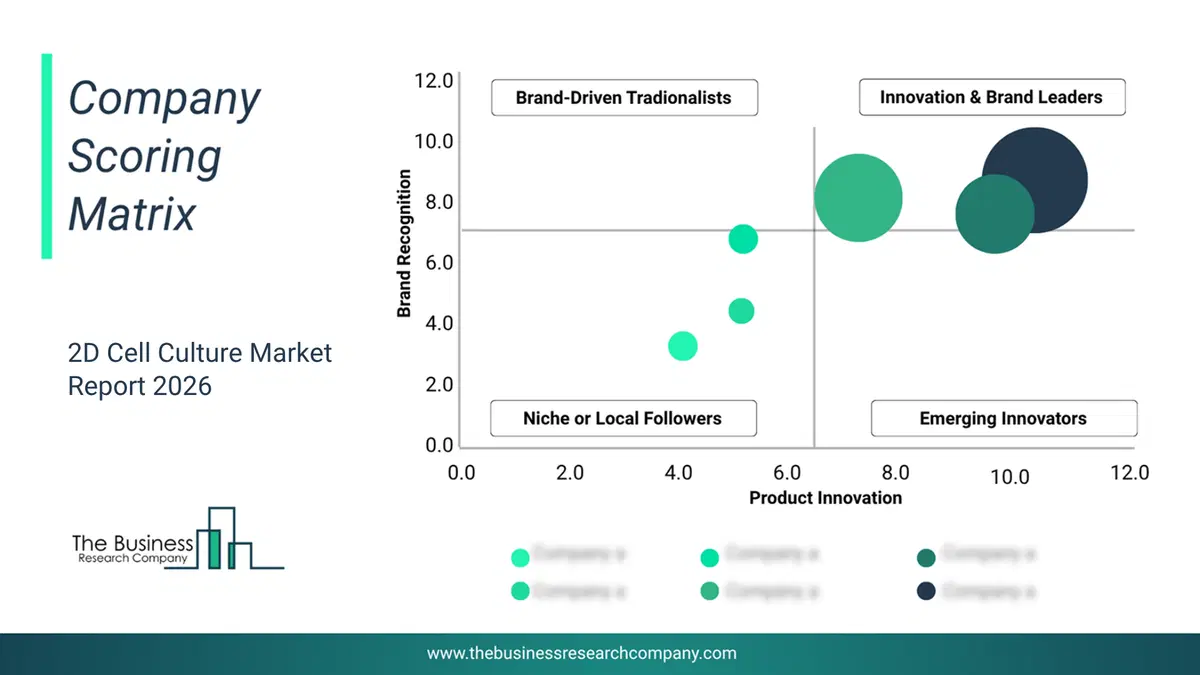
This chart maps companies by product innovation and brand strength, with bubble size indicating relative revenue, helping identify market leaders, challengers, and niche players. This is an illustrative chart; the full report provides a complete and accurate competitive analysis.
Global 2D Cell Culture Market Trends and Insights
Major companies operating in the 2D cell culture market are focusing on developing advanced biomaterials, such as thin hydrogel coatings for 2D substrates, to enhance cell adhesion, mimic native tissue environments, and improve experimental reproducibility. Thin hydrogel coatings for 2D substrates refer to specialized surface layers that provide a biomimetic, cell-friendly environment to improve cell attachment, growth, and function in 2D cultures. For instance, in September 2025, TheWell Bioscience Inc., a US-based Biotechnology company, introduced an innovative, xeno-free biomimetic hydrogel system. This platform is engineered to support both 2D and 3D neuronal cell cultures, as well as in vivo injectable delivery. It aims to advance neuroregenerative research by closely mimicking the natural cellular environment. The technology also supports precision medicine, cell therapy, and biomanufacturing applications. Overall, it represents a significant step forward in developing effective cell-based therapies.What Are Latest Mergers And Acquisitions In The 2D Cell Culture Market?
In April 2023, AnaBios Corporation, a US-based company that provides cells from the brain, liver, kidney, eye, and lung, including specialized endothelial cells, acquired Cell Systems for an undisclosed amount. Through this acquisition, AnaBios provides human tissue samples, primary human cells, and human-focused ex vivo services for research in drug discovery and safety testing. Cell Systems is a US-based company that provides products for cell culture, including 2D cell culture.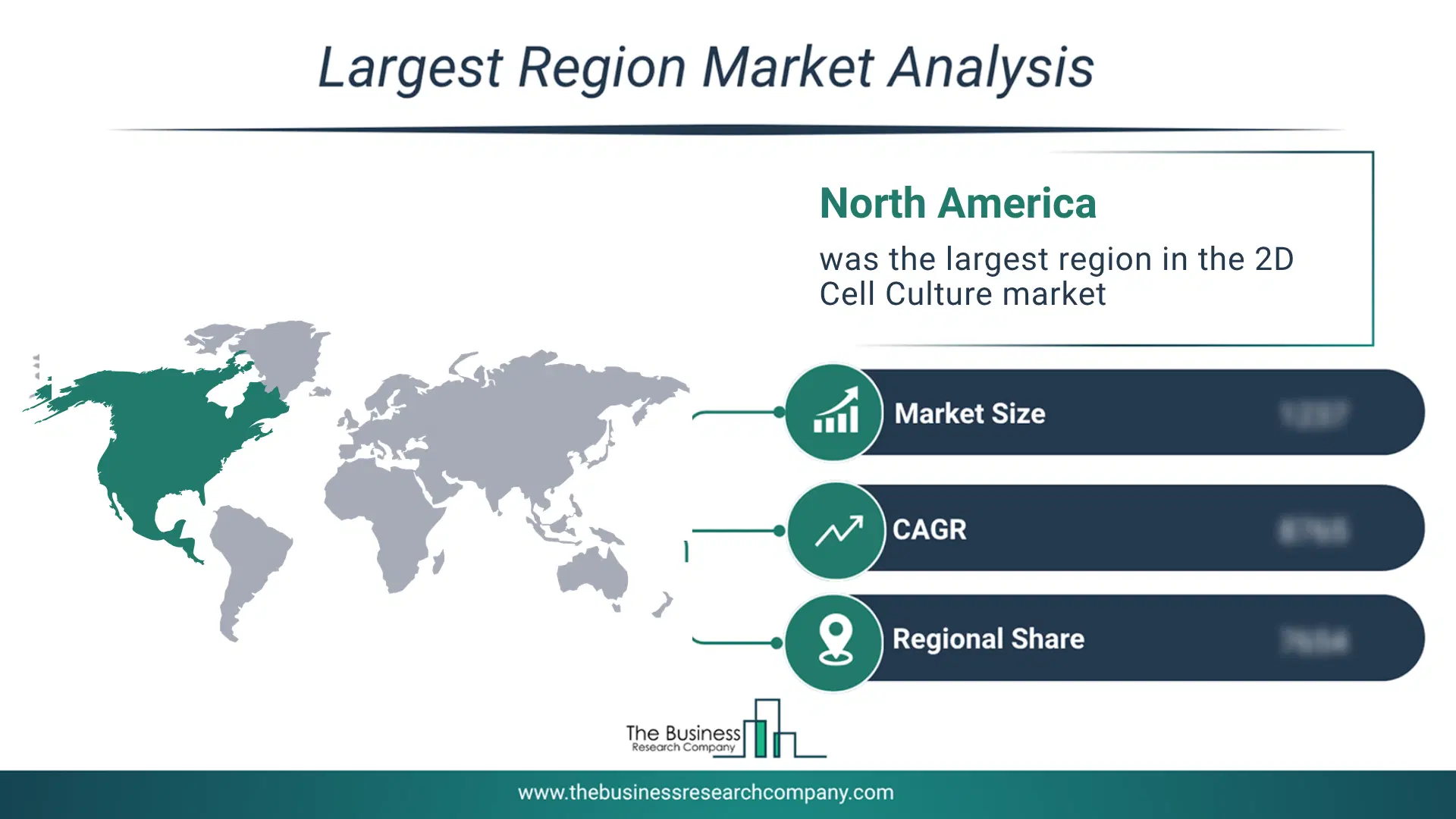
Regional Insights
North America was the largest region in the 2D cell culture market in 2025. Asia-Pacific is expected to be the fastest-growing region in the forecast period. The regions covered in this market report are Asia-Pacific, South East Asia, Western Europe, Eastern Europe, North America, South America, Middle East, Africa. The countries covered in this market report are Australia, Brazil, China, France, Germany, India, Indonesia, Japan, Taiwan, Russia, South Korea, UK, USA, Canada, Italy, Spain.What Defines the 2D Cell Culture Market?
The 2D cell culture market consists of revenues earned by entities by providing services such as cell line development, cell banking, assay development, and cytotoxicity testing. The market value includes the value of related goods sold by the service provider or included within the service offering. The 2D cell culture market also includes sales of culture media, petri dishes, flasks, and multiwall plates. Values in this market are 'factory gate' values, that is, the value of goods sold by the manufacturers or creators of the goods, whether to other entities (including downstream manufacturers, wholesalers, distributors, and retailers) or directly to end customers. The value of goods in this market includes related services sold by the creators of the goods.How is Market Value Defined and Measured?
The market value is defined as the revenues that enterprises gain from the sale of goods and/or services within the specified market and geography through sales, grants, or donations in terms of the currency (in USD unless otherwise specified). The revenues for a specified geography are consumption values that are revenues generated by organizations in the specified geography within the market, irrespective of where they are produced. It does not include revenues from resales along the supply chain, either further along the supply chain or as part of other products.
This chart presents market attractiveness based on a quantitative evaluation of growth, competition, strategic alignment, and risk, offering a clear view of opportunity areas for decision-making. This chart is for illustrative purposes; the full report contains the complete analysis.

This chart highlights the Total Addressable Market (TAM) by estimating the maximum revenue opportunity using an assumption-driven approach, supporting strategic planning and opportunity sizing across markets. The chart is illustrative; the full report provides a more comprehensive analysis.
What Key Data and Analysis Are Included in the 2D Cell Culture Market Report 2026?
The 2d cell culture market research report is one of a series of new reports from The Business Research Company that provides market statistics, including industry global market size, regional shares, competitors with the market share, detailed market segments, market trends and opportunities, and any further data you may need to thrive in the 2d cell culture industry. The market research report delivers a complete perspective of everything you need, with an in-depth analysis of the current and future state of the industry.2D Cell Culture Market Report Forecast Analysis
| Report Attribute | Details |
|---|---|
| Market Size Value In 2026 | $5.83 billion |
| Revenue Forecast In 2030 | $8.44 billion |
| Growth Rate | CAGR of 10.0% from 2026 to 2030 |
| Base Year For Estimation | 2025 |
| Actual Estimates/Historical Data | 2020-2025 |
| Forecast Period | 2026 - 2030 |
| Market Representation | Revenue in USD Billion and CAGR from 2026 to 2030 |
| Segments Covered | Type, Technology, Application, End-User |
| Regional Scope | Asia-Pacific, Western Europe, Eastern Europe, North America, South America, Middle East, Africa |
| Country Scope | The countries covered in the report are Australia, Brazil, China, France, Germany, India, Indonesia, Japan, Taiwan, Russia, South Korea, UK, USA, Canada, Italy, Spain. |
| Key Companies Profiled | Tecan Group Ltd., Roche Holding AG, Thermo Fisher Scientific Inc., Takara Bio Inc., Danaher Corporation, Merck KGaA, GE Healthcare, Corning Incorporated, Becton Dickinson and Company (BD), Lonza Group AG, Agilent Technologies Inc., Sartorius AG, PerkinElmer Inc., Bio-Rad Laboratories Inc., Eppendorf AG, Bio-Techne Corporation, STEMCELL Technologies Inc., Greiner Bio-One International AG, Promega Corporation, BICO Group AB, Cedarlane Laboratories Ltd., Creative Bioarray Inc., PromoCell GmbH, Biolamina AB, HiMedia Laboratories Pvt. Ltd., 3H Biomedical AB, Cell Microsystems Inc., AlveoliX AG. |
| Customization Scope | Request for Customization |
| Pricing And Purchase Options | Explore Purchase Options |