

3D And 4D Technology Market Report 2026
Global Outlook – By Input Device Type (3D And 4D Scanners, 3D And 4D Cameras, 3D And 4D Sensors), By Output Device Type (3D Displays, 3D Smartphones, 3D Televisions, 3D Projectors, 3D Printers), By End User (Military And Defense, Automotive, Construction, Consumer Electronics, Industrial, Entertainment, Healthcare, Other End Users) – Market Size, Trends, Strategies, and Forecast to 2030
3D And 4D Technology Market Overview
• 3D And 4D Technology market size has reached to $328.58 billion in 2025 • Expected to grow to $824.83 billion in 2030 at a compound annual growth rate (CAGR) of 20.2% • Growth Driver: Increasing Government Initiatives Driving The Growth Of The Market Through Innovation Funding And Policy Support • Market Trend: Advancing Precision Sensing Through Next-Generation 4D Lidar Technology • North America was the largest region in 2025 and Asia-Pacific is the fastest growing region.What Is Covered Under 3D And 4D Technology Market?
3D technology creates or displays images with depth perception, while 4D technology adds time-based changes or effects to the 3D experience, such as motion or sensory changes. 3D technology is used to enhance visual experiences in movies, gaming, and design by adding depth perception. 4D technology is used in entertainment and simulations to incorporate real-time environmental changes, such as motion or smells, alongside 3D visuals. The main types of 3D and 4D technology input devices are 3D and 4D scanners, 3D and 4D cameras, and 3D and 4D sensors. The output device types include 3D displays, 3D smartphones, 3D televisions, 3D projectors, and 3D printers. 3D scanners are devices that capture the shape of physical objects using lasers or structured light, creating digital 3D models used in manufacturing, design, and quality control. They are used by various end users, such as military and defense, automotive, construction, consumer electronics, industrial, entertainment, healthcare, and others.
What Is The 3D And 4D Technology Market Size and Share 2026?
The 3D and 4d technology market size has grown exponentially in recent years. It will grow from $328.58 billion in 2025 to $395.21 billion in 2026 at a compound annual growth rate (CAGR) of 20.3%. The growth in the historic period can be attributed to increasing demand for 3D movies and gaming, growth of consumer electronics with 3D capabilities, adoption in automotive design, early implementation in industrial prototyping, rise of 3D scanning and imaging technologies.What Is The 3D And 4D Technology Market Growth Forecast?
The 3D and 4d technology market size is expected to see exponential growth in the next few years. It will grow to $824.83 billion in 2030 at a compound annual growth rate (CAGR) of 20.2%. The growth in the forecast period can be attributed to integration with virtual and augmented reality, expansion in healthcare imaging and simulations, adoption in defense and military applications, growth in immersive entertainment experiences, advancements in 3D and 4d printing technologies. Major trends in the forecast period include advancements in 4d motion and sensory effects, integration with entertainment and gaming platforms, development of high-resolution 3D displays, expansion of 3D printing applications, adoption in automotive and industrial design.
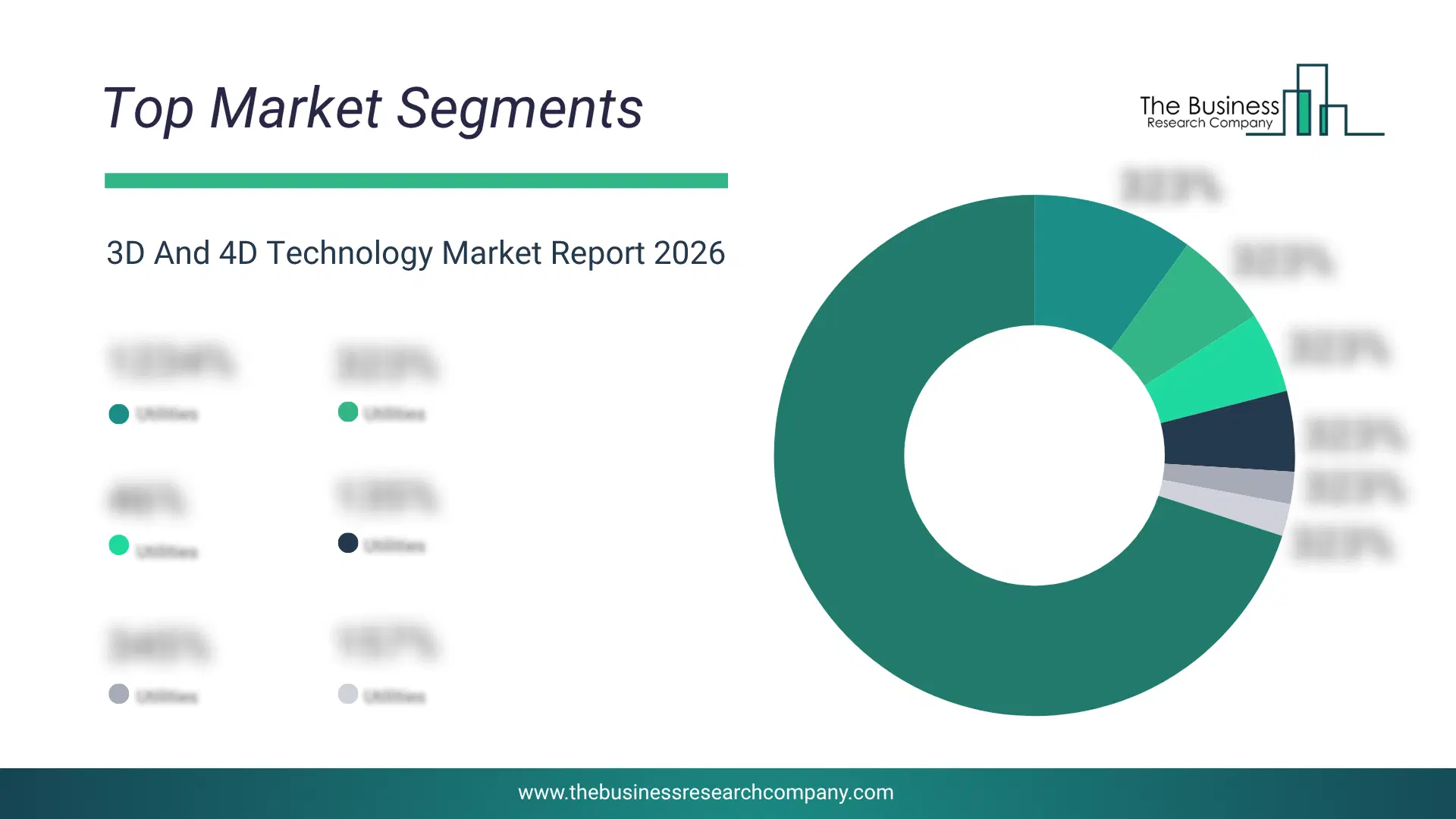
Global 3D And 4D Technology Market Segmentation
1) By Input Device Type: 3D And 4D Scanners, 3D And 4D Cameras, 3D And 4D Sensors 2) By Output Device Type: 3D Displays, 3D Smartphones, 3D Televisions, 3D Projectors, 3D Printers 3) By End User: Military And Defense, Automotive, Construction, Consumer Electronics, Industrial, Entertainment, Healthcare, Other End Users Subsegments: 1) By 3D And 4D Scanners: Laser Scanners, Structured Light Scanners, Handheld Scanners 2) By 3D And 4D Cameras: Stereo Cameras, Depth Cameras, Time-Of-Flight Cameras 3) By 3D And 4D Sensors: Proximity Sensors, Motion Sensors, Imaging SensorsWhat Is The Driver Of The 3D And 4D Technology Market?
The increasing government initiatives are expected to propel the growth of the 3D and 4D technology markets going forward. Government initiatives refer to actions, funding programs, and policy frameworks implemented by national or regional authorities to promote technological advancement and industrial innovation. Government initiatives can catalyze the development and application of 3D and 4D technologies through funding, policy support, and fostering industry-academic collaborations. For instance, in September 2023, the Department of Energy, a US-based organization, government announced allocations of US $45 million for manufacturing innovation projects, including wind and water technologies that explicitly utilize 3D-printing methods for large-scale equipment manufacturing. Therefore, the increasing government initiatives are driving the growth of the 3D and 4D technology industry.Key Players In The Global 3D And 4D Technology Market
Major companies operating in the 3D and 4d technology market are Google LLC; Samsung Group; Sony Corporation; LG Corporation; Intel Corporation; Hewlett-Packard Company; Panasonic Corporation; Canon Inc.; Koninklijke Philips N.V.; Dassault Systèmes SE; Hexagon AB; Autodesk Inc.; Dolby Laboratories; Barco N.V.; DreamWorks Animation LLC; Cognex Corporation; Stratasys Inc.; EOS GmbH; 3D Systems Corporation; FARO Technologies Inc.; Materialise NV; Vicon Motion Systems Ltd.; CT CoreTechnologie Group; Organovo Holdings Inc.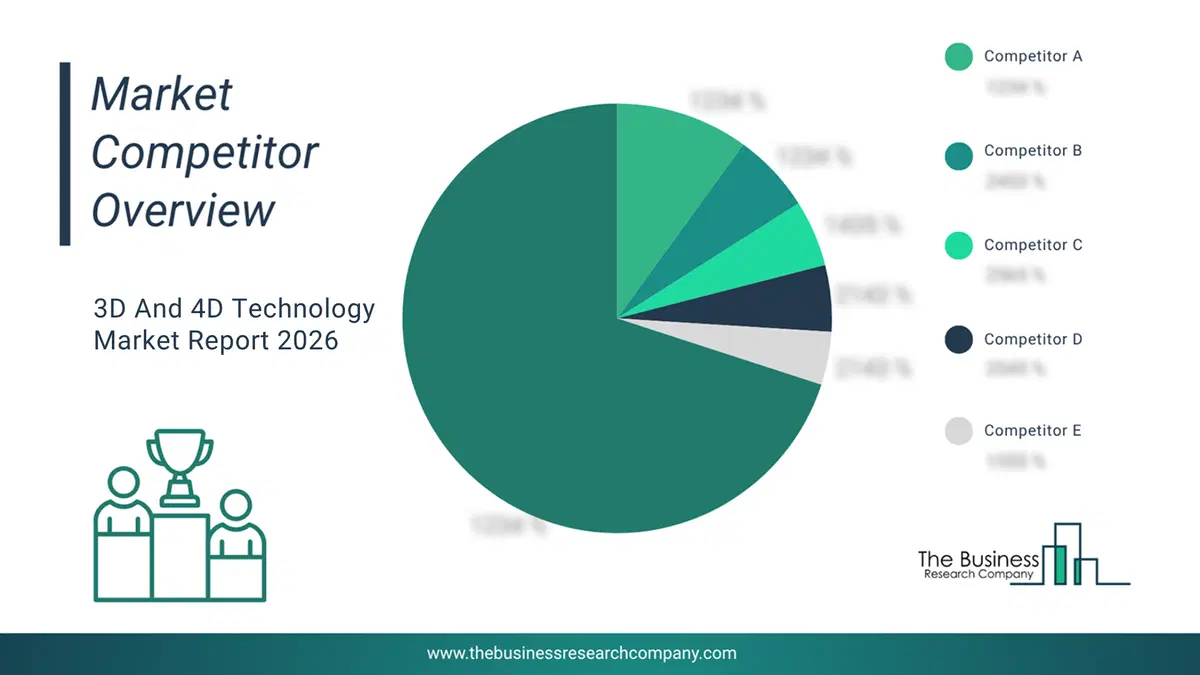
This chart is for illustrative purposes; the full report includes a detailed competitor analysis and comprehensive overview of the top 10 companies in the market.
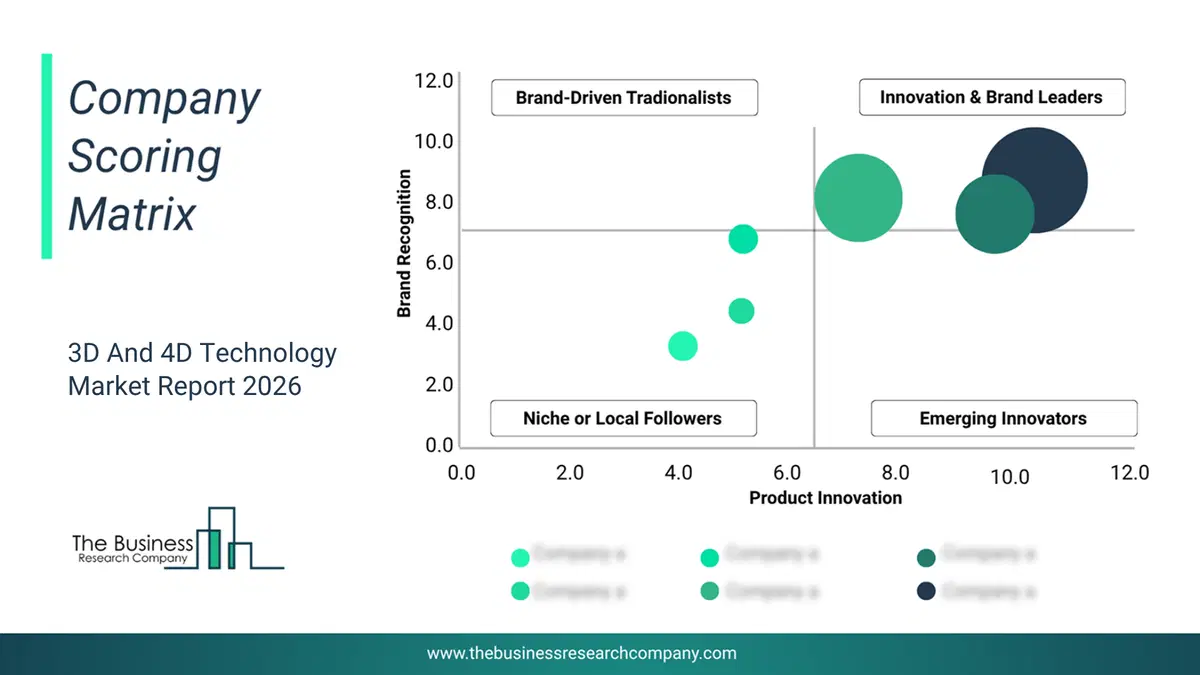
This chart maps companies by product innovation and brand strength, with bubble size indicating relative revenue, helping identify market leaders, challengers, and niche players. This is an illustrative chart; the full report provides a complete and accurate competitive analysis.
Global 3D And 4D Technology Market Trends and Insights
Major companies operating in the 3D and 4D technology market are increasingly focusing on developing innovative products such as automotive-grade sensors to enhance real-time perception and meet the growing demand for advanced autonomous and safety systems. Automotive-grade sensors are high-reliability sensing devices engineered to meet strict automotive safety, durability, and performance standards, helping vehicles detect and interpret their surroundings with greater accuracy, which in turn improves real-time decision-making, enhances driver assistance functions, and supports autonomous driving capabilities. For instance, in January 2024, Aeva, a U.S.-based sensing technology company, launched the Atlas 4D LiDAR sensor, an innovative automotive-grade device designed for mass-production applications. The Atlas sensor is built on Aeva’s custom silicon integrated lidar-on-chip module and its X1 system-on-chip processor and uses FMCW technology to measure distance and velocity simultaneously. It offers a detection range of up to 500 meters, immunity to interference from sunlight or other LiDAR systems, passive cooling due to high power efficiency, and pairing capabilities with Aeva’s perception software for high-resolution imaging, dynamic object tracking, hazard detection, and scene understanding.What Are Latest Mergers And Acquisitions In The 3D And 4D Technology Market?
In August 2023, Leia Inc., a US-based company manufacturing 3D light-field products and software applications, acquired Dimenco Holding B.V. for an undisclosed amount. Through this acquisition, Leia aims to harmonize 3D technology across various devices, offering a unified, immersive experience without the need for wearables, thereby expediting its widespread adoption. Dimenco Holding B.V. is a Netherlands-based display technology company, including 3D and 4D display.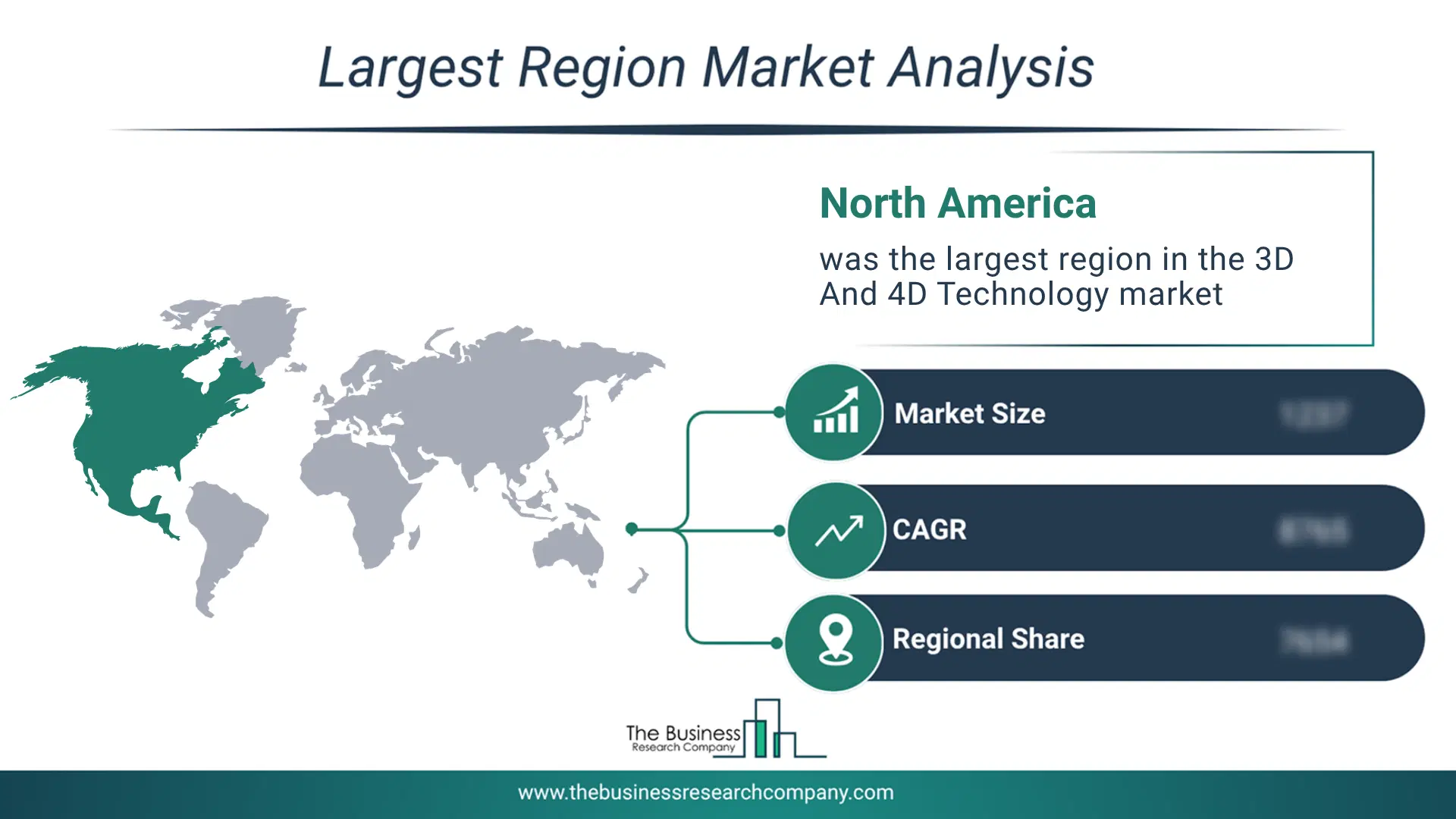
Regional Insights
North America was the largest region in the 3D and 4D technology market in 2025. Asia-Pacific is expected to be the fastest-growing region in the forecast period. The regions covered in this market report are Asia-Pacific, South East Asia, Western Europe, Eastern Europe, North America, South America, Middle East, Africa. The countries covered in this market report are Australia, Brazil, China, France, Germany, India, Indonesia, Japan, Taiwan, Russia, South Korea, UK, USA, Canada, Italy, SpainWhat Defines the 3D And 4D Technology Market?
The 3D and 4D technology market consists of revenues earned by entities by providing services such as virtual reality, augmented reality, printing, scanning, and building information modeling. The market value includes the value of related goods sold by the service provider or included within the service offering. The 3D and 4D technology market also includes sales of modeling software, VR headsets, AR devices, simulation software, graphics processing units, and workstations that are used in providing services. Values in this market are ‘factory gate’ values, that is, the value of goods sold by the manufacturers or creators of the goods, whether to other entities (including downstream manufacturers, wholesalers, distributors, and retailers) or directly to end customers. The value of goods in this market includes related services sold by the creators of the goods.How is Market Value Defined and Measured?
The market value is defined as the revenues that enterprises gain from the sale of goods and/or services within the specified market and geography through sales, grants, or donations in terms of the currency (in USD unless otherwise specified). The revenues for a specified geography are consumption values that are revenues generated by organizations in the specified geography within the market, irrespective of where they are produced. It does not include revenues from resales along the supply chain, either further along the supply chain or as part of other products.
This chart presents market attractiveness based on a quantitative evaluation of growth, competition, strategic alignment, and risk, offering a clear view of opportunity areas for decision-making. This chart is for illustrative purposes; the full report contains the complete analysis.

This chart highlights the Total Addressable Market (TAM) by estimating the maximum revenue opportunity using an assumption-driven approach, supporting strategic planning and opportunity sizing across markets. The chart is illustrative; the full report provides a more comprehensive analysis.
What Key Data and Analysis Are Included in the 3D And 4D Technology Market Report 2026?
The 3d and 4d technology market research report is one of a series of new reports from The Business Research Company that provides market statistics, including industry global market size, regional shares, competitors with the market share, detailed market segments, market trends and opportunities, and any further data you may need to thrive in the 3d and 4d technology industry. The market research report delivers a complete perspective of everything you need, with an in-depth analysis of the current and future state of the industry.3D And 4D Technology Market Report Forecast Analysis
| Report Attribute | Details |
|---|---|
| Market Size Value In 2026 | $395.21 billion |
| Revenue Forecast In 2030 | $824.83 billion |
| Growth Rate | CAGR of 20.2% from 2026 to 2030 |
| Base Year For Estimation | 2025 |
| Actual Estimates/Historical Data | 2020-2025 |
| Forecast Period | 2026 - 2030 |
| Market Representation | Revenue in USD Billion and CAGR from 2026 to 2030 |
| Segments Covered | Input Device Type, Output Device Type, End User |
| Regional Scope | Asia-Pacific, Western Europe, Eastern Europe, North America, South America, Middle East, Africa |
| Country Scope | The Countries Covered In This Market Report Are Australia, Brazil, China, France, Germany, India, Indonesia, Japan, Taiwan, Russia, South Korea, Uk, Usa, Canada, Italy, Spain. |
| Key Companies Profiled | Google LLC, Samsung Group, Sony Corporation, LG Corporation, Intel Corporation, Hewlett-Packard Company, Panasonic Corporation, Canon Inc., Koninklijke Philips N.V., Dassault Systèmes SE, Hexagon AB, Autodesk Inc., Dolby Laboratories, Barco N.V., DreamWorks Animation LLC, Cognex Corporation, Stratasys Inc., EOS GmbH, 3D Systems Corporation, FARO Technologies Inc., Materialise NV, Vicon Motion Systems Ltd., CT CoreTechnologie Group, Organovo Holdings Inc. |
| Customization Scope | Request for Customization |
| Pricing And Purchase Options | Explore Purchase Options |