
3D Cell Culture Technologies Market Report 2026
Global Outlook – By Type (Scaffold-Based, Scaffold-Free, 3D Bioreactors ), By Application (Cancer Research, Stem Cell Research, Drug Discovery, Regenerative Medicine), By End Users (Research Laboratories and Institutes, Biotechnology and Pharmaceutical Companies, Other End Users ) - Market Size, Trends, Strategies, and Forecast to 2030
3D Cell Culture Technologies Market Overview
• 3D Cell Culture Technologies market size has reached to $3.96 billion in 2025 • Expected to grow to $9.8 billion in 2030 at a compound annual growth rate (CAGR) of 19.9% • Growth Driver: Increased Demand For Organ Transplantation Boosts The 3D Cell Culture Technologies Market • Market Trend: Advancements In High-Throughput 3D Bioprinting Technologies Enhance Scalability And Reproducibility In Cell Culture Research • North America was the largest region in 2025 and Western Europe is the fastest growing region.What Is Covered Under 3D Cell Culture Technologies Market?
Cell culture is a process for developing substrates for the safe production of viral vaccines. 3D cell culture is an in vitro technique wherein the cells can grow in an artificially created environment. These technologies are essential for understanding more complex biological processes, such as tissue development, cell behavior, drug responses, and disease mechanisms. The main types of 3D cell culture technologies are scaffold-based, scaffold-free, and 3D bioreactors. The 3D bioreactors are small plastic cylinder chambers designed specifically for growing cells in three dimensions. The technologies are applied for cancer research, stem cell research, drug discovery, and regenerative medicine that are used by research laboratories and institutes, biotechnology and pharmaceutical companies, hospitals and diagnostic centers, and other end users.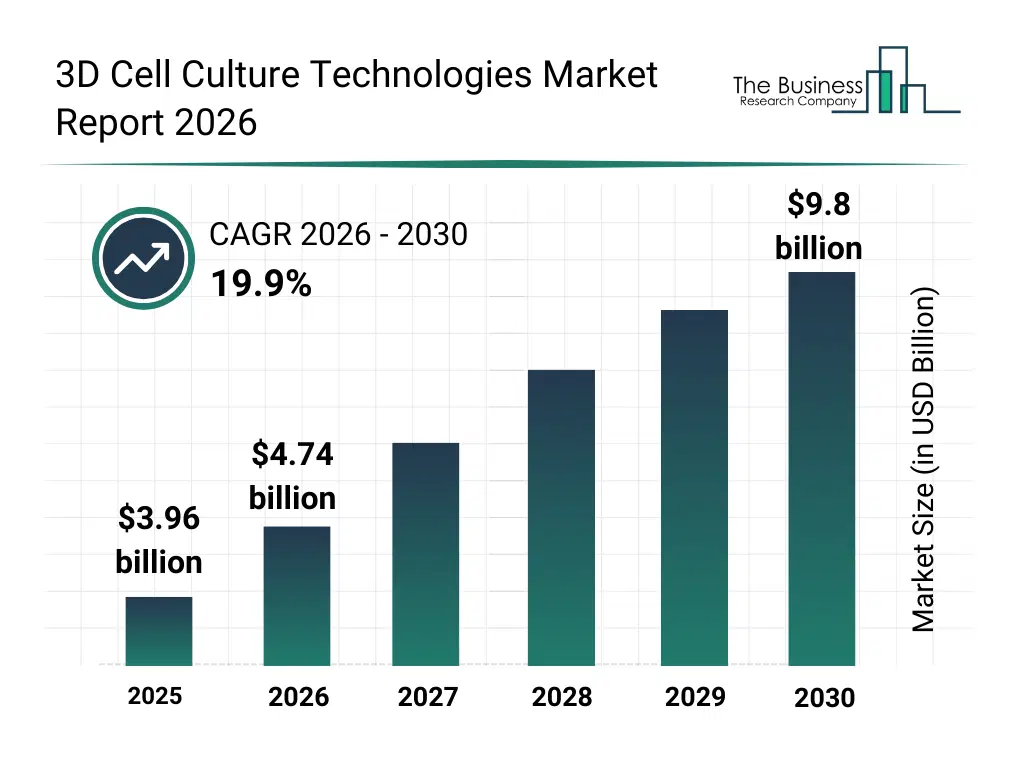
What Is The 3D Cell Culture Technologies Market Size and Share 2026?
The 3d cell culture technologies market size has grown rapidly in recent years. It will grow from $3.96 billion in 2025 to $4.74 billion in 2026 at a compound annual growth rate (CAGR) of 19.7%. The growth in the historic period can be attributed to growing use of cell culture in vaccine production, increasing cancer research activities, limitations of 2d cell culture models, rising academic research funding, expansion of biotechnology research infrastructure.What Is The 3D Cell Culture Technologies Market Growth Forecast?
The 3d cell culture technologies market size is expected to see rapid growth in the next few years. It will grow to $9.8 billion in 2030 at a compound annual growth rate (CAGR) of 19.9%. The growth in the forecast period can be attributed to advancement in 3d bioreactor technologies, increasing investment in regenerative medicine, growth in pharmaceutical drug discovery pipelines, rising adoption of personalized medicine, technological improvements in scaffold materials. Major trends in the forecast period include increasing adoption of 3d cell culture in cancer research, rising use of organoids and spheroids for disease modeling, growing demand for advanced drug screening platforms, expansion of stem cell and regenerative medicine research, higher preference for in vitro models over animal testing.
Global 3D Cell Culture Technologies Market Segmentation
1) By Type: Scaffold-Based, Scaffold-Free, 3D Bioreactors 2) By Application: Cancer Research, Stem Cell Research, Drug Discovery, Regenerative Medicine 3) By End Users: Research Laboratories and Institutes, Biotechnology and Pharmaceutical Companies, Other End Users Subsegments: 1) By Scaffold-Based: Natural Scaffolds, Synthetic Scaffolds, Hybrid Scaffolds 2) By Scaffold-Free: Spheroid-Based, Organoid-Based 3) By 3D Bioreactors: Spinner Flask Bioreactors, Rotating Wall Bioreactors, Microcarrier-Based Bioreactors, Hollow Fiber BioreactorsWhat Is The Driver Of The 3D Cell Culture Technologies Market?
The increasing requirement for organ transplantation is expected to propel the growth of the 3D cell culture technologies market going forward. 3D cell culture involves forming three-dimensional cell structures that closely mimic the architecture and function of tissues or organs, enabling tissue and organ regeneration as well as drug toxicology screening. The rise in organ transplantation is driven by growing incidences of organ failure and advancements in medical technology that make transplantation more feasible. 3D cell culture technologies support this trend by providing models for organ development, regenerative therapies, and preclinical testing. For instance, in January 2024, according to the United Network for Organ Sharing (UNOS), a US-based nonprofit organization, the United States performed a record 46,632 organ transplants in 2023, surpassing the previous annual record and marking continued nationwide growth in transplant activity. Therefore, the increasing requirement for organ transplantation is driving the growth of the 3D cell culture technologies industry.Key Players In The Global 3D Cell Culture Technologies Market
Major companies operating in the 3D cell culture technologies market are Becton Dickinson and Company, Corning Incorporated, Eppendorf AG, Merck KGaA, Thermo Fisher Scientific Inc., Lonza Group AG, HiMedia Laboratories Pvt. Ltd., PromoCell GmbH, CellGenix GmbH, Greiner Bio-One International GmbH, Irvine Scientific Sales Company Inc., American Type Culture Collection (ATCC), Miltenyi Biotec B.V. & Co. KG, Sartorius AG, CN Bio Innovations, Nortis Inc., Kiyatec, Nanofiber Solutions, Known Medicine, Synthecon Inc., 3D Biotek LLC, 3D Cell Culture Innovations LLC, 3D Matrix Inc., Allevi Inc., BioSpherix Ltd., Emulate Inc., MicroTissues Inc., Sumitomo Bakelite
This chart is for illustrative purposes; the full report includes a detailed competitor analysis and comprehensive overview of the top 10 companies in the market.
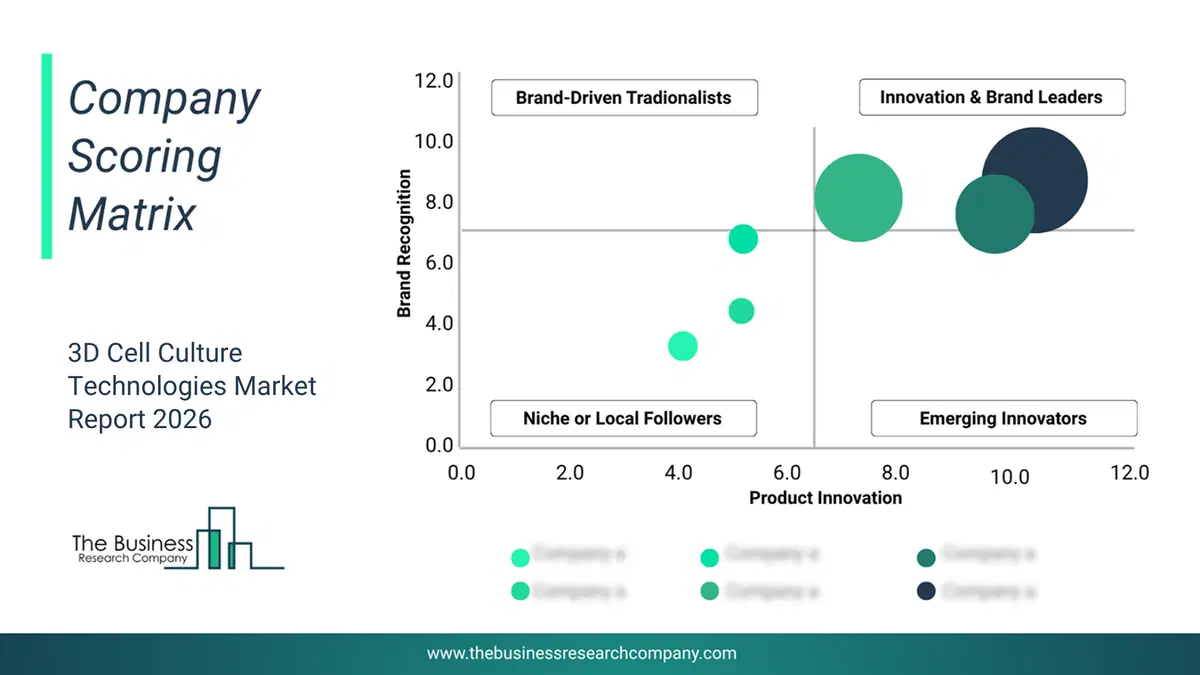
This chart maps companies by product innovation and brand strength, with bubble size indicating relative revenue, helping identify market leaders, challengers, and niche players. This is an illustrative chart; the full report provides a complete and accurate competitive analysis.
Global 3D Cell Culture Technologies Market Trends and Insights
Major companies operating in the 3D cell culture technologies market are focusing on developing advanced high-throughput scalability systems to enhance efficiency and reproducibility. High-throughput scalability refers to platforms that can rapidly generate large numbers of 3D cell models with consistent quality, thereby reducing variation and cost per sample. For instance, in January 2025, Inventia Life Science, an Australia-based company that provides 3D cell culture technologies, launched RASTRUM Allegro, featuring drop-on-demand bioprinting and precision robotics. The system can produce a 96-well plate in about 6 minutes and a 384-well plate in 9 minutes, allowing a throughput of over 35 plates per day. It delivers post-print intra- and inter-plate coefficient of variation (CV) of under 10 percent and downstream assay CVs under 19 percent, making results highly reproducible. The platform is optimized for patient-derived samples, enabling the creation of up to 3.5× more 3D models from limited cell numbers, thereby reducing cost per well and increasing accessibility for translational research.What Are Latest Mergers And Acquisitions In The 3D Cell Culture Technologies Market?
In December 2024, Merck KGaA, a Germany-based science and technology company, completed the acquisition of HUB Organoids Holding B.V. (HUB) for an undisclosed amount. Through this acquisition, Merck aims to enhance its 3D cell culture and organoid technology capabilities to support drug discovery and the development of next-generation therapeutics. HUB Organoids Holding B.V. is a Netherlands-based company specializing in organoid models and 3D cell culture technologies.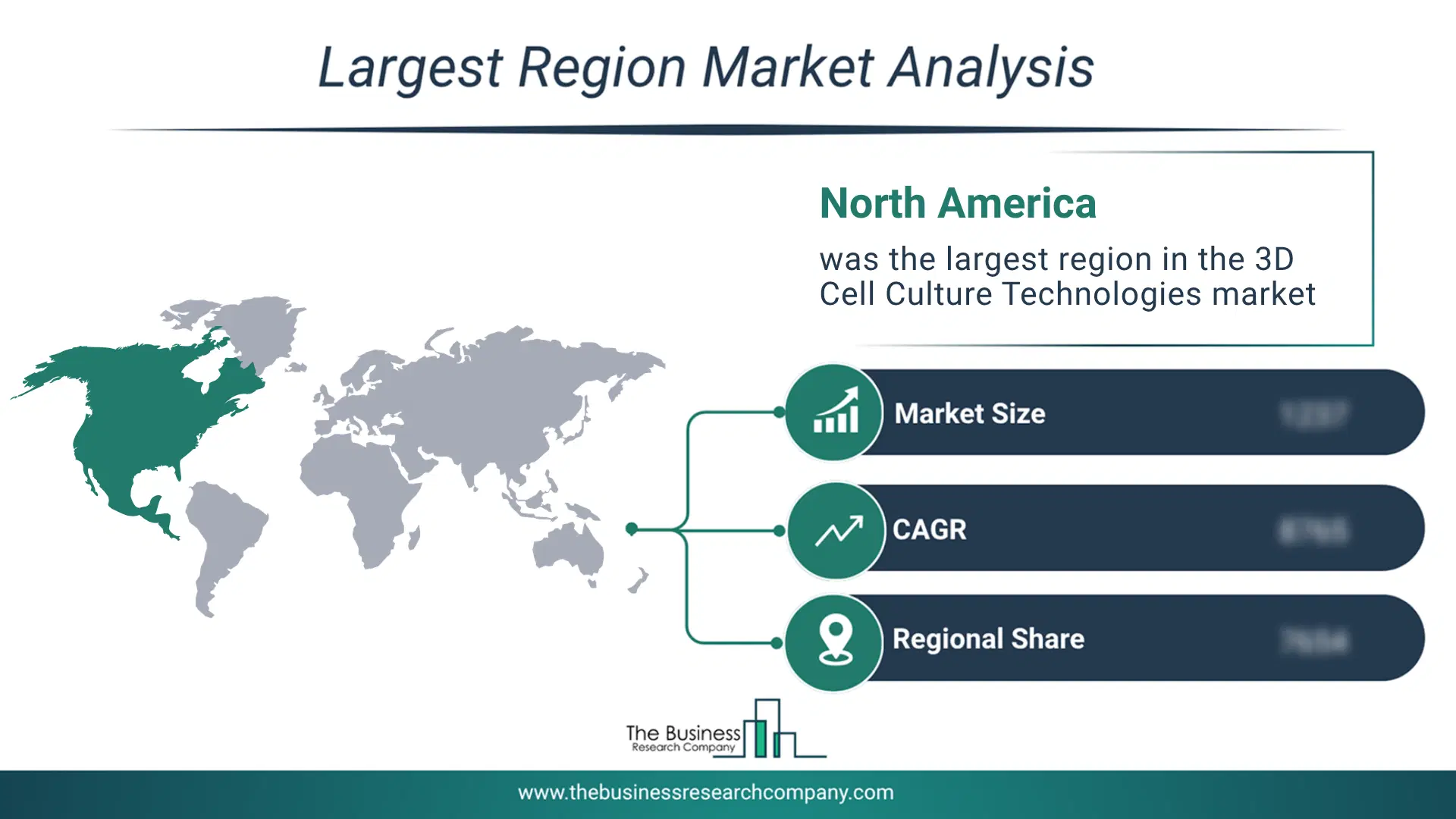
Regional Outlook
North America was the largest region in the 3D cell culture technologies market in 2025. Western Europe was the second largest region in the 3D cell culture technologies market. The regions covered in this market report are Asia-Pacific, South East Asia, Western Europe, Eastern Europe, North America, South America, Middle East, Africa. The countries covered in this market report are Australia, Brazil, China, France, Germany, India, Indonesia, Japan, Taiwan, Russia, South Korea, UK, USA, Canada, Italy, Spain.What Defines the 3D Cell Culture Technologies Market?
The 3D cell culture technologies market consists of sales of 3D cell culture technologies such as microfluidics, hydrogels scaffolds, scaffold-free 3D cell culture techniques, spheroids, cube, spherical droplet, stacked plate, magnetic bead, organ-on-chips and other technologies. Values in this market are factory gate values, that is the value of goods sold by the manufacturers or creators of the goods, whether to other entities (including downstream manufacturers, wholesalers, distributors and retailers) or directly to end customers. The value of goods in this market includes related services sold by the creators of the goods.How is Market Value Defined and Measured?
The market value is defined as the revenues that enterprises gain from the sale of goods and/or services within the specified market and geography through sales, grants, or donations in terms of the currency (in USD unless otherwise specified). The revenues for a specified geography are consumption values that are revenues generated by organizations in the specified geography within the market, irrespective of where they are produced. It does not include revenues from resales along the supply chain, either further along the supply chain or as part of other products.
This chart presents market attractiveness based on a quantitative evaluation of growth, competition, strategic alignment, and risk, offering a clear view of opportunity areas for decision-making. This chart is for illustrative purposes; the full report contains the complete analysis.

This chart highlights the Total Addressable Market (TAM) by estimating the maximum revenue opportunity using an assumption-driven approach, supporting strategic planning and opportunity sizing across markets. The chart is illustrative; the full report provides a more comprehensive analysis.
What Key Data and Analysis Are Included in the 3D Cell Culture Technologies Market Report 2026?
The 3d cell culture technologies market research report is one of a series of new reports from The Business Research Company that provides market statistics, including industry global market size, regional shares, competitors with the market share, detailed market segments, market trends and opportunities, and any further data you may need to thrive in the 3d cell culture technologies industry. The market research report delivers a complete perspective of everything you need, with an in-depth analysis of the current and future state of the industry.3D Cell Culture Technologies Market Report Forecast Analysis
| Report Attribute | Details |
|---|---|
| Market Size Value In 2026 | $4.74 billion |
| Revenue Forecast In 2030 | $9.8 billion |
| Growth Rate | CAGR of 19.9% from 2026 to 2030 |
| Base Year For Estimation | 2025 |
| Actual Estimates/Historical Data | 2020-2025 |
| Forecast Period | 2026 - 2030 |
| Market Representation | Revenue in USD Billion and CAGR from 2026 to 2030 |
| Segments Covered | Type, Application, End Users |
| Regional Scope | Asia-Pacific, Western Europe, Eastern Europe, North America, South America, Middle East, Africa |
| Country Scope | The countries covered in the report are Australia, Brazil, China, France, Germany, India, Indonesia, Japan, Taiwan, Russia, South Korea, UK, USA, Canada, Italy, Spain |
| Key Companies Profiled | Becton Dickinson and Company, Corning Incorporated, Eppendorf AG, Merck KGaA, Thermo Fisher Scientific Inc., Lonza Group AG, HiMedia Laboratories Pvt. Ltd., PromoCell GmbH, CellGenix GmbH, Greiner Bio-One International GmbH, Irvine Scientific Sales Company Inc., American Type Culture Collection (ATCC), Miltenyi Biotec B.V. & Co. KG, Sartorius AG, CN Bio Innovations, Nortis Inc., Kiyatec, Nanofiber Solutions, Known Medicine, Synthecon Inc., 3D Biotek LLC, 3D Cell Culture Innovations LLC, 3D Matrix Inc., Allevi Inc., BioSpherix Ltd., Emulate Inc., MicroTissues Inc., Sumitomo Bakelite |
| Customization Scope | Request for Customization |
| Pricing And Purchase Options | Explore Purchase Options |