
3D Imaging Software Market Report 2026
Global Outlook – By Component (Software, Services), By Deployment Mode (On-Premises, Cloud), By Application (Architectural And Product Visualization, High-End Video Games, Marketing And Advertisement, Training Simulation), By End-User (Banking, Financial Services And Insurance (BFSI), Healthcare, Media And Entertainment, Manufacturing, IT And Telecommunications, Other End-Users) – Market Size, Trends, Strategies, and Forecast to 2030
3D Imaging Software Market Overview
• 3D Imaging Software market size has reached to $6.35 billion in 2025 • Expected to grow to $12.25 billion in 2030 at a compound annual growth rate (CAGR) of 14% • Growth Driver: The Growing Demand For Minimally Invasive Surgeries Is Driving Market Growth Due To Improved Surgical Precision And Faster Recovery Times • Market Trend: Aura Enhances 3D Imaging Capabilities For Clinical Applications • North America was the largest region in 2025.What Is Covered Under 3D Imaging Software Market?
3D imaging software refers to specialized tools that capture, process, and analyze three-dimensional data from physical objects or environments. It enables the creation of detailed 3D models used in various industries such as automotive, construction, and robotics. These software solutions leverage technologies like laser scanning, computer vision, and artificial intelligence for accurate visualization and measurement. The main component types of 3D imaging software are software and services. Software is a program that allows the creation, manipulation, and analysis of three-dimensional digital models or images for applications in fields like design, medical imaging, animation, and simulation. It is deployed in different modes, like on-premises and cloud, and it is used for various applications such as architectural and product visualization, high-end video games, marketing and advertisement, and training simulation. The key end users include banking, financial services, and insurance (BFSI), healthcare, media and entertainment, manufacturing, IT and telecommunications, and others.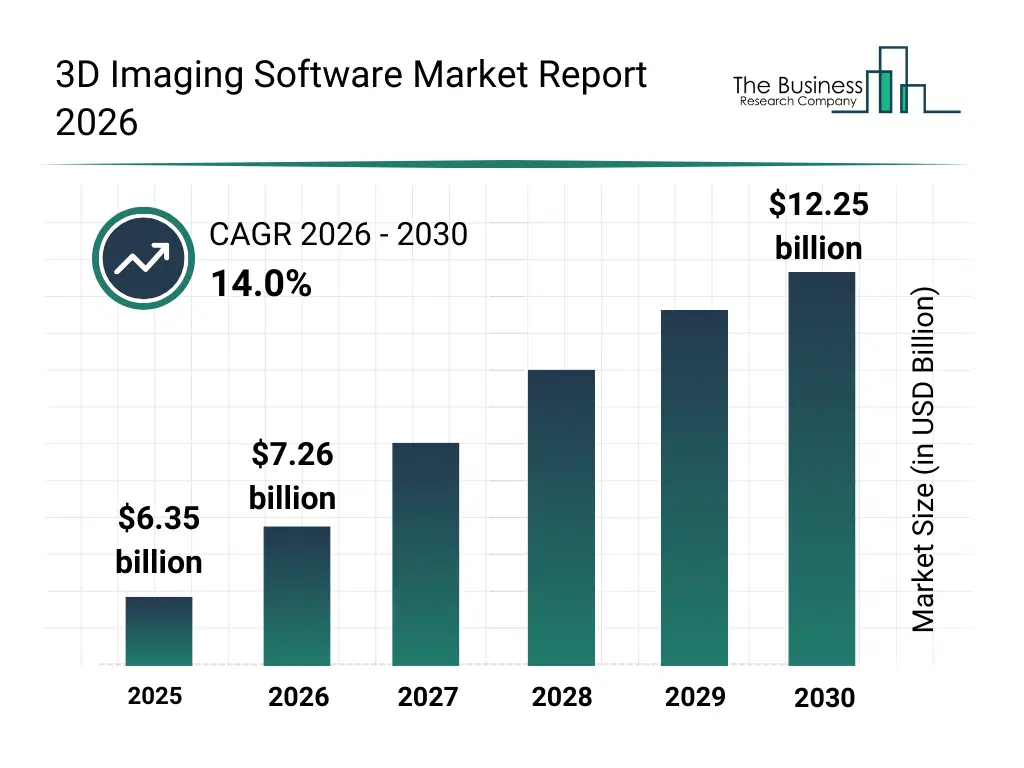
What Is The 3D Imaging Software Market Size and Share 2026?
The 3D imaging software market size has grown rapidly in recent years. It will grow from $6.35 billion in 2025 to $7.26 billion in 2026 at a compound annual growth rate (CAGR) of 14.3%. The growth in the historic period can be attributed to adoption of computer aided design tools, early use of 3D scanning technologies, demand for realistic visualization, growth of manufacturing automation, expansion of digital content creation.What Is The 3D Imaging Software Market Growth Forecast?
The 3D imaging software market size is expected to see rapid growth in the next few years. It will grow to $12.25 billion in 2030 at a compound annual growth rate (CAGR) of 14.0%. The growth in the forecast period can be attributed to smart manufacturing adoption, increasing use of digital twins, demand for real time 3D analysis, growth of robotics applications, expansion of cloud based visualization tools. Major trends in the forecast period include advanced 3D visualization tools, AI driven image reconstruction, cloud based 3D imaging platforms, high precision measurement software, integration with simulation and design systems.
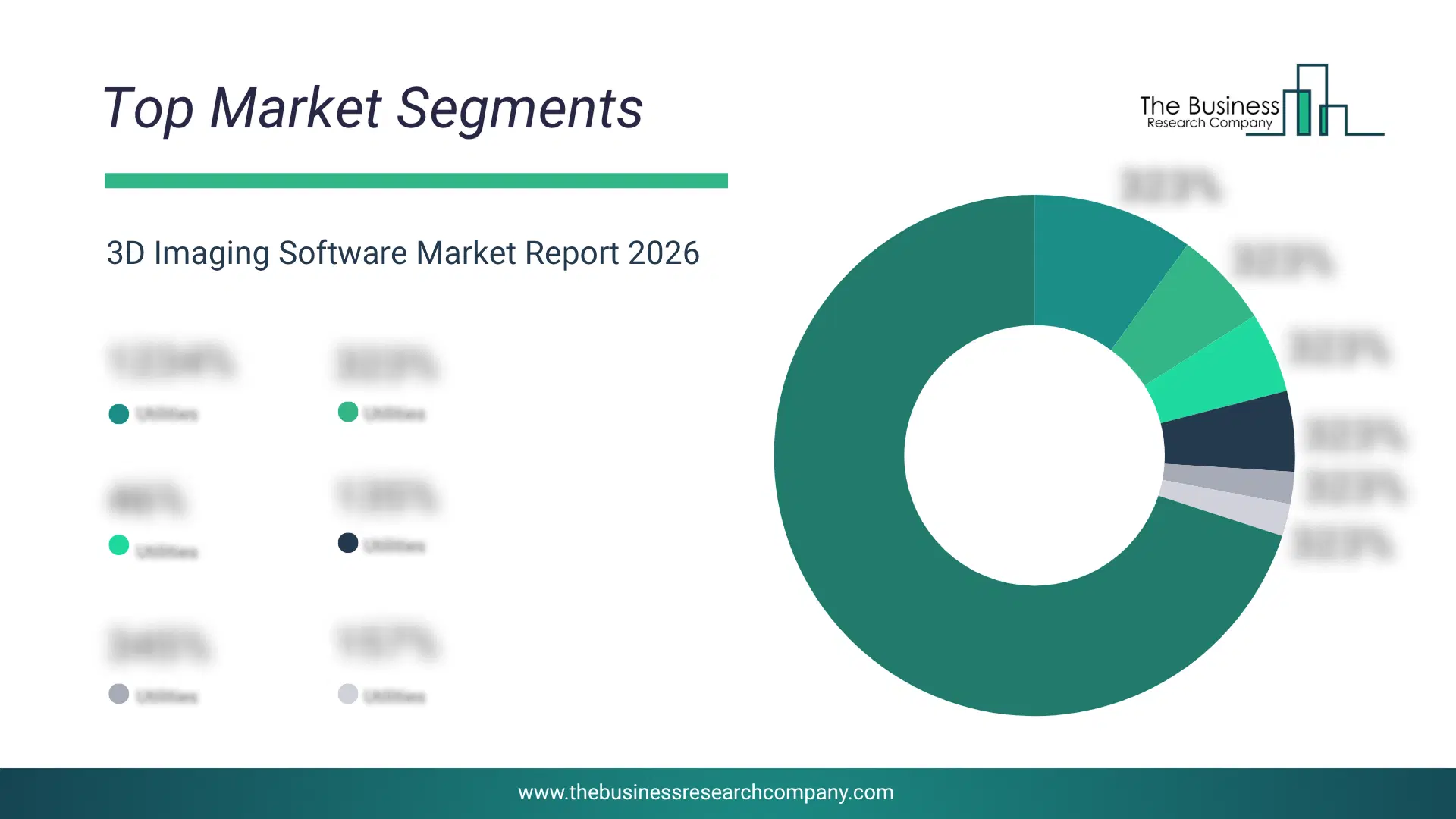
Global 3D Imaging Software Market Segmentation
1) By Component: Software, Services 2) By Deployment Mode: On-Premises, Cloud 3) By Application: Architectural And Product Visualization, High-End Video Games, Marketing And Advertisement, Training Simulation 4) By End-User: Banking, Financial Services And Insurance (BFSI), Healthcare, Media And Entertainment, Manufacturing, IT And Telecommunications, Other End-Users Subsegments: 1) By Software: 3D Modeling, 3D Scanning, 3D Rendering, Image Reconstruction, Animation And Visualization 2) By Services: Consulting Services, Integration And Deployment, Support And MaintenanceWhat Is The Driver Of The 3D Imaging Software Market?
The increasing demand for minimally invasive surgeries is expected to propel the growth of the 3D imaging software market going forward. Minimally invasive surgery (MIS) involves performing procedures through small incisions using specialized instruments, reducing tissue damage, pain, and recovery time. The rising demand for minimally invasive surgeries is driven by faster recovery, reduced pain, lower complication risks, and advanced surgical technologies. 3D imaging software supports the minimally invasive surgeries by offering precise, detailed visuals that enhance surgical accuracy and reduce recovery times. For instance, in September 2023, according to the American Society of Plastic Surgeons, a US-based organization of board-certified plastic surgeons, in 2023, a total of 25.44 million cosmetic minimally invasive procedures were performed, representing an increase from 23.67 million procedures in 2022. This reflects a 7% growth in minimally invasive treatments for both genders in 2023. Therefore, the increasing demand for minimally invasive surgeries is driving the growth of the 3D imaging software industry.Key Players In The Global 3D Imaging Software Market
Major companies operating in the 3D imaging software market are Canon Inc., Siemens Healthineers AG, Koninklijke Philips N.V., Adobe Systems Incorporated, Dassault Systèmes SE, Synopsys Inc., Autodesk Inc., Dentsply Sirona Inc., Trimble Inc., PTC Inc., Planmeca Oy, FARO Technologies Inc., Carestream Health Inc., Maxon Computer GmbH, Shining 3D Tech Co. Ltd., Artec 3D Ltd., Dolphin Imaging and Management Solutions, Oqton Inc., Evatronix SA, NewTom Inc.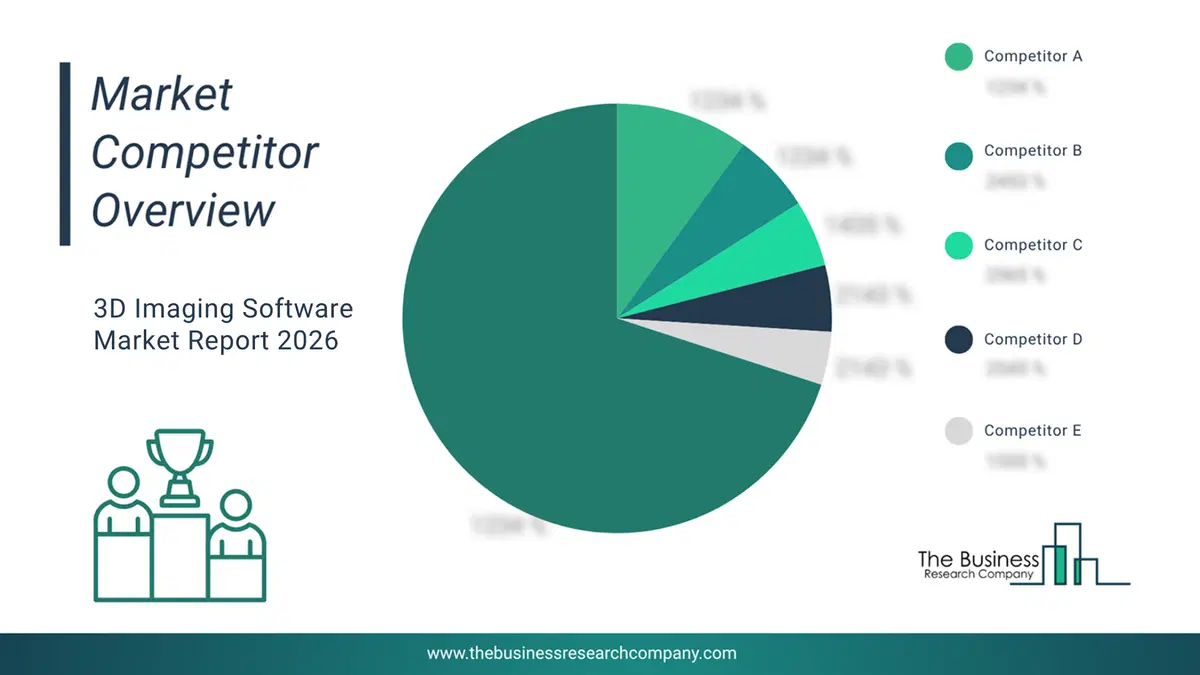
This chart is for illustrative purposes; the full report includes a detailed competitor analysis and comprehensive overview of the top 10 companies in the market.
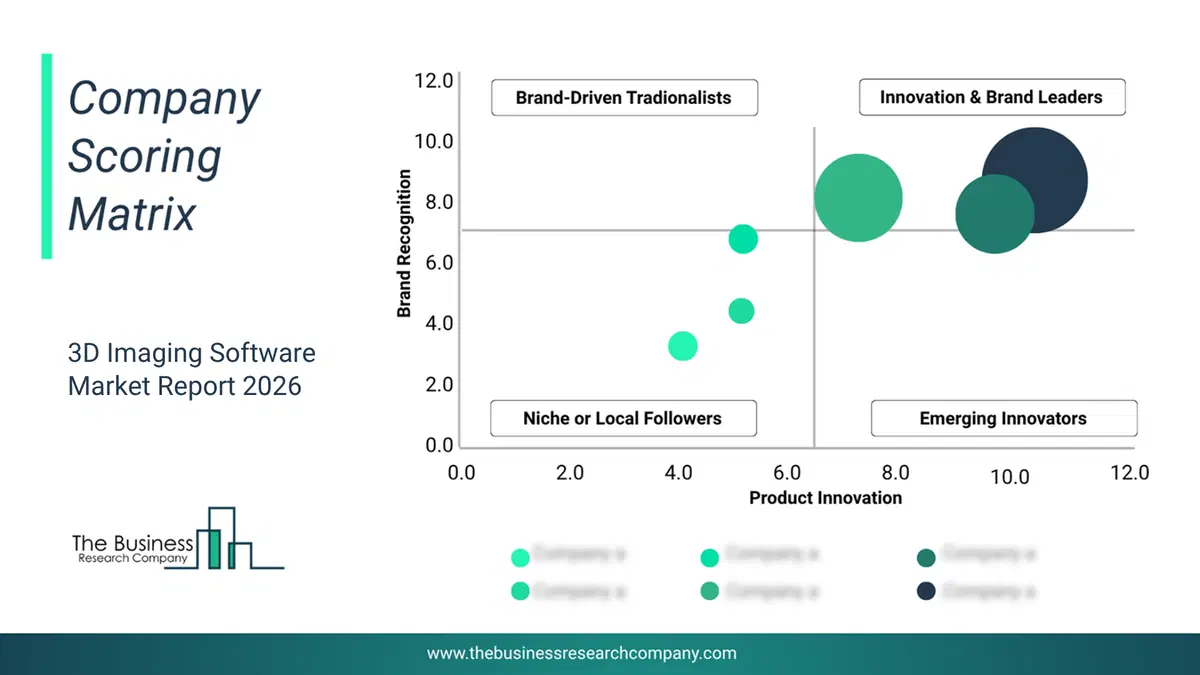
This chart maps companies by product innovation and brand strength, with bubble size indicating relative revenue, helping identify market leaders, challengers, and niche players. This is an illustrative chart; the full report provides a complete and accurate competitive analysis.
Global 3D Imaging Software Market Trends and Insights
Major companies operating in the 3D imaging software market are focusing on developing advanced solutions such as AI-powered digital twin visualization to enhance patient engagement and clinical decision-making. AI-powered digital twin visualization is a technology that creates a photorealistic 3D model of a patient’s face or body using multiple camera captures and lighting setups, providing real-time analysis and measurements that improve treatment planning and patient communication. For instance, in April 2024, Aura, part of Hexagon, a Sweden-based reality technology company, launched the Aura 3D Imaging System featuring high-fidelity 3D facial capture and AI-driven analysis. The system captures facial structures and skin details, including wrinkles, pores, and red and brown areas, in a single scan and delivers a comprehensive digital twin to the practitioner’s device. It enables real-time skin assessment, facial measurements, and before-and-after visualization. Its intuitive user interface allows minimal training for practitioners, streamlines workflow, and strengthens patient trust and confidence by enabling a shared visual understanding during consultations.What Are Latest Mergers And Acquisitions In The 3D Imaging Software Market?
In January 2024, Karl Storz SE & Co. KG, a Germany-based medical technology company, acquired Innersight Labs for an undisclosed amount. With this acquisition, Karl Storz aims to integrate InnerSight Labs’ advanced 3D imaging technology into its surgical solutions, enhancing preoperative planning, improving visualization of patient-specific anatomy, and optimizing surgical precision. Inner Sight Labs is a UK-based company specializing in advanced 3D imaging and visualization solutions.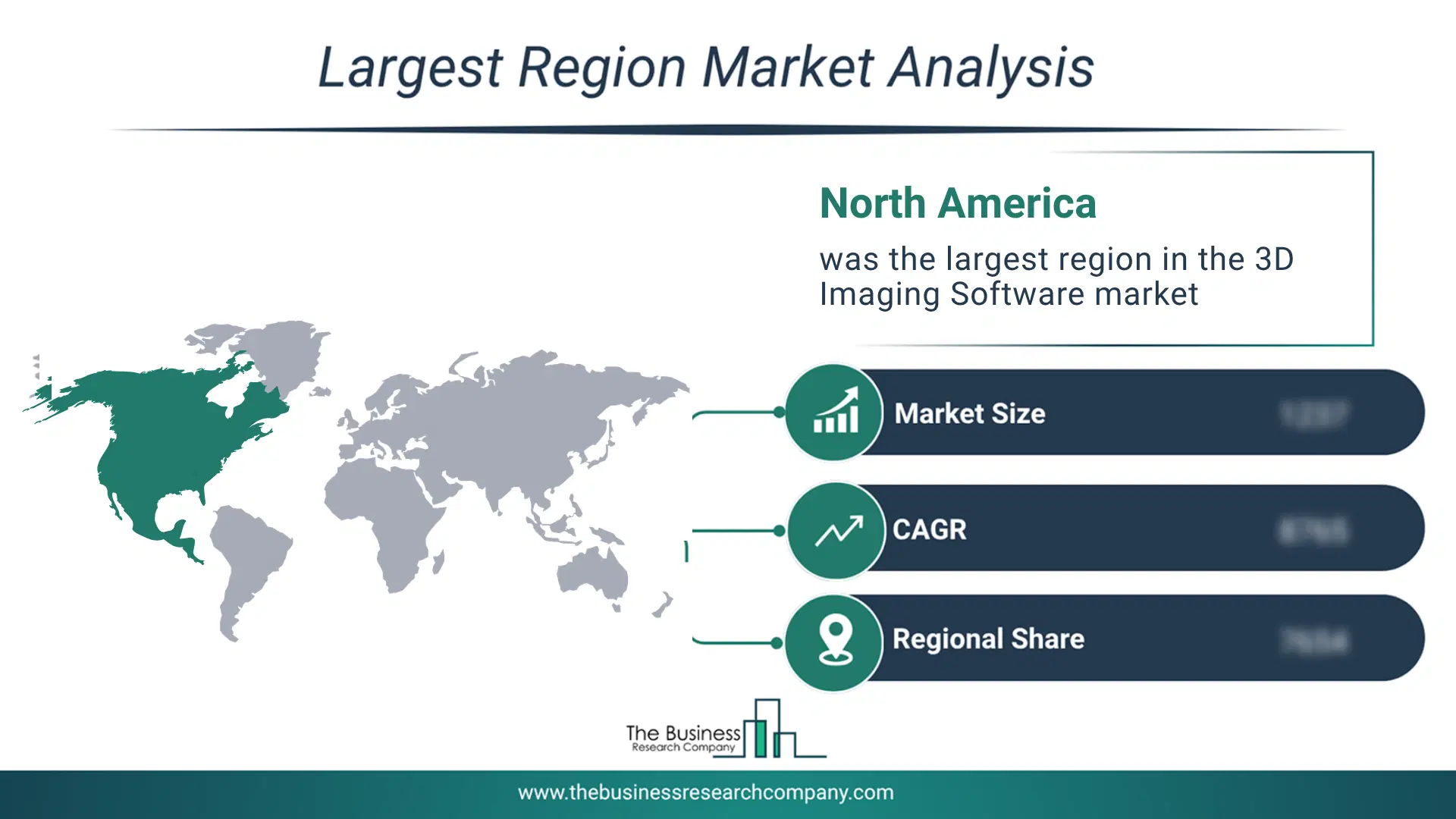
Regional Insights
North America was the largest region in the 3D imaging software market in 2025. The regions covered in this market report are Asia-Pacific, South East Asia, Western Europe, Eastern Europe, North America, South America, Middle East, Africa. The countries covered in this market report are Australia, Brazil, China, France, Germany, India, Indonesia, Japan, Taiwan, Russia, South Korea, UK, USA, Canada, Italy, Spain.What Defines the 3D Imaging Software Market?
The 3D imaging software market consists of revenues earned by entities by providing services such as 3D modeling and design, 3D printing integration, geospatial and GIS mapping, and simulation and analysis. The market value includes the value of related goods sold by the service provider or included within the service offering. The 3D imaging software market also includes sales of 3D scanners, imaging software licenses, hardware for 3D printing, 3D cameras, and augmented reality devices. Values in this market are ‘factory gate’ values, that is, the value of goods sold by the manufacturers or creators of the goods, whether to other entities (including downstream manufacturers, wholesalers, distributors, and retailers) or directly to end customers. The value of goods in this market includes related services sold by the creators of the goods.How is Market Value Defined and Measured?
The market value is defined as the revenues that enterprises gain from the sale of goods and/or services within the specified market and geography through sales, grants, or donations in terms of the currency (in USD unless otherwise specified). The revenues for a specified geography are consumption values that are revenues generated by organizations in the specified geography within the market, irrespective of where they are produced. It does not include revenues from resales along the supply chain, either further along the supply chain or as part of other products.
This chart presents market attractiveness based on a quantitative evaluation of growth, competition, strategic alignment, and risk, offering a clear view of opportunity areas for decision-making. This chart is for illustrative purposes; the full report contains the complete analysis.

This chart highlights the Total Addressable Market (TAM) by estimating the maximum revenue opportunity using an assumption-driven approach, supporting strategic planning and opportunity sizing across markets. The chart is illustrative; the full report provides a more comprehensive analysis.
What Key Data and Analysis Are Included in the 3D Imaging Software Market Report 2026?
The 3d imaging software market research report is one of a series of new reports from The Business Research Company that provides market statistics, including industry global market size, regional shares, competitors with the market share, detailed market segments, market trends and opportunities, and any further data you may need to thrive in the 3d imaging software industry. The market research report delivers a complete perspective of everything you need, with an in-depth analysis of the current and future state of the industry.3D Imaging Software Market Report Forecast Analysis
| Report Attribute | Details |
|---|---|
| Market Size Value In 2026 | $7.26 billion |
| Revenue Forecast In 2030 | $12.25 billion |
| Growth Rate | CAGR of 14% from 2026 to 2030 |
| Base Year For Estimation | 2025 |
| Actual Estimates/Historical Data | 2020-2025 |
| Forecast Period | 2026 - 2030 |
| Market Representation | Revenue in USD Billion and CAGR from 2026 to 2030 |
| Segments Covered | Component, Deployment Mode, Application, End-User |
| Regional Scope | Asia-Pacific, Western Europe, Eastern Europe, North America, South America, Middle East, Africa |
| Country Scope | The Countries Covered In This Market Report Are Australia, Brazil, China, France, Germany, India, Indonesia, Japan, Taiwan, Russia, South Korea, Uk, Usa, Canada, Italy, Spain. |
| Key Companies Profiled | Canon Inc., Siemens Healthineers AG, Koninklijke Philips N.V., Adobe Systems Incorporated, Dassault Systèmes SE, Synopsys Inc., Autodesk Inc., Dentsply Sirona Inc., Trimble Inc., PTC Inc., Planmeca Oy, FARO Technologies Inc., Carestream Health Inc., Maxon Computer GmbH, Shining 3D Tech Co. Ltd., Artec 3D Ltd., Dolphin Imaging and Management Solutions, Oqton Inc., Evatronix SA, NewTom Inc. |
| Customization Scope | Request for Customization |
| Pricing And Purchase Options | Explore Purchase Options |